

My “Great-Great-Great-Great … Cousin” Johann Sebastian … Research on the Binderleben Branch of the Bache Family of Musicians..
My very special thanks and our fond memories go to Ms. Helga Brück, whom we were fortunate to meet “just in time.” We shared only a few short years of genealogical fun together. We filmed the video together, visited the last remaining Bachs in Bindersleben, and received her “treasure”, a word that really doesn’t belong in quotation marks. Had we found Helga Brück’s book online just a little later, the door to our family research would have been closed forever. Our deepest gratitude goes to her. R.I.P., Helga Brück..
On Our Own Behalf..
Let me start by saying this: This site is not designed for editors who have a passing interest in Bach genealogy ... whether in their personal lives or as part of their daily work. And, of course, it’s not intended for wiki gatekeepers either: After all, on those platforms, contributions from others on a given topic are generally welcomed only at their discretion – but more often than not, they’re rejected. I no longer give personal presentations on Bach genealogy – in front of a live audience, that is, one where you can shake hands to greet people – in lectures. And I also no longer give interviews to media outlets that request them. This is because, on four separate occasions, I was left disappointed afterward because the resulting publication turned out so differently from what I had expected. I had particularly negative experiences with the daily newspaper Die Zeit, with Apothekenrundschau, with the Kölner Stadtanzeiger, and with Wikipedia: Wikipedia also published a historical photo of my family that I had painstakingly restored and then – in a legally questionable move – hid behind my “lack of” creative value-added. Furthermore, Wikipedia is reluctant in every area to publish my work and findings or to include a link to my pages. That hurts ... especially when it comes to Google rankings. But you get used to it..
As an important foundation, it should be noted here that these remarks do not primarily examine my lineage in relation to Johann Sebastian Bach, but rather the connection of the Bindersleben family to the musical family of JSB’s great-great-grandfather and his ancestors as well. The connection arises inevitably from the fact that the Bindersleben line belongs to the family of musicians and that I am a member of the Bindersleben Bachs. This is further supported by the affiliation of other members who can be traced back to the Bindersleben family..
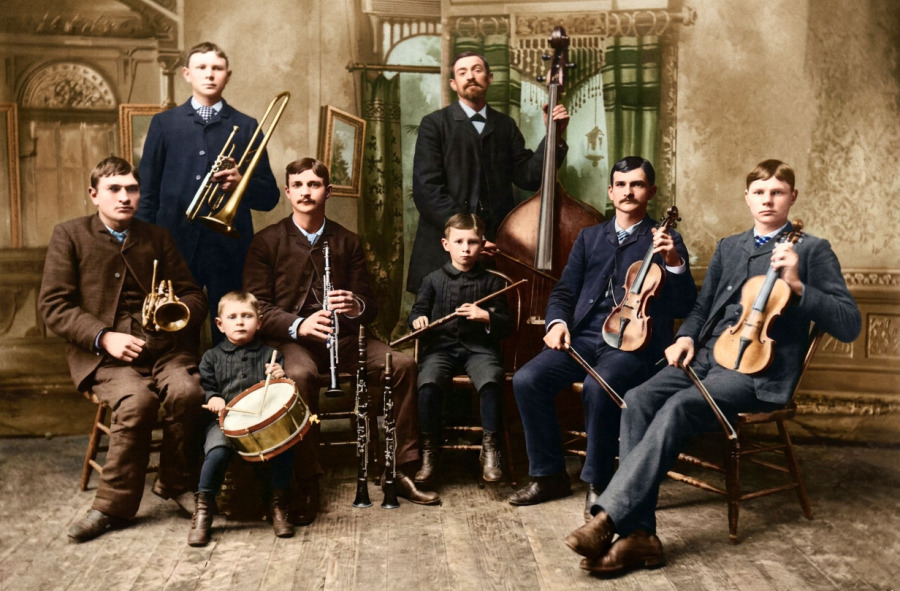
The Bach Band in Marion Township, a suburb of Rochester, Minnesota, USA. The original photo is blurry and black-and-white. For the purposes of illustrating this page, it has been sharpened and colorized using AI. To underscore the credibility of my research, I am noting here that AI was used for post-processing..
Finally: This page about the Binderslebeners of the Bachs (… or, as they’re also known today, the Bäche) feels like a personal diary to me. I most likely share this page with the fewest visitors out of all 640 pages on my Bach website Bach on Bach. And it’s just one of about 50 websites on the subject of Bach..

This website is very, very personal. Of course, I was thrilled to have confirmation that my grandfather’s theory was correct. Who wouldn’t be?! The problem? You research and gather clues, save them, file them away, and set them aside … and before you know it, you end up with an almost unmanageable “mountain” of documents of all kinds. To finally classify, organize, review, and summarize all of this, and to close this chapter once and for all: That is the purpose of this page. For those interested – perhaps someday there will be eight of us on Earth – it’s certainly fascinating. For me, it’s the final step before turning my attention to something new or continuing exciting projects ... like my Bach portal. © Pixabay..
Several of My “Bundles of Indications”..
Four “bundles of indications” of varying quality had to be examined. These are: a) my affiliation with the Bindersleben line; b) the affiliation of the Bindersleben Bache with the Bache family around and after Johann Sebastian Bach; Third, c), the oral tradition of relationship through the ages must be examined (… for example, J.S. Bach’s collection of 42 out of 53 men and boys in the "Ursprung" is undoubtedly based on the memory of many, many similar stories that were passed down from great-grandparents to grandparents and on to Bach’s sons). For Bach himself had not inquired into or researched his “origins,” as is evident from the absence of many – easily verifiable – birthdays in this collection. Finally, it is d) the musicality of the entire family that needed to be examined and illuminated from a scholarly perspective. This brings us to the most contestable thesis in the overall discussion: How valuable, how seriously to be taken, and how useful is my grandfather’s claim that “We’re supposed to be related to Johann Sebastian Bach”? This requires a very lengthy digression, which would almost certainly be “brushed aside” by any editor, because he or she wouldn’t want to go to the trouble of acknowledging the possibility that this claim might be true ... and then having to revise their own opinion, which they had held as settled until it was verified..
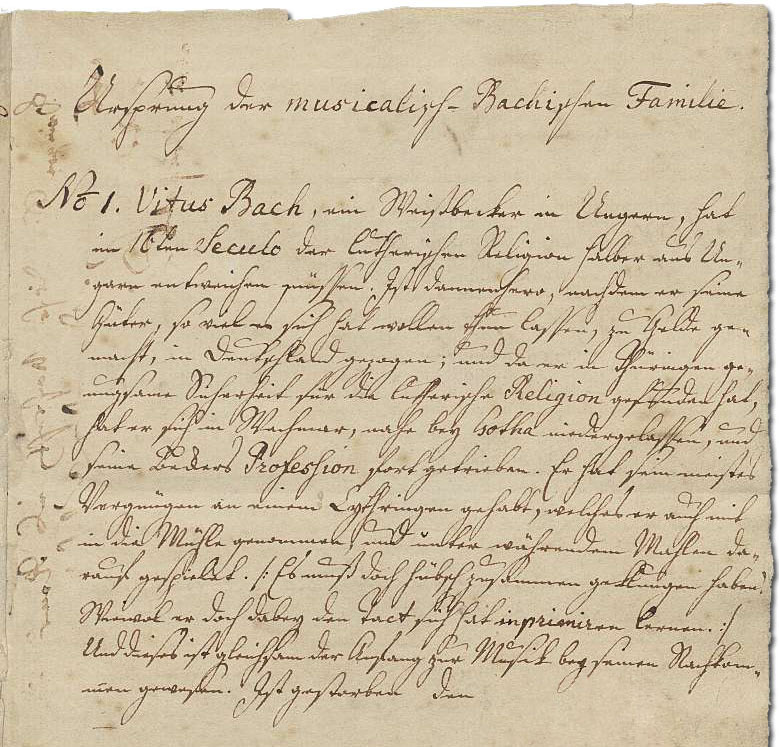
How often—even in the most reputable publications over the past 270 years—do we come across a description of Johann Sebastian Bach’s “Ursprung” that defines the 53 listed “Bach men” as a family tree?! It is not a family tree! Absolutely not! Certainly not! It has been proven not to be! It doesn’t matter whether the author is a professor, a legendary Bach biographer, or a scholar. Nor are they the musicians who were adults during Bach’s time. In 1735, Bach didn’t care “one bit” about dates of birth: He could easily have found them out, but he simply didn’t draw up a family tree. And there weren’t 53 musicians, amateurs and professionals combined. There were 42 musicians. Any other claim about the “Ursprung” is poorly researched or simply “copied.”...
17 Indications..
The legal definition (… quote): “In a trial based on circumstantial evidence, the prosecution attempts to convince the judge of the guilt of the perpetrator indirectly through circumstantial indications. A single piece of indication on its own is not sufficient for a conviction. However, the totality of the circumstantial indication (… chain of indication and series of indication) is intended to present an overall picture such that the defendant’s guilt is established to the full satisfaction of the court (… end of quote).” This applies when no direct evidence can be presented (… my note)..
In criminalistics in particular, but also in many scientific fields, evidence is often lacking. However, there is frequently circumstantial indication leading to a probability in favor of one conclusion or another. I therefore based my reasoning—for myself and on my own behalf—on this line of thought, which supports my own research and that of my wife regarding our connection to the family of musicians. From 2012 to 2015, Renate and I compiled 17 different pieces of circumstantial indications. Today, in the summer of 2026, this page was created as one of the very last “epic” ones (… except perhaps for further FAQs). And I found it difficult to track down all 17 pieces of evidence—that is, to locate the key points in hundreds of Word files. To organize these files, clarify their content—which once served as the basis for the respective pages of the website—and… then close or delete the page. That’s why today I could no longer trace 17 pieces of evidence, but “only 15.” Never mind. Why? Because it’s enough that I know there were, are, and will always be 17. I’m not exactly at a loss for explanations. And what can never be avoided? That, in the course of optimization, you come across further clues. So the 17 indications have now even become 19..
Indication 1, Quality 4 Out of 10: My Name Just Happens to Be Bach..
It sounds arrogant, but that’s not how it’s meant. Smith, jones, or von Kolson … nothing about these last names suggests a connection to the family of musicians. Yet Elmar von Kolson is a member of that family. An important one. And so is his son. And so are his grandchildren. They are the true great-great-great …-grandchildren of the master. It’s different with the name Bach … it might well encourage someone interested to investigate whether the name connects them to the Thuringian musicians. But it’s a rather weak initial indication. It’s a weak indication because the name Bach – and this is where the other Bachs “come into play” – was and is quite common. Compared to the Mozarts, there were likely 50 to 100 times as many people named Bach. Compared to the Beethovens, there were as many as 100 to 300 times as many people named Bach. Because this information (… provided by AI) refers to Thuringia, it will later play such a significant role in determining where – that is, to which region – the journey back to one’s own roots leads..
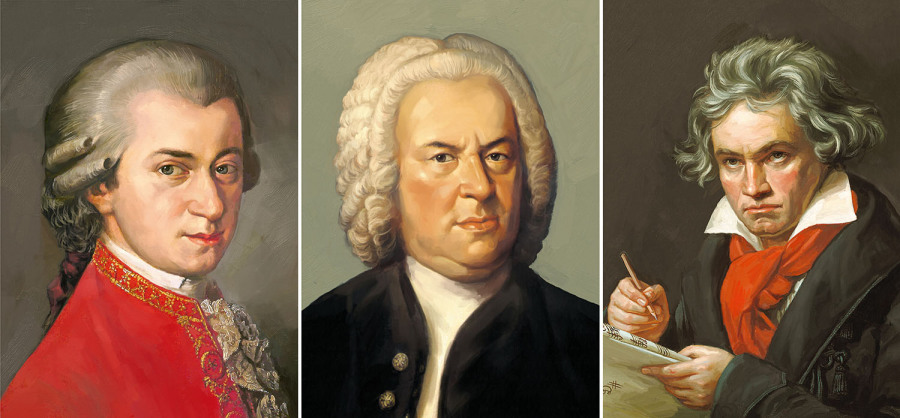
There are hardly any other groups of people and their families that are as complicated to study as the Bachs in Thuringia. It starts with the frequency of the name and extends to the time period in which the prominent figure lived, The closer that person lived to our own era, the easier it is to study them..
Indication 2, Quality 2 Out of 10: Who Formulates So Precisely?..
I find something remarkable: “We’re supposed to be related to JSB” … such family traditions are astonishingly precise in the way they’re phrased. My grandfather—and later my father, and as we later heard from relatives in the U.S.—did not say, “We are descended from Johann Sebastian Bach,” but rather, “We are supposed to be related to Johann Sebastian Bach.” A similar way of putting it would have been: “There’s supposed to be a connection between us and the Bachs.” Or “They say we’re part of the same family as Johann Sebastian.” This cautious phrasing suggests an actual oral tradition in which the exact genealogical relationship was no longer known over the course of generations..
In contrast, a genealogically exaggerated statement would be: “We are related to Johann Sebastian Bach.” Or, alternatively: “We belong to this family of musicians.” Or: “We are descended from Johann Sebastian Bach.” The latter, however, already requires considerable genealogical knowledge, because option 3 is only possible if the grandfather’s last name is – for example – von Kolson. If his name were Bach, this statement would be genealogically impossible, because the male line descending from Johann Sebastian Bach has long since died out. However, if Grandpa’s last name is Brown, Smith, or Miller, then such a claim – assuming little interest in genealogy – would not be possible … though it could mean that one is related to Bach. If “we’re supposed to” is used when the grandfather’s last name is Goofball, then the statement can hardly be made without further explanation ... specifically, an explanation of how the grandfather came to the conclusion that you’re related. Without a minimum of research, this statement is really – at best – pure fantasy..
Unlike indication 3 below, this indication 2 is not the content that points to the family connection, but rather the credibility of the statement itself – specifically, the wording. In the case of “We are related to Johann Sebastian Bach,” a grandfather would have to be able to prove beyond a shadow of a doubt why that is the case. If he cannot, then his “conviction” – the conviction with which he conveys his message – discredits him. A statement phrased in this way would be unconvincing..
Indication 3, Quality 1 to 6 Out of 10: “We’re Supposed to Be Related to Johann Sebastian Bach!”..
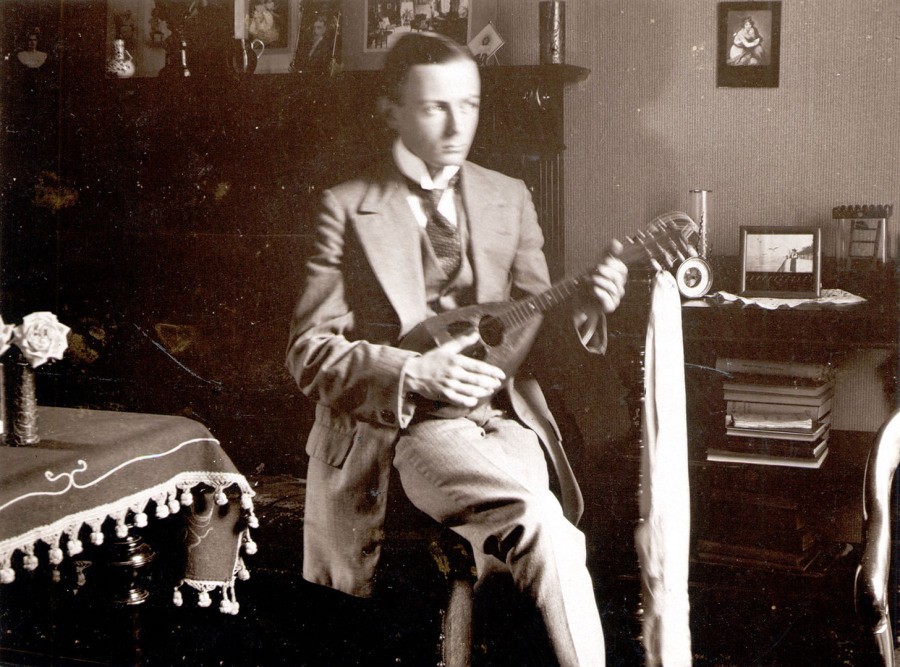
My grandpa was a musician? Nope. But having his picture taken with a musical instrument ... that was definitely a cool idea..
Now – with this indication – it’s not about the precise wording, but about how likely it is that what was said could be true. “We’re supposed to be related to Johann Sebastian Bach!” Those were the words passed down to me by my grandpa – via my father. Taken on its own, that’s “not worth a bean.” Especially not if one isn’t willing to fully buy into an argument ... yes, that’s right, my argument (!). In this context, let me reiterate why I place such special importance on not wanting or having to explain myself to any “pseudo-committee.” And by the way: When I write about any “grandpa” on this page, I could just as easily be referring to a “grandma.”..
So: “Not worth a bean” is such a statement “We’re supposed to…”, when this remark stands alone. This statement “on its own.” Generally speaking, two key criteria apply for me: First is the value of the indication on a scale of 1 to 10. Any reader can start laughing at a rating of 1; he – or she, or even it – might even skip the smirk and burst out laughing. The second benchmark is the number of pieces of evidence. If there are four of them, then proof – of whatever it may be – is much more likely than if there is only a single piece of indication, whether strong or weak. I have 19 indications on the topic ... but I already mentioned that above..
Back to “we’re supposed to be …”. Of course, I was interested in the (semi-)scientific aspects of this statement. So I tried my hand at research. And before 2012, it went something like this: As part of his quest to prove his Aryan ancestry, my father and my grandfather talked about how we “… are supposed to be related to Johann Sebastian Bach.” My father and I talked about this when I was “still little” and wasn’t interested in either our family history or Bach. The occasion was a document that proved our roots in the U.S.... Jenny Bach’s birth certificate. It wasn’t until I was 55 that our best friends – Axel in Germany and Teri in the U.S. – “infected” me with the idea of starting my own “digs.”..
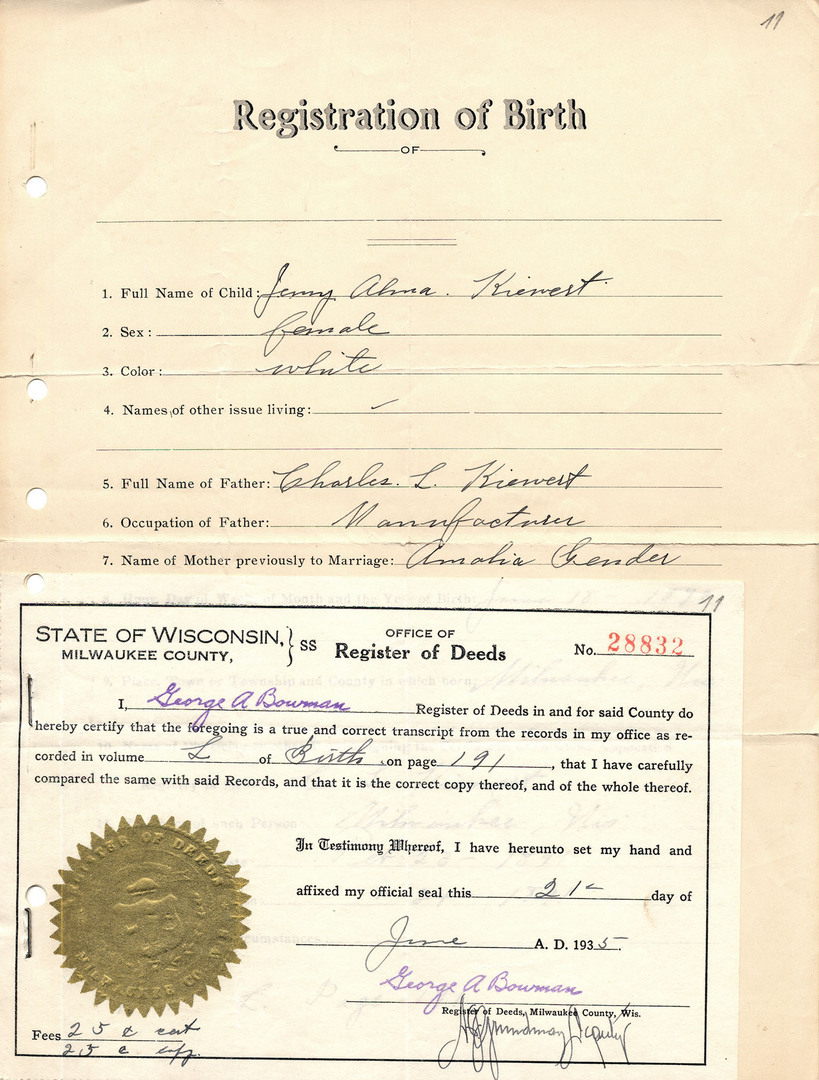
The United States … it has always been a place we’ve dreamt of, both Renate and I. Even before we met. I don’t remember when my parents first told me about Jenny. But it was definitely more than just once..
Interruption: Right at the very beginning, in the midst of my euphoria at the start of my – and our – Bach Project and our Bach Mission between 2010 and 2012, I was at the Bach Archive in Leipzig, Germany with my wife. When I met one of the staff members, I mentioned that I was supposedly related to the master. I said this right after introducing myself by name. “Without missing a beat,” the staff member replied kindly that this couldn’t be possible because Johann Sebastian Bach’s male line had died out. That spontaneous reaction – so quick – was, for me, a sign that I needed to “counter” her as objectively and accurately as possible. Not very convincingly, I pointed out that she surely meant I couldn’t be a descendant of Bach with the name Bach. Because that line has indeed died out. But grandchildren – who don’t bear the name Bach – are still very much alive and well among us. So “being a descendant of” and “being related to” aren’t the same thing … that’s how it all starts..
Back to my grandpa. How credible should we consider his statement, “… we’re supposed to …”? That’s what I wanted to investigate. As a side note at the beginning: My grandpa’s account, as worded, spans generations. This is different from how Bach conveyed the words of his great-great-grandfather, Veit Bach, in his history ... transporting them from the past to the present: For Bach, his “story” was presented as fact. I needed to determine whether such a narrative from my grandpa and its content could stand as proof (… hardly) or at least as circumstantial indication. Strong or weak?..
“We’re supposed to be related to Bach,” my great-grandfather said to my grandfather ... because he was a prankster? Or did my great-grandfather not come up with it at all, and was my grandfather the joker? Do a lot of people do that when their names are Wagner, Mozart, Beethoven, or even Bach? I don’t remember my grandfather as a clown. In fact, I can’t remember a single smile from him. So I don’t believe he wanted to “start” a cross-generational joke. But that’s exactly what needed to be investigated..
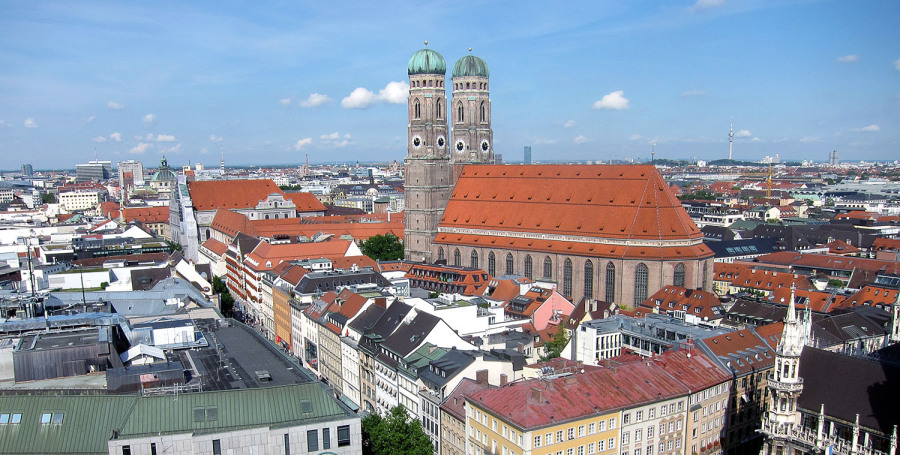
100 Bachs in Munich. I found them, I called them, and I asked if their grandfather had told them about their ancestors. © Pixabay..
I gathered 100 phone numbers of people named Bach in Munich. And then I called them one by one. Ninety-nine of them replied, “No, nothing like that was ever mentioned in their family.” Only one was joking around, and I realized immediately – and that was his intention – that he wasn’t seriously claiming to be related to Bach just because his grandfather had said so. So much for the joke behind the claim. Who else – in my family today – knew about this statement? All three of my siblings told me they’d heard about it during their childhood. And in different ways! So if it had been passed down to my generation like that, I wondered whether the next generation – that is, my younger brother’s children – were also aware that this family connection was supposed to exist. So I asked both kids – explicitly without putting the words in their mouths – whether their grandpa or their dad had also “spouted that nonsense” that we were related to the most famous composer on earth. Both said no … of course, much to my great regret. Because that would have meant the tradition had ended with my generation. And my theory would have “gone down the drain”. Of course, this was worth investigating. After all, why did my three siblings know this story, but not the two kids in the next generation?! However, it wasn’t until much later that I learned this story had, in fact, already reached the next generation ... namely, the children of my older brother, whom I didn’t meet until much later..
Once again, with no recollection of the exact course of my thoughts around 2012, I wanted to find out on what occasion such information is passed on. I investigated the two different ways this happened, which – for data protection reasons – I cannot explain in detail here: Through an internal family situation, I only learned very late that my grandfather had also told his granddaughter – my sister – about this fascinating connection. Specifically, this story was “passed on” to her when she told her grandfather – who is also my grandfather – that she liked Elvis. Among other things, he replied during that conversation … “that we’re supposedly related to Johann Sebastian Bach.” So the trigger for talking about it was the topic of music. My older brother’s mother told him that my father had told her we were supposedly related to Bach. She later told her son, and “the first transfer” took place during a very brief period when they were living together. The topic was most certainly music again, and not genealogy. After all, my older brother is now a very well-known and successful conductor of several choirs and a Bach orchestra, both among the general public and in professional circles..
So music was a connecting theme. But why didn’t my nieces know anything about this connection? After receiving this information – which was so important to me, yet so disappointing – from my nieces, I naturally talked to them about the background of my research. And it struck me that it was I ( ! ) who had linked the pieces together: namely, through the topic of genealogy. It was I ( ! ) who passed on this information ... through my conversation about my family research. That was most certainly also the topic of discussion between my grandfather and my father. For while they likely had no common interest in music, they certainly did in family history. My grandfather is said to have pursued it even beyond the research into “proof of Aryan descent.” My father remembered a “shoebox full of discoveries”. Lost during the war or in the postwar turmoil. That, however, shrunk to a single family book with three entries, written in pencil, which “meant the world” to us. So it was the topics of music and genealogy that triggered the passing down of these stories..
One indication, several indications. Each one insignificant or convincing. Those are the two benchmarks. Without further evidence, I would have attached “no significance whatsoever” to the claim made by my ancestors ... that is, my grandfather. I would have rated its quality as a 1. And I wouldn’t have seriously told anyone about it, because the smirk at the conclusion would have been all too obvious. However, after consulting my siblings and conducting my own research with the 100 Bachs from Munich, I rated this piece of evidence with a significantly higher quality score of 3 (… out of 10). By the fifth piece of evidence at the latest, it became increasingly likely that the story’s transmission through the ages was not a joke. Today, I rate this piece of evidence at a quality level of 5. With a total of 18 additional pieces of evidence of varying quality, one could certainly rate this one as a 6 or even a 7. I do just that … and I don’t care what others think about it. Renate, by the way, doesn’t consider Grandpa’s statement to be sooo important as I do..
Not quite in line with my memory, I was able to find the exact wording of the second email from my cousin Kathryn in the U.S. What is certain – still in the exact wording – is that our acquaintance began a little less cautiously than the questioning of my nieces and the 100 Bachs of Munich. After explaining the Andiolebin problem, I wrote to Kathryn that she belongs to this family of musicians. Kathryn then replied in 2011 – with this knowledge – in her third email: “Hello Peter: This is wonderful news. I grew up with stories that we might be related to Johann Sebastian Bach, but when I started my search, I could never prove it.” I just figured it was wishful thinking on my family’s part. Talk to you later, Kathryn.”..
Much later, in April 2015, Daniel got in touch regarding his research. Several pieces of evidence already pointed to the family, and he asked for support. He, too, remembered that his grandmother had said they were related to Johann Sebastian Bach. Once again, I was struck by the precision of her choice of words. After all, with the statement “We are…,” at least a very small number of documents would have been needed to provide proof. We were able to help and actually found the connection to the branch that was once based in Molsdorf and later in Bindersleben. It was 2026 when his great-grandfather Emil’s diary also revealed a tiny chance to preserve his research for posterity. We plan to begin examining it in the summer of 2026. A diary. Written in Sütterlin script. What a project!..
The Bible, the Aztecs, Rungholt, and others … The fact is: Verbal traditions have been “the norm” throughout history. The Bible is certainly the most significant example, while my connection to Bach is the least significant. In between lie legends, myths, and finally the words of “Veit Bach, who died in 1619,” which his great-great-grandson, Johann Sebastian, did not write down until 1735 ... after more than 100 years of oral transmission..
This is going to get very, very, very detailed. Epic. So if reading this part of my research becomes too detailed for you … just scroll down to the next headline and the next chapter (... indication 2). Because what we’re discussing now is the credibility of oral traditions over time in general..
Let’s take Troy, for example. It is believed to have been destroyed around 1180 B.C. This was followed by the end of the Mycenaean civilization over the next 80 years. After that, the so-called Greek “Dark Ages” began. It wasn’t until 750 B.C. that the Homeric epics began to take shape in written form. The fact that Schliemann finally discovered Troy in the 1870s is not at all relevant to us here. We are only interested in the period between the destruction and the first written mentions in the Iliad. This is a period of 400 to 500 years during which most historians assume that everything was passed down orally. There were so-called singers or bards (… in Greek, Aoidoi) who recited heroic tales at festivals and at royal courts. These singers memorized long narratives and continually adapted them to their audience..
We continue with the “transmission of knowledge”. Many Old Testament stories were likely told for a long time before they were written down. One example is the story of the Flood. It is interesting to note that similar flood stories also appear in older Mesopotamian texts, such as the Epic of Gilgamesh, and among other ancient peoples. This illustrates how stories can travel through time and change within cultures..
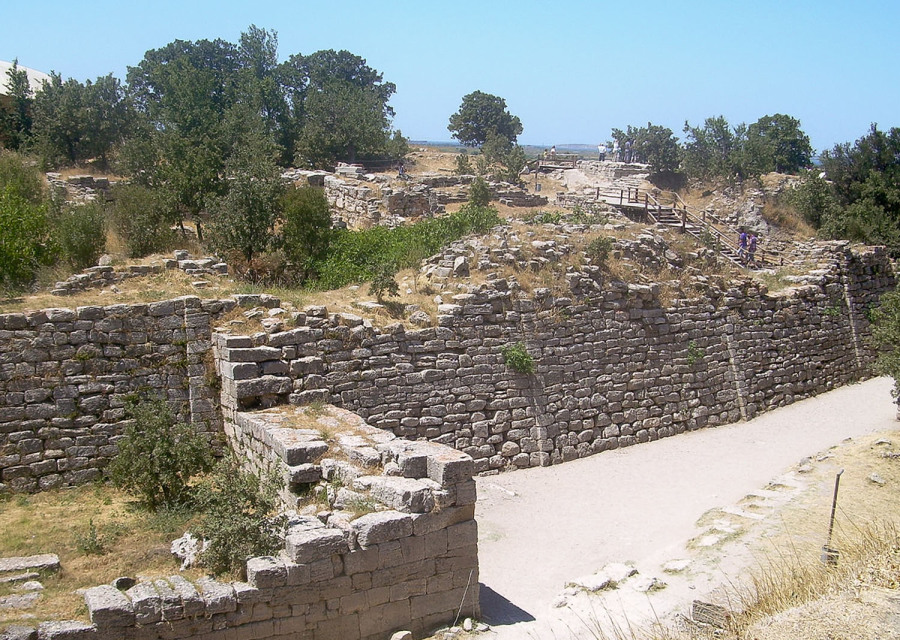
The castle walls of Troy: For 400 to 500 years, its existence and fate were passed down only by word of mouth. 400 years … that’s 16 generations; 500 is 200. © Info..
The story of Rungholt, a settlement in the North Sea, is equally fascinating in this regard. It existed, and then it vanished after a devastating storm. For generations, people passed down stories about this settlement … until it was unequivocally discovered in the Wadden Sea in our time. The United States and its Native Nations … we called them “Indians” for a long time: They tell of life from ages long past. And so do the descendants of the Maya and the Aztecs, who were not entirely wiped out. But almost. How far are we willing to go together?..
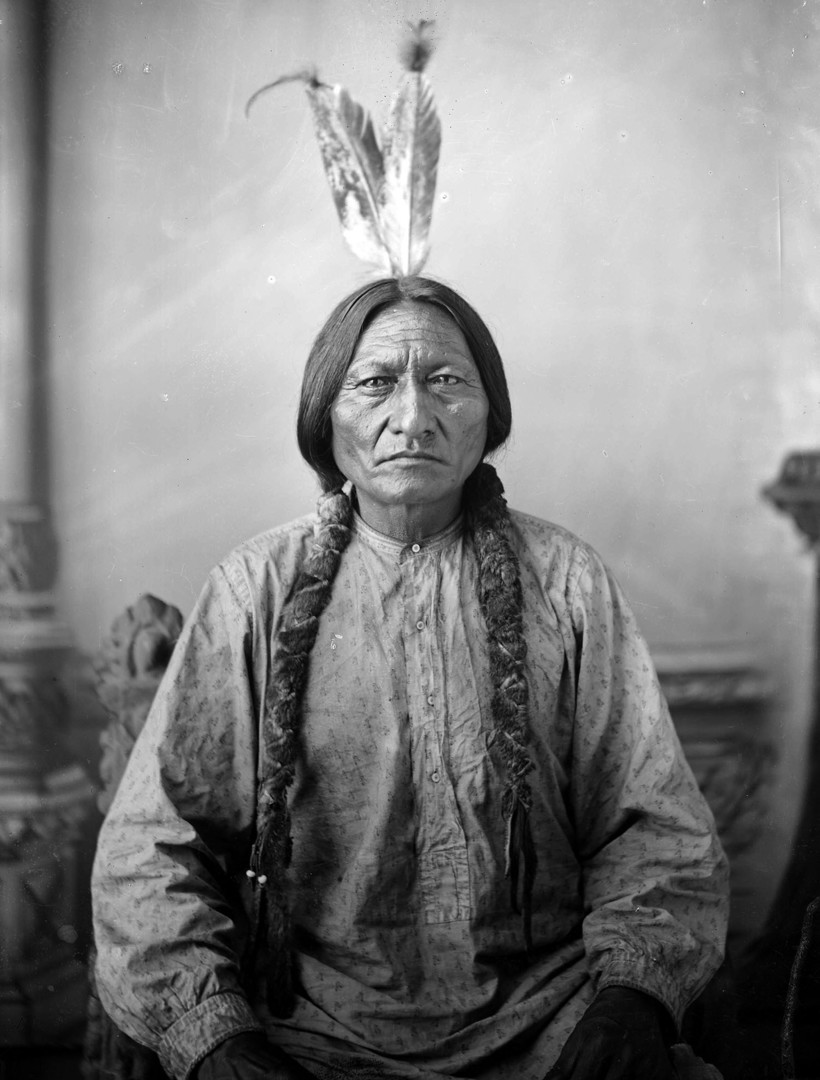
Sitting Bull told his children the story of his people. And they passed it on to their descendants..
Aren’t the traditions of some peoples – that star beings came down and “helped” with various things – also examples of such traditions? No … we don’t want to go that far. Perhaps we can mention the Aboriginal people of Australia: memories have been passed down to our time for 7,000 years … retold. Most spectacular of all: The University of New England and other researchers have studied the stories of Australian Aborigines. Some describe coastlines and islands as they appeared before sea levels rose following the last Ice Age. For example, these traditions also recount how people were once able to reach islands on foot that are now separated from the mainland by the sea..
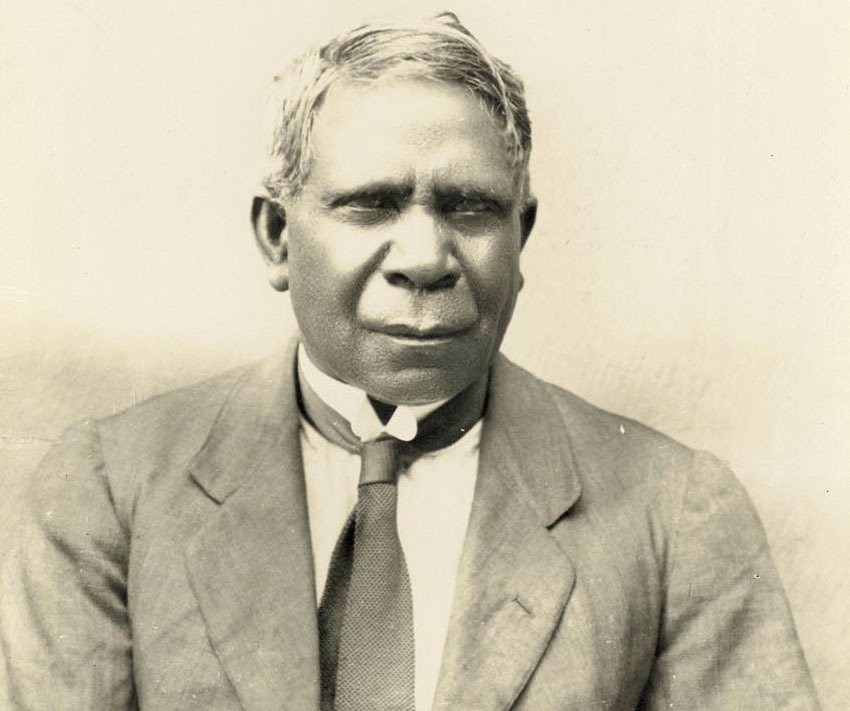
David Unaipon: He was a writer and an activist for Aboriginal rights..
Finally, the Viking sagas. The events mostly took place in the 9th and 10th centuries. However, the famous Icelandic sagas were often not written down until the 13th century. That leaves a gap of about 300 years of oral tradition. Surprisingly, archaeologists were later able to actually verify some of the locations described in them. Geologists date these changes to about 7,000 to 10,000 years ago. No one claims that every detail remained unchanged. But the core message – for example, “there used to be land here” – seems to have been passed down over hundreds of generations..

The Vikings have certainly surprised us time and again. And they were doing just that all around their homeland long, long before our time. Back then, the neighboring peoples weren’t exactly thrilled. And … well, of course … this isn’t a historical photo. This is how AI imagines the “typical Viking.”..
Perhaps it is not any single story that is the most fascinating, but rather the realization that people have been able to preserve information without writing for thousands of years. Just a few decades ago, many scholars assumed that oral traditions would become unreliable after only a few generations. Today, a more nuanced picture is emerging: In cultures with a strong tradition of oral storytelling, important memories can be preserved over very long periods of time … especially when they help shape the community’s identity or are regularly passed down in a ritualized form..
This raises an exciting question: How much historical truth might also be found in other ancient myths? Many researchers today believe that some legends are not purely fictional stories, but rather memories of real events that have become intertwined with symbolic and poetic elements over time..
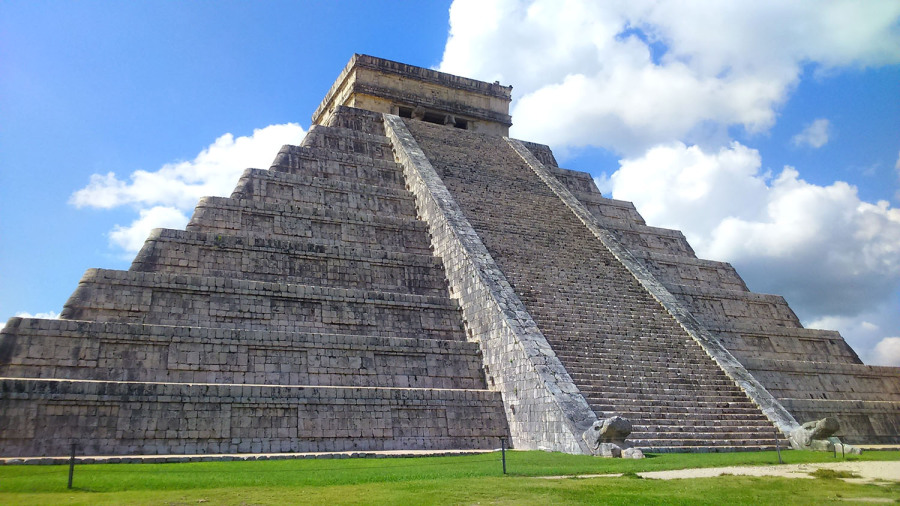
Do we descend from celestial beings who significantly altered our DNA? It can't be proven. But neither can … the opposite. The Maya built these a long time ago: pyramids. This one is located in Chichén Itzá, Mexico. © Pixabay..
Once again: How far back into the past do we want to journey together? There are centuries-old traditions claiming that ancestors came from the stars. Nonsense? A flowery fantasy? And if so, whose fantasy? That of these people’s ancestors ... the ancestors of the Maya or the Inca? Both tribes were radically decimated, but contrary to popular belief, there are still plenty of descendants. Or those of the researchers who investigated these theories? At first, only Erich von Däniken was convinced of them. Today, there are many more authors who share this view. Do we know for sure? No, we don’t. But as soon as we know exactly how the pyramids were ultimately built, we’ll know more. Currently, Elon Musk’s AI, Grok, is already weighing in with its own speculations..
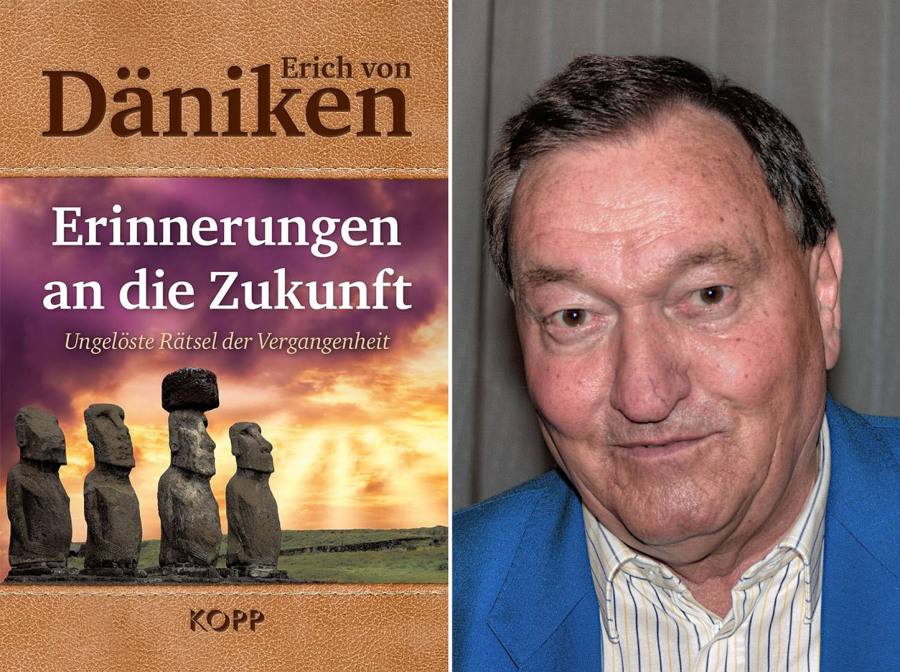
He was certain: All over the world, ancestral tales lead to the stars. Do we believe that, too? © Info..
Back to the Flood. Stories passed down from generation to generation: Did everyone “just pass on the fun” because the reports of a massive flood were so exciting and captivating? After all, an unusually large number of peoples carried these stories through time: the Gigamesch epic for Mesopotamia, and the Atrahasis, an even older version of the story for that part of the world. Then there’s the Book of Genesis … that was the story of Noah. In Greece, Zeus used it to wipe out humanity except for a single human couple. It’s said to have happened in India, too. And in Iran. The Maya, Aztecs, and Incas have passed it down. In what is now the United States, the Hopi, Ojibwe, Cherokee, and Tlingit tell these stories. The story is known in China, and in Oceania, flood tales persist: in Hawaii, Samoa, Fiji, and New Zealand. Closer to my home, the Celts and Slavs also recount these tales..
A quick return to the North Sea: This really made an impression on me personally. There was this island called Rungholt in the North Sea, in the Wadden Sea. That’s what “our northerners” have passed down through many, many generations. In a massive storm surge in 1362, Rungholt was completely destroyed and literally sank into the North Sea. But people remembered it and passed the story down to their children and grandchildren. It wasn’t until 2023 that one of the two main settlement centers – including the foundation walls of the long-sought-after large church – was discovered (…quote). How many generations, then, passed down this memory as “history”? If we assume a generation – as experts do – to be 25 years, then there were over 26 generations that spanned exactly 661 years with their “report”..

After Rungholt had “disappeared from the face of the earth,” the descendants of those who had known it firsthand passed down the story. For a full 661 years. Until the story turned out to be a real event: Above, an epic storm is gathering over the Wadden Sea..
I’ve come to the conclusion that the point is not to reject a possible truth in my grandfather’s statement outright, but “merely” to question it. That’s the purpose of my assessment of the “quality” of each of the 19 pieces of circumstantial indication. Far from being proof … each piece of indication can be highly probable. Or, conversely, highly improbable. That is all I ask of my imaginary critics, whom I have no desire to meet..
To conclude this section, I would like to mention how, for decades, Bachs who were still alive until recently engaged in bitter disputes with Bach officials, Bach scholars, and Bach genealogists over whose research was correct, most probable, and which was merely the product of immense wishful thinking. It is also worth noting the incredible lack of interest in “officially” incorporating findings and discoveries about the musical family into the body of Bach knowledge and facts. Three Bach researchers known to me locally – though certainly insignificant on a regional and national scale – had to endure this. Let us recall here the experts Helga Brück, Evelyn Odrich, and Gisela Thielicke, who were frustrated by Bach luminaries and an anonymous Wikipedia author because “truths” once established were simply not to be reexamined. The Bachs mentioned at the beginning of this section? They have all since passed away: Ronald Bach, Ed Bach, Kurt-Hermann Frickel, and the three women mentioned above ... Brück, Odrich, and Thielicke. And what about us ... my wife and I? We don’t argue..
How wonderful that I have absolutely no interest in trying – or having to – convince anyone that I “belong.” This page on my Bach website addresses this topic solely because, here and in two other places, I view the internet as “a kind of memory box.”..
Back then, I wanted to back up everything with additional evidence and verify it by looking into at least one other famous person and that person's relatives. But it turned out that it was not only difficult ... it was, as it later became clear, impossible. Why? Because either the famous name and the person behind it were so young that there were, without a doubt, only two groups of people: those who belonged to that family and those who did not. An example? Elvis Presley. And the Presley family. The ancestors are well-known, as are the descendants. Another example? Beethoven. He died in 1827, so long before Presley. We also know his ancestors and his entire extended family. No one named Beethoven is unaware of whether they belong to this family. The descendants of the Mayflower passengers. Today, that’s a huge number of people. And everyone knows whether their ancestors were among them. Mind you: This only applies to those who might wonder whether they belong to it. Some know: Yes, they are descendants. Others know: No, they are not. There really is no one who claims, “We’re supposed to belong to it.” Unless they “couldn’t care less” and haven’t done the slightest bit of research … such as, for example, asking the General Society of Mayflower Descendants (… Mayflower Society) for help. Let me be perfectly clear once again: The point isn’t that there are no descendants of prominent figures who died 300 or 500 years ago. The point is whether there is “that little gap” between those who know they aren’t related and those who know they are. Wait, wait ... there’s one exception: Our friend in the field of genealogy actually once investigated the ancestry of a client who had heard from her family circles that they were “supposed to be related to Luther.” And Christian found out: She actually was – and still is – related to him..
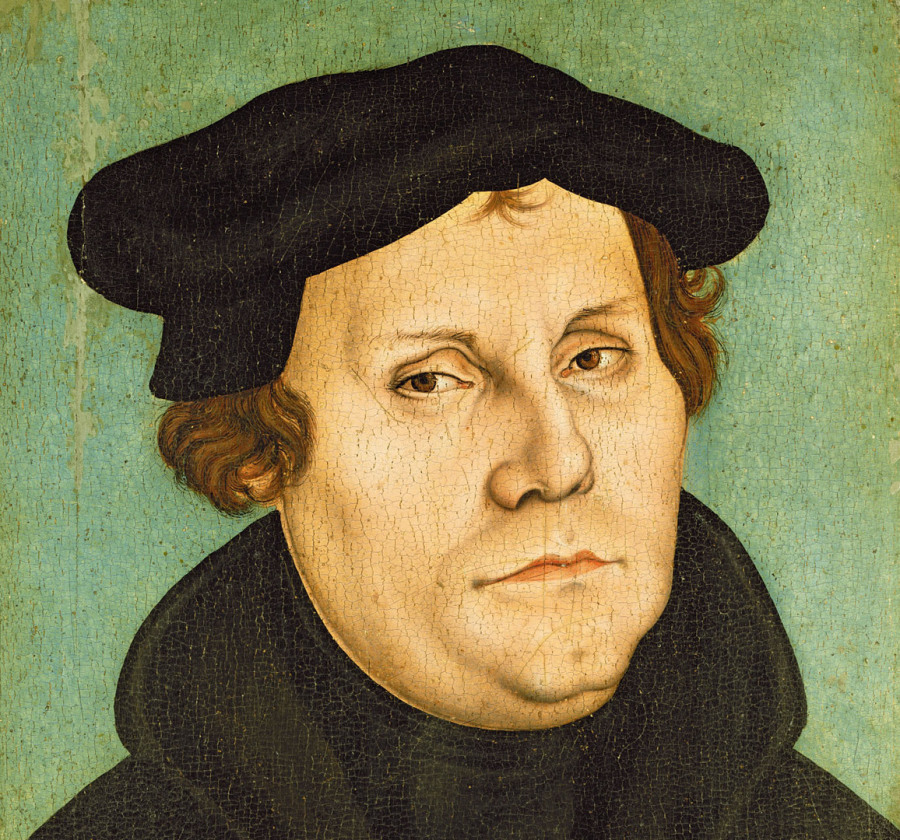
It's much the same with him: He's famous, lived a long time ago, and some of his descendants might still not know whether they're related to these Luthers … or not..
A time jump: Time and again during those early years – after 2012 – there was, of course, also time to enter my own family history into Ancestry.com and incorporate the information found there. Now, you have to understand how Ancestry – a commercial company – works. At least in very general terms. Explained in a few words. Ancestry.com is an incredibly vast database of historical records. Events such as births and deaths, along with related locations, as well as photos, obituaries, passenger manifests, and much more are compiled there. And Ancestry “shovels” more data into it every day. Entire church archives from all over the world are added. First, this “merchandise” is purchased. With what? With the membership fees you pay if you want to benefit from this data and the community. There aren’t millions, but rather billions of potential matches for every paying member. It is – in my opinion – one of the fairest offerings of its kind. It’s worth every penny and multiplies the likelihood of finding ancestors for your own family tree..
Back to the practical side of things. So my wife entered data, read posts by other researchers, searched, found, and posted her own findings. And many months after my work on the transmission of “We’re supposed to…” began, the first exciting development took place. Renate found a branch that could be clearly traced back to the Bachs. In the U.S. Just any Bachs, mind you. Only two things stood out. First, their research ended in Andiolebin in Hesse. Genealogically speaking, there was no way for an American – and a non-native speaker – to figure out that the place name had been entered incorrectly in the documents. What was actually meant was Andisleben, and that – as we now know – is not in Hesse, but in Thuringia. We knew that. But “our Americans” didn’t know that. Suddenly, by chance, an incredible opportunity opened up. Because I realized in time that this information would allow us to create the situation I hadn’t been able to “provoke” with Presley & Co. above. What did we do?..
We got in touch with these Bachs, who had “stalled” in “Andiolebin in Hesse.” We drafted a carefully worded message that initially did not explain why, after tracing their family history back two or three generations, they had reached a dead end in Andiolebin. They were thrilled to hear from us, and with that initial trust, we asked – without revealing our own identities – whether they were familiar with the composer Johann Sebastian Bach in Germany. Within a very short time, we received the answer that meant so much to us. We were told that their grandfather had already done some genealogical research, but he, too, had been unable to delve any deeper into the past ... only as far back as this Andiolebin in Good Old Germany. And what’s more: This grandfather had actually claimed that their family was related to this famous musician in Germany. However, this could never be proven or verified in any way. With that, I had a completely “self-contained” third through fifth source – a message in a bottle through time – that matched the topic 100 percent: the same story, and even in the exact same wording. “…should…,” because, after all, it couldn’t be proven. But the tradition had been passed down to the generation with whom we were corresponding. We were delighted by the new addition to the family, congratulated our “new cousins,” and were able to expand the Bach family tree once again – far beyond the findings of Brück, Frickel, Kock, and Siegel – and we were proud to be able to substantiate our thesis with three more examples. Four times we were able to relive this scenario ... always with Americans, of course. This was partly because Andiolebin had naturally spread, and partly because we were now specifically contacting our U.S. Bachs to play the “same game” with them. We asked them specifically whether the name Johann Sebastian Bach “meant anything” to them, and then shared our delight at solving the “Andiolebin dead end.” Coincidence can be so wonderful. We were “as happy as can be.” Especially me, of course, because as you can see, I’m “quite alone” in my assessment of the significance of this indication..
Indication 4, Quality 1 of 10: Equal Rights for Both Bachs..
Actually, the idea is quite simple, and yet it took me many, many years to realize it: Johann Sebastian Bach’s famous statement in the even more famous “Origin of the Musical Bach Family” – namely, that his ancestors came from Ungern and that “Veit” then played a cythrin in Wechmar … that, too ( ! ), is oral tradition passed down through the ages. And basically, Bach “conveyed” nothing different from what my grandpa did: Bach said, “We are descended from a musician who was the first in the family in Wechmar to make music to keep the mill running.” My grandpa claimed – in essence – nothing different, but not in the sense that it was a certainty, only that “that’s what people said.” From this, one could now conclude: Since Bach composed divinely, the memory of the statements made by his father and his father’s father and his father’s father was surely reliable. But then … my grandpa could have done something like that, too. Or: Let’s “forget” about that first musician in the family. We’ll never mention Veit again, and Hans the minstrel is the new progenitor?! Fair? Fair! And that – namely, the acceptance of the tradition that J.S. Bach’s great-great-grandfather came from Ungern – was then not questioned for 270 years by one single person among hundreds of renowned, unknown, and famous Bach experts, Bach scholars, and Bach genealogists. Not a single one? Actually, one and a half researchers did not accept what Johann Sebastian Bach had conveyed: One and a half? That’s right: Christoph Wolff, undisputedly the No. 1 in the Leipzig Bach world and across the globe for 50 years, mentioned Veit in an earlier publication (… The Bach Family), but no longer does so in his current bestseller. And of all people, “our” Helga Brück … there is not a single mention of Veit Bach. Intentionally!..
Indication 5, Quality 5 Out of 10: Musical Genes “En Masse”..
I myself am not musical – I don’t play an instrument – but I’m very active in the arts. And creative. Well … now on to my relatives. First, let me define this: “Active in music” are people who perform in front of an audience, play in an orchestra, or sing in a choir. Or they have to teach music. Ideally, they earn their living through music ... either part-time or full-time. Alternatively, they at least play at parties on the weekends or at weddings. And that includes my uncle, my brother mentioned above, my sister-in-law, four of her six children and in-laws, my niece, my cousin, two relatives in the Netherlands, and more female musicians in the U.S. The musicality of entire branches of the family has been studied. A monument is dedicated to the Bache family of Ohrdruf; “other branches” have also been musicians through and through. There were the Bachs of Erfurt: town pipers, organists, and cantors. Then the Baches of Arnstadt: They were town musicians. The Meiningen Bachs: court musicians and organists. The Franconian Bachs and – those you’ve already met above – the U.S. Bachs, who still make music today. Let’s conclude with the Eisenach Bachs..
The musical talent in this – the largest family of musicians of all time – was so extraordinary that people still spoke of “Bache” even after many decades, when members of the Bach family were no longer as commonly found as musicians. In the decades prior, “Bach” had become a leading – if not the very first – regional brand. Just like Tesa today, or Band-aid, Caterpillar, Tupperware, Edding, and “Googling” in the past..
This high frequency of musical genes is reflected – and has been reflected – in more than 200 of these Thuringian Bachs who lived – and continue to live– between Veit’s time and the present day and who performed music. If musicians in the current family – in the sense of my definition given above (… that is, simply enjoying listening to music is not enough) – play music, then this, together with other indications, becomes increasingly significant … an exciting indication..
Indication 6, Quality 2 Out of 10: The Geographical Homeland of One’s Own Ancestors..
With a well-maintained family register, you can quickly trace your family back three or four generations. My journey – and ours – took us to Marbach, Germany. What luck: Marbach is just a “stone’s throw” from Heilbronn. Just a few minutes by car. And there, we experienced the first “roller-coaster ride” in our still-young research into our own family history. As it turned out, there wasn’t just no pastor named Bach in Marbach on the Neckar. Worse still: There was no one named Bach in Marbach at all..
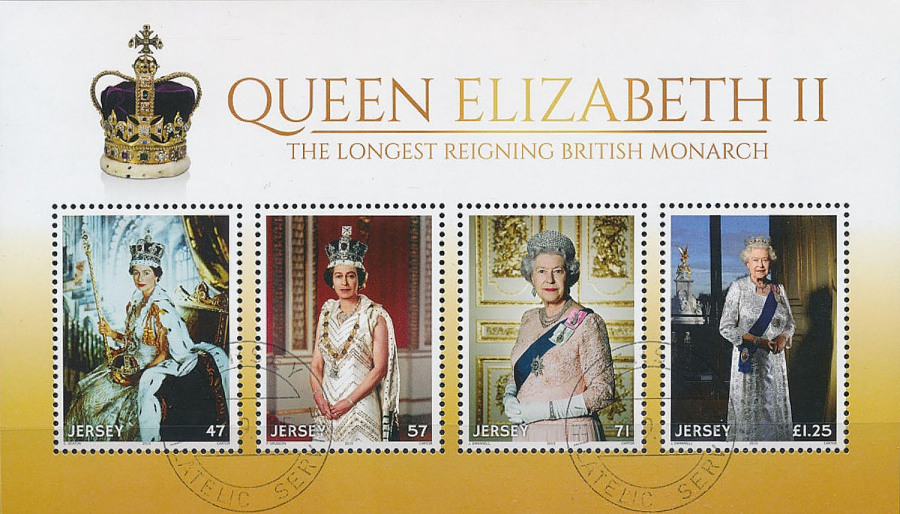
In 1965, Queen Elizabeth II did not visit Marbach on the Swabian Alb, but rather Marbach on the Neckar. The famous question, “Where are the horses?” is now considered a charming newspaper legend..
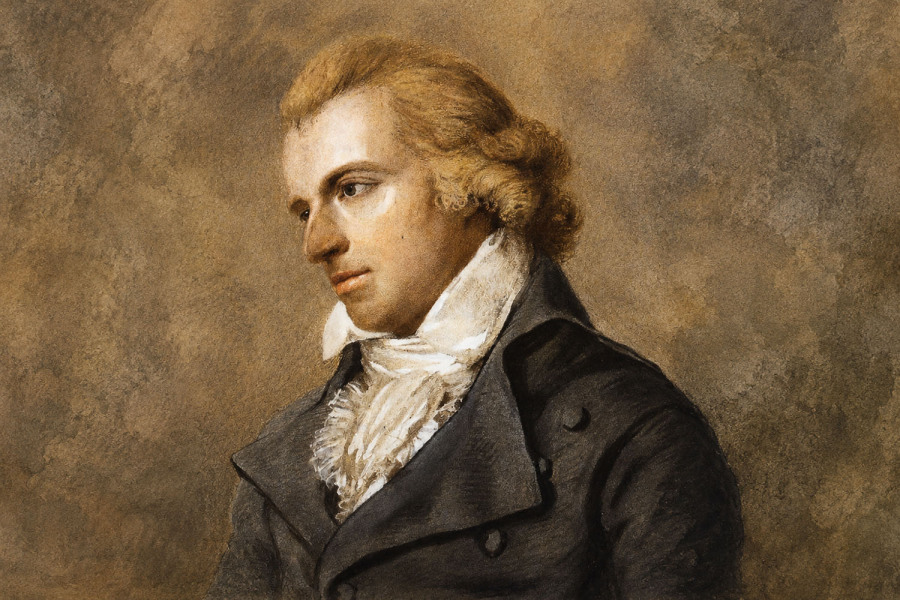
Marbach on the Neckar is the birthplace of the poet Friedrich Schiller. His birthplace is one of the town’s most famous landmarks and serves as a tribute to his life and work. Every year, numerous literature enthusiasts visit Marbach to follow in Schiller’s footsteps and explore the German Literature Archive..
Marbach is also the name people associate with the stud farm on the Swabian Alb. And with the small place of the same name there. But Queen Elizabeth II never stayed there. It’s world-famous among horse lovers. My ancestor might well have lived there, too..
And where did this – our disappointment – take place? In a church archive in Stuttgart, Germany. On microfilm. We had simply expected to find out, in this church archive, the father, the corresponding place of birth, and perhaps a little more about “our Bach in Marbach.” Maybe even the cherry on top ... a little more information than we’d hoped for. But we found: nothing … absolutely nothing. However, the staff in Stuttgart were helpful, and so the “roller coaster” ride of genealogy took us on another upward turn. They told us that there are other places named Marbach, and one of them is even a suburb of Erfurt in Thuringia..
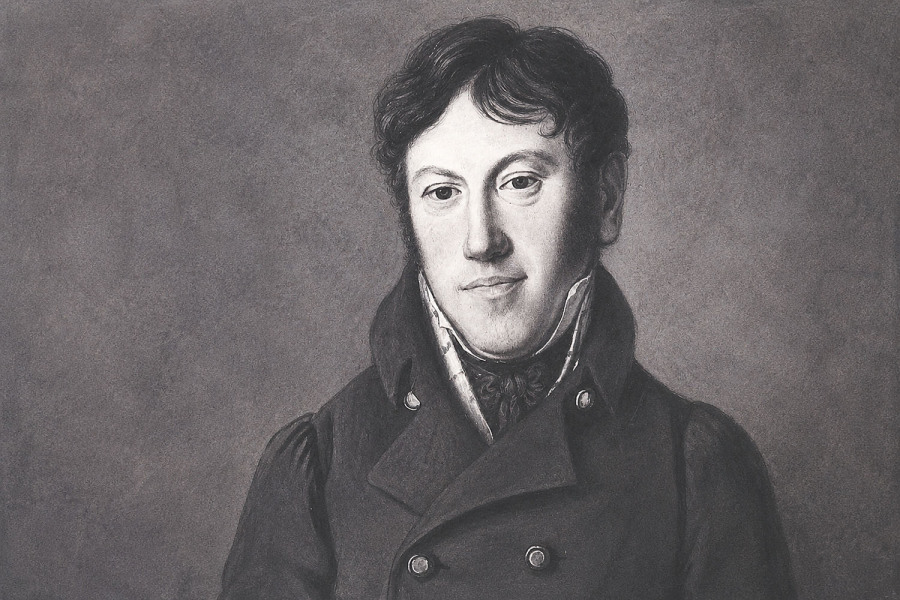
From Marbach to Bindersleben—both locations are right near Erfurt. The composer and organist Johann Christoph Bach. He was—so to speak—the local shining star of the Bache family in Bindersleben..
Erfurt … as we later learned, and the area surrounding Erfurt is the “Land of Bache.” Or, as we like to call it, “Bach Country.” And Erfurt is the epicenter of it all. Marbach was – and still is – right nearby, and members of the Bach family lived and worked in Bindersleben, Molsdorf, Arnstadt, Wechmar, Gotha, Eisenach, Weimar, Andisleben, Ohrdruf, Gräfenroda, Gehren … and, of course, in Erfurt. There are 60 entries alone in the church records of Thuringia’s capital that relate to this family of musicians. It would never occur to me that a person might belong to this Bach family just because his grandfather or great-grandfather – for example – was born in Gotha … and nothing else points to a connection to the Bachs. But … if that’s just one piece of indication among many … then it does count..
Indication 7, Quality 8 out of 10: The Binderslebeners..
Helga Brück, a Bach genealogist and Bach researcher, has undoubtedly established through her research that the Bindersleben branch belongs to the Bach family tree. She merely noted that the link to Wechmar is missing. This therefore means that belonging to the Bindersleben Bachs substantiates and confirms the family relationship with Johann Sebastian..
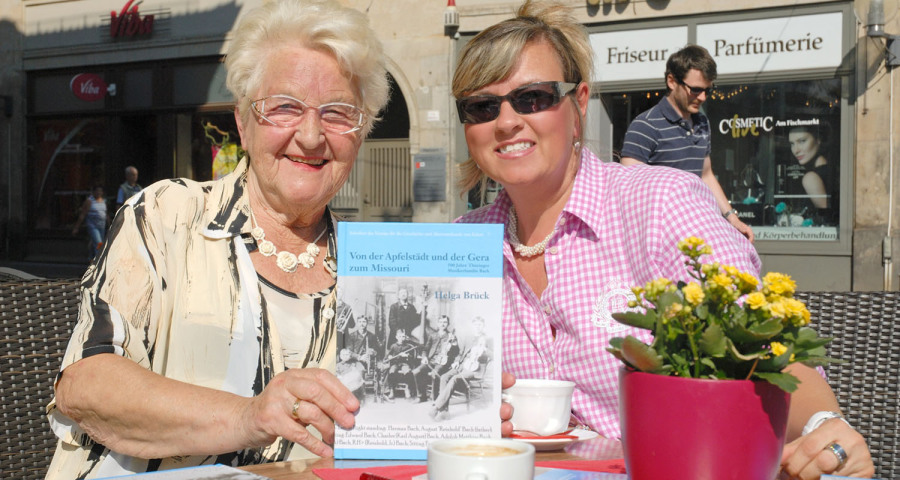
We had so much fun. Especially during the part where Ms. Brück introduces the Bach Houses in Erfurt. How can you film the scene and also capture Ms. Brück in a close-up? It’s simple: She turns around … and the actress in her comes to life. You can see it in the video at the very top of this page..
Back to the “Marbach Discovery.” Erfurt, along with its suburbs of Marbach and Bindersleben, was too far away for us to successfully conduct research in church records. The key factor here is the likelihood of overlooking or failing to find essential information. And sifting through microfilm is exhausting. Through AGOFF, we met a genealogist who has since become a long-time friend of ours. Christian Andreas Hoske had previously investigated a connection related to Luther for a client and was able to prove her kinship. Christian Hoske took us three generations further back into the past. However, his leads ran out at a certain Zacharias Bach. Once again, we had hit a dead end. And once again, it was a low point in our research..
Now back to Helga Brück. It’s a fascinating story. As fans of the U.S. and Florida, Renate and I spent many weeks there “in a row” ... right around the time of our research. Sometimes I have “quirky ideas,” and back then I was determined to “bring together” the two terms “U.S.” and “Bach” in a genealogical search result. So I googled. For hours. To be precise? About four hours. And finally: There was a result. On page 100 of the Google results ... or just before it. How cool was that?! And what did I discover? It was about when the quality of Bach’s work reached the U.S. ... in other words, when people in the U.S. recognized what an extraordinary genius Bach was..
So I started a second round of nonstop, intensive googling. This time: nine hours long. And finally, my goal appeared right in front of me on my laptop. It was Helga Brück’s book: “From the Apfelstädt and the Gera to the Missouri”. Basically: a truly impossible-to-find read. After all, who would ever Google the keywords “Apfelstädt,” “Gera,” “Bach,” and “Missouri”?! I, however, had reached my goal. Genealogically speaking, this book was the jackpot. At first, it was of immeasurable value. Later, it proved to be even more valuable than that: Without Ms. Brück, we would likely never have found the connection to the Bindersleben clan..
Indication 8, Quality 1 of 10: Who Looks Like Whom Here?..
Right at the beginning, regarding this piece of indication, it must be mentioned that it is “nice to have”. Far-fetched. Borderline. And based on the idea that where there’s smoke, there might be fire. In her book – which is so valuable to us – Helga Brück devoted an entire, though small, section to the Bindersleben Bachs. Specifically, she did so beneath a picture – on page 100 – of Johann Christoph Bach, the local luminary of this branch, which, however, is not officially a self-contained Bach branch. She writes that the music teacher of Johann Christoph’s son, Lothar Bach, at the Erfurt Gymnasium not only noticed his “great musicality,” but was also particularly “impressed by his striking resemblance to Johann Sebastian Bach”. When we viewed the original photos at his sister’s home during a visit with her, we were unable to determine what might have prompted the high school teacher to make this statement. However – and this is my opinion, not Renate’s – such a statement by the teacher might indeed have existed. For it is so unscientific on the subject that one finds it hard to believe that one of the people who passed it down – perhaps Christa Bach herself – would have simply made up such a prank. Such a statement would even put “… we are supposed to …” in the shade. So let every visitor here, every reader themselves consider whether we want to accept this piece of indication at all. To give you a personal impression, we took a photo: Lothar Bach in Christa Bach’s “Bach Room,” which we visited with Ms. Brück..
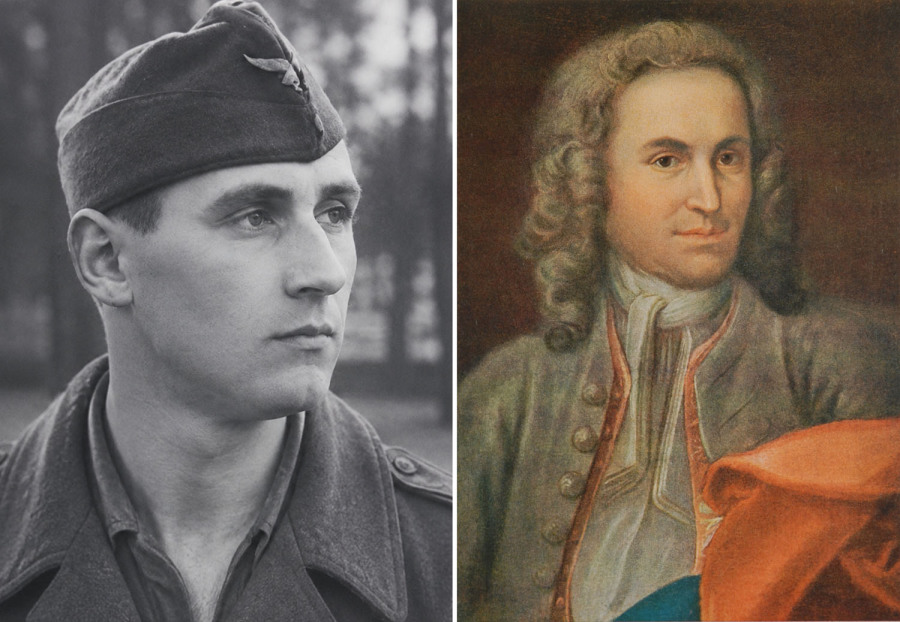
Lothar Bach in the specially furnished Bach Room at the home of Christa Bach, Lothar Bach’s sister, in Bindersleben. What do you think: Does Lothar really look like Johann Sebastian Bach? We’ll leave that entirely open to interpretation..
The following consideration is absolutely crucial regarding this indication of low quality: The issue is not whether Lothar and Johann Sebastian Bach actually look alike. Rather, it is that the thoroughly reputable – and, in her mission, in no way prone to frivolity – Bach genealogist Helga Brück decided not to intervene in this oral tradition and to “bury” it by ignoring it. Instead, the scholar chose to continue “passing the content down through time.” It would have been easy for her to omit this single sentence from the manuscript, on page 100, in the first section..
Indication 9, Quality 5 Out of 10: The Bindersleben Bachs and Ms. Brück..
Johann Christoph Bach (… 1782–1846) is discussed on pages 98 and 99 of Helga Brück’s book. He was unknown both regionally and nationally; he was a musician and composer. And he belonged to the Bindersleben branch, which is not an equal branch of this musical family. This is in contrast to the Molsdorf branch, from which it descended. A certain Hans Bach initially paid his corvée tax from Molsdorf to Erfurt, and later from Bindersleben. This is evidence of the Bachs’ move from Molsdorf to Bindersleben, just three kilometers away as the crow flies. Ms. Brück wrote the following about these Bachs from Bindersleben: “It is entirely conceivable that the Bach family from Bindersleben was related to the Bach family from Wechmar. For the Bach farmers of Bindersleben were highly musical and played the organ in their church for several generations.”..
Johann Christoph Bach founded an adjuvant choir and an instrumental ensemble. Several of his short compositions were even published in Erfurt. He also collected compositions by colleagues and compiled two catalogs ... one in 1800 and one in 1821. The collection consisted of 300 musical works. Ms. Brück continued:..
“For many generations, musical talent had been passed down through the peasant Bach family, as had the tradition that the eldest sons, in addition to their farming work, played the organ in the Bindersleben branch of the family.”..
She finished her remarks on the Binderslebeners with the following statement: “A connection to Veit Bach is, however, conceivable, since the trail of the Bach families from Günstedt can be traced through … Bindersleben … all the way to Molsdorf. The only missing link is the connection to Wechmar.”..
Indication 10, Quality 8 Out of 10: Both Branches Told the “Fairy Tale of Hungary”..
Philipp Spitta was, without a doubt, one of the greatest historical Bach biographers, and his work – a two-volume set still available in print today – is, without a doubt, the most comprehensive ever written. Before him, only Johann Nikolaus Forkel was a scholar and author of his caliber, and one can assume that Spitta did not adopt any speculations or conjectures from second- and third-rate Bach authors. Not in the main body of his biography, but in the sources, we find a reference to Bindersleben that is uninteresting to all readers, but highly intriguing to me: With the words “even now,” he alludes to the time of his research, which he conducted before writing the biography. He did this in Leipzig in 1873. The Bach Society had been founded in 1850 … so scholarly work on Bach was already well underway. Philipp Spitta was closely associated with this Bach Society, though he was not among its founders in 1850. After all, the Bach Society was founded when Spitta was only eight years old. But Spitta later played an important role. He also became a contributor to the Complete Works of Bach, published by the Bach Society. He edited several volumes of this work and wrote scholarly prefaces. His two-volume biography "Johann Sebastian Bach" (1873/1880) became one of the most important foundational scholarly works in Bach research. In contrast, he co-founded the Leipzig Bach Society in 1874, together with Elisabeth von Herzogenberg, Heinrich von Herzogenberg, and other Bach enthusiasts. This society was dedicated to the preservation and performance of Johann Sebastian Bach’s works and should be differentiated from the Bach Society. It complemented the Bach Society’s editorial work in an ideal way..
Preßburg? Forget it. Not a single document was found there that provides any information about Veit Bach. And in over 270 years, no one even looked for it. Preßburg wasn’t that far away, after all. It wasn’t Papua New Guinea, for goodness’ sake. Things were really hopping in Ungern. Ockham sends his regards: Was Ungerndorf the “Ungern” mentioned by J.S. Bach? That … is the most likely explanation from a scholarly standpoint..
At the time Spitta was writing his first and second volumes (… published in 1873 and 1880, respectively), the prevailing view was that the Bachs had “fled” from Hungary. This was not definitively proven false until 2021. This notion of their origin resulted primarily from CPE’s falsification of the necrology. Forkel then included this in his biography without verifying it. This was followed – completely out of thin air – by the later addition of the “Preßburg” theme by the “scribbler” Korabinsky..
Had Spitta conducted any special research into the Bach family tree? Yes … and on a remarkable scale, in fact. Philipp Spitta was one of the first scholars to treat the genealogy of the Bach family systematically as part of his scholarly biography. However, one must distinguish between his own archival research and the analysis of existing sources. His actual achievement – as a genealogist – lay less in discovering entirely new branches of the family than in organizing the numerous Bachs historically and genealogically for the first time. In the first volume of his Bach biography, he therefore did not begin with Johann Sebastian himself, but with his ancestors, and describes the various lines in detail … such as the Bachs of Erfurt, Arnstadt, and Ohrdruf. This approach was new for its time and shaped Bach research for decades..
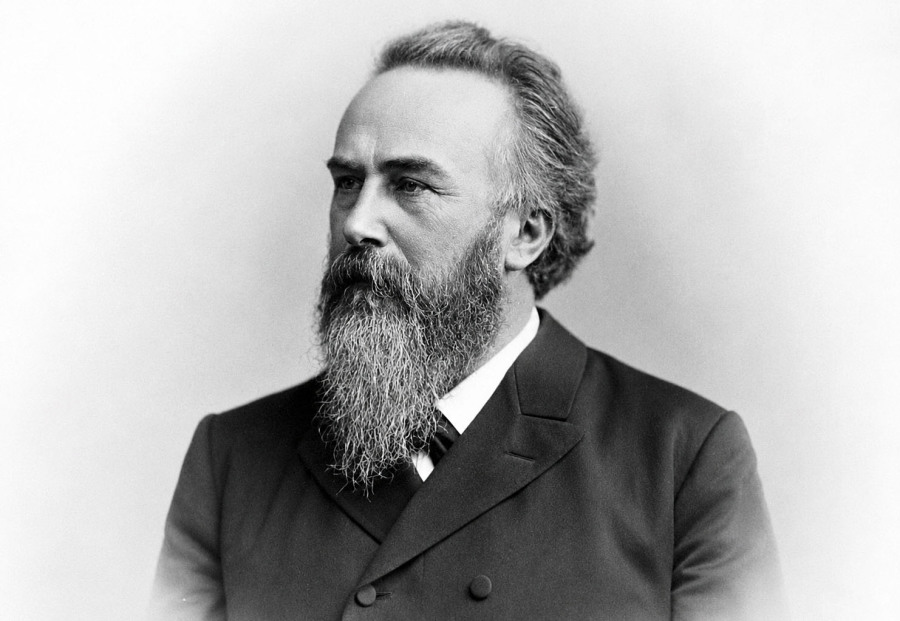
How cool that Spitta has already given us an indication. What's the quality like? Feel free to decide for yourself..
The wording in Spitta’s source references is particularly exciting. It appears in the first section of the first chapter of the first book, on page 11:..
(Quote) “The fact that it describes the father as a carpet weaver is a clear confusion with Hans Bach, and even if there are three musical sons here as well, this casts doubt on the credibility of the account as a whole and gives it the appearance of a later fabrication. As for what the genealogy subsequently reveals about the further branches of this line, it itself describes most of it as conjecture, to which even less weight should be given, since the author knew nothing of the Thuringian existence of the Bach family, which extended far beyond Veit. The fact that the tradition still lives on in the Bindersleber line – that their ancestors immigrated from Bohemia or Hungary, without their knowing anything of a kinship with Sebastian Bach – might, for a moment, incline one to connect this family with Veit’s second son. However, the very fact that they have their progenitor move to Molsdorf immediately reveals the later and artificial origin of a tradition that was surely rooted, from the outset, in the desire to link the Molsdorf-Bindersleben line to Sebastian Bach ... all the more so when one considers that, even for Sebastian’s ancestors, that tradition is only partially accurate. (End of quote)..
In Volume 1, Chapter 1, Philipp Spitta also writes about the relationship between the Bache of Binderesleben and the Bache of Wechmar. His conclusion is the same as the one my wife Renate draws regarding the connection between the Scharf family and the Bach family in Andisleben: It is about two different places. First, Bindersleben. There, following significant destruction during the Thirty Years’ War, approximately 150 to 300 people lived in about 35 to 40 farms and houses. In Andisleben, there were still 23 houses and roughly 115 to 140 people. Both figures are from around 1650. The question that Bach biographer Spitta, Bach genealogist Brück, and Renate have all asked – or are asking – is: How likely is it that, among (… an average of) 225 or 125 people, two families with the same last name – yet unrelated and not related by marriage – could have lived there? Decide for yourself:..
(Quote) “… Over a period of barely 70 years, more than twenty members of the Molsdorf family are mentioned; the male members with the names Johann, Andreas, Georg, Ernst, Heinrich, Christian, Jakob, and Paul – names which, with the exception of the last one, were also frequently used in Sebastian Bach’s line – while the female names differ. Other sources also mention a Nikol Bach from Molsdorf, who had joined the Swedish army and was buried in Arnstadt on June 23, 1646, because he had been “stabbed to death while drunk, through his own fault.” Nor are we likely to be mistaken in attributing Johann Bach, “General Vrangels’ musician,” to the same town ... a man praised as “artistic,” but of whom little else is known except that he was already dead by 1655 and had left behind a daughter. This would then be the first musician of the Molsdorf line. The aforementioned Georg Bach and his wife Maria had a son, Jakob, on May 23, 1655; he became a corporal in the Saxon Cuirassier Regiment and the distant heir to the family line. This line left Molsdorf at the beginning of the 18th century to settle further north in Bindersleben near Erfurt. The family still exists there today, having produced several accomplished musicians, among whom Johann Christoph (1782–1846) appears to have been the most significant; although he was a simple farmer, he enjoyed a good reputation in Thuringia during his time as an organist and composer..
We now continue our journey for the third time toward the southwest, where, near Gotha, we reach the homeland of Sebastian Bach’s direct ancestors. It is impossible to say exactly how they are related to the previously mentioned lineages, but it would be highly improbable to deny this connection when considering families with the same surname (1*) and, in many cases, the same first names (2*), living side by side in a small geographical area (3*).
Incidentally, we must trace our common roots back at least to the mid-15th century, for by the 16th century the family tree had already sprouted mighty branches in many directions. In Wechmar as well – the final destination of our journey – the Bachs had already been firmly established before 1550. Their oldest representative …” (End of quote; * Note: I added up the numbers in parentheses)..
Simply because the video about Wechmar belongs on this page … that’s why it’s here now. Even if all the indications were conclusive, I still wouldn’t know through which line I’m related to the Thomas Cantor. Through the marriage of a Bach to a Mr. Scharf (1), or the marriage to Ms. Scharf (2), or through a common ancestor earlier than “Veit, died 1619” (3)..
We'll find out later what Forkel had to say about it..
Indication 12, Quality 10 Out of 10: My Relatives in Andisleben and the Marriage Customs of the Scharfs and Bachs There..
For me, the path leads to Andisleben; for my cousins, it continues beyond their ancestors to the United States of America..
It should be noted at the beginning that this part of the research was carried out entirely and independently by my wife, Renate. It is important to note that its primary goal was to clarify my relationship to Johann Sebastian Bach – apart from the research via Bindersleben – and that it has been successfully completed for the time being. The results of her research yield a completely independent conclusion. However, when combined with the findings from the other ( ! ) chains of indications, this discovery enhances the credibility of the other indications in this area. After all, the more indications point in the same direction, the more reliable they become. I would like to preface this with a significant independent assessment of these other chains of indications, on which the two of us – we Bachs from Flein – do not agree. I suspect my connection to “our composer” dates back five to ten generations before Veit. Renate believes this “intersection” occurred at a later time..
Furthermore, Renate’s research reveals not only a connection to the first branch of the Bachs in the U.S. discovered by Helga Brück, but likely even a second connection among these individuals ... separate from one another. This discovery would then confirm – and ultimately provide documentary evidence – that I belong to this family. After all, there is no doubt that this first U.S. line belongs to the family of musicians from Thuringia, to Johann Sebastian Bach. The fact that there are even two connections – via the Scharfs – leading to this family is not entirely easy for me to understand, but I’ll do my best when we “dive into” this again, because as of 2026, it is not yet genealogically representable ... or comprehensible to third parties. This has to do with the Bach family and the Scharf family in Andisleben. We’ll get to that now..
Right in the middle of the “Land of the Bache,” which we also call “Bach Country” – about a 20-minute drive from Erfurt, which we know as the epicenter of the Bach family – lies a tiny village that plays a very significant role in the genealogical research of American hobbyists. You can read more about this in the section titled “Indication 5.” In this tiny village called Andisleben – where an even smaller number of people lived in 23 houses (… see the Andisleben website) than there are today, and today there are only 600 residents – lived ancestors named Scharf and ancestors named Bach. I have deliberately omitted from this sentence whose ancestors these Scharfs and Bachs were. What is certain, however – and documented in records that still exist today – is that members of the Scharf family married members of the Bach family. The task now is to determine whether this most likely involved a single Scharf family, or two ...namely, Scharfs who were not related to one another and not related by marriage. And whether the Bachs constituted one Bach family, rather than two or even three..
Let’s be clear – and of course – we would like to be related to these musical Bachs. But we’ll still look at and evaluate the situation objectively. In Andisleben, there was exactly one Scharf family and one Bach family, each certainly part of their respective clans. We turn once again to Ockham and conclude: The probability that in such a “nest” there existed only one related Scharf family – as opposed to there being two unrelated Scharf and Bach families – is far more likely. Three unrelated lineages – one of Bachs and one of Scharfs – wasn’t meant seriously but was just my typical bit of fun..
More than once, a Scharf married a Bach … and vice versa. That’s still easy to understand today. And it was quite common back then, too. A widow would often marry her late husband’s brother after his death. And vice versa, and in other combinations as well. That’s how it was back then in Eisenach, in Thuringia, and throughout Germany. So why not in Andisleben?! As of 2026, when these lines were written, there were at least three such marriages. We’ll examine this in more detail later: There are actually more. Around 1650, Andisleben – most likely – had about 300 inhabitants following the Thirty Years’ War. So, based on these figures, we can assume that there weren’t four distinct clans with two different surnames living in tiny Andisleben, all of whom were not “interrelated” in some way..
As for the Bachs of Andisleben: They are the branch of the clan that – as documented – belongs to the family of Johann Sebastian Bach. Although the complete genealogy of the U.S. Bachs was lost along with Johann Reinhold Bach when the Empress of Ireland sank, it is empirically established that this U.S. branch of the Bachs is related to the Bachs descended from Veit Bach. Two conclusions necessarily follow from this: a) the Bachs of Andisleben were undoubtedly members of this one famous family of musicians. It also follows that b) only one group of Bachs existed in Andisleben, namely those mentioned above who were related to Johann Sebastian Bach..
Back to my own family tree. In my personal line, a male Bach or a female Bach married a Scharf. And the same is true of another connection: a male Scharf or a female Scharf married a Bach from the line of Johann Sebastian Bach. This, too, is documented..
And that brings us to Renate’s research from around 2012 to 2015. After 2015, her work obligations at the time prevented her from continuing her research because – contrary to what someone who doesn’t do genealogical research might imagine – it’s not just a matter of briefly skimming through interesting documents. Instead, you need “a clear head” for days and weeks on end to conscientiously research documents without overlooking anything important because “your mind isn’t on the task at hand.” Renate is therefore convinced that these Bachs – among whom I, too, may count myself – had married someone named Scharf. But beyond that, another exciting connection emerged. Renate is convinced that I’m not only related to Johann Sebastian Bach – through our common ancestor Veit Bach – but even more closely, namely to my cousins Nancy, Debbie, and Susan in the U.S. Documenting that, however, is a “lifetime project” that will surely follow once our heads are clear again after our “change” in professional circumstances … at least clearer than they are today and than they have been over the past ten years..
The scientifically correct view? It cannot be directly proven by documents that I am related to the Thomas Cantor. Indirectly, however, it is very likely possible. And we will demonstrate this over the next ten years. However, for me – and for us – this scientific presentation is only of a “challenging and ambitious” nature. For us, the evidence – its abundance and quality – is sufficient. Plus the Andisleben genealogy. Since that is the case, I do not wish to debate my relationship. Why not? Because well-meaning interlocutors agree with the argument and follow it. Critical observers, however, rarely take the time or make the effort to “consume” everything fairly and neutrally. And the vast majority of these imaginary “critics,” editors, Bach experts, self-proclaimed Bach connoisseurs, and know-it-alls – as has been the case several times now, mainly the luminaries who watch over Wikipedia – simply for the fun of it oppose it..
Furthermore, we now know of far too many verifiable inaccuracies and distortions of Bach’s genealogy. Fraud perpetrated by the highest authorities and verifiably false or incorrect interpretations of Bach’s history are revealed only to those who – perhaps with other goals in mind – delve deeply, incredibly deeply, into the works of Forkel, Spitta, Kock, Siegel, Frickel, and Brück..
Directly related to the Bachs’ connection to Bindersleben is, of course, the question of to what extent Johann Sebastian Bach was actually related to this Bindersleben branch of the family. The Bachs of Bindersleben were a small group of people who made music. And strictly speaking, it could well be that this family of musicians represents a second, entirely different family of Bach musicians who are neither related to nor by marriage to the family of Johann Sebastian Bach. In this context, the same naturally applies to the famous family of musicians mentioned in the famous "Kirchenbuße", to which the letter writer named Bach belonged. But how likely is it that, both in the circle of the author of the "Kirchenbuße" and in Bindersleben – with so few residents at the time – a second, perhaps even a third Bach family lived there that was unrelated to the other two?! This fact becomes even more striking when one looks at the group of Bachs in Andisleben: There, too, lived a Bach family that, according to records, belonged to the Bachs associated with Johann Sebastian, as well as later to the Bachs associated with Johann Reinhold Bach, whose parents emigrated to the United States. This would be – under certain circumstances and if one were to insist – a fourth Bach family that had no genealogical connection to the ancestors or descendants of Johann Sebastian and Veit. However, this latter connection is only significant if one examines the connection described in the next piece of evidence. It was in Andisleben, in fact, that members of the Bach family and members of a Scharf family intermarried on multiple occasions. This raises the question of how likely it is that there were also two unrelated Scharf families – and, on top of that, two unrelated Bach families – in a town with only a few hundred residents!..
Back to Johann Sebastian Bach’s declaration. He was visiting Gräfenroda, which you can read about in detail on my website under “Gräfenroda.” There, Bach said that he wanted to stop by Wechmar and then visit his relatives in Bindersleben. Sure … the whole “Gräfenroda story” could be a hoax. But I don’t believe that!..
Indication 13, Quality 10 Out of 10: What Does a Professional Genealogist Find?..
He’s a professional researcher. And he’s successful. If there’s anything to find there at all. He doesn’t skip a single word; he can read Sütterlin script, and he’s well-versed in the grammar and wording of that era. He’s just … great..
Our friend Christian Andreas Hoske, a genealogist in the Bach city of Eisenach, summarizes my request and the results: “The starting point for this research is your ancestor Johann Christoph Bach, born on July 16, 1810, in Marbach. In Marbach, I was able to trace three additional generations, along with collateral lines. The progenitor of the Marbach Bachs is a Zacharias Bach, born around 1688 at a location still unknown; all the Bachs from Marbach are descended from him.”..
In Stuttgart, we (… Renate and I) had already searched the church archives for Marbach on the Neckar and for Marbach, the stud farm and suburb on the Swabian Alb, but hadn’t found a single Bach. However, in Stuttgart we were told that there was another Marbach near Erfurt. We knew of Marbach on the Neckar because of its proximity to Heilbronn; we learned about Marbach on the Swabian Alb from my parents. The time between our disappointment at not finding a Bach in either of these two Marbachs and identifying the suburb of Marbach near Erfurt as a potential destination was 0 days and 0 hours; thus, after much mental reflection – 14 years later – it became clear why we hadn’t searched for other “Marbachs” in Germany ourselves earlier – via Wikipedia..
Christian Hoske thus found three additional generations of the Marbach family near Erfurt in the Erfurt church records, along with collateral lines. The progenitor of the Marbach Bachs was a Zacharias Bach, born in 1688 in a place that – at the time of his research – remained unknown. All the Bachs from Marbach are descended from him..
This Zacharias was the oldest verifiable ancestor of my forefathers. However, his parents could not be identified. With Zacharias, my own line of descent thus reached another dead end..
It was only after receiving the handwritten family tree of the Bachs in the Erfurt area from Helga Brück – four meters wide and one meter high – that we were able to identify this very Zacharias. Ms. Brück called this enormous paper document “her treasure.” We were also able to determine his place and date of birth: January 1698 in Bindersleben. From the genealogical table of the Bach family in the villages of the Erfurt Mountain District. Based on the original Molsdorf line (… according to T.S. Terry and Johann Sebastian Bach; sources: church records of the parishes in the Erfurt Mountain District and Bindersleben from 1780 onward, as the earlier records were destroyed by fire). The municipal and church records of Bindersleben in the Erfurt City Archives and at the archives of the Evangelical Church Ministry; the bailiwick accounts of the Allach bailiwick; the village chronicles of Bindersleben and SS-Vargula, published by Fritz Urbich, Erfurt, 1960 (… he compiled the family tree by hand)..
This handwritten family tree clearly shows that Zacharias was indeed related to our Christa Bach and that both belong to the Bindersleben branch of the family..
Indication 14, Quality 2 Out of 10: “Where Does He Plan to Stay?”..
An article is said to have appeared in a historical issue of “Gartenlaube” – an early precursor to today’s magazines – that pointed out or at least explored whether Johann Sebastian Bach’s statement in Gräfenroda was authentic and historically accurate. All issues of “Gartenlaube” are housed in the Heidelberg University Library. I spent two full days there searching for this article. Without success – but after reading many fascinating articles on other topics – I finally had to give up this search..
It wasn't until many years later that I stumbled upon this remark by J.S. Bach again. It turned out that a passage in a novel referred to a statement by Bach. It is important to note that – first – it is perfectly clear that excerpts from a novel do not have any evidential value and – second – this statement, though similar in wording, differs from a second passage that is indeed historically documented. Coincidentally, both passages concern Bach’s overnight stay with relatives in Bindersleben. The sources are particularly noteworthy because the sequence in the novel is based on passages in Spitta’s biography of Bach. However, I derive the second statement from a document that was discovered in the 1960s by a small local research team and was not available to Spitta..
In 1895, “Die Gartenlaube” (for example, in issues 35, 38, and 39) published a serialized novel that also appeared in book format a year later. It was the book “Sturm im Wasserglase” by Stefanie Keyser. The passage that interests us is as follows:..
“…which she packed into a knapsack; tears fell into it as well. ‘Where does he plan to stay, running off into the night like that?’ asked Ms. Wedemann dismissively. ‘With one of my cousins in Wechmar or Moldsdorf, Bindersleben, or Erfurt,’ Sebastian mused. His aunt nodded with utter disdain. “Yes, yes, wherever there’s an organist playing within a ten-mile radius, a town crier blowing his horn from the tower, or a town piper tooting away, it’s surely a Bach. And he’s always been a bit of a drifter, always flitting about the world. He’ll…”..
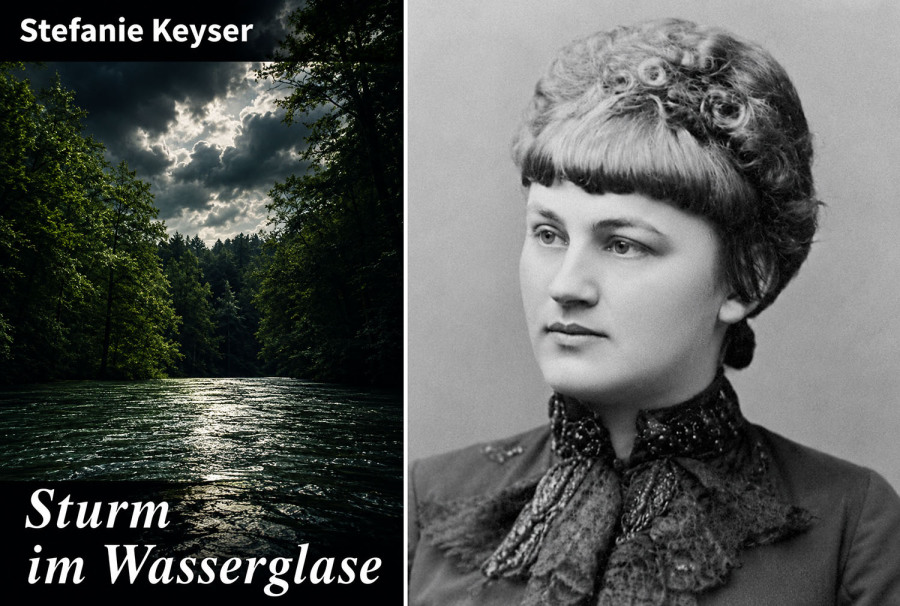
Stefanie Keyser: She wrote the book "Sturm im Wasserglase". She has also written many other books, all with a historical backdrop..
It is noteworthy that Stefanie Keyser was apparently very well informed about the Bach family’s extensive network of musicians. Historically, it is entirely plausible that Bach had relatives in these places. The mention of Bindersleben in the novel is no coincidence; rather, it reflects the knowledge of Bach’s genealogy at the time. What evidence suggests that Stefanie Keyser conducted research? Stefanie Keyser was regarded as an author of cultural-historical novels. Her contemporaries praised her specifically for her thorough historical preparation. Many of her works are based on intensive research of primary sources..
Toward the end of the 19th century, numerous works on local history were published about Thuringia and its families of musicians. Since Stefanie Keyser was from Sondershausen and had studied Thuringian history extensively, she may also have had access to regional literature or archival material. Wikisource user Aschroets believed he had found the crucial clue:..
“The passage in "Sturm im Wasserglase" can very likely be traced directly back to Philipp Spitta … and not to a travelogue by Johann Sebastian Bach, but to Spitta’s account of the Bach family’s genealogy. Spitta’s key sentence reads: ‘That same branch left Molsdorf at the beginning of the 18th century to settle further north in Bindersleben near Erfurt. It still exists there today.’ Spitta means the Molsdorf branch of the Bach family. He thus explicitly describes how part of this family moved from Molsdorf to Bindersleben. This explains the passage in the novel remarkably well. Stefanie Keyser has Sebastian Bach say: “…with one of his cousins in Wechmar or Molsdorf, Bindersleben, or Erfurt…”. Comparing the two texts reveals a clear picture:..
“Wechmar is the birthplace of the Bach family. A branch of the Bach family lived in Molsdorf. That branch moved to Bindersleben … and it was precisely this branch that later moved ... after Spitta. Ultimately, he named the center with the Erfurt branch with numerous relatives.”..
This is by no means a coincidence. Stefanie Keyser essentially adopts the geographical distribution of the Bach family as described by Spitta. An interesting observation: In the novel, Molsdorf and Bindersleben are listed immediately side by side: “… Molsdorf, Bindersleben, or Erfurt ….” This is exactly the same order found in Spitta’s account, since he explains that the Molsdorf branch of the family moved to Bindersleben. This suggests that Keyser actually had Spitta’s genealogy chapter in front of her while writing.” Wikisource user Aschroet’s conclusion: “In my estimation, the probability is very high (… over 90%) that Stefanie Keyser developed this passage based on her reading of Spitta’s "Johann Sebastian Bach".”..
Of course, Spitta’s research and Keyser’s novel cannot serve as proof. If they did, my entire page on this website would be superfluous. However, their work can be seen today as one of several indications that Johann Sebastian Bach did, in fact, have relatives in Bindersleben..
Indication 15, Quality 3 Out of 10: “No Pig Can Read This”..
In the 1960s, a small local team of scholars led by Professor Günter Kraft conducted research in what was then the GDR on the origins of the Bachs before Veit. This masterful achievement is covered in great detail – almost epically – in my chapter “Genealogy of the Musician Family.” In the course of their work, a document found its way into the hands of this small group of local historians. And at least one professor and one Ph.D. – that is, genuine scholars – were now “on board.” In a nutshell, it concerns a historical document written in unreadably poor handwriting. Because it was practically illegible, it was – perhaps for that very reason – given away. It was sent by the pastor in Gräfenroda to Dr. Niemeyer, one of the researchers specializing in Bach genealogy. This pastor claimed that “no pig could read it anyway.” She passed it on to Professor Kraft, who, however, was indeed able to read it. It mentions a visit by the Thomas Cantor to Gräfenroda. The local organist played the organ with Bach; they dined together, and Bach invited him to return the visit in Leipzig. And Bach mentioned that he still wanted to go to Wechmar, because there were supposed to be graves there that were of great interest regarding the Bach family’s origins. Finally, Johann Sebastian Bach remarked that he wanted to go to his relatives in Bindersleben afterward. That was likely the plan for his return journey via Wechmar – or wherever else he had primarily been – to Leipzig, with almost no detour through Bindersleben..
Indication 16, Quality 5 Out of 10: What Did Master Forkel Have to Say About This?..
Ms. Helga Brück conducted comprehensive and scientifically rigorous research into the connections between the Bach branches and lineages around Erfurt and within Johann Sebastian Bach’s sphere of influence. Her findings and conclusions are of the highest quality and can be regarded as indisputable and based on documented evidence. This leads to her hypothesis that the Bindersleben line originated from the Molsdorf line, about which the first biographer (… Johann Nikolaus Forkel) also wrote regarding Johann Sebastian Bach: ...“It is impossible to say exactly how they are related to the aforementioned lineages, but it would be highly improbable to deny their connection when there are families with the same surname (1) and, in many cases, the same first names (2) living in a small area adjacent to one another (3)...” (… which is a similar assessment to the one my wife Renate makes regarding the “Scharf/Bach” connection in Andisleben)..
Indication 17; Quality 5 Out of 10: What Does AI “Think”?..
This is really not scientific: I turned to ChatGPT, my AI of choice. ChatGPT offered to do some research, which resulted in the following text:..
“The Molsdorf line is shown below in simplified form, as derived from Philipp Spitta’s account and later genealogical research. It should be noted that this Molsdorf line is not part of Johann Sebastian Bach’s direct lineage, but rather forms a collateral branch of the widely ramified Bach family of musicians” (My note: Collateral branches are also related to JSB)...
“What is known about this line: Georg Bach lived in Molsdorf, southwest of Erfurt. His son Jakob Bach (born May 23, 1655) served as a corporal in a Saxon cuirassier regiment and became the progenitor of this branch. In the early 18th century, the family moved to Bindersleben near Erfurt. There, a musical tradition flourished once again. The best-known member was Johann Christoph Bach (1782–1846), who, although a farmer by profession, enjoyed a good reputation in Thuringia as an organist and composer. The Bindersleben line is therefore not a new family, but rather the continuation of the Molsdorf line.” And then ChatGPT says ..…
“I correct myself: The complete family tree of the Bindersleben line between Jakob Bach (1655) and Johann Christoph Bach (1782–1846) is, however, not included in Spitta’s book. Spitta, in fact, skips several generations. The precise reconstruction is based on church records and later genealogical works, particularly those by Helga Brück and Kurt Hermann Frickel..
“What's interesting is that, in scholarly circles, the Bindersleben Baches are indeed regarded as part of the Bach musical family. However, they do not belong to one of the famous main lines (… Erfurt, Arnstadt, etc.), but rather form a collateral branch that has long been overlooked in the literature. That is why they are either not mentioned at all in many family trees or are only noted in a marginal comment.”..
Once again, to conclude my remarks on this point, I want to note that I am quite familiar with AI. This includes the AI issue that will arise in the summer of 2026, stemming from the fact that ChatGPT – and likely all other AIs as well – begins to make things up when it doesn’t know the answer or can’t provide a better one. This becomes problematic when the AI ultimately presents the information with “absolute conviction.” For an academic study, I would verify every single phrase ChatGPT generates multiple times using independent sources. But … this site is, after all, not an academic study..
A Very Recent Piece of Indication 18 With a Quality Rating of 1 Out of 10: Well, What Do We Actually Believe?..

The Luther Rose is the best-known symbol of the Protestant faith. It was designed by Martin Luther and illustrates the fundamental ideas of the Reformation: the cross in the center represents faith in Christ, the white rose represents joy and comfort, the blue background represents hope for the Kingdom of Heaven, and the golden ring represents the eternity of God. And yes, the graphic above was not, of course, created by Martin Luther himself..
Researching one's own family history: It happens “in waves. ” Sometimes you’re really “into it,” then there’s a break of many months or even years. Then an email comes along and you “jump right back in” to the subject. Researching one’s own family history is a “marathon.” Fifty years ago, I thought it was a “sprint”, not even 100 meters, but just 50. Seriously, I was naive enough to think I could figure out my connection to Johann Sebastian Bach in a single Saturday afternoon. How wrong I was..
Time jump to the year 2026. I wanted to check with my cousin Daniel to see if his grandmother had also told him many years ago that they were supposed to be related to Bach. Or if they actually are. Daniel replied just an hour later and also sent me the results of a query he’d made to an AI. And it listed key indicators that point to a family connection. And one indication was … the same religion. What a discovery … yet another indication. I was thrilled. And that’s how this paragraph came to be..
Indication 19, Quality 1 of 10: How Much Ockham Would You Like?..
Ockham? Ockham's Razor? You can find the info here..
There is one world-famous family of musicians whose various branches are all – documented and traceable – related to one another. The Bachs of Eisenach, the Bache of Arnstadt, the Bäche of Ohrdruf, the Andisleben branch, the musical U.S. branch, the Rhön branch, the Molsdorf branch, the Bachs of Erfurt, the Meiningen branch, and the Bachs of Suhl … just a few of a total of about 25 to 30 collateral lines, each with at least several professional musicians..
And then there are the Binderslebeners: four generations, several musicians … and the church records have been destroyed by fire. And the Molsdorfers had previously moved to Bindersleben..
And of all places, there are two Bach families there, meaning yet another separate family named Bach, highly musical, and not related to any of the other Bach branches?..
Just forget it!..

Advertisement
The 3 Bibles of the Bach Genealogy ... Back Then..
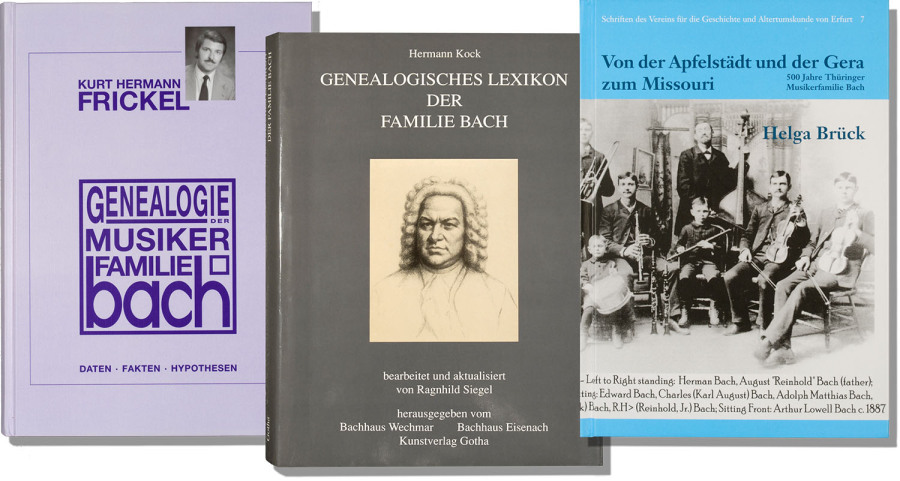
They all struggled with data protection. But every publication is “worth its weight in gold.” Frickel and Kock & Siegel are practically impossible to find anymore, not even used. There are only a few copies left of Helga Brück's book at the Publisher “Bach 4 You.”..
End of Advertisement
 Druckversion