

Bach FAQ 39
Which Instruments Was Johann Sebastian Bach Able to Play?..
In his day, Johann Sebastian Bach was the undisputed best organ player. But does that still hold true for the period between his death and today? To make such a claim, we must also consider the opinions of other famous composers and musicians. And according to their judgment, he remained the most gifted organist in the world even in the roughly two and a half centuries following 1750. It is highly unlikely that there will ever be a better organ player in the future. Accordingly, Johann Sebastian Bach was and remains the best organist on earth and of all time..
Johann Sebastian Bach was also the greatest harpsichordist. After all, someone who was very likely his counterpart, that is the French star musician Louis Marchand, challenged him to a musical contest in Dresden. And yet, even before the match, he secretly left the competition location in the middle of the night. This suggests that Bach was likely at least one of the world’s best musicians when it came to playing the harpsichord as well. And since today regular concerts in which the harpsichord* plays a major role take place in only one location in the world, Johann Sebastian Bach will probably remain one of the best, if not the very best, on this instrument for all time..
And of course, Bach also played the clavichord and the piano. He sang, too. But of course, that last point doesn't really belong here. Besides, he only sang during his childhood..
Then Johann Sebastian Bach certainly played the violin as well. Perhaps also the viola, cello, double bass, oboe, bassoon, horn, and most certainly the flute and definitely the recorder. He could surely play other instruments that aren’t even found in a standard orchestra today..
Of course, it remains entirely unclear how well Bach played those instruments that are not explicitly mentioned by Forkel, Spitta, and Wolff. However, a crucial factor to consider in this regard is that Johann Sebastian’s father, Johann Ambrosius Bach, was a town piper. Johann Sebastian Bach himself was self-taught, and it is now up to each reader to assess the likelihood that the young Bach tried his hand at the recorder and other instruments..
J.S. Bach’s son Bernhard, the fifth of his six musical sons, who, however, did not become famous, was the one who learned to play the flute. The biography first mentions Johann Sebastian Bach and the transverse flute in Köthen. But ... in connection with composition: Did Bach, Sr. actually play it? That must remain an open question. However, it was certainly less likely that he learned to play the recorder during his time in Köthen than that he played the flute as a young boy in Eisenach..
After all, Bach composed flute concertos, and if one is to believe the one specialist, composers back then knew how to play the instruments for which they composed. However, if you believe other Bach experts, they see things quite differently..
* This concert on a cembalo among other instruments is what you may experience twice a day. However, this exclusively takes place only in the Bach House, the Bachhaus in Eisenach, Thuringia, Germany..

City pipers of the past: This is what they looked like. Did the very young Johann Sebastian Bach play one or even several of the instruments his father, Johann Ambrosius, was skilled at? The photo shows the stained-glass window in front of the “Stadtpfeifer” restaurant in Leipzig, the city of Bach. © Info..
Recorder: Did Johann Sebastian Bach Perhaps Play This Instrument as Well?..
There was a heated debate in January 2015 on the topic “Did Johann Sebastian Bach himself play the recorder?”, which needed a – that is my – thorough review After all, if this website is to be suitable for classroom use, it must be open to criticism. At first, I wanted to phrase the third paragraph above a bit more carefully. That has been done, so the old version is out. What is exciting, however, are the contributions from a total of four specialists on the topic.:

Stamp Number 3: the flute. Bach composed music for it. But was it one of the musical instruments that Johann Sebastian played?..
Dear Peter,
I've sent an email to my colleagues in musicology regarding your question. As soon as I receive a reply, I'll forward the email to you..
In Bach's day, composers were generally able to play the instruments for which they composed. But I'm no expert on that subject..
The email mentioned above: ... Please find attached the reply from my colleague, who is blessed with an extremely solid foundation of knowledge..
So if you write that it’s safe to assume J.S. could play the flute – you’re on the safe side..
Take care, and best regards*
(... conductor of a Bach choir and a Bach orchestra; my note)..

A clavichord. Definitely an instrument for which Johann Sebastian Bach composed music. But also, without a doubt, a musical instrument that Bach played to perfection. To find out what a clavichord is, just click here..
Dear Mr. Bach:
Having grown up in a family tradition of town pipers, Johann Sebastian certainly became familiar with the entire range of town piper instruments at a young age and—at least to a practical degree—learned to play them as well. Even though it is clear that string instruments were his primary focus, he was undoubtedly also able to play the recorder. I briefly consulted Christoph Wolff (J.S. Bach, Frankfurt a.M. 2000, esp. pp. 46ff.), though I found no concrete evidence of his potential flute-playing. The traverso, which originated in France in its modern form, is certainly more specialized; to what extent this instrument was widespread in the Central German town piper tradition of that time, I cannot say with certainty at the moment. However, since Johann Sebastian later composed for this instrument—which also became highly popular in Germany—one can safely assume that he was able to play it at a basic level—that is, certainly without being a “virtuoso.” (... he did, however, have contact with, for example, the professional Dresden flutist P.G. Buffardin.)..
That's about all I can say from memory; if I find out any more details, I'll let you know..
Warm regards*
(... a Bach specialist; my note)..
Dear Mr. Bach:
Unfortunately, I am not aware of any source that indicates that JSB played the recorder himself. It is reasonable to assume that he did, given the way he composed for the instrument and the fact that he was the son of a town piper.
Also, there is no flute listed among the musical instruments in the estate (perhaps because it was of too little value) ... but owning one doesn’t automatically mean you can play it :-).
Also, best wishes to you and your wife,
Warm regards* (... a Bach specialist; my note).

We know this for certain about him: about His Majesty, King Frederick II. He played the flute. Did Johann Sebastian Bach’s son, Carl Philipp Emanuel, think that the“Old Fritz” was a good musician? Nothing has been recorded about this, but some interpret CPE’s facial expression..
Dear Mr. Bach:
J.S. Bach was certainly familiar with the violin, but probably not with the flute. His father, Ambrosius, was a town piper ( that is a brass player), so he likely had little contact with woodwind players (think of it as the difference today between wind and string players). Bach rarely composed for a specific instrument, but he often reworked and adapted themes and variations (e.g., the Double Concerto in D minor for violin and harpsichord, as well as the use of cantata themes for contrafacta, such as in the St. Matthew Passion, etc.). The flute was more of a domestic instrument, and J.S. Bach wrote the Badenerie at the suggestion of his Köthen flutist so that the latter could show off his skills. After all, he never again had musicians as good as those in Köthen..
I know that JSB consulted Gottfried Reiche on certain issues (overtone series, auxiliary notes, wolf tones, embouchure, and breath control) to ensure the pieces remained playable. I also believe that he first wrote out the partitas and then gave them to musicians. I don’t know if changes can be seen in the originals, but I suspect so, because it was practically necessary. Three weeks ago, I played some two-part inventions at a concert with a colleague (he played the right hand on the tenor sax, I played the left hand on the electric bass), and we also had to adjust notes within the octave range so that the pieces remained playable. That’s roughly how you have to imagine it, and that’s what the instrumentalist in question does - with or without consulting the composer..
In short – as a composer who writes for a specific instrument (which really only started with J.S. Bach), I need to know about the instrument, but I don’t have to be able to play it. Since the Romantic period, the study of instrumentation has been an integral part of the composer’s craft, and that’s where you learn such things – even if a lot of nonsense goes on (trumpet in A, horn in E, and so on – things nobody needs anymore, but which composers use to show that they know their craft).
I can't rule out the possibility that JSB played the flute, but I think it's unlikely..
Best regards*
(... a teacher, educator, and Bach expert whom I hold in very high regard; my note)..
* ... Of course, I’ve removed the names, because I’d like to be able to ask these experts – who are far more knowledgeable than I am – more questions in the future. I’d like to take this opportunity to thank you all once again for your quick and, above all, expert assistance..

Once again, town pipers. A good town piper should be able to play as many common instruments as possible –even the rauschpfeife, the zinken, the dulcian, and the krummhorn. You can find out more about town pipers here. Does this suggest that Johann Ambrosius also played the flute and that young Johann Sebastian Bach followed in his footsteps? Exactly ... well ... we just don't know..
Welcome to My Hobby ... Johann Sebastian Bach, and Everything Remains Difficult..
That’s exactly why this website was created: Bach is complicated. And ultimately, much of it isn’t entirely clear. This page will become even more comprehensive in the near future and will eventually serve as the definitive answer to the question: “What musical instruments did Johann Sebastian Bach actually play?” As a side note, while researching, one discovers that there’s even mention of some very strange instruments. And that Bach only first encountered the transverse flute in Köthen—and no, there is no record of this from there either—nor in any biography—as to whether he actually played it. You also learn, quite incidentally, that town pipers did not necessarily play woodwind instruments, but often “only” whistled (?) on brass instruments . For me, this is by no means a given..
I’ve made it my firm resolution to evaluate all the sources regarding which musical instruments Johann Sebastian Bach himself was actually able to play. The time will come for that eventually. For those who are now increasingly curious about whether Bach most likely played the flute—or rather, “maybe.” Or “probably not.” A cool article about town pipers published by “BR Klassik” quite a while ago might be helpful. And then—as is so often the case with Bach—you can form your own opinion. But as for knowing for sure … we still don’t..

A street musician “from today”. Not while working, of course. And where is he? In Leipzig. In the courtyard of the Gewandhaus. And what is he doing there? Generally speaking, he’s “just hanging out,” and specifically, he’s wrapping up the chapter on the far-from-clear answer to the question “What musical instruments did Johann Sebastian Bach actually play?” © Info..

Advertisement
Bach Gifts, Really Cool Personalized..
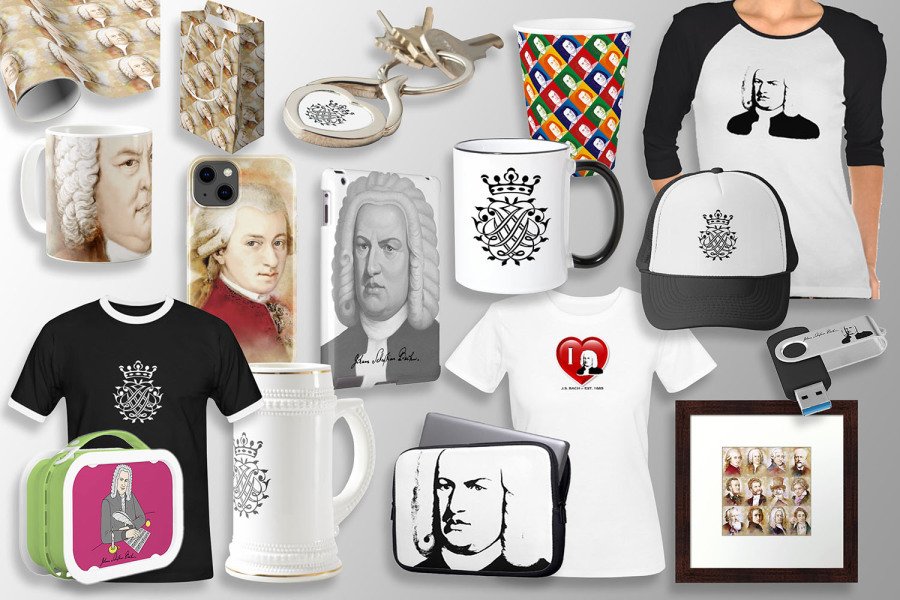
1,000,000+ music gifts, uncountable Bach gifts and 60 music calendars … learn more here..
Music Calendars Make Grat Music Gifts, and so Do Bach T-Shirts..
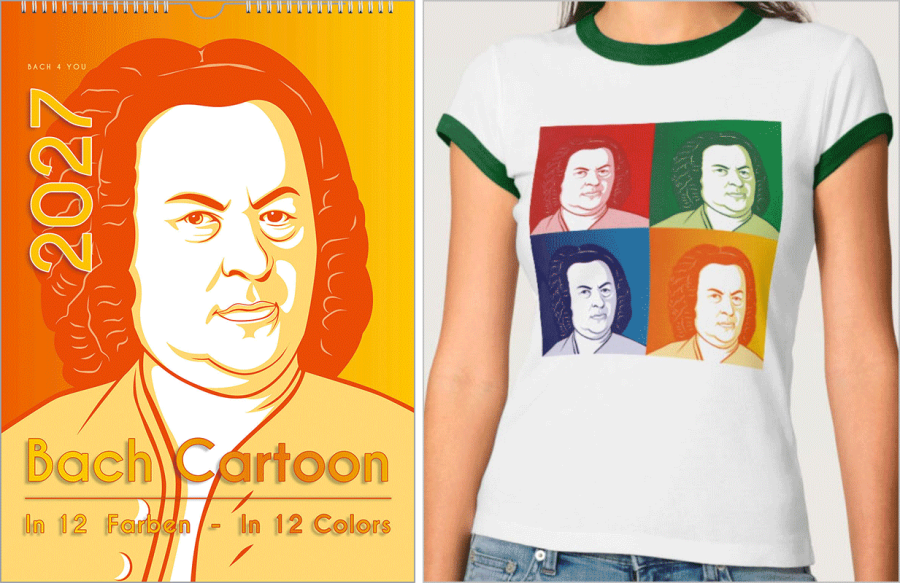
On the left is one of the 20 Bach calendars; on the right is one of countless T-shirts featuring Johann Sebastian Bach..
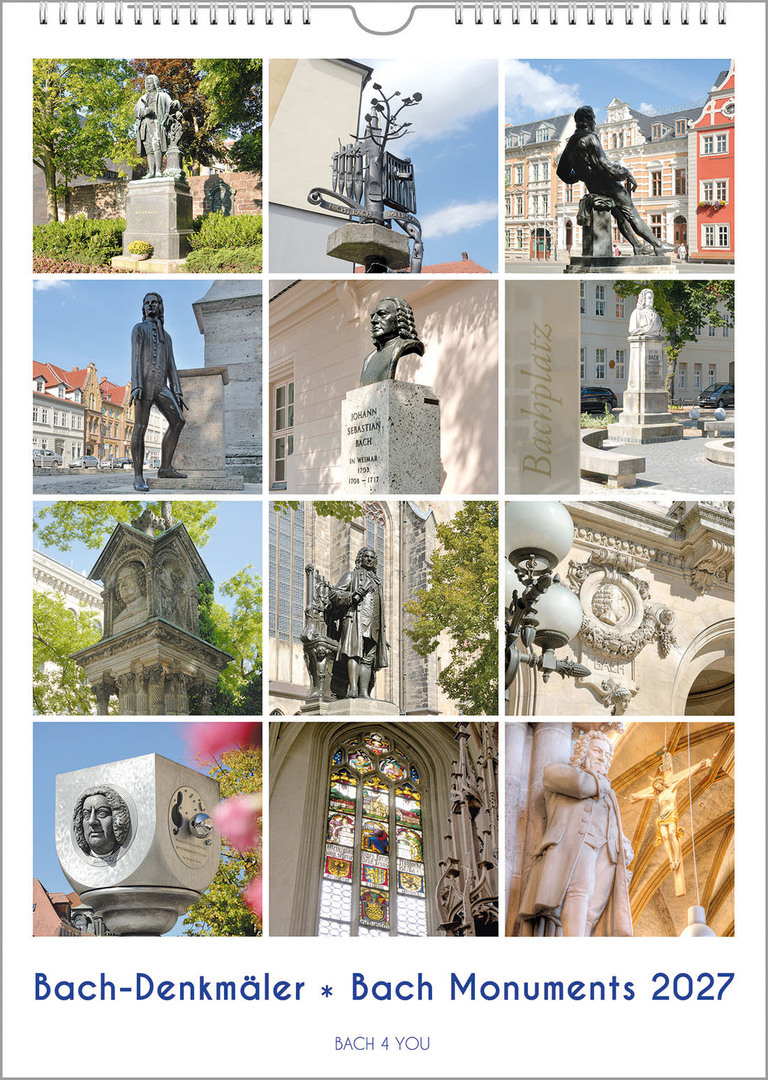
Another one of the various Bach calendars ... the Bach monuments calendar. Three sizes. For this year and next year. Two calendar styles. To the Shop..
End of Advertisement
 Druckversion