

Advertisement
Bach FAQ 121
What Is Classical Music? What Is Popular Classical Music? A Path to the "Classical Music Top 100/300"..
What is Classical Music? What is Classic? What is Popular Classical Music? Which are the most Popular Classical works? What is the “Popular Classic TOP 100”? Five questions: An even more detailed description and the 300 most famous, popular, and greatest works of Classical Music can be found on a special website with just one click. This page here will only take you 20 minutes to read. Everything is described in much greater detail there..
1,000,000+ Music Gifts, 1,000+ Bach Gifts..

Many, many personalized Music and Bach gift ideas … learn more here..
60 Music Calendars Are 60 Music Gifts..

That’s why this entire page is an advertisement page: because I’ve chosen my calendar pages from 20 composers calendars as illustrations. And that, in fact (... if there’s any doubt ...), is already ... advertising! But 99 percent of this website is about the topic: “What is Classical Music?”, respectively “What is Popular Classical Music?”..
Classical Music. Okay … but what … exactly is Classical Music? We all know it ... or at least feel as though we do ... depending on our age ... pretty much everyone. Even kids would be able to accurately identify 100 percent of the Classical Music pieces played to them out of 100. And everyone older … anyway..
Are you a teacher? Perhaps even a music teacher? If so, you may not yet be familiar with my “Teaching Material Classical Music” offer, which is published by my wife’s Publishing House. You can access the dedicated Bach FAQ via the link above. Or go directly to the 14-part collection in the shop via this link here..
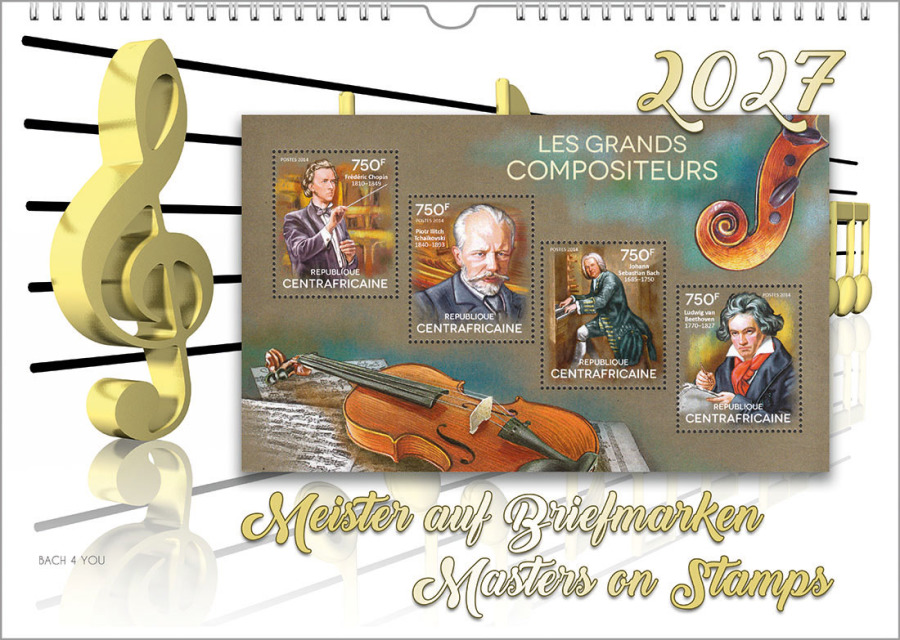
What is Classical Music? It’s definitely the music of the gentlemen up there..
Classical Music. The challenge is: How do you explain it? In a way that’s easy to understand. How do you put it into words? Who explains it best? On the internet. Of course. Where else? Let’s start with Wiki, and there it is – well – somehow correctly explained. But not really convincingly. It starts with the fact that, apparently, it can be “explained” in different ways. And it continues with the note “ … in the German-speaking world …”. So how … does Classical Music explain itself differently to the British, the Dutch, and the French, for example? No, Classical Music must be conceived of completely and – here – “outside the box.” To explain it. Outside the box? Yes, you have to “think outside the box.” Why such a roundabout “approach” in the first place? Precisely because it … isn’t so easy to get to the point..
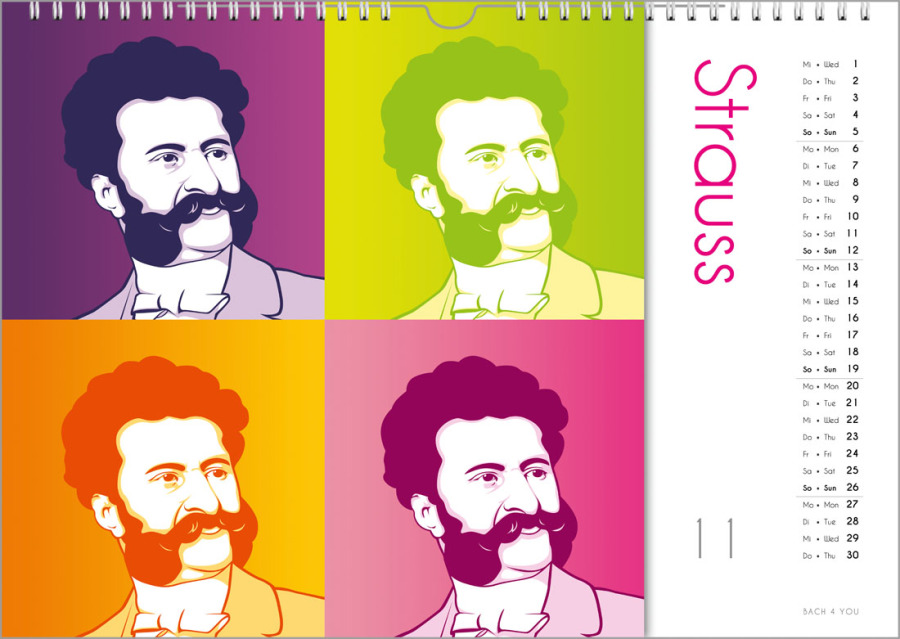
The next composers calendar features a completely different style: The picture shows Mr. Strauss four times. But is it “Strauss the Elder” or “Strauss the Younger”?..
Classical Music in a nutshell? Sure. But watch out ... it’s a slippery slope! “Classic” refers to a stylistic period, but “Classical Music” is something entirely different! And it’s a wonderful topic for debate. Preferably with “full-blooded musicians.” But ... that doesn’t really get to the heart of it. Actually, it’s not an answer at all. So, why isn’t it clear? It’s not that simple..
The “Classical” period ( ! ) lasted from 1750 to 1820. Before that came the “Baroque” period. However, various websites in Germany define this quite differently. On Wissensstandpunkt (... Scientific Standpoint), for example, the term “Classic” doesn’t even exist. There, the “Baroque” era is followed by the “Rococo” era. Then comes “Classicism”: Great, cool ... more complicated is better. But ... not really..
Classical Music ( ! ) has been around for 350 years and much longer, and it’s still being composed today. If you’re a student, though, don’t argue with your teacher without having read this page of my website very carefully. Hildegard von Bingen was probably one of the first to create this kind of music. That was around 1150. But then things were pretty quiet until Bach’s time. If you’re looking for very significant names..
So we already know this much: Classical Music has nothing to do with a specific era. Because if that were the case ... and let’s take three superstars of music history as our examples ... well, if that were the case, then some of the masterpieces by Freddie Mercury and Queen wouldn’t be Classical Music. Nor would Ennio Morricone, John Williams, and so many other composers of the film soundtracks for Star Wars, Jurassic Park, and E.T. have composed Classical Music. People will still enjoy listening to these melodies just as much in two centuries as they do today. Well, 200 years is a long time, and it’s more likely that today’s top hits will be covered someday. Time and again. Over and over. One of the best examples: “Somethin’ Stupid”, sung (… today, and this isn’t Classical Music) by Nicole Kidman and Robbie Williams. People enjoy listening to many songs over and over again, even after a very long time. And they’re always performed by the next artist in the prevailing musical spirit of the time. For the younger generation, in the trendy covered version of the day. The older generation “sway to the melody of earlier performers.” They then also speak of an “evergreen”. By the way, that’s a word that’s gone very much out of fashion..
This leads us to conclude that music does not become Classical Music simply because it was composed many, many years ago. So there must be something else to it. Incidentally, if we define the Classical period as an era, there are only three famous Classical Composers. And those are Haydn, Mozart, and Beethoven. However, there are hundreds of Classical Composers..
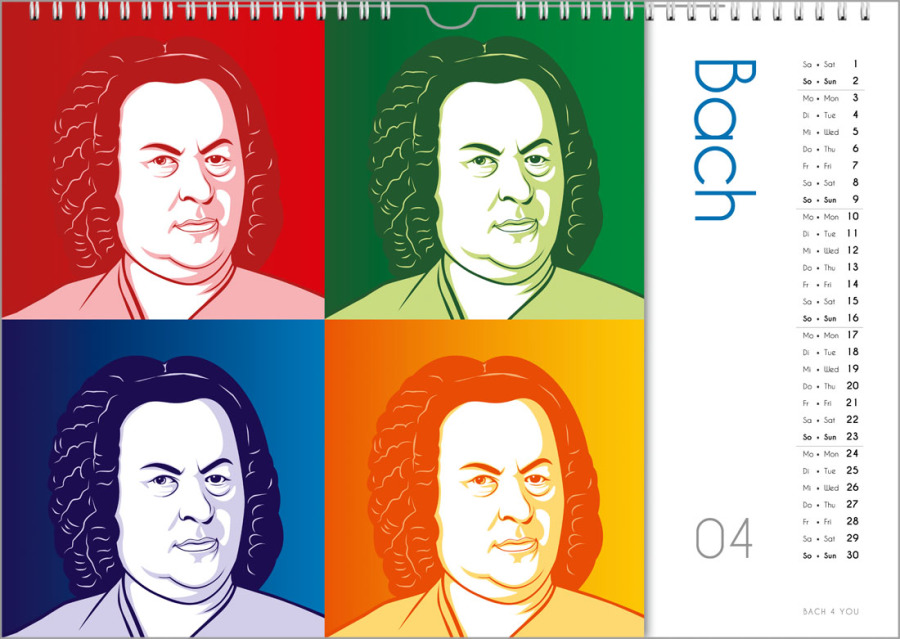
The painter Haußmann, who lived in Leipzig during Bach’s time, probably wouldn’t have been too fond of this interpretation of his 1746 painting. Bach, however – as his family agrees – would certainly have found it cool..
If you had just ten seconds and you were also familiar with the subject ... and you had to name two examples of Classical Music. Or two Classical Composers and two works, or performers for all other genres of music. Then Bach, Beethoven, and Mozart would surely come to mind as Classical Musicians. Plus a few other masters … well, you know who I mean. But why, just why? And why can’t we explain it? Let’s do this together, and I warmly invite all the teachers here to disagree with me. But … I’d also be just as happy to have my approach acknowledged..
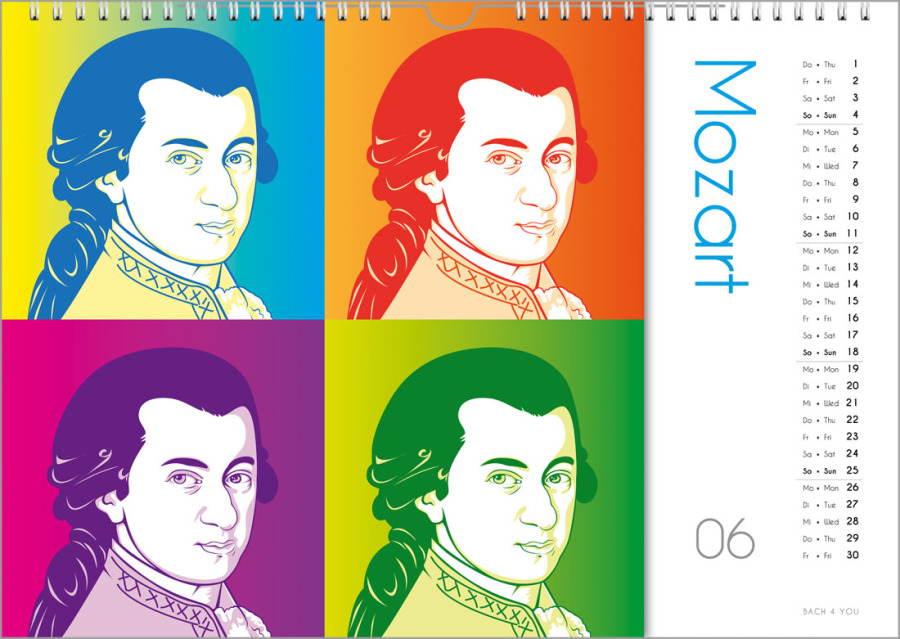
Another one in this style ... then that's enough..
Classical Music. What is Classical Music? Well, let’s start by doing what everyone else does. When people talk about Classical Music today, they usually –perhaps 99 percent of the time – mean music composed by musicians who look solemn, sometimes wearing wigs, often appearing serious in old black-and-white photos taken many, many decades ago. Names like Strauss, father and son (… did you figure it out above? It’s Strauss, the son), Liszt, Bruckner, Schubert, Handel … those are the ones that come to mind..
Not you? You know … well, maybe … just three or even four from the list in the last sentence? Okay. But that’s where the problem really lies. I didn’t want to bring up Bach, Mozart, Beethoven, and Wagner again. They really aren’t the only Classical Composers. But: There are certainly many you don’t know. 20? Great. 40? Phenomenal. 100? Never. But … they exist! So let’s face it: Classical Music is associated with musicians or composers who, as a rule, have long since passed away. Exceptions – as always – prove the rule..

One of the most recent Bach calendars..
Once again, we can rule out the following: There was, in fact, the music of the Classical era. Note: The word “era” is key here. It followed the Baroque era and was succeeded by Romantic music. A major hurdle, then..
Johann Sebastian Bach, the exceptional composer in music history. He is counted among the musicians of the Baroque ... that epoch, that time, that era. More than that: It is said that Bach lived during the height and the end of the Baroque. He composed Classical Music. But that would not fit at all with the content of this section ... the one you are reading right now. So forget this definition of Classical Music. That is, “based on” the era known as the Classical period..
Baroque music emerged around 1600 and lasted until 1750. The Classical period (... era) spanned from 1750 to 1830. Romantic music began – roughly speaking – around the turn of the following century, that is, from 1890 to 1910. Easy, but that’s not what we’re looking for. We want to distinguish Classical Music from other genres. We can already do that (… well, sort of), but we can’t explain it. The explanations I found online didn’t make sense … not in the context of our question..
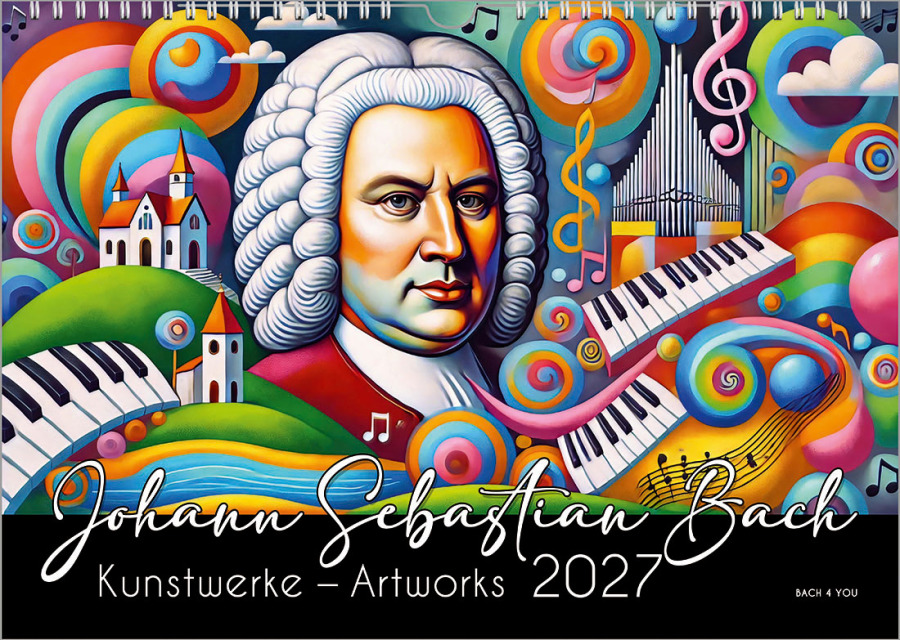
And ... another Bach calendar, which wasn't created until twelve years after I started my Bach Project..

A different compositeur, a different style, a different composers calendar. This one is much more conservative than all the others mentioned above..
We don’t really get any closer to Classical Music (… or, more precisely, Classical Music) through two terms that used to be more popular. Today, hardly anyone talks about "serious music" and "entertaining” music. I don’t like either term. Because it’s easy to find an example of why such a distinction misses the mark. Besides, serious music can also be entertaining. And boy, how it can be entertaining. But broadly speaking, that distinction doesn’t really help us now..
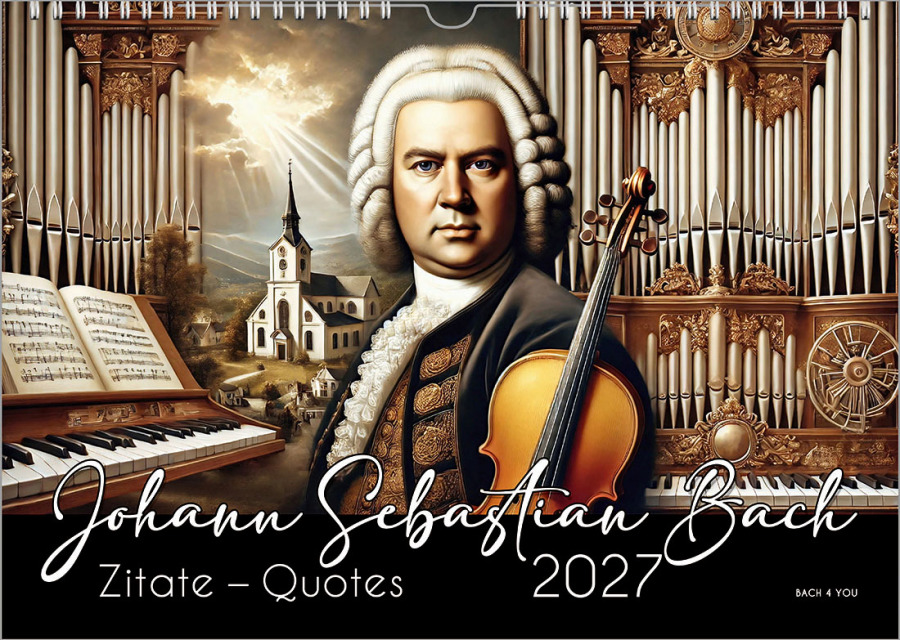
The third Bach calendar, which was created quite late..
Serious music seems to be music that is created with greater seriousness or consumed with greater seriousness. Does that mean with less joy? With more sadness? With less happiness? Certainly not, for thousands of examples could be found that prove the opposite..
Does this perhaps refer to the effort and the time the composer put in when creating a masterpiece? Not that either. Because it would be unfair to consider a piece of music created in a single night as less worthy simply than one that an artist spent ten years “tinkering with” over and over again. Even Bach could – and indeed had to – compose pieces in a single night. So that … isn’t it either..

Mozart and Salzburg, Austria: This is where he invented the famous treats. They’re still called Mozartkugels today. Really?..
But what is it, then? What is Classical Music? Back to the "serious" and "entertaining". Which doesn’t really get us anywhere, because entertaining can be serious. Serious things can be entertaining. But, as we’ve already noted together: It’s difficult to explain. And I can also tell you: It won’t be reducible to a single sentence. So please feel free to read on, if you enjoy it. If not, then only if you happen to want to give a presentation on this very topic in front of your class and don’t yet know the best way to “approach” it. Then this page of my website can at least serve as a bad example. By the way, there’s something much more detailed out there, namely my very special website dedicated to this question..
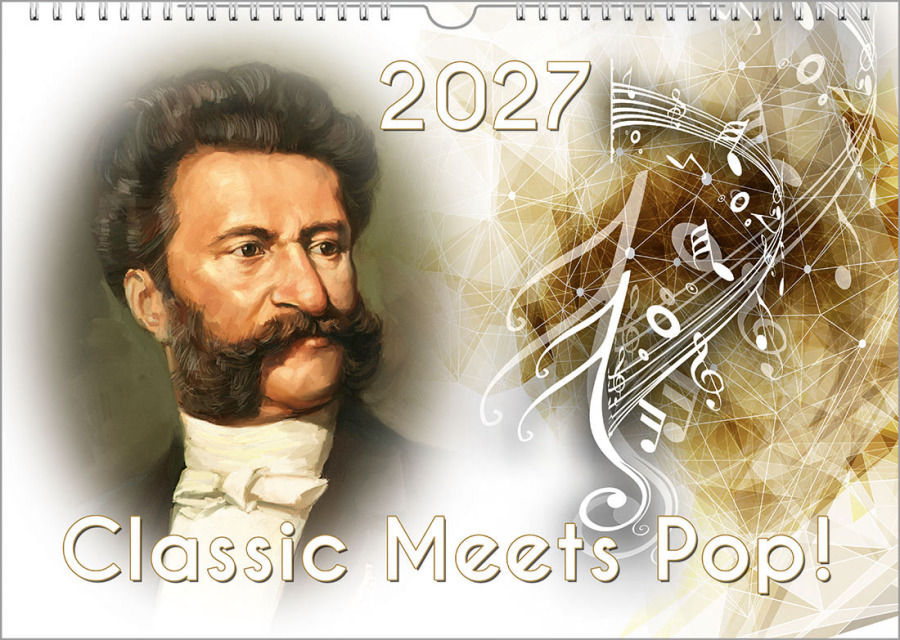
Vienna, Austria ... is there more to say?..
In music, there are genres and styles, and it’s certainly fair to say that as time goes on, there are more and more of them. They’re evolving worldwide, but also within each genre to appeal to an ever-growing audience. Pop, soul, rap, Schlager, Neue Deutsche Welle, Philly Sound … these were and are the music genres of our time. But what … exactly … is our time? The 2020s, that is, from 2020 to 2029? Or is it the first 25 years of the third millennium, that is, from 2000 to 2025? Or does it refer to all music that emerged after the era of the great Classical Composers? So, roughly speaking, starting around 1950..

In fact, in the front row are the smallest Bach busts: the perfect gift among Bach fans..
Back to music genres. You’re surely passionate about one. You might like pop, or maybe Schlager, or perhaps brass band music. Or you might be into oldies. Or the rap I mentioned. Folk music is a genre. Oh, and genres are also described as “styles.” So Alpine Rock is one such musical style, a music genre. Fashion plays a huge role. No, not the kind of fashion you wear. Not the trend of getting a piercing in your nose, either. Also not the trend of getting what you think is trendy and super cool today tattooed on your skin. Even though you know how silly you looked with that hairstyle 15 years ago. The one you were totally into back then..

The most important thing about each of these Bach busts is Bach’s facial expression. We searched for a long time to find these five pieces..
Let’s approach this from the perspective of the apparent effort a musician puts into composing. And the effort an orchestra then puts into performing the composed piece. Just to remind you: This comparison or approach is very borderline … but then again, so is the complete answer to the question of what Classical Music is. Let me explicitly state once more that I do not consider contemporary music to be inferior to Classical Music. And that, whether it was “invented” –that is, composed – very quickly, or whether it is – and moreover – much, much more labor-intensive to perform … or not..
It seems so simple: “Ob-La-Di-Ob-La-Da” by the Beatles. Composed in 1968. A global hit. A smash. Cool. One of several works that signaled the beginning of a whole new era in music. Written by Beatle Sir Paul McCartney (… not yet “Sir” at the time). Maybe in just an hour or two. Is it light music? Music composed for entertainment? Of course. Is it also Classical Music? Probably … not. Or is it? Let’s continue here and bring in Freddie Mercury, a gifted artist who will be remembered for only a few more decades, half a century at most..
60 Music Calendars: 60 Music Gifts..
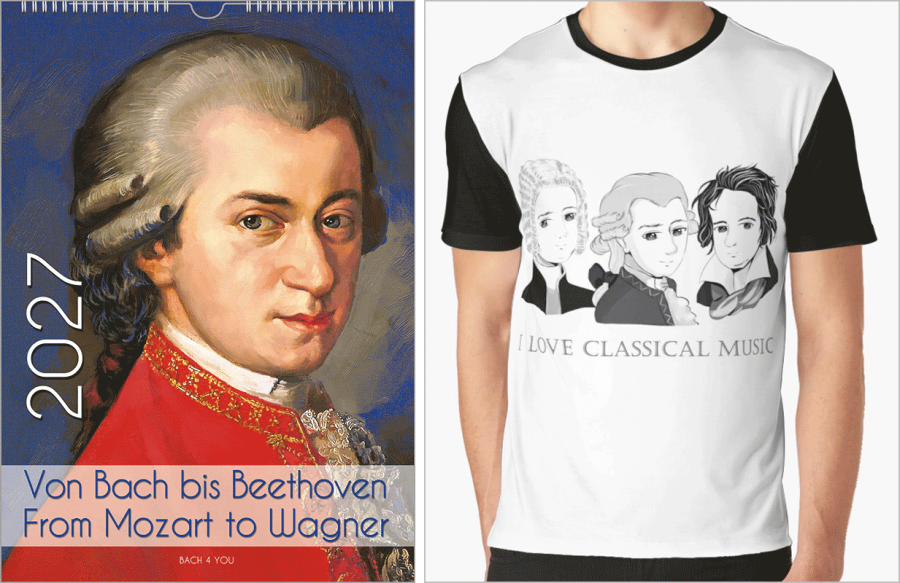
Bach calendars, composers calendars, music calendars, and pipe organ calendars are 60 gifts for musicians: three sizes. For this year and next year. Visit the shop. Oh, and composer T-shirts make great gifts, too..
10,000 or 100,000 or 1,000,000+ Music Gift Ideas?..

There are almost countless personalized Bach gifts for you to discover. Visit the shop..
So What Finally Is Classical Music? the Very Complicated Answer to This Riddle!..
Freddie Mercury, for example: Renate and I didn’t truly come to appreciate his talents and the musical results they produced until long, long after his death. Specifically regarding his composition Bohemian Rhapsody: For very conservative music fans, the lyrics are an affront. But the lyrics only reflect the Classical Character of a work to a very limited extent. Because it’s really about the music. So even with a Classical Work, strictly speaking, it’s only about the part the instruments play. Or the melody that’s sung. Explicitly not about the lyrics. How – and above all, who – is to decide whether Mercury’s work isn’t Classical, but Bach’s and Gounod’s Ave Maria are? A music scholar? A committee? A group of experts, like at Duden ... the German Duden editorial board?..
Classical Music is something you have to get to know. Discover. Experience it. Find out for yourself what it’s all about. “Learning by Meeting”. You can do this by listening to a few pieces of music ... you don’t even have to listen to them all the way through. Just listen for a minute ... and you’ll already be well on your way. Here, with just two clicks (... now here and then there again), you’ll find a huge selection of perfect pieces for exactly this purpose ... to get to know an entire musical genre. Important: For a first “encounter,” the pieces should be as “light and popular” as possible. In other words, ones you know many people like. Otherwise, you almost always quickly get the wrong impression of what Classical Music actually is. An example: Listen to five minutes of Classical Music from a Classical Radio Station or a TV Classical Music program. The likelihood that you’ll like what you hear there at almost any given moment? Zero percent. Am I sure of that? Yes! Absolutely sure!..
Finally ... Classical Music: It’s often played on an incredible number of instruments, and it’s usually best to picture an orchestra leader as well. That is, a conductor in a black suit. The musicians in an orchestra are also usually dressed formally. But not always. Of course, there are also Classical Performances featuring just one artist. Or three or four ... right, or two..
These artists practice in jeans and a T-shirt or a sweater, in other words, in casual, laid-back clothing. Not always many performers play Classical Music. A military band (... yes, of course, and that includes the Krautheim City Band) is actually made up of many artists. And they can also perform pieces that have absolutely nothing to do with Classical Music. The same applies to choirs. Again, the rule applies: You can’t really “pin down” Classical Music to anything. We tend to associate Classical Music with the concert hall rather than with a happening. But of course … not every time. Classical Music … that’s more the great, rarely heard names “from the past” like Bach, Beethoven, Schubert, Verdi, and Handel. And not the current names like the Rolling Stones, ABBA, Elvis Presley, Lady Gaga, the Spice Girls, Madonna, or K-pop bands ... but, as mentioned above ... not consistently. And Morricone, Webber, Jarre, and “the like”? They, too, compose and have composed Classical Music. But who knows them? Compared to Bach and Lady Gaga, Beethoven and one of the most successful singers of all time, Taylor Swift..
A tip ... my tip: Over the next few days, take a listen to about 20 to 30 tracks on my list, spending about one minute on each. Keep in mind that this list consists entirely of “Popular” Classical Pieces..
And then just wait until you get older. Because one day, you might just come to enjoy this genre of music. But then you’ll have to remember how to find what you’re looking for … on the internet. Because then the usual Classic Top 10, Classic Top 25, Classic Top 50, and the “Queen of the Top Lists,” the “Classical Music Top 100” won’t help you at all. They’ve been left there by Classical Music fans who are “overqualified” for the task (…and I mean that warmly, not maliciously). Especially for beginners. For those who want to approach a musical genre they’ve never listened to before via these top lists. It doesn’t fit. Because the usual Classic top lists aren’t actually (…yes, actually) what you’re looking for. Oh, and it goes without saying that you shouldn’t just binge-listen to “Star Wars,” “E.T.,” and “Back to the Future”..
And now for the conservative Classical Music fans as well as the full-blooded musicians (... again, this is meant as a compliment, since there are quite a few of them in my family, as you know ... the Bachs ... a family of musicians and all that ...): My approach doesn’t ruin anything at all. Anyone who finds themselves immersed in Popular Classical Music but actually wanted to tackle Wagner’s “hard-to-digest” works will find their way. Back away from my Popular Classical Music. But anyone who tries “The Ring of the Nibelung” as their first Classical Music piece might … yes, might … possibly discover for themselves:..
No, Classical Music isn't for me! Beyoncé, Rihanna, Swift, and the rest are more “my thing.” And solely so. Not alongside anything else. And that ... would be a shame. That’s how I felt..
End of Advertisement

 Druckversion