

Genealogy as a Passion
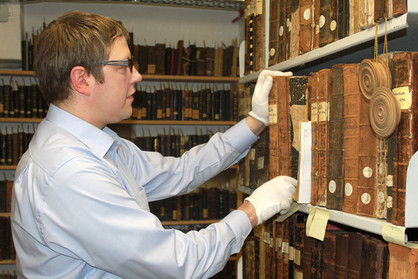
Do you get a feeling? Thousands of books – and you are looking for that one entry: Christian Hoske is researching in that archive. You learn more about Christian Hoske on this page. © Rainer Krieg.
If you are just interested in the genealogy of the Bach family around Johann Sebastian Bach, than you are actually wrong here! Because this page is about genealogy in general. Just click here and I guide you to the page, were you actually wanted to get.
Advertisement
60 Music Calendars, Composers Calendars and Bach Calendars

It's not only a Bach calendar, but a Bach postage stamps calendar as well. Three sizes. This year and next year. US + EU style. To the shop.
Discover All Five Bach Online Stores

Countless music gifts, 60 music calendars … learn more. You can visit the “Bach Seal Shop” here: One click is all it takes.
End of Advertisement
Your Ancestors ... A Mystery?
There are two interesting assumptions, which are designed to initiate these pages of my Bach website. First of all it seems most people start to be interested in genealogy not earlier as at the age of 50. Earlier you may be already excited by the research of a friend, of your uncle or you listen to the exciting reports of an acquaintance. But seeing your self as a researcher, if at all, is what you plan for a later section of your life. Or, you can't imagine such a passion as a hobby of your future at all.
Plus, there is an exquisite poem regarding the passion of ancestry. It's written, that in every generation there seems to be this one individual, who is interested, what his ancestors have experienced. Who were they and where did they live? To explore and discover this, to preserve it and to hand it down to coming generations, seems to be exciting for just this one person of one familyand per generation.
In my family it's crystal clear: this was my grandfather, who did ancestry. He was it, who, with his research, leveled my path into the past. Far back into the past. Without his groundwork and without his expertise we would never have been able to get that deep into the family history. Today we try, not only to discover the secrets of my family, but the genealogy of the greatest musician of all times as well. Today we may accomplish both with a never present medium, which former generations of genealogist never could use: the internet.
An Investment of One Hour
It is a golden tip – and probably you confirm it later – perhaps when it's too late. It happens to almost every family researcher. In each generation, in every family. Do you know the maiden name of your grandmother? If yes, do you know the maiden name of your great-grandmother, too? Probably not. And exactly this is the problem. At least at the beginning of your research, in a time, when you are not yet much interested in your own family history or you plan to do that later as a passion.
Research in your own family in the beginning is really not constant. But rather it begins in steps. The first two steps back in time actually are no challenge. In many cases your parents are still alive and they are those who you ask first about their parents and about their grandparents as well. If their capacity of remembering is good, you already have "conserved" the names and data of four generations after your consultation. That is to say yours, those of your parents, the data of your grandparents plus maybe those of your great-grandparents. However they assume an averaged distance of 25 years per generation. And that means, that you might miss exactly the knowledge about one generation, if you decide for a research as late as age 50 instead of a start, when you are 25 years old. Because at your age of 50 it's absolutely more likely, that your grandparents don't live anymore.This is different, when you are 25.
This one generation can be of very high importance and you will experience it: it's unclear when and in which generation - but with the highest likeliness your research into the past comes to a full stop some day. Because there are no more files, that offer a projection to the next generation back in time. However, often you realize that, with much research, time and energy, there is a way around such "dead ends". This is a research like a roller coaster and once in a while it can be very frustrating. The task to research the next generation, that is to say finding out the names and data of your great-grandparents could be tenfold, compared to the option just to drive to the next vicarage and copy the data – the data of the next following generation.
Back to your grandma. It is likely that the data and names of this generation, which is available when you are around 25 years of age, is lost, when you are 50. And that is to say with the death of your grandparents who actually don't live until they are 110 years old. So, if your are stuck exactly on that level, than it's really annoying, because you now knew that you messed it up.
One hour investment – 100 hours profit. If somebody would offer you such a chance in the stock market, plus there would be no risk coming with it, you wouldn't hesitate one minute. Visit your grandparents. Take a notebook with you and a pen or your tablet with you and invite yourself for a desert or a cup of coffee. Your grandparents will enjoy your visit much and the information from the past is irreplaceable. Write it down. Fold this piece of paper and put it in your family Bible or your family register. After that ... just forget it. So, if you after 25 or even 30 years suddenly enjoy your completely new passion genealogy, you realize, how valuable this first trivial for a beginner was, even before you were interested in that hobby.
Even more: if you are already in your 50s and you just started this passion, than speed up right now! Because with your survey of the oldest family members you get to more persons of this generation and these too won't live forever. It started with the research of my grandfather, which we considered lost for 50 years. However, it was not, the whole research were some 20 entries with a pencil. And with it comes the branch-off direction Bach genealogy, with which I was late for exactly two weeks and a conversation with a Bach genealogy expert would have been so extremely important. I spoke to him 14 days earlier, he was pleased that we would meet. Next he fell ill. And died. I didn't manage to meet him.

Helga Brück, on the left, is the most significant “discovery” I made after nine hours of googling. Without her life’s work, many generations would have been missing from our family chronicle.1126.
Top Tip 2: Ancestry ... Research in the 21st Century.1126.
Like in almost every aspect of our life, the research for our ancestors has changed dramatically in last 20 years. All what you could do in the last century, to find your family, is what you are still able to do today. However one option added. And this changes your success chances dramatically and for all coming generations it promises to become even more considerable. It is the computer, the electronic communication and it's the internet.
As silly as the breakdown of the electronic above in genealogy seems to be: these more three disciplines are important. While your computer efficiently helps to organize your finds – with special genealogy software, but office programs and Exel help already, the two other corner pillars are different approaches. The communication today: what needed weeks a long time ago, for the reason a letter had to be transported, but as well as communication on paper just needs more time and effort, communication today seems to be light years faster and less complicating. Finally the internet offers possibilities and support, which were just not existing even rudimentary two decades ago: today it is like one gigantic organism searching for data from the past and interchanging finds like trading potatoes and onions. Genealogy portals are beyond a blessing.

Great ... published in the summer of 2024, it will remain up-to-date for many years to come, covering all the latest, exciting possibilities. It’s almost “required reading.” We don’t receive any commission when you purchase one of the genealogy books on this page … and there’s no affiliate link for you either.1126..
Advertisement
Top Tip 4: Let a Pro Handle It.1126.
Why is this an advertisement? Because Christian doesn't work for free, of course. However, we don't receive any commission from him. So, just to be safe: blue text.1126.
At some point, you’ll “get stuck”. That much is certain. 1817, 1766, 1500, 1412 … at some point, it just ends. But until then, you’ll encounter a variety of challenges. The easiest “round” is interviewing your parents. It gets more difficult with your grandparents. After all, at 80, memories aren’t as vivid as they are at 40 or 50.1126..
Then you move on to the first church archive. Just figuring out which one is responsible, that is, where the records are stored, how to access them, what it costs, how far away the archive is, and how much energy you’ll need to expend per session, Itis a whole different challenge from visiting Grandma for coffee and cake. But think of it as a hobby: with this particular passion, the “journey is the destination”. Still … it takes time – an endless amount of time – the further back in the past you go. 1126.
Then you move on to the first church archive. Just figuring out which one is responsible, that is, where the records are stored, how to access them, what it costs, how far away the archive is, and how much energy you’ll need to expend per session, Itis a whole different challenge from visiting Grandma for coffee and cake. But think of it as a hobby: with this particular passion, the “journey is the destination”. Still … it takes time – an endless amount of time – the further back in the past you go. 1126.
At some point, every genealogist reaches a stage where continuing the research becomes far too time-consuming for a variety of reasons: The nearest “relevant” church archive might be 500 kilometers (... 310 miles) away. Or you realize it would take several days to get to the next generation. Perhaps the reason is much, much more trivial: You’re not very skilled at reading Sütterlin documents (... in Germany). Or you can’t decipher Old German script at all ... a style that varied across Germany before Sütterlin was standardized. The effort may also seem too great if you’re in the middle of your career. In that case, a trip lasting several days might simply not be feasible.1126.
Now, a professional in family history research might be the perfect choice. And you can hire one for just a few Euros. Of course, then it won’t be for very long. He can translate a single document perfectly. And that’s just the beginning of his portfolio. He feels most at home in an archive, surrounded by shelves full of ancient books: church records, tax files, and city council transcripts. He takes photos, interprets the documents, and, above all, knows what’s important. And what isn’t. He knows what your father was called 200 years ago, your uncle, and – most importantly – your godfather. The best part? You decide how much you want to pay. He conducts his research within that budget, and you always know exactly how much it will cost. If there’s something to be found, he’ll find it. We’re talking about Christian Hoske, our very own family historian. Our expert in – as my wife and I call it – “Bach Country,” in Eisenach, Thuringia. However, he conducts research throughout Germany. And through partners, throughout Europe as well. Plus, in the U.S., too. If you have relatives there, your trip will turn into a real adventure. Take a look below to see what we’ve found. And these are just a few examples. Oh, and one important thing ... so I’ll say it again: We don’t receive any commission or anything else from Christian for this advertisement.1126.

Christian Hoske: He charges very fair prices and is a true professional. He’s the go-to choice when you’re “at a loss.” That’s right, you’ve already met him earlier up this page. He’s often the right choice … though not for beginners, of course. Or perhaps especially for beginners. © Rainer Krieg.1126. © Rainer Krieg.1126.

“Lotti, times two,” a discovery on our – and my – journey through time. On the left is my great-great-grandfather in the U.S. On the right, that’s me. And we haven’t photoshopped (... changed) anything at all that couldn’t have looked that way naturally. The expression, the posture, the beard, the clothing ... all of these are elements that are allowed to be altered. And the rest? The resemblance is striking. Found where? In the U.S. 1126.

The Bach Band in Marion Township near Rochester, Minnesota, USA. What a photo! We first came across it in a book by Bach scholar Helga Brück. Later, Catherine Meyers, my cousin in the U.S., even gave us the original as a gift. Sadly, she, too, has since passed away. As has Helga Brück. 1126.

My great-great-grandmother’s birth certificate in the U.S. This document has been in our family book for decades. And my great-great-grandfather was drunk on one of his entries into the U.S. We found the record of that incident during our research in the U.S. And whenever we happen to come across it again amid the hustle and bustle of daily life, we’ll add it here as an illustration. 1126.
End of Advertisment
Top Tip 5: Let People Find You. 1126.
Publish your findings. Of course, you shouldn’t publish the names of people who are still alive ... and perhaps not even those of the previous generation. But you can publish information about earlier generations on your own simple website: your Merkel family history, your Müller genealogy, your Feldbusch family research. It’s quite easy to do these days ... with a website building kit. The easiest one to use is, without a doubt, Jimdo. That’s right ... you’re currently reading this on a website “put together” using the Jimdo website builder. Ionos is just a tiny bit more advanced. Wix is in the same league. WordPress, on the other hand, is extremely advanced. I’d definitely recommend Jimdo, unless you’re an IT specialist. The cost for this website: with Jimdofree, not even a single cent.1126.
Why could presenting yourself and your research online be a huge success? Because “out there” there are still an enormous number of other people – whether or not they’re related to you – who are searching. For their ancestors. And even if you don’t come up with new findings that match exactly, you might be able to help another amateur genealogist. And then, the day after tomorrow, a third party will provide you with exactly the information you’ve been struggling to find for months. How will people find you? By creating a website optimized for top Google rankings. To learn how, please visit the website of Finn Hillebrandt ... and perhaps others as well.1126.
And what's the point? Well, if you really do it right, then what happened to us might happen to you, too. And you can read all about it in epic detail in the genealogy sections on my website. Now, to the point?.1126.
I thought I had reached my goal with my research into the origins of Veit Bach, who died in Wechmar in 1619. I published my findings and asked anyone who might have something interesting to add to please contact me. A full six years later, a local historian and amateur genealogist from Austria got in touch, and the (... Bach-) sensation was complete: a mystery over 270 years old had been solved. The Bachs just do not come from Hungary.1126.

Veit Bach did not originally come from Hungary, but from Ungern. And this Veit Bach also lived in Hanfthal back then. The village used to be called Hanniftall. This location is just a few minutes’ walk from Ungerndorf, a place that used to be called Ungern as well. © Michael Lehner.1126.
And what does that do for you? Other amateur genealogists are searching at the same time as you are. They, too, reach a “dead end” on their journey into the past. They reach the generation beyond which it becomes a real challenge to continue researching. That’s when it’s Google’s “turn.” You start searching – now more intensively – for family members online as well. First, for those with the same name. Now you should – for other researchers – not only be present online, but also appear as high as possible in the search engine results. That way, you’re giving “chance a chance” – or rather, a very big chance.1126.
When I began my search for Bachs, I knew from my father – who had mentioned it to me every now and then, at long intervals – that a Jenny Bach was part of the first wave of immigrants returning from the U.S. Now, my wife and I share not only our “Bach hobby” but also a passion for the U.S. And so I strongly wanted to connect the two topics. To do this, I searched online in Florida using the keywords “Bach,” “Johann Sebastian Bach,” “USA,” “genealogy,” and a few others. I also tried combinations and full sentences. The phenomenal result? After nine hours of nonstop searching, I found a reference to the book by Ms. Helga Brück, who lived in Erfurt. I called her from the U.S., and we immediately set up an appointment in Erfurt, Thuringia, Germany. Thanks solely to her research ... and ( ! ) the online presence ... we were able to find exactly that one person on a four-meter-wide (.... some 13 feet) handwritten family tree who enabled us to “delve” into several additional generations and ultimately into the Bach family of musicians.1126.
Why not take a look at this very short video on the topic “Genealogy for Beginners”? Ms. Brück and her hometown of Erfurt in Thuringia play the leading roles in it.1126.
Top Tip 6 (... (... The Bonus Tip in Addition to the First 5): DNA for Beginners.1126.
What about DNA? In my case? It’s been a long – really, really long – journey. Full of frustration and with no results. The problem is that DNA “dilutes” over generations. And over decades. And that makes it even worse: DNA sometimes yields incorrect results. What does that mean?.1126.
DNA can be used to determine family relationships. But it cannot be used to determine the opposite. Why not? Because there may be too few markers remaining from the past. Second, and even more importantly, because a test subject is the product of a relationship involving a foster child. Specifically?.1126.
In my opinion, in my case, a familial connection to the Bach family should have been proven. That is, when my DNA matches that of people who are definitely related to Johann Sebastian Bach by a minimum percentage. 1126.
It’s an incredibly ambitious undertaking to persuade people you barely know to order a DNA test. Although it’s very easy to do, the disclosure and storage of intimate data play a huge role. In Germany, by the way, this is even more so than in the U.S., where interest in one’s own family history is ten times greater than here in Germany. Nevertheless, I managed to convince members of this musical family – in Germany, the U.S., and the Netherlands – to do me this favor. What was the result? No one was compatible with anyone else. And that should have been the case, since the other participants could undoubtedly be traced back to this musical family. This is verifiable through historical records.1126.
While analyzing this result and conducting a second round of analysis with one of the world’s leading experts in this field – a Ph.D. candidate at the University of Cambridge in the UK – an intriguing finding emerged. Namely, that if the point at which the two lineages (... mine and that of the Bach family members) intersected lies too far in the past, the results are, in fact, worthless. I estimated my ancestry to be about two to three generations (… 50 – 75 years) before the forefather of the musicians, Veit Bach, who died in Wechmar in 1619. Much, much too far back in time.1126.
The topic of DNA and genealogy can be exciting for you as a beginner then if the two people you’re comparing are separated by about two to four generations. Or if you find it really fascinating to learn whether your ancestors roamed the African savanna, earned their meals by hunting in northern Spain, or spent their time in the Near East. It’s fun and worth the money, but … DNA analysis is not a “panacea for genealogy.” However, it’s very possible that the database – for example, Ancestry’s, against which your sample is matched – will reveal an exciting surprise. A brother you never suspected existed, a half-sister, or perhaps even a real sensation that fits perfectly into your research, and one you would never have discovered through more traditional research methods.1126.

They’re more affordable than ever: DNA tests, such as those offered by Ancestry. This has actually only been possible for a few years. The database of the provider you choose (... that is, this company or that lab) is constantly growing, making a match more likely. The larger the lab you work with, the more DNA data from other people is available for comparison. © Pixabay.1126.

Advertisement
60 Music Calendars, Composers Calendars, Pipe Organ Calendars, and Bach Calendars.1126.

It's not only a Bach calendar, but more precisely, a Bach cities Bach places Bach calendar. Three sizes. This year and next year. US and EU style. To the shop.1126.
Five Bach Online Shops Are as Exciting as This Reading Offer on This Page ... Promise!.1126.
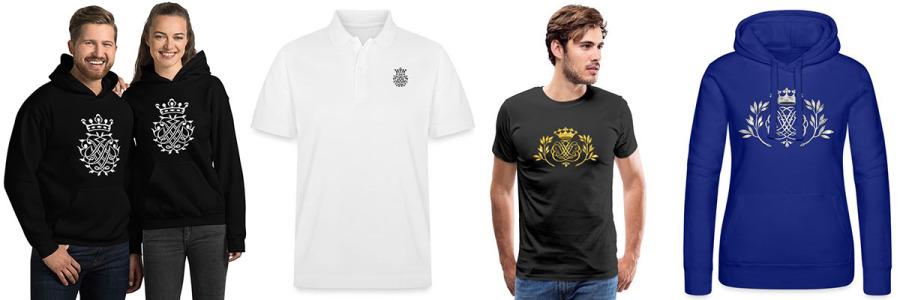
Personalized Bach gift ideas ... learn more here. And of course ... there are plenty of other “music-related” offers as well. You can even get directly to the “Bach Seal T-Shirt Shop” featuring the two authentic Bach seals, as well as other Bach seal products on “Zazzle.” Just click here.1126.
End of Advertisement
 Druckversion