

Advertisement
My Teaching Material Classical Music ... for Cool Teachers..
On this website page, I offer you three sections to explore. First is my philosophy: why I believe that my approach is the best way to introduce kids to Classical Music. Second, there’s really entertaining, interesting, and above all cool information to explore on the topic of Classical Music. And third, there’s a section introducing my “Teaching Material Classical Music”. Click here to get directly to the right place in the shop already now..
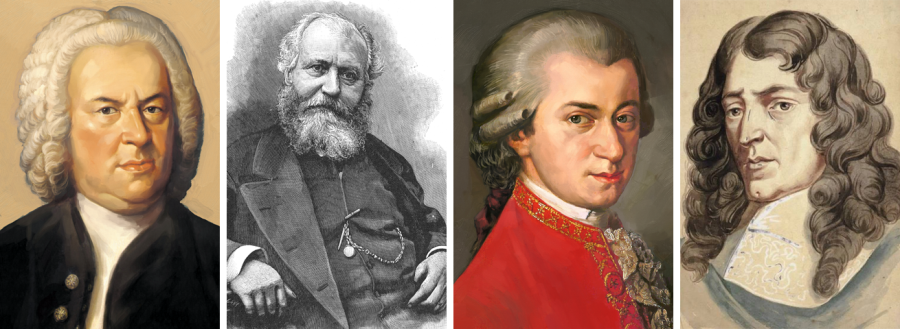
“Teaching Material Classical Music": You surely recognize the man on the far left and the “Number 3.” And the second of the four is also a very well-known performer. But who ... is the maestro on the far right?..
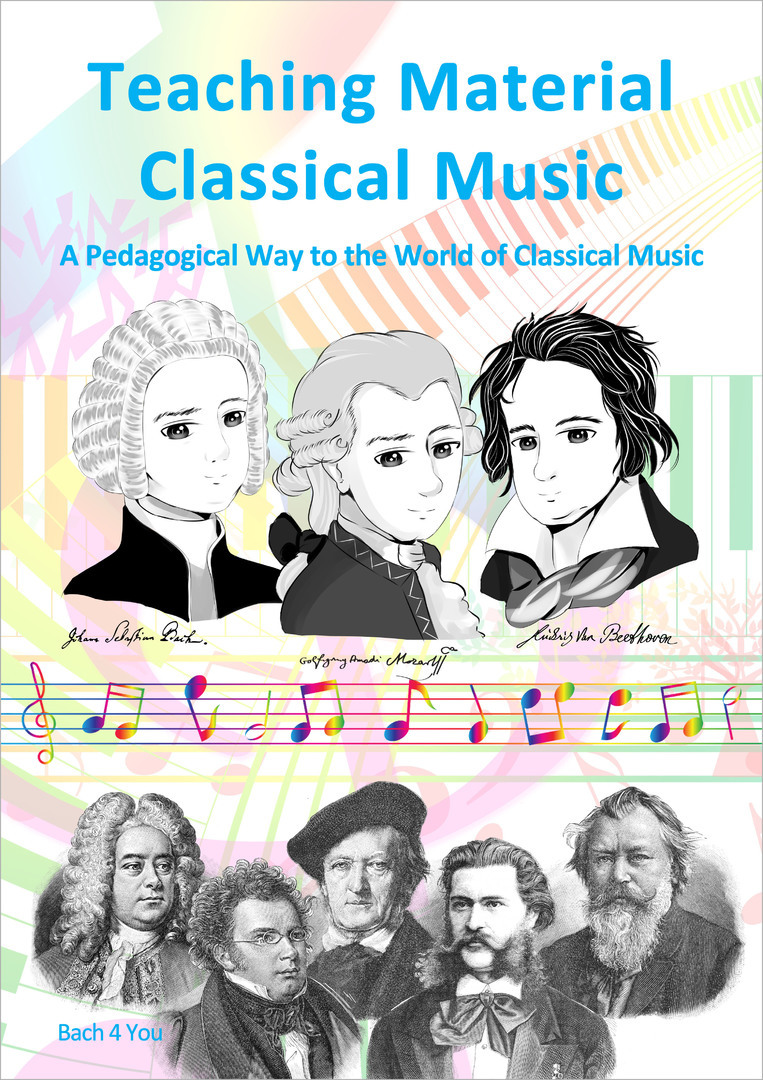
My “Teaching Material Classical Music”: 150 questions, 150 answers ... all in multiple-choice style. 20 parts are 15 PDFs, 2 MP3s, and 3 videos. © Pixabay..
One part of the Teaching Material Classical Music – and included even in the free “portion”: a Bach music collection. It features Bach’s most popular hits in just over 45 minutes. Why not try it out right now and see how it “works”? Click the link at the end of this section to access SoundCloud and listen – very quietly – to some of Bach’s most popular musical works while you continue reading this page. Click here to get directly to this music selection..
Teaching Material, Exciting Stuff and My Philosophy ... With the Subject Classical Music..
My personal philosophy regarding the teaching material: Just keep reading below this selection..
To visit the special website dedicated exclusively to the question “What is Classical Music?”, please click here..
For an exciting and fun read on the topic of “Classical Composers and Their Quirks”—full of eye-opening insights and fascinating facts—that goes perfectly with my teaching materials, please click right here and now ... and you get all the way down on this page to find this entertaining content for you and your kids..

You don’t have to be a Classical Music fan to recognize the first composer in the picture above. The image of the man in the top hat next to him is also famous. And Beethoven as the fourth ... I’d only dare ask elementary school kids that. But who is the stylish contemporary in the black-and-white photo in position 3, wearing a cap and medals?..
1 My Special Philosophy Regarding My Special “Teaching Material Classical Music”..
“What is Classical Music precisely?” ... That was the question that kicked off the era of my teaching material for teachers in our Johann Sebastian Bach Mission. Why? Because I hadn’t been able to find a satisfactory answer anywhere myself. Because there are four ways to explain Classical Music. And because, along the way, I discovered that I could use this answer to indirectly lead people to Bach as well. A special website dedicated to this question came into being back then..
Shortly after that, I developed the topic “Is there Classical Music for children?” And I also “crafted” yet another special website. In doing so, I also fulfilled a lifelong dream. Of course, it was never something I thought about every day, nor was it ever a major obsession. Namely, to put together a cool collection of classical works that I liked. And I really didn’t like much classical music..
Please keep in mind as you read my text that I enjoy writing a lot ... and I intentionally do so. I never “get to the point right away.” So that’s true here, too. A report on the German TV news channel n-tv introduced the Lehrermarktplatz.de portal (... The Teacher Market Place Portal). That’s when it “clicked,” and I knew that my “path to Bach” could also work through the general topic of “Classical Music.” And especially through Popular Classical Music. More on Popular Classical Music later..

There are really only three types of teachers, and I think I can help all three groups. That's right ... this above is definitely not a music lesson. © Info..
First, there are the Classical Music fans. With my “Teaching Material Classical Music,” I can provide them with a new, additional “tool” that might help them get more kids interested in Classical Music starting right away. This group certainly regrets the most that interest in this – their musical genre – is so difficult to transfer. The second group?..
Some of the teachers might not like Classical Music at all. In that case, my teaching material will certainly make things much easier for them starting this year. And the third group? You might – like me – enjoy some Classical Pieces but not the vast majority of Classical Music: If that’s the case, then this site is especially exciting for you. I promise!..
I am firmly convinced that successfully introducing children to Classical Music is a tremendous challenge. And I am also convinced that, when it comes to The Carnival of the Animals and even The Four Seasons, the only way to do it is by following the motto: better this way than not at all. Even Peter and the Wolf is only of limited use. But ... there simply hasn't been any other approach so far..
However, I finally found another one ... or rather ... I made one up myself. The right keywords would actually be “fun,” “entertainment,” and “Popular Classical Music” (... just not on Google). You’re familiar with “fun” and “entertainment,” so that leaves “Popular Classical Music.”..
Popular Classical Music is what I’ve been searching for my whole life, and I didn’t even know the term before I got deeper into the subject. That was exactly it ... what had been running through my mind for just a few seconds at those moments for nearly 50 years. At those moments, whenever I heard a piece of Classical Music – whether in a movie, an advertisement, or on the radio – that I really liked..
Also over the course of these past 50 years, I made many half-hearted attempts to spend a few minutes listening to a Classical Music program on a Classical Radio Station ... while channel surfing on TV during a performance of Classical Music, or while “hopping from one radio station to the next” in a traffic jam. And each time, a brief reflection (... again and again) led me to conclude: I still didn’t seem “mature enough for Classical Music.”..
Today I know: That wasn't the problem. Buying a CD titled “Best of Bach” around 2011 brought me a significant step closer to the solution: I thought most of the pieces were awful (... how embarrassing), two were “pretty okay,” and two I really liked..
And what does that mean? I couldn’t figure out what people found so special about Bach’s music. Today I know. It was the commercial aspect that drives music publishers to put together such collections. And it’s the convenience with which “best-of” lists on Classical Music pop up online. They use whatever’s readily available or cheap to use (... CDs). Or they copy from someone else what’s supposed to be exciting. The author (... usually) couldn’t care less about how the interested listener then consumes the music. That ... was the “key.”..
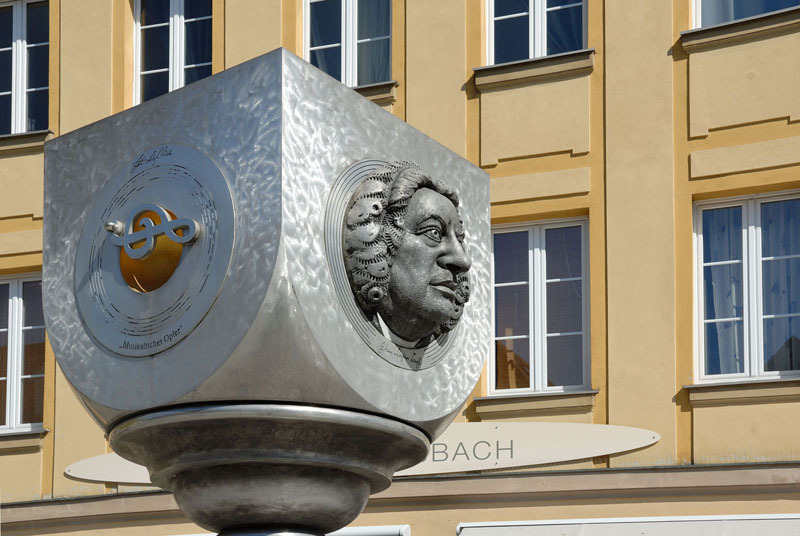
What a charming little slip-up: In Ansbach, Bavaria, Germany, on the third side of the rounded cube (... not visible in the photo), the artist forgot the “b” on the staff with the musical notes B-A-C-H. He thus inadvertently turned Bach into H-A-C-H. Also interesting: At the building’s facade, you can read the word “BACH,” which, however, has nothing to do with the composer. It is simply the end of the lettering “WÄSCHEHAUS ANSBACH” (... sort of “Linens House Ansbach“). And if you notice this while there, you can take such a picture..
The problem with cool Classical tracks? You usually hear them by chance. That is, when Classical Music isn’t your preferred genre. While watching TV or at the movies, in films and TV shows, while listening to the radio, or in commercials (... for pizza, for example). But: At that moment, you have absolutely no way of figuring out what the piece is called and who composed it. Shazam doesn’t help, and the lesser-known Google service Song Finder in Chrome doesn’t work either. It recognizes Bieber and Swift, the Beatles and the Stones too. But Charpentier, Pachelbel, and Sousa: Forget it! Not even Bach, Beethoven, and Mozart are “on the radar.” I’m still investigating whether it works with Google’s “Alexa.” Please let me know if it actually does. I think it might ... but I doubt it..
Time jump. For three years in a row – even before the big COVID-19 disaster – I managed, while channel-surfing, to “stumble upon” André Rieu’s annual big concert right at the start each time. As usual, I put myself to the test with my “Ready for Classical Music?” question. And in the second year, it worked: Renate, my wife, and I enjoyed the entire concert. By the way: If you can’t stand André Rieu, his music, his facial expressions, and his brand of “lighthearted entertainment” at all, please be sure to click here. Please! Next: But that didn’t solve the mystery yet. It wasn’t until the third year ... that the circle finally closed and I had found my own personal solution. Because Rieu performed many, many of exactly those pieces that I had heard throughout my life, just as described above. So Rieu was meant to lead me to my goal..
For 15 years, I’ve wanted to put together a large collection of Classical Masterpieces for kids titled “Oh ... that’s by him!”. Time and again, that was the plan “for quieter times.” But those times never really came. Then, however, the moment was ripe..
YouTube provided the solution. There, I found an endless number of Classical Pieces performed by the Dutch musician Rieu ... both now and in the past. And I discovered something even more crucial: YouTube always suggests – in the vertical list on the right – other titles you might enjoy. There, the infinite treasure trove of all Popular Classical Works was ready and waiting “latent”. Because popular pieces always rank higher in such a search engine than those that are “enthusiastically consumed” by only a few people..
If you search long and hard enough – and, of course, not just for “Rieu performances” – you eventually reach the point where there’s only one more track to discover per hour. And obviously … those are rated as “absolutely worth listening to” by fewer and fewer people. Of course, it’s a gradual transition, and of course, personal tastes shift the rankings significantly again starting at number 150 or 200. But … the principle becomes clear. And so it was finally, finally “born”: my Classical Top 100, and as the name suggests, I’ve got 300 of these timeless Classical Super-Hits. LOL..

Here’s another cute “gem” on the theme of “Classic and Fun”: The artist was apparently so impressed by Bach that he went ahead and renamed the Thuringian composer’s entire hometown from “Eisenach” to “Eisenbach”: how charming..
With Caution ( ! ) Toward Classical Music: The Essentials with My Teaching Material for You..

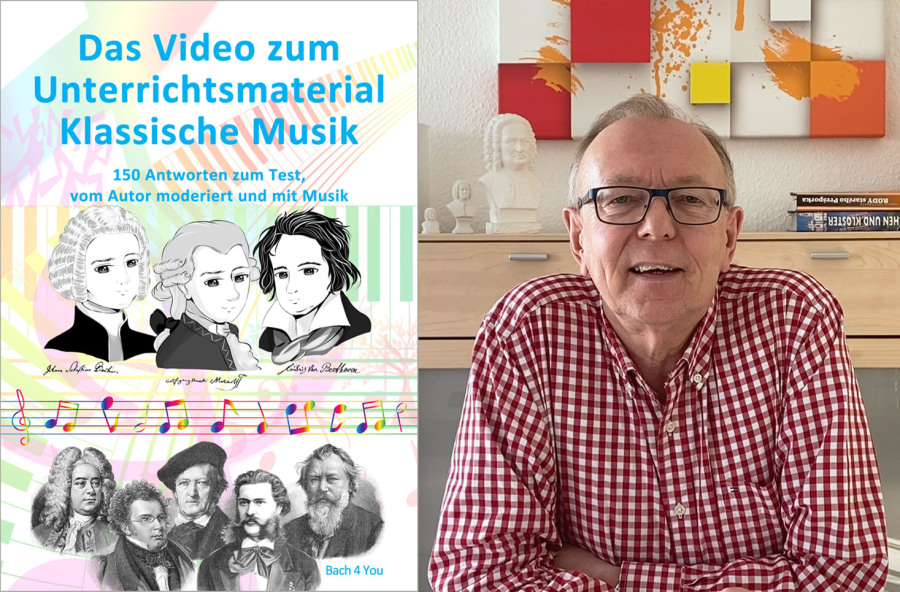
On the left is the cover of my Teaching Material. And on the right? That’s me, the author, and a representative of the Bach family of musicians..
I firmly believe that if you want to introduce kids to Classical Music, the most important thing is to approach the project with extreme caution and in a way that’s truly child-friendly. That said, it’s not the same as discovering together with children that a bass can sound like a lion and a flute sounds “like a little birdy.” Aside from that: You can certainly offer that as an extra. And now seriously: The approach with “The Carnival of the Animals” is certainly cool, but – in my opinion –it’s not the way to introduce children to Classical Music in a lasting way..
The path to Classical Music – with me and my “Teaching Material Classical Music” – is paved with fun, joy, and “aha moments.” It’s about listening enthusiastically to Popular Classical Pieces: not about your kids sitting passively and waiting for this “dusty music” to be over. But through introducing Classical Works while covering the topic. And, yes ... of course, practically all the little rascals have fun and enjoy engaging with “The Four Seasons,” “The Carnival of the Animals,” and “Peter and the Wolf.” That’s a positive encounter with Classical Music ... but it’s simply not sustainable!..
I’ll provide you with six components (... free of charge) ... or 20 components, to help you cover Classical Music in class in a concise and effective way ... whether you want to “get it done” quickly or expand it to a length that seems optimal to you. One class hour, or two, four, or ten. With homework or without. With a casual and entertaining test ... that is, a class exam ... or without (... and you don’t even have to grade this homework or the text at home?!?!)..
“Relaxed” is the key word. Year after year. Class after class ... and it will certainly yield far better, more lasting results than current offerings. That’s what I believe..
Das ganz Besondere an meinem Ansatz: Er ist nicht ultimativ. Sie können ihn neben anderen Optionen einsetzen. Und jedem einzelnen Kind bleibt ja später die Möglichkeit, sich zusätzlich weniger populären Stücken eines Komponisten zuzuwenden. Oder einen speziellen Musiker zu bevorzugen. Und sich ihm zu nähern oder auch sich das Gesamtwerk des einen oder des anderen Könners „anzutun“. Mein Ansatz macht nie etwas kaputt. Er kann aber dazu führen, dass wir gemeinsam mehr Kinder an Klassik – zunächst über die Populäre Klassik – heranführen. Lassen Sie es uns doch einfach probieren..
What makes my approach so special: It is not the ultimate approach. You can use it alongside other options. And every single child will later have the opportunity to explore less popular pieces by a particular composer. Or to prefer a specific musician. And to delve into their work ... or even to “tackle” the complete works of one or another master. My approach never ruins anything. But it can lead to more children being introduced to Classical Music – starting with popular classical music –through our joint efforts. Let’s just give it a try..
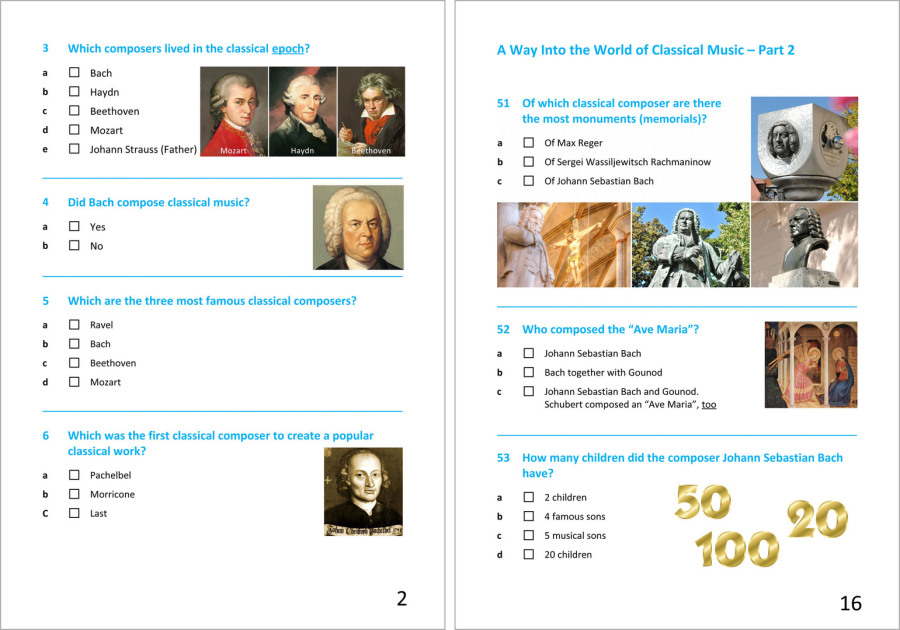
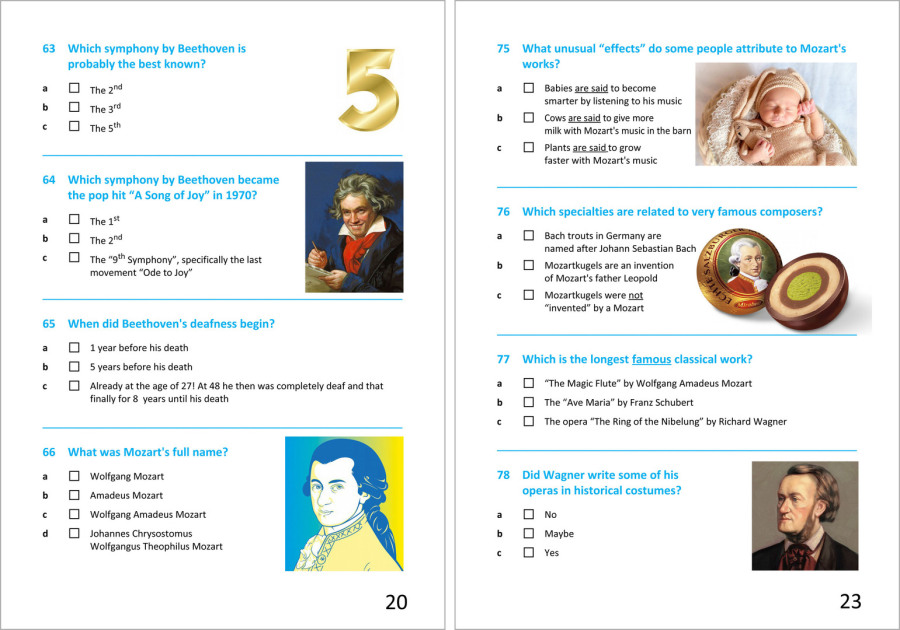
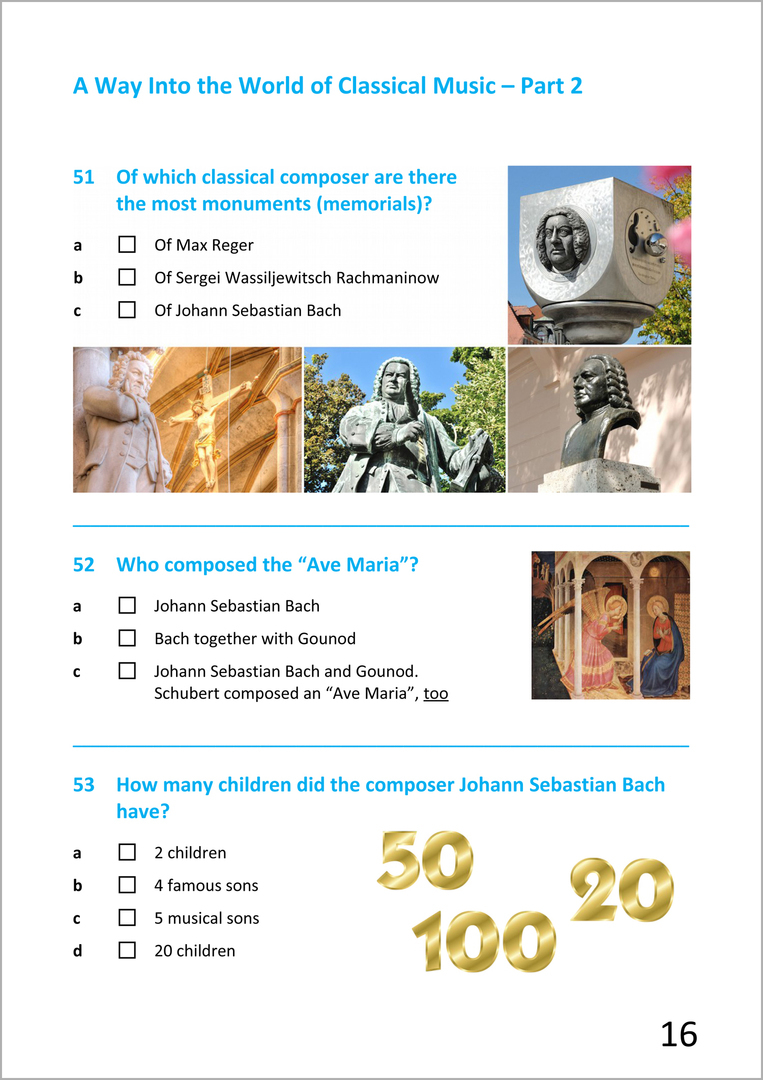
Six pages and 23 out of 150 multiple-choice questions: The point is to engage with the topic of Classical Music. It’s not about getting the answers right. You can view these six pages and 23 questions in high quality, with sharp clarity and in a large format, via the PDF below. © Pixabay..

PDF-Dokument [9.9 MB]
Two Cool Options “Teaching Material Classical Music”: Compact and XXL..
With my “more compact” offering, Teaching Material Classical Music 1, you’ll get quite far. And it’s even free. This is important to us because we have a mission. And we don’t want to “make money”; we just want to offset a small portion of the high costs associated with our projects related to Johann Sebastian Bach in particular and Classical Music for Kids in general..
Now for the smaller, more compact unit of my Teaching Material: It consists of six parts. The first is the background section: What exactly is Classical Music? Just click the link to get there. And second, you can read up on my philosophy. This gives you my definition, and we don’t have to agree at all: “Argue against it” or let’s agree. Your kids can read about it there, too. After your lesson or as preparation. Or not at all..
Then there is – thirdly – my list of 300 musical works, featuring the 300 Popular Classical Pieces that so many people love so much. There are endless ways you could use this to entertain your kids. And I’m sure you can think of many more: Listen to 10 pieces from this list in full, or 50 for 20 seconds each, or just the ones “marked in green”... or whatever..
Fourth, further down on this page, you’ll find lots of interesting things to read that you can “moderate” in front of your class. Some of it is only suitable for slightly older kids. Other fun facts are suitable even for the very youngest. These are my Funny+++ Facts..
Fifth and final, I’ll provide you with convenient background music that complements my Teaching Material. It consists exclusively of the most popular and well-known Bach works, selected from a collection of 1,128 masterpieces. About 45 minutes at a time. Use a small speaker connected to your tablet, smartphone, or laptop (... available on Amazon starting at eight dollars ...) and let the music play in the background while you teach. That way, your kids won’t even notice that they’re hearing some pieces for the first time ... and might even come to love them later on..
In addition – sixthly – I’ve put together four more collections of Classical Music Pieces for you. One of your students could play these – as a DJ – while you’re teaching. Unfortunately, I’m not allowed to put together such a playlist or even a 45-minute music collection for you: copyright, GEMA / ASCAP, and all that! But if you or one of your students knows how to put together a playlist, then that’s obviously the most elegant approach. However, as mentioned – with a DJ – it also works in a relatively straightforward and uncomplicated way. From your PDF or from my very special website..
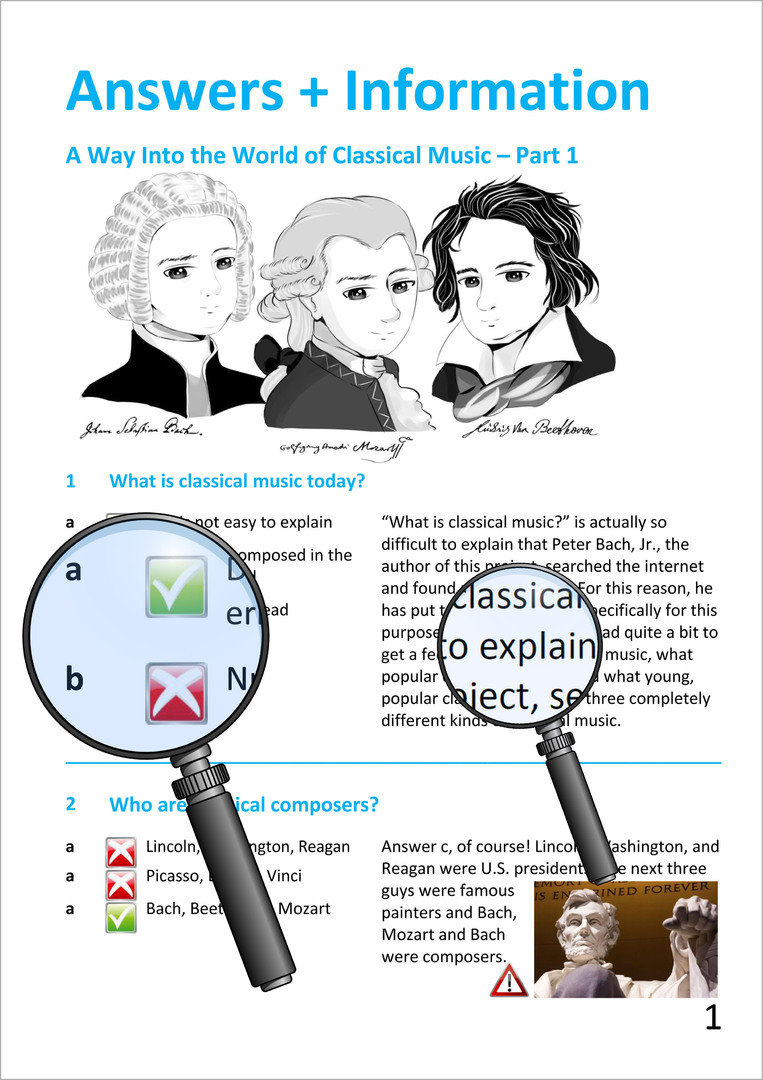
Here's the exciting part: You don't correct them at home. Instead, you do it in class ... and ... with your kids, while listening to Classical Music..
My Super-Cool “Teaching Material”: The XXXL Package at a Super Price..
Now to my “Ferrari” among the two Classical Music Teaching Material options: the XXL version. It naturally consists of the six components listed above. The entertainment background (... Funny+++ Facts) is the same. The Classical Top 100 is the same, too. And you generate and use the question What exactly is Classical Music? just as you do in the mini-package. Even all the musical components are available free of charge (... that was the fourth point). The finished Bach music collage is available for free. And finally, sixth, you’ll receive the four collections of tracks I’ve selected for you as a list. Not as a playlist..
The main difference between the two options is a set of homework consisting of 150 fun, easy, and exciting questions. They are to be answered using the multiple-choice method. There are trick questions, questions with obvious answers, and questions where the illustrations themselves provide clues. And then, every now and then, there are some very serious questions... though only a few of them..
This homework assignment is “completed” by the children in one, two, three, or six sessions. Your students then bring the finished homework back to class and hand it in to you, or send it to you as a digitally filled-out PDF. You can assign this homework as a “dive in at the deep end,” or wait until after an introductory lesson on the topic..
Then you can correct the work together. Environmentally friendly digitally or traditionally on paper. In in-person classes or via distance learning. Through homeschooling or hybrid learning. That is, with half, third, or 7/16 classes ... or full classes. Even when sitting side by side, one child can “work” electronically while the other uses paper. Any combination is possible. Your kids could even start by reading on their own about what Classical Music actually is. Then they’ll do their homework..
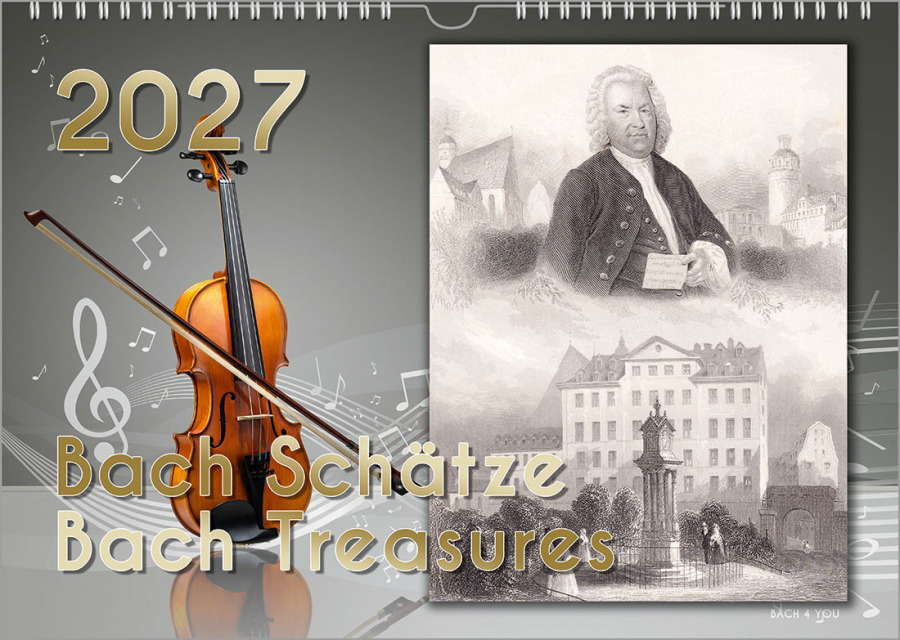
Since I have to label this entire page as an advertisement for you – due to the nominal fee for the XXL version – I might as well take this opportunity to promote my most popular Bach calendars: twelve times the excitement when it comes to Bach. This year and next year. In three sizes. In two calendar styles.
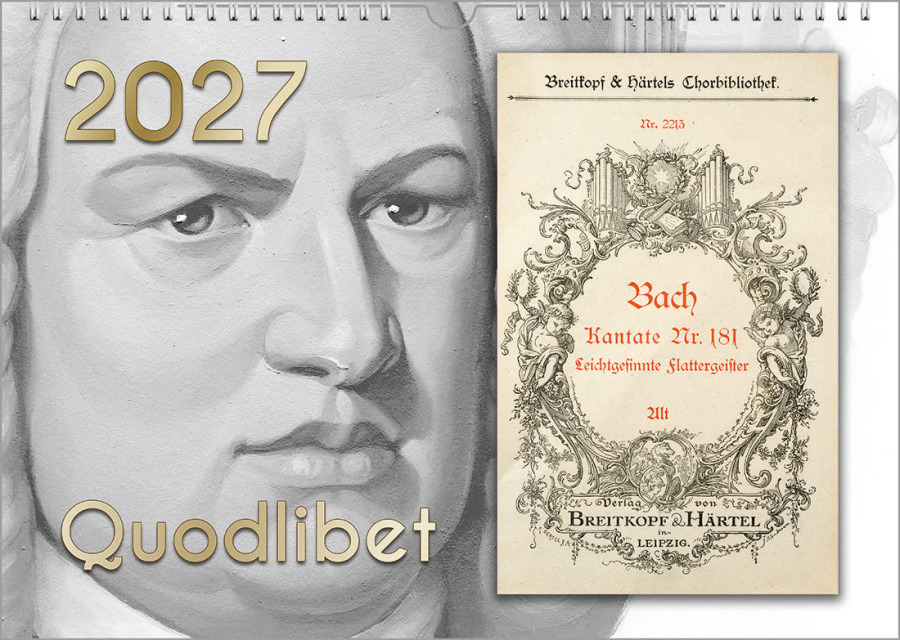
Here are another twelve “Bach gems.” Also available this year and next year. As a poster calendar and as a brochure calendar..
My XXL “Teaching Material Classical Music” Package: Great for School or for Digital Use at Home..
What happens to this completed “homework”? Nothing! You don’t grade it. Its purpose is simply– and perhaps surprisingly – to introduce your kids to the world of Classical Music. To get them thinking about the subject. To have them look up a thing or two on Google. To ask their parents or call their friends. So just “toss the completed questionnaires aside.” The most eco-friendly way, of course, is electronically..
The next step is the class test (... at least that’s what it was called in my day) and today – I suppose – the exam. Copying and even cheating are allowed. But of course, you don’t tell your kids that beforehand. This means the exam can also be taken at home. Do you remember? No association of Classical Music with pressure to succeed. I still remember to this day when I said “goodbye for good” to my recorder (…why “for good,” anyway?), after it had just squeaked for 45 minutes. We don’t want that to happen now with kids’ first encounter with Classical Music..
Back to the topic of “tests / class exams”: Once again, you play Classical Music in class. Or rather, you instruct your students to actually take the test at home with background music. More on that later. The test corresponds exactly to the 150 questions in the homework assignment ... down to the exact wording. The only additional graphic element is intended to ensure that you do not receive the same assignment back a second time, even if everything works online. You will not be grading this test or the class exam either..
That’s exactly what your students do. During in-person classes, together with you and anonymously ( ! ), because you assign each student a number on the first page of the test sheets. Then you cut off the names (... or delete them in the PDF) and return the sheets. Of course, you keep track of the fact that Markus received number 24 from you. And Tina got 333. After redistributing the sheets, you “entertain” your little rascals and comment on each answer with interesting and funny facts. You mix this with other oddities and curiosities, which you can read at the bottom of this page. You’ll also receive these separately as one of the 20 components of the XXL Teaching Material Classical Music..
For this lesson, your DJ will “play” the music from my other four Classical Music collections. Piece by piece, or – as mentioned – via a playlist, if you … or one of your kids … are already able to create such a playlist. I produced the MP3s featuring the most popular Bach works myself for you. That means I didn’t just compile them, but I also “tinkered” with the pieces on the computer. Classical Music fans, professional musicians, and music teachers, please forgive me for this monstrosity (... producing Classical Music on a computer): But GEMA / ASCAP and the legislature have established the rules for this:..
Johann Sebastian Bach has been dead for well over 70 years ... in fact, for over 270 years. So his compositions are in the public domain. Anyone is free to use them. But, a big but: The musicians who perform them in their current productions are, after all, not yet 70 years dead. Many are even still alive and well today. And that is why I am not allowed to use their Bach music either. But I – myself – I am not a member of GEMA / ASCAP. Unfortunately, however, I don’t play a single instrument. And that is why my music for you comes from my PC..
So much about Bach's music. My compilation of these Bach works for you – in my two “Teaching Material Classical Music ” packages – is a byproduct, because I needed and produced the music for my Bach on Bach project. With all other Classical Works – that is, all pieces not by Bach – it’s completely different. While they are, for the most part, in the public domain, the rights of the musicians who performed them mean that I am not allowed to compile them. So … not for you. I, for myself, am allowed to do so. That is a massive legal difference. For you, I am not even allowed to compile a playlist. You, for yourself – for use in your classroom and for nothing else – are allowed to do so. Once compiled, you can use it forever. But only in your classroom. Not for distribution to your students, not in a school performance, and certainly not for distribution to your colleagues. Fifty years of excellent cooperation with GEMA / ASCAP and the advice of my late father Peter Bach, Sr. taught me: You can “battle it out” with the IRS, but with GEMA / ASCAP... better never! And the latter ... not really either..
Then ... I wanted to “craft” instructions on how to create a playlist. And I gave up halfway through. It’s so complicated to explain (…not to do) and little details are constantly changing (…which would then have to be updated in the screenshots). Ultimately, data protection also plays a role. Because to create a playlist, you have to set up an account with personal information. You … or one of your students. In practice, this means you have three options. You or one of your students can put together a playlist from my four Classical Music collections. And you or a “trusted schoolchild” can start the playlist at the beginning of each class. Or one of your students can prepare their contribution to our shared Classical Music fun: namely, playing the tracks one after another directly from the website. Or from the PDF sent by you, to him, or her..
Finally, the winner – or the top three students, or the top three teams (... with a maximum of two kids per team) ... in our test, the class exam, will receive an electronically fillable certificate, as well as the audiobook “The Bach Biography for Children”, which I wrote myself..-
After all, my book isn’t available either as an audiobook or as an e-book or as a version for tablets. Instead, it’s available in all three formats. And as an added bonus, you also get the right to copy these three options for all your kids. This year, next year, 2030, 2050, 2100 ... and long after that.
And you will receive – as a thank-you – our audio file “The Most Beautiful Quotes About Johann Sebastian Bach.” Featuring his music and a brief ten-minute biography, it adds up to about 70 minutes of entertainment ... all free of charge. Everything is narrated by two professional voice actors and accompanied by music from the Eisenach superstar.
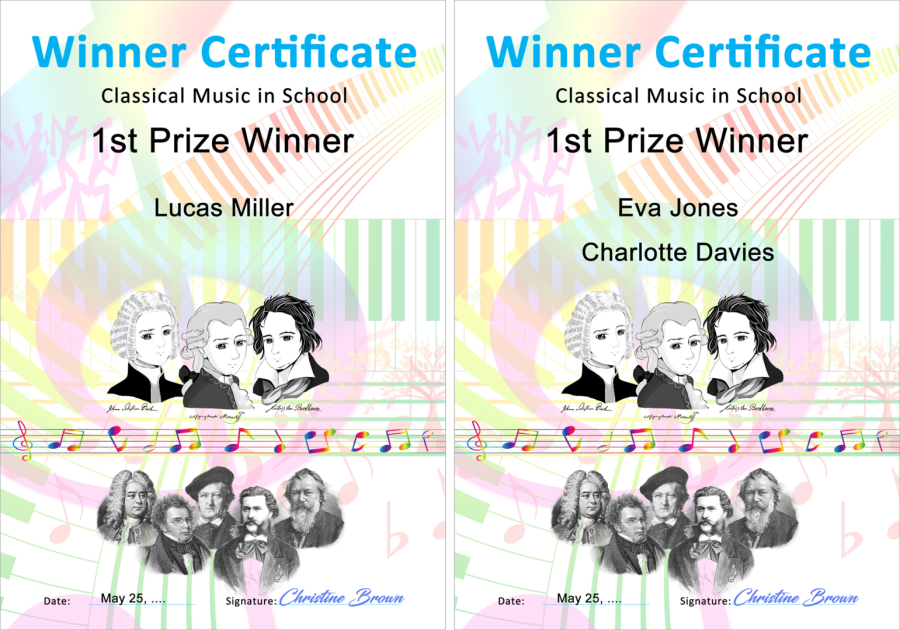
No, the winner’s certificate isn’t what makes this special. You can print it out for the winner. Or for the top three kids. Or for the best team. Or for the best teams of up to two friends or classmates. The prize consists of the audiobook “Johann Sebastian Bach for Children” in three digital formats. And that’s for the entire class. And for all eternity..
Pure, Exciting Entertainment on the Subject of “Teaching Material Classical Music”..
Now we’ve made it this far together. You’ve “read through” everything up to this point. Or perhaps you clicked directly from the top— below the part about the Teaching Material – right here. Welcome to the entertainment section of my Teaching Material Classical Music for teachers. I hope you enjoy the rest of your reading from here on out..
You surely knew that Johann Sebastian Bach, with two wives, had a total of 20 children at the time. But did you know that only half of them survived childhood? Of Bach’s sons, four became famous, and two of them were even – in their own time – more famous than their father was in his. All six sons were musically gifted. But the fifth gave up, even though he had initially earned a living through music as well. One, according to his brother, was disabled but very musical. Moving on with the Bachs: They are, were, and will continue to be the largest and most famous family of musicians of all time. That’s around 200 musicians, and even today, some Bachs still make a living from music. This is the case in Germany, the Netherlands, and the USA..
Bach is also said to have composed the most Classical Works. The world’s leading Bach expert believes that the Bach masterpieces still in existence today account for just ten percent of his life’s work. This means that, in his opinion, there were roughly 11,000 works. Bach’s work was never lost. Every musician over the past 270 years has always known how great Bach was and has been able to “get his hands on” Bach’s music. However, immediately after Bach’s death, his music fell out of fashion. And demand for it quickly “dropped to zero.” That didn’t change until about 80 years after his death. When another famous composer, Felix Mendelssohn Bartholdy, performed Bach’s St. Matthew Passion for the second time ... almost exactly 100 years later (...on Good Friday, to be precise). On that Good Friday, the Bach Renaissance began. And to be exact, it was 102 years later ... on the same day of the year ... on Good Friday..
Want a little more about the master? Over the course of roughly 333 years, 66 notable personalities have expressed their enthusiasm for Bach and his work. In addition, over 50 monuments honor the Eisenach native around the world: in Shanghai, China, Paris, France, Prague, Czech Republic, and Barcelona, Spain. Most of them, of course, are in Germany. That’s enough about Bach for now. But there’s more to come later..
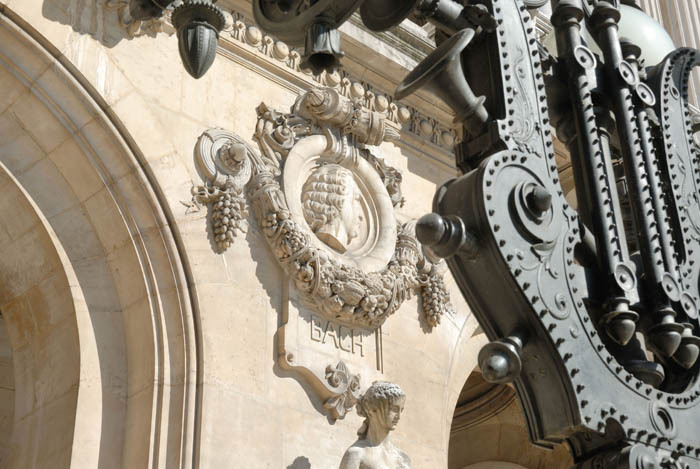
Bach at the Paris Opera in France..
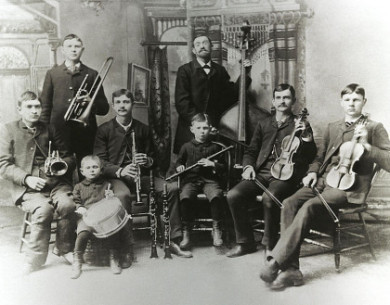
These eight Bachs above contribute to making this musical family the largest in the world. But they don’t make it the most famous, however: The Bach Band in Rochester, Minnesota/USA..
You’re familiar with some of the fun facts on the topic. For example, that Wolfgang Amadeus Mozart was nicknamed “Wolferl.” And that his full name was Johannes Chrysostomus Wolfgangus Theophilus Mozart. But that he wrote a six-part canon titled “Lick My Ass”... that you surely didn’t know?! And that he hated the sound of flutes. And that’s why he composed his masterpiece “The Magic Flute” only reluctantly as a commissioned work. You knew that he had perfect pitch, just like his colleague Beethoven, by the way. But did you also know that Mozart made his first marriage proposal at the age of six?..
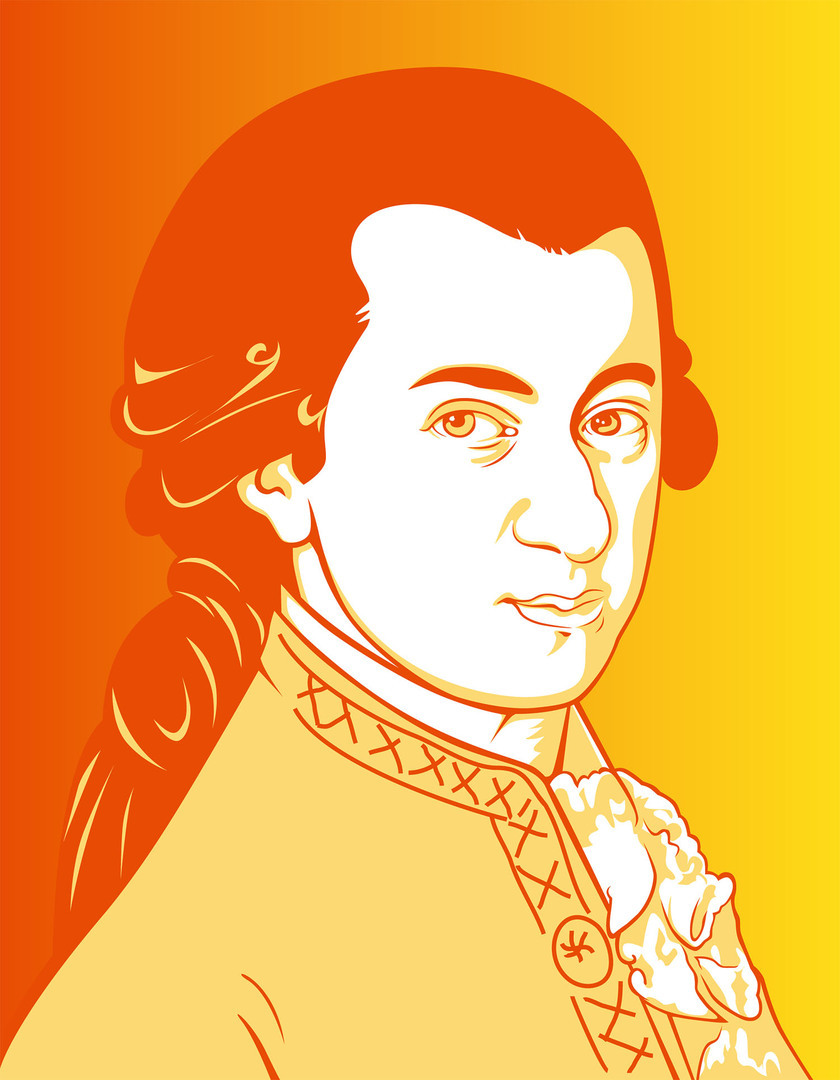
The gentleman composer who didn't invent the Mozartkugel. But the first Mozart candy was named after him. That's what the first Mozartkugels were called..
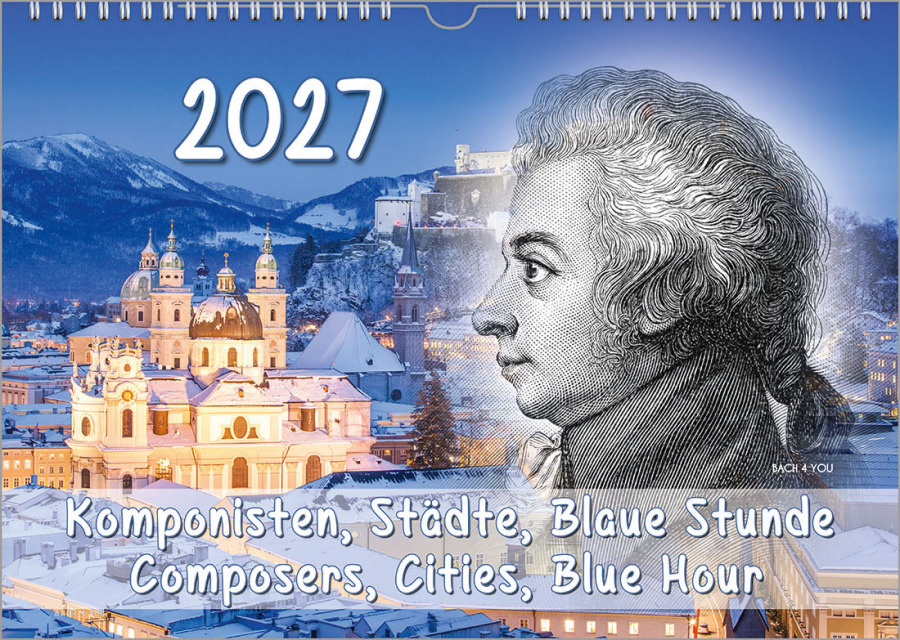
No, Wolferl didn’t know what Mozart candies tasted like. They weren’t “invented” until long after his death. And even then, they weren’t called Mozartkugeln for a long time. In fact, for 101 years, no such candies existed ... candy or kugel, whatever you call it. Here they are – 20 composers calendars and a Mozart calendar – in the shop..
You would have figured out on your own that the shortest Classical Pieces, just like today, were only two or three minutes long ... some even four. But the longest ones ... you didn’t know those. I’m certain of that: The very longest piece consists of 180 notes, and the composer instructed that this passage be repeated 840 times. Which results in a concert lasting 18 hours and 40 minutes. The world premiere in New York was performed by ten pianists. The second-longest piece is undoubtedly Richard Wagner’s opera cycle Der Ring des Nibelungen (... The R9ing of the Nibelung). This makes the second-longest piece the longest famous one. The strangest Classical Piece is certainly a work titled “4'33”. It is four minutes and 33 seconds long and consists of silence. It was composed – seriously now – by John Cage..
Do you know of any other particularly productive composers? Without no doubt, that would be Georg Friedrich Telemann. He composed an impressive 3,600 works. Once time travel becomes possible, we’ll be able to determine whether we need to mention Bach again, with his estimated 11,000 pieces. But 1,128 pieces are – compared to other musical virtuosos – also “nothing to sneeze at”..
You know there are two “Ave Maria(s).” And you know which one is the more famous. No, one of them is not by Bach. It’s by Gounod feat. Bach … that’s what they call it these days. And it’s the first famous work that two masters “invented” together. The second “Ave Maria” is actually and originally called “Ellen’s Third Song.” And it was composed by Franz Schubert..

Yes, these are the gentlemen composers whose music many very conservative Classical Music fans consider to be true Classical Music. And these are the musicians who come to mind when trying to define the term. However, there are no younger colleagues included who “undoubtedly also know how to compose Classical Works.”..
Let’s continue having fun with the Teaching Material Classical Music: It’s no surprise to you that Bach lived to be 65 and Mozart only 35. But did you know that Beethoven wrote a piece called “Elegy on the Death of a Poodle”? And that Wagner named his two pets at home – a dwarf rabbit and a parrot – “Little Son Fips” and “Little Daughter Papo”? And that he liked to compose while wearing historical costumes? Did you know that Beethoven was deaf for a full eight years? And that this condition developed slowly over a full 21 years? Are you aware that the Wagners, together with the Liszts, are one of the biggest families of musicians? And that Hildegard von Bingen, Clara Schumann, and Fanny Mendelssohn Bartholdy are the only famous female Classical Composers? Incidentally, at the age of 14, Mozart was awarded the Order of the Golden Spur by Pope Clement XIV..

A really cool place to listen to a Classical Concert: the Sydney Opera House in Australia. © Pixabay..
More around my Teaching Material Classical Music: Bach did not die in poverty, nor did his widow have to live in poverty. However, he left behind so little money that his widow applied for welfare in Leipzig, which was common practice at the time. This is often misrepresented. To continue living in a manner befitting her status, that is, as she had during Bach’s lifetime, she had to sell sheet music, as well as instruments and copies of her late husband’s works. There is a dedicated FAQ on this topic. The Leipzig City Council did not pay for a tombstone after 27 years of service. Without any honors, Bach was hastily buried at the time. However, he was later exhumed. And then buried again ... this time with greater honor. Even later, “he was brought out into the fresh air a second time.” Today he rests in the St. Thomas Church ... very, very likely..
By the way, Bach almost never traveled abroad (... that is, beyond today’s German borders). The exception was his trips to Karlovy Vary in the Czech Republic ... together with his prince. This was in stark contrast to Handel: Handel was born in the same year as Bach, traveled extensively throughout Europe, and died in wealth. For a time, both lived just a 30-minute drive (... right, cars didn’t exist back then) apart. But they never met. Instead, both were operated on for the same eye condition by the same ophthalmologist, the famous John Taylor from London, during his travels through Europe. In addition to the surgeries on Bach and Handel, he messed up roughly 100 more operations. Speaking of London and returning to the Bachs: Did you know that the Berlin Bach was at the same time also the Hamburg Bach, and the Milan Bach also the London Bach?..
Verdi wrote his masterpiece, the opera "Nabucco", in Egypt. And it was also Verdi who founded a retirement home for musicians. It still exists today and is called Casa Verdi..
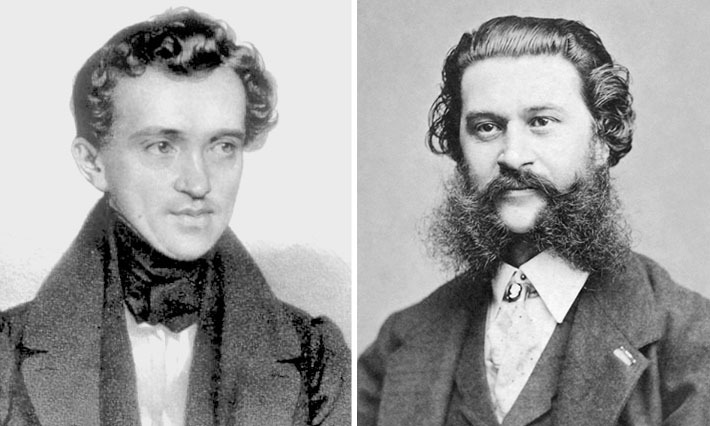
Well, do you need a quick memory trick to figure out which of the two Johanns pictured above is the “Waltz King”? And who’s the father, and who’s the son? Sure thing. Please arrange both images of the Strausses in your mind’s eye exactly like this. Then the father is the one who looks more conservative: Strauss, Sr. looks – in your imagination – more “tame” on the left … next to his son. We read from left to right. So the father is on the left, the son on the right. We stick to reading from left to right. And now the father looks more fatherly, the son more hip. The following fame is shared by both: On the left is the Strauss who “invented” the Viennese Waltz. On the right is his son, who later became the “Waltz King.” And since there can’t be a Waltz King without the Viennese Waltz having been invented, this now fits into my “quick memory trick suggestion” as well. Does it help? Surely it does..
Join Me in Making Classical Music More Exciting: Your Kids Will Then Discover More Demanding Classical Music on Their Own..
And now back to my – free – entertainment program for you and/or your kids: Yes, the Waltz King. That is, the son. And why the Waltz King? After all, his dad invented the waltz. And how many waltzes did his son end up composing? It was 168 waltzes. Today, Strauss, Sr. (...II) is a “one-hit wonder” of Classical Music. Only the Radetzky March is still world-famous today... and that isn’t even a waltz..
Tchaikovsky, by the way, is the only person in the world –and of all time – who could find nothing special in Bach’s music. At least he enjoyed playing Bach’s fugues. How fortunate that 66 other famous people disagree. And the first Popular Classical Masterpiece ... who composed it? It was Pachelbel, and the title is “Canon in F Major”. You’ll recognize it when you hear it ... I promise..
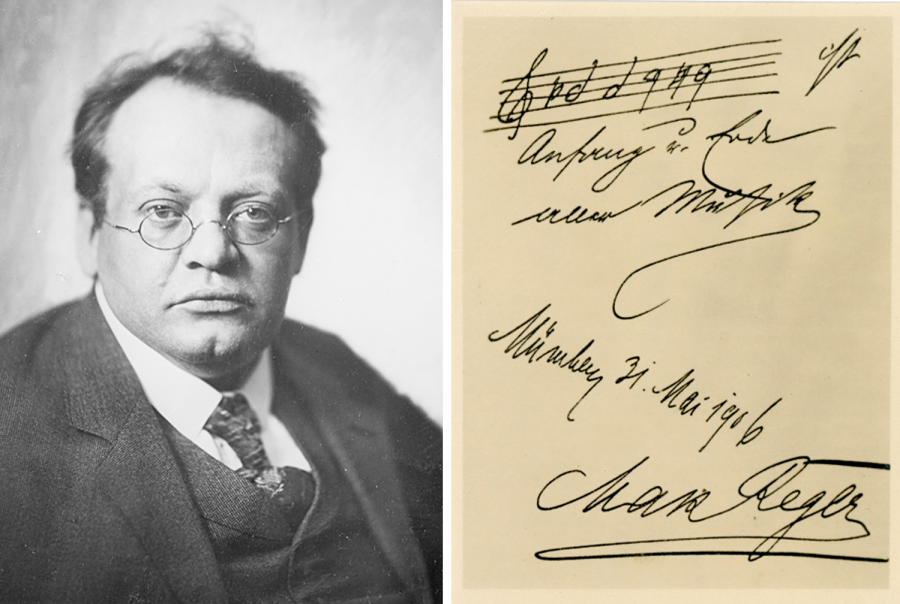
The only quote about the quality of Bach’s music that has been handed down in handwritten form comes, incidentally, from Max Reger. He was a great composer himself: “Bach is the beginning and the end of all music,” he left us. And Bach himself said on the subject of music that anything not written for the glory of God is merely “diabolical noise.” You also know a single prominent piece by the composer Charpentier. It has opened the Eurovision Song Contest every year for decades. And ... can you hum it right away? If you play an instrument yourself, then you know that “Bach” is the only composer’s name that can also be sung and played. But only in the German-speaking world. Not in America, for example..
Yes, you can also play and sing “Bach.” But why only in Germany, Austria, and Switzerland ... only real musicians can explain that..
Do you need more entertaining material because you want to spread your lesson content over more than two class hours? Okay, sure. In Ansbach, there’s a Bach monument – the most modern one, by the way– where the artist forgot the “b” before the notes that spell out Bach’s name. And so he changed B-A-C-H into H-A-C-H. It’s so charming when even experts have a little slip-up now and then. Another artist was so enthusiastic about Bach that he went ahead and renamed Bach’s entire hometown after him: He turned Eisenach into Eisenbach on a postage stamp..
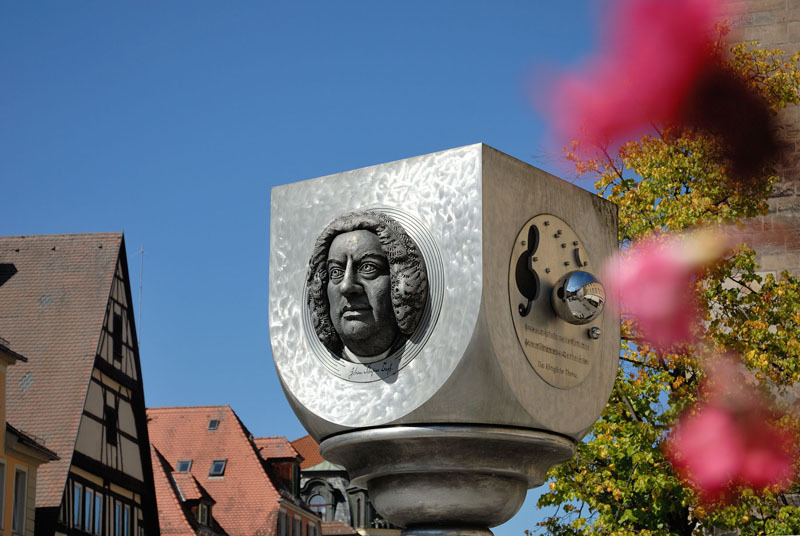
It’s impossible to see the charming mistake here. And I wasn’t aware of it either when I was in Ansbach taking photos a long, long time ago. That’s right ... if you’ve read the entire page, you’ve already come across a similar image. And you’re already familiar with the postage stamp below as well..
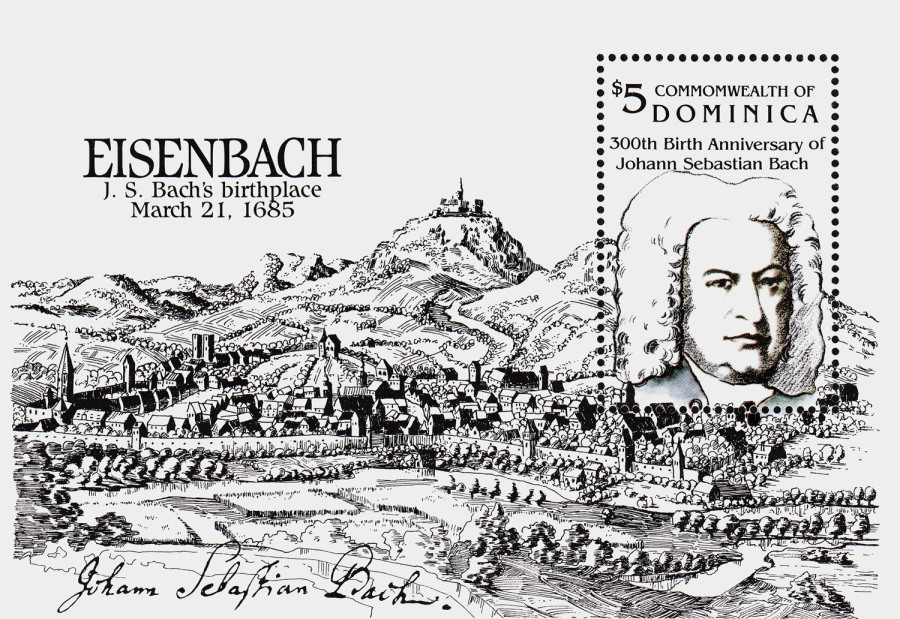
The likeable error number 2: “Eisenbach” instead of “Eisenach”..

And ... what's so special about it? You can see it better in the enlarged image below..
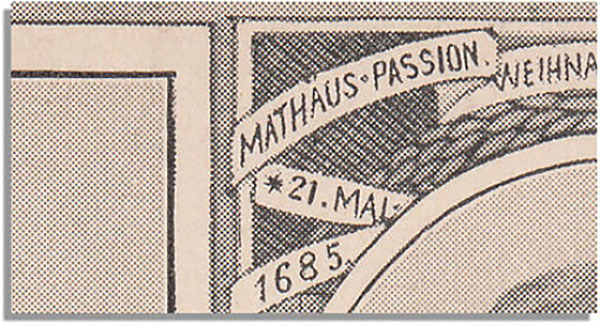
And while we're on the subject. Yes, there are also some minor errors in print: Whether according to the Gregorian or the Julian calendar ... Bach was not born in May..
Here’s more with my Teaching Material for you: That Grieg was Norwegian and Sousa was a Classical American Composer? Sure, you probably knew that. That the U.S. National Anthem and the Rhapsody in Blue are surely the two most famous Classical Works by Americans ... maybe you knew that, too. But did you know that Puccini’s full name was Giacomo Antonio Domenico Michele Secondo Maria Puccini? You're right, it's not something you need to know..
Voyager 1 and Voyager 2: Of course you know about the Golden Record on board. But did you also know that Bach “won” in every category when it comes to representation on the LP? He has the most tracks, and he tops the ranking. Curious, unimportant, and whatever. But that’s what this corner of my website is all about. By the way, there’s a special FAQ on the topic of “Bach on the Golden Record.”..
Which opera by Carl Maria von Weber remained unfinished? That’s right, “Rübezahl.” And how many asteroids are named after Bach? That’s right, two, and one after Reger as well. Really two after Bach? Whether Vivaldi was a gondolier on the side or a Roman Catholic priest is a trick question for your kids, because I’ll show them a picture of “Venice with gondolas” to go with this question. It’s clear who we have to thank for the German national anthem. Or maybe not? That’s right, Haydn composed it..
Bach spent four weeks in prison. But do you know why? For being stubborn. Franz Liszt spent significantly less time there, and Schubert is even said to have spent time behind bars because of a composition. Only Richard Wagner was able to “flee” abroad to avoid arrest..
Beethoven was a "nitpicker" when it came to his coffee. He counted out exactly 60 coffee beans for each cup and started his day with it ... in the morning, of course. By the way, Mozart wasn’t the superstar that Falco portrayed him to be. Beethoven deserves that honor. When Beethoven was buried, 20,000 citizens attended ... half the population of Vienna’s city center at the time. Children had the day off from school, and the military organized the proceedings. He was the superstar of his time. Beethoven, incidentally, called “wind” his enemy. And you probably didn’t know that he moved more often than any other celebrity ever has: 68 times, to be exact. He decided to move on over the slightest thing..
By the way, national anthems are almost always Classical Music Pieces. We can hum some of them. The shortest is the Japanese national anthem, which is four minutes long. The longest is the Greek national anthem, which consists of 158 verses..
By the way, Franz Schubert’s friends called him “little mushroom” (… in Austria, “Schwammerl” …). Because of his brown hair and his height. Speaking of hair: So many admirers wanted a curl from van Beethoven (… sounds funny) that he got himself a dog. His name was Pimperl. From then on, he supplied the “locks.” Before that, he had actually given a friend’s wife a tuft of goat hair. By the way, you can still bid on one of Beethoven’s locks today for 39,000 Euros* . Maybe. And maybe it really is Beethoven’s hair after all.(... * Check what's that in Dollars today via the link)..
By the way, the entire London Symphony Orchestra nearly went down with the Titanic. Just moments before departure, they boarded a different ship bound for New York..
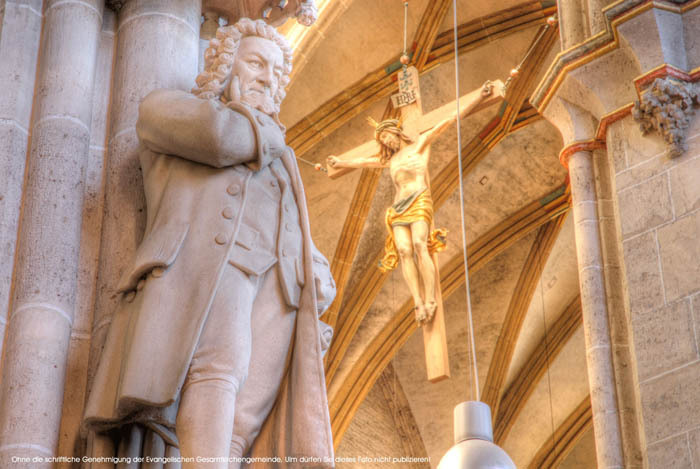
Bach didn’t find playing the piano particularly difficult. Nor did he think it was hard to play as well as he did. At first, he said that playing the piano simply required “pressing the right key at the right moment,” and regarding the quality of his playing, Bach remarked that anyone who practiced as much as he did could achieve the same. Above is the Bach monument in the Ulm Minster. Until 2026, it was the church with the tallest tower in the world..
To finish off, here’s the penultimate piece of trivia to wrap up my curiosities about “Teaching Material Classical Music”: Rachmaninoff was the Classical Composer who earned the most money among such “tone poets.”
In 1929 alone – the year the Great Depression began – that amounted to the equivalent of six million Euros. Incidentally, while it has been semi-scientifically studied that termites eat wood twice as fast when exposed to heavy metal, this has absolutely nothing to do with Classical Music..
One of the Most Recent Bach Calendars: Three Monthly Pages in a Surreal Style..

Twelve times Johann Sebastian Bach. All motifs painted as surrealist works of art..

This Bach calendar in October..

Again this of 20 Bach calendars ... in December. Would you like to see all the other monthly pages now? You can do that in the shop at exactly the right place..
The Bach Portraits & Quotes Calendar: Three Monthly Pages..
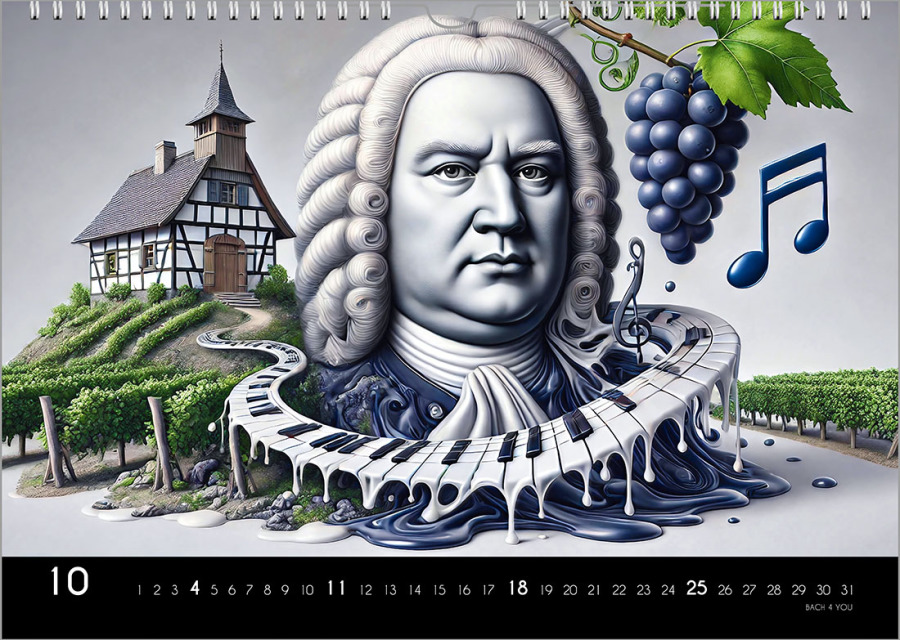
This Bach calendar in October..
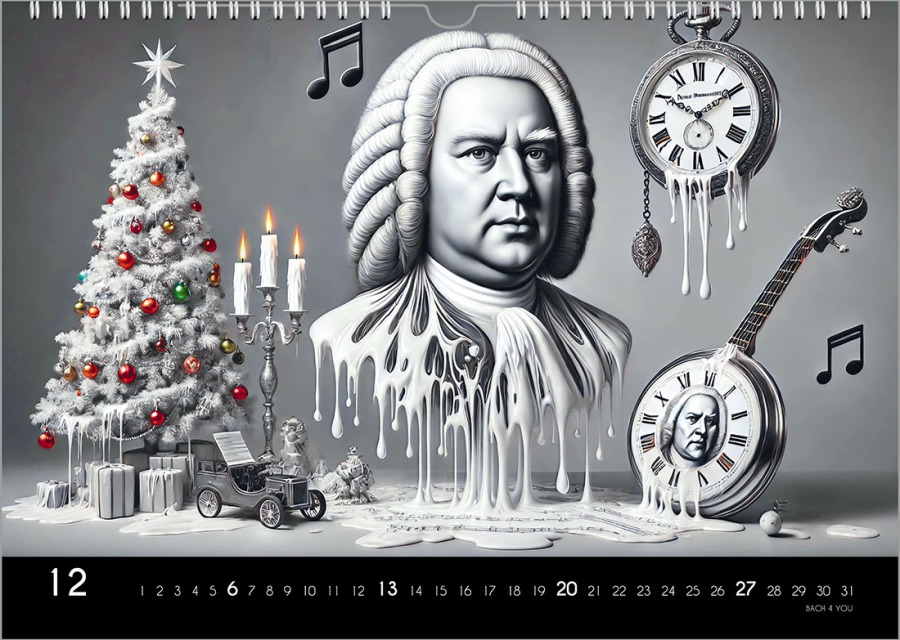
Here again is this one from 20 Bach calendars ... for December. Would you like to see all the other monthly pages now? You can find them in the shop in exactly the right place..
The Bach Portaits & Bach Quotes Calendar: Three Monthly Pages..
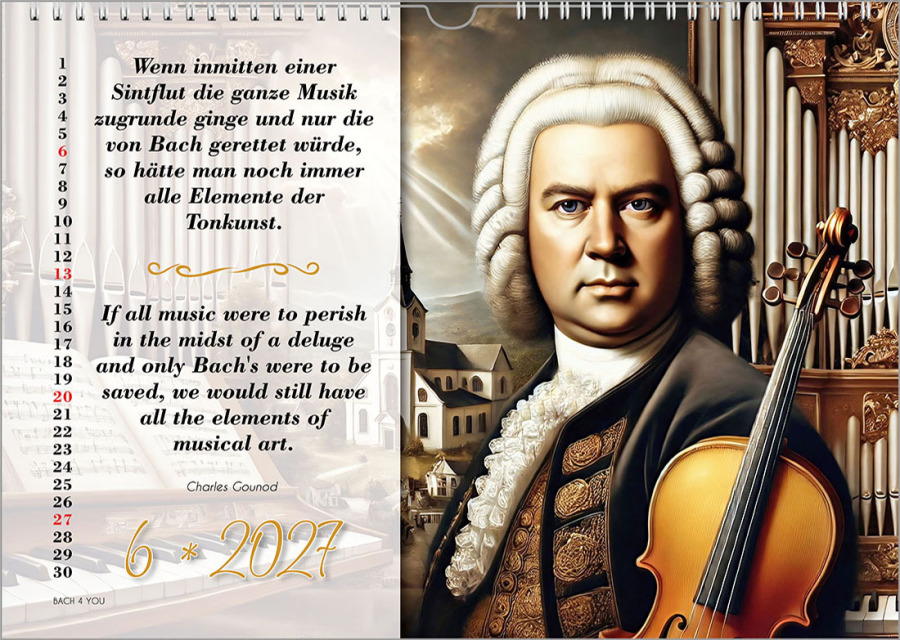
Twelve paintings of Johann Sebastian Bach in various artistic styles. Each is accompanied by a quote from a famous personality about Bach and his music. We can do that, too. Click here to see all the calendars. This second of two Bach quote calendars was created a full ten years after the first..
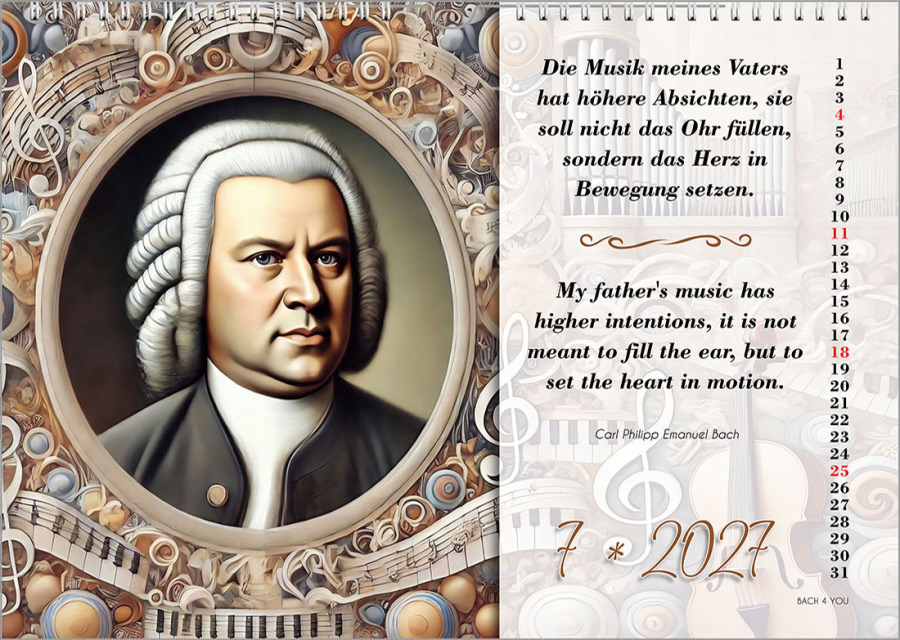
The Bach Quotes Calendar in June..
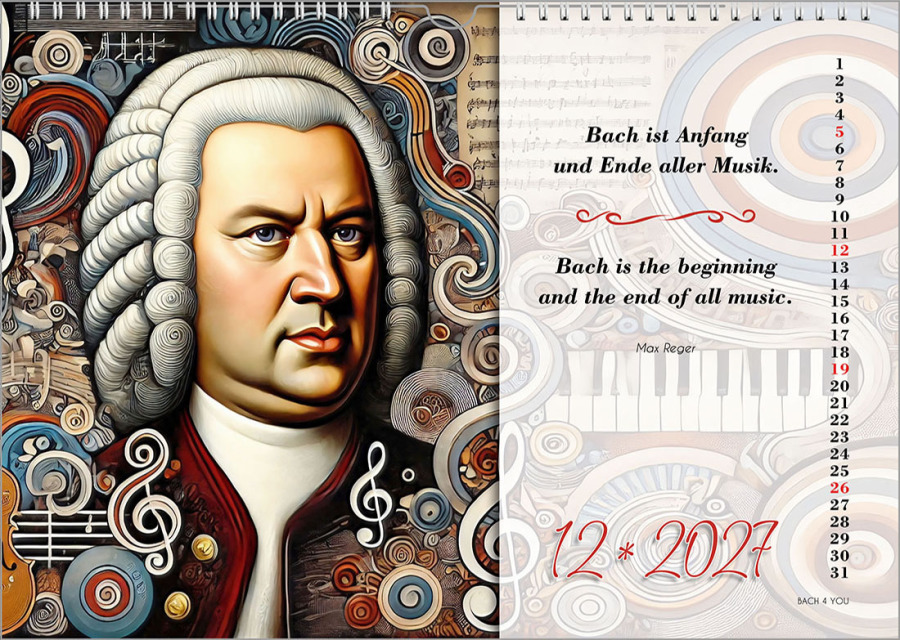
The Bach Quotes Calendar for December: Would you like to see all the other monthly pages from this Bach calendar? You can do that in the shop, right where you need to be. Click here to go back there. But now, let’s move on to Calendar 2 of the three most recent Bach calendars..
End of Advertisement
 Druckversion