

Bach FAQ 114
Did Bach Actually Want to Live and Work in Halle? Why Didn't Bach Finally Move to Halle?..
Getting to the point: Even today, it remains one of the great mysteries why Bach did not move to Halle, Germany to live and work there..
Halle – specifically Halle an der Saale – is first and foremost the “Handel City .” But Halle is also, to a small extent, a Bach city. A Category C Bach city. In just a moment, you’ll be able to learn a bit more about this beautiful city in a concise format. For example, why it is now one of the 33 Bach locations. Click here to get there. Of course, as always, more detailed information is available on Wikipedia and via Google. Under the keyword “Halle,” the city presents itself even before the Wiki: Click here for the Halle city website. With the two keywords “Handel and Halle,” the Saxony-Anhalt Wiki, Wikivoyage, and Wikitravel also appear right at the top. But… Handel… that’s not the topic here, and certainly not … for you today..
Advertisement
1,000+ Bach Gift Ideas Are Soon 10,000+ Bach Gift Ideas..
Five shops … learn more here..
On the left, it's the “Bach Drehkastl" (... Little Bach Turning Box). On the right: Bach calendars make great gifts for musicians and music lovers. Three sizes. For this year and next year. EU style and US style. Visit the Shop..
End of Advertisement
Halle Is Handel City and Halle Is Also a Bach City..
Also worth noting: “Halle and Handel” also takes you to the page Handel Halle, to the Handel Festival in the Georg Friedrich Handel Hall, and to the Handel Festival, another wiki. The website of the Handel-Haus Foundation in Halle rounds out my offering here. There is also an article from the “nmz” . . . the neue musikzeitung. Actually written with lowercase initial letters. The title of the article: 300 Years Ago: Johann Sebastian Bach Wanted to Become Organist in Handel’s City. Sorry about the fact, that none of the websites, recommanded in this paragraph are in English..
Did Bach Want to Become an Organist in Halle? Did He Really Want That?..
Johann Sebastian Bach regularly presents fans and scientists – across all disciplines – with major puzzles. One particularly great mystery, dating back almost exactly 300 years, is the episode surrounding “A Job in Halle.” Due to the lack of personal correspondence from J.S. Bach, it remains unclear to this day why Bach applied for a position in Halle ... and then decided against it. As always when precise facts are lacking, there are still probabilities. These are based on Bach’s behavior in other situations, on sources dealing with entirely different topics, and on research into people who played a role in Bach’s surroundings. Such as, for example, the organist in Halle, Zachow. And of course ... they are also based on documents in Halle..
It is interesting, if only as a side note, that it has been confirmed that Bach was determined to visit Handel in Halle. To meet him. On three occasions, these two great musicians were very close to meeting, and on all three occasions, it did not work out..
It’s also worth noting that Handel was very well-known internationally during his time. This is in contrast to Bach, whose fame abroad didn’t come close to matching Handel’s. It’s also interesting to note that, unlike Bach, Handel was wealthy. Oh, and by the way, here’s a link to the master from Halle. To the Handel House, which – nowadays, having been spruced up – really makes quite an impression..
It’s also interesting to note that Handel was born just a few weeks before Bach. That was in Halle. However, he didn’t die until many years after Bach. In London. That was in 1759. So, by the standards of life expectancy at the time, he lived to a very old age. In contrast to Bach, who “only” reached the ripe old age of 65. Incidentally, both musical stars suffered from cataracts. And both composers were operated on by the same ophthalmologist, John Taylor of London. But enough about Handel on this Bach website..
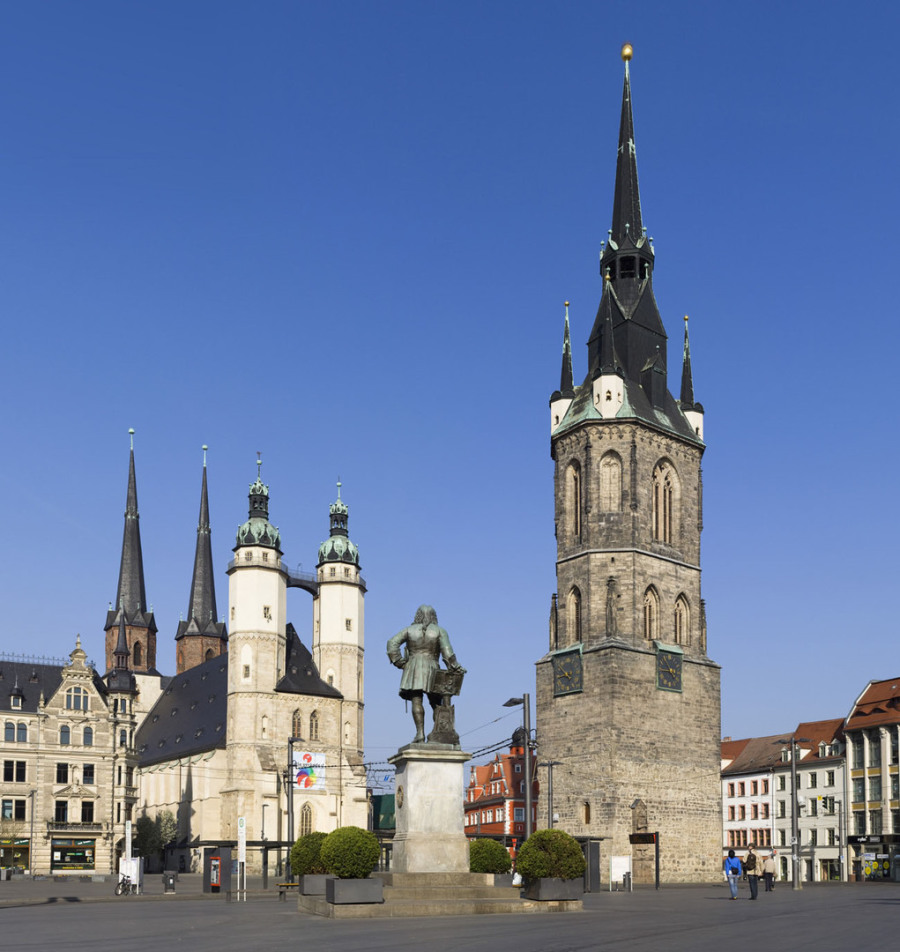
The marketplace in the city of Halle today: Almost Halle would have become a Bachstadt ... of first-class quality. © Pixabay..
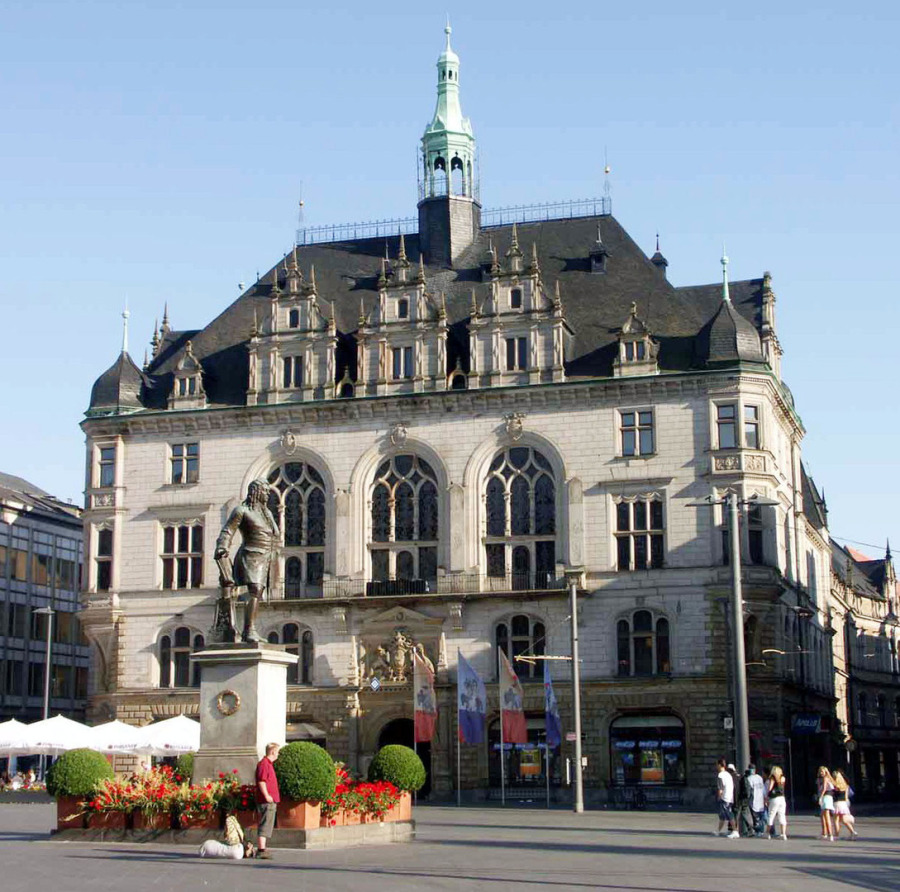
Halle has 237,000 residents, and above all: Halle is beautiful! Bach’s entire life would likely have taken a completely different course had he accepted that position in Halle back then. After all, thanks to the city council’s decision, he already had the job “in the bag.” The photo above shows Halle City Hall. © Info..
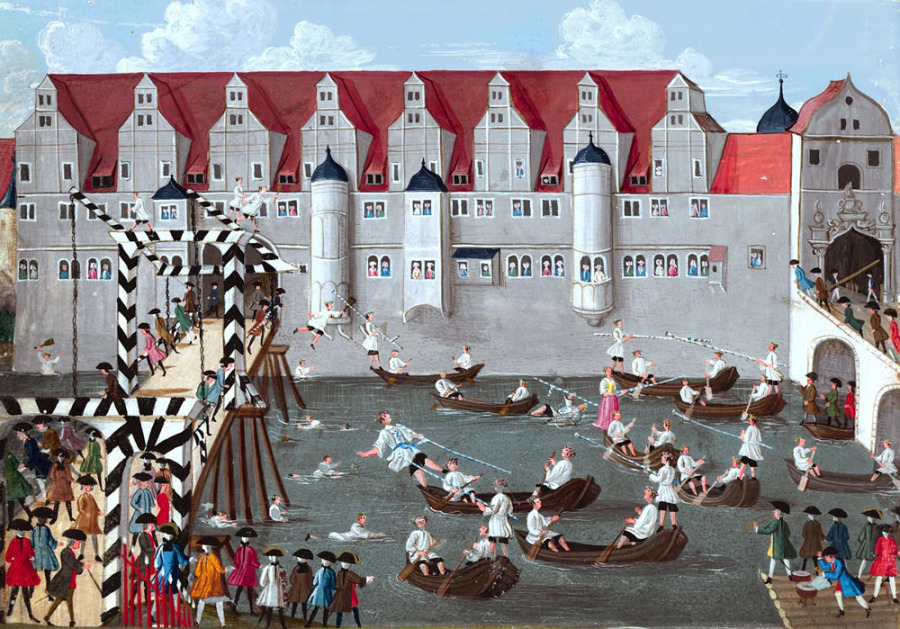
Halle, the Handel City: Wherever Johann Sebastian Bach performed back then, he was met with enthusiasm. This was also the case after his audition in the metropolis on the Saale, Halle. That is why Halle is, after all, one of our Category C Bach Cities today..
Why Did Bach Make a Trip to Halle? What Do Some Scientists Think? Why Did Bach Decide Against Halle, Later?..
Who could solve one of the Bach mysteries better than a Bach scholar? Of course, every Bach fan, every Bach writer, every Bach biographer, and indeed every Bach expert can form their own opinion based on the known facts. Ultimately, however, there is always a lack of convincing, written evidence for nearly every “Bach thesis. And so interpretations also “flourish” regarding Johann Sebastian Bach’s application in Halle. And regarding his later rejection to this beautiful city. That was around 300 years ago..
Essays have been written and published. Interpretations of Bach’s behavior have been made public. Ironically, it is a scholar from Moscow who is currently presenting by far the most plausible theory on the topic of “Bach in Halle.” But – as we know – nothing is simple when it comes to Bach. This scholar and author does not present his findings in a book titled “Bach in Halle.” No, the book is called “Zachow’s Cantatas.” It is about a completely different musician. Specifically, one of Handel’s students. So nothing in the book’s title suggests that a full 100 pages are devoted to the “Bach topic.” More precisely? The topic “Bach in Halle” ... and in German, of all languages. Not ... sorry ... in English..
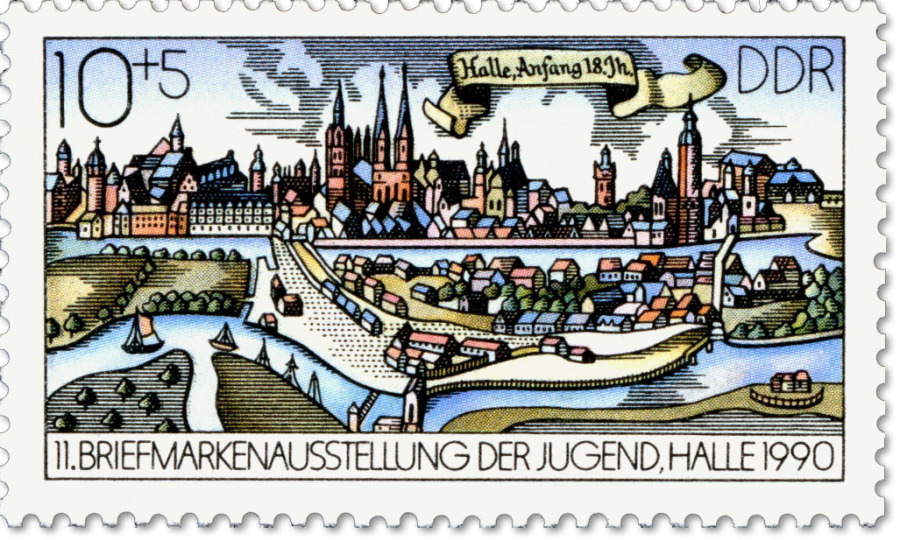
A postage stamp issued by the former GDR. It depicts Halle at the beginning of the 18th century. This means that both Handel and Bach knew the city like this. Bach, however, did not visit Halle until several decades later..
About Doctor Vladimir Stadnitschenko from Moscow in Faraway Russia..
Who is Dr. Vladimir Stadnitschenko? And how did a Russian musicologist in Moscow– a nearly 20-hour drive from Halle, after all – come to write about such a distinctly German topic? And to do so with documented sources that substantiate the accuracy of his statements better than any previous analysis? Read a few lines from this scientist, this doctor from Russia, Mr. Vladimir Stadnitschenko. Where and how? On the Peter Lang Publishing website, after clicking here, a little further down on this page, via the “Excerpt.”..
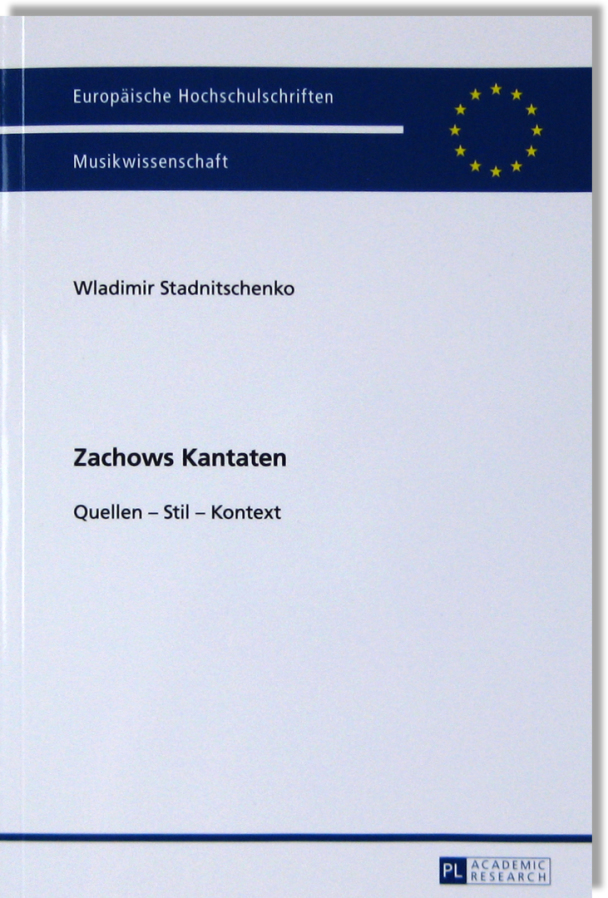
The most fascinating book in the world on the topic of “Bach in Halle”: Not a single word on the cover – or even in the title – hints at this treasure trove of information on Johann Sebastian Bach: 100 pages of JSB expertise. You can order the book at bookstores or directly from Peter Lang Publishing. Of course, here’s the link to the book, and the title for Bach lovers should really be “Zachow’s Cantatas – Bach and Halle.” And that’s right … we don’t get a commission..
Advertisement
100,000+ Music Gift Ideas or 1,0000,000+ Music Gift Ideas?..
Bach gifts and more Bach gifts … learn more here..
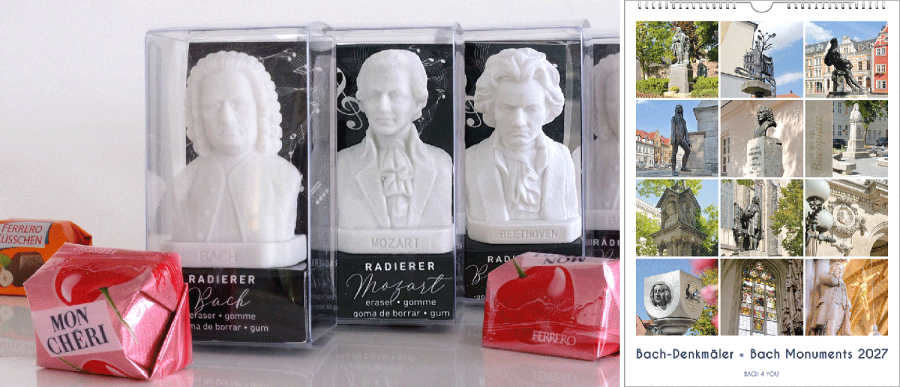
The shop "Bach 4 You" is the specialist, when it comes to precious Bach figures, and it is the music calendar specialist on the planet. To the shop..
End of Advertisement
Want to Experience More of Johann Sebastian Bach in Halle? a Description by the Author Himself ... in a Few Lines..
Over three hundred years ago, in late fall 1713, the then 28-year-old Weimar court organist, the “highly learned and most honorable” Mr. Johann Sebastian Bach, applied for the vacant position previously held by Friedrich Wilhelm Zachow (1663–1712), who had been G. F. Handel’s first and only teacher in Halle. When attempting to examine this episode in Bach’s life, one encounters many unanswered questions ... the number of which is truly enormous..
The most important question remains the following: Under what circumstances did Bach apply for the position in Halle in late fall 1713? Did Bach intend to apply from Weimar for the position of music director and organist in Halle? Did the Weimar court organist actually design an organ arrangement for Christoph Kuntius beforehand? A correct answer to this question leads to the identification of Bach’s ideal sound in the field of organ building..
The incorrect response had already led to the questionable idea of the fake application in Halle and ultimately to Bach being labeled a careerist. From CPE Bach’s obituary to the present day, it has been known that the record of Bach’s life is incomplete. In general, although much has been written about him, only a few documents concerning him have survived. Not much is actually known about his daily life in the cities where he lived, such as Eisenach, Arnstadt, Lüneburg, and Mühlhausen, as well as others..
It is a paradoxical situation that the world’s most significant composer is, biographically speaking, almost impossible to pin down. In this sense, the brief “Halle episode” in Bach’s life truly represents nothing more than a footnote. It must be noted, however, that Bach’s application for Zachow’s vacant position in Halle is a story in its own, and one that nevertheless remains a special case..
Almost as little is known about Bach’s trip to Halle as, for example, about his trip to Lübeck in 1705. In this sense, therefore, these episodes are comparable. On the other hand, the “Halle episode” nevertheless represents a truly exceptional case. This applies even to the broader context of his life. And for the following reason: No other story in Bach’s life has ever been so thoroughly misunderstood. And none has therefore been misinterpreted as often as Bach’s application for Zachow’s vacant position in the late fall of 1713. The main problem lies primarily in the fact that this episode is far too poorly documented. And the story as such remains incomprehensible to some authors. A specific reason for Bach’s first trip to Halle is by no means apparent from the two surviving “Halle letters,” the file notes, or the invoices from St. Mary’s Church. The exact purpose of the trip remains unknown..
A serious, thorough, and expert re-examination of the preserved historical facts and documents provides convincing evidence of the following. In short, it leads to the conclusion that:..
1 In late fall 1713, J.S. Bach had traveled to Halle not to apply for Zachow’s position..
2 Bach was invited to Halle to play the organ built by organ builder Christoph Kuntzius. He also visited the Saale City at that time in his capacity as an organ expert, with the aim of providing expert advice on organ building and possibly offering a partial examination..
3 Bach’s second invitation to Halle—in May 1716—had already been planned in writing by organ builder Kuntzius as early as 1712 (…see item no. 14 in Kuntzius’s organ-building contract from that year, 1712…)..
4 It came as a great surprise to J.S. Bach that, after the matter of the new organ had been settled, the “highly learned senior pastor of Halle, Johann Michael Heineccius” – who composed cantata texts himself – persuaded him (... Bach) to apply for the aforementioned vacant position and gave him (... Bach) his own text for the cantata..
Bach agreed to this application with a delay of one year. And he was the fifth ( ! ) candidate. It seems likely that Zachow’s student Georg Kirchhoff, who had a connection to the organ builder Kuntzius – Kirchhoff, incidentally, was considered the top candidate in this application – also played a personal role when Bach was invited to Halle in 1713. It is not known exactly what kind of cantata Bach composed in Halle in 1713. I agree with Alfred Duerr (… since our phone conversation in April 1997) that it could have been his cantata “Christen ätzet diesen Tag”; BWV 63. However: with a text different from the well-known one, which remains unknown to this day..
Who Actually Is This Author?..
Vladimir Stadnitschenko, born in Moscow, is a graduate of the Moscow State Tchaikovsky Conservatory. He earned his doctorate at the Seminar for Musicology in Freiburg (... under Prof. Christoph Wolff) and is active in the fields of music education and culture in Russia..
Again Back to the "nmz" – You Remember -the New Music Newspaper – In German Written with Three Low Letters..
Here you can read the full report on Bach’s application in Halle. sorry, you need a translation software upfront. Or you can stay with me and read the summary. In 1713 / 1714, following his audition in Halle, Bach was indeed accepted by the City Council of Halle. Yet he did not take the position … and no one knows why. Incidentally, since the summer of 1712 – more than a year earlier – the position had remained vacant following the death of the previous organist, Wilhelm Zachow ... a sign that others had also “backed out.” Or hadn’t wanted it from the start. And did Bach do the same as they did? It is said to have been about the money. The pay is said not to have been enough for Bach. Is that really the reason? In the necrology about J.S. Bach, his son Carl Philip Emanuel Bach made no mention of that. Was there a reason for this, and was it not due to the amount of the salary?..
It was not until 1717 that Bach moved from Weimar to Köthen ... so immediate dissatisfaction – as was later the case when he left Weimar – could hardly have been the main reason for Bach’s interest in the position in Halle at that time..
“Penny-pinchers” is what the city councilors in Halle were said to have been back then, according to the “nmz” – you do remember what “nmz” stands for, right? – and that might indeed have been the reason they didn’t immediately start looking for a new organist. Six months later, that would explain the customary mourning period for King Frederick I. Or perhaps it’s just my speculation from earlier..
They wanted to pay Bach 192 guilders. Instead of the 210 he was receiving in Weimar at the time. For Bach, who had secured a higher salary at least twice before in subsequent contracts at other locations – and who was also earning more than the musicians who had held the same position before him – this alone would have been a glaring loss of face. Added to this – as can still be read in historical documents today – is the fact that they actually, yes actually, did not want to allow Bach to have additional income ... by playing at festivals, weddings, and funerals. The gentlemen of the Council in Halle considered this “questionable.” Then – in those weeks – Bach even received 30 guilders more in Weimar, bringing his total to 240..
At this point, I’m convinced that you should check out “nmz” if you’ve suddenly become so interested in the topic. Because the article there about Bach in Halle is superbly written. And after that... well, after that... you’ll learn from Dr. Vladimir Stadnitschenko – with the help of translation software DEEPL, for example – and through the Peter Lang Publishing Group – a completely different, still young, and current perspective on things..

Advertisement
60 Music Calendars, Composers Calendars, and Bach Calendars ... Yes ... And Angels Calendars..
There are many more music calendars beyond the 60 European style music calendars … learn more here..
Discover the Difference Between Calendars in Europe and Calendars in the US..
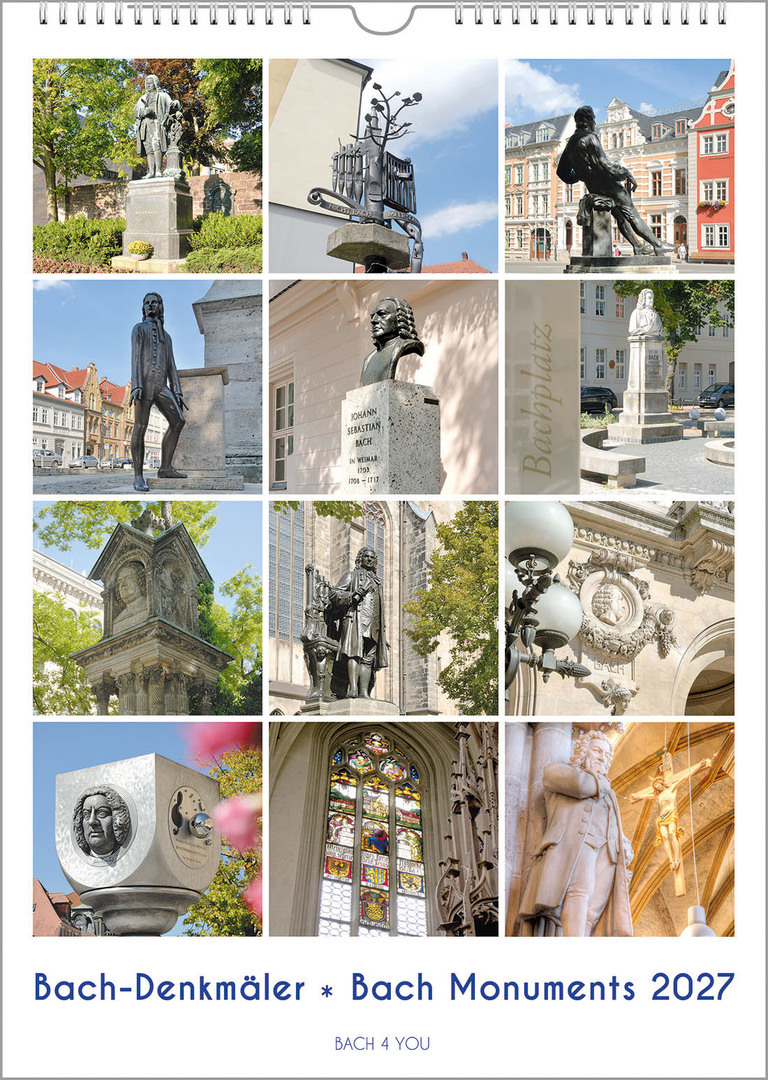
A Bach calendar and a Bach monuments calendar. Three sizes. For this year and next year. In two calendar styles. To the shop..

The Renate Bach Publishing House specializes in Bach T-shirts and Bach seal T-shirts. Visit the shop..
End of Advertisement
 Druckversion