

Bach FAQ 116
Wilhelm Friedemann Bach, Bachs Son ... Was Wilhelm Friedemann Bach Really the Black Sheep in the Family of Musicians?..
So ... was he the “black sheep” of the Bach family? No, no, no! Wilhelm Friedemann Bach was an honest person..
1) The first novelist Albert Emil Brachvogel really spoke very bad about Wilhelm Friedemann Bach. 2) Wilhelm Friedemann Bach ... the picture with "hat and fur"? That actually isn't WFB. But – and this is clearly scientifically clarified – a completely different Bach from the huge family of musicians from Thuringia. But ... it's just not Wilhelm Friedemann Bach..
The "Freundeskreis Wilhelm Friedemann Bach" (... Circle of Friends of Wilhelm Friedemann Bach) in Berlin and in particular Gisela Thielicke as well as the Bach portal "Bach on Bach" and Aryeh Oron with his English Bach portal "Bach Cantatas Website" ...this "handful" of Bach enthusiasts has decided to "rehabilitate" WFB, as insiders call the oldest Bach son every once in a while. This is because both this one image (... the man with the hat and the fur) remains so obstinate. And the novel by Albert Emil Brachvogel does the same. This realization – that the gentleman with the hat and the fur is not WFB and that the book by Albert Emil Brachvogel is just not worth reading – to spread these facts there, where they hopefully will be found more and more in the future – that is, on the internet, on Google and on Bach on Bach, too – that is the declared way of these four hobby scientists in the matter of Bach. And ... that is the reason, why it is the FAQ 116 in our Bach Mission. Related to Wilhelm Friedemann Bach. To the Wilhelm Friedemann Bach, who he really was. And to the pictures that show him how he really looked like back then..
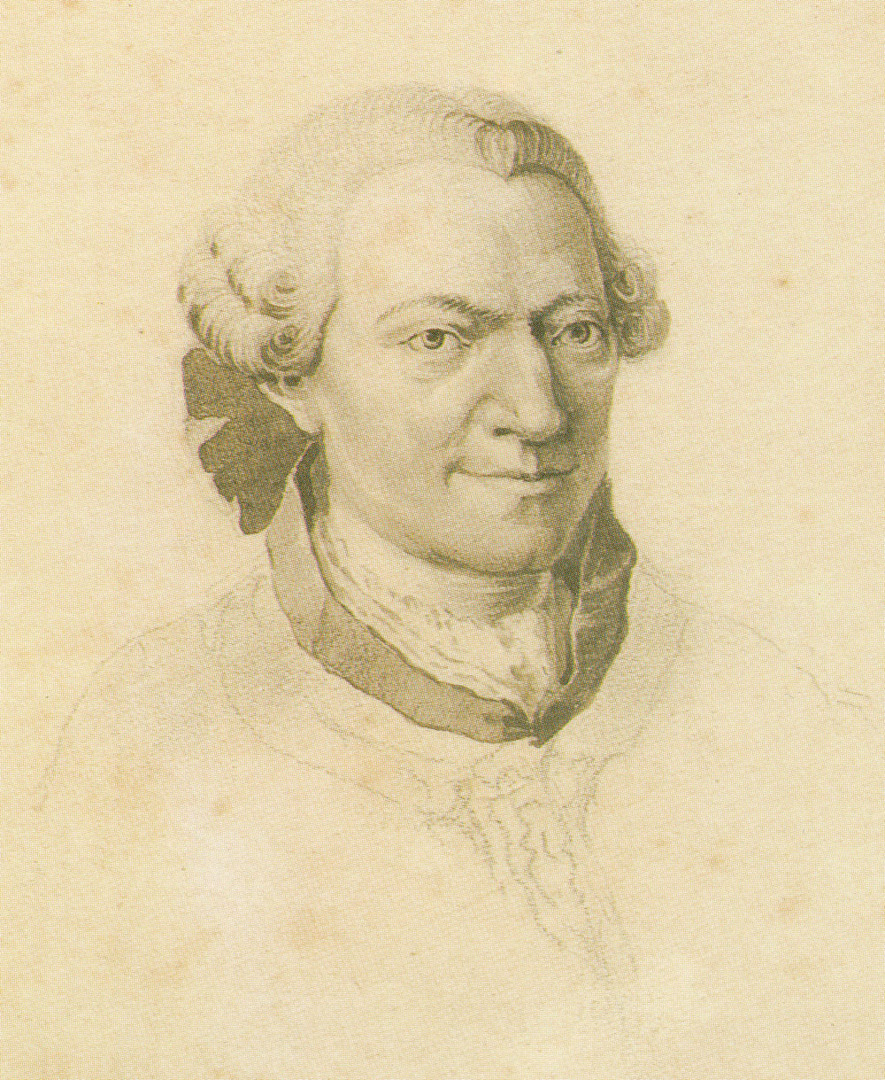
Wilhelm Friedemann Bach? Yes, that's exactly Wilhelm Friedemann Bach. The "gentleman with the hat and the fur," who is, of course, not shown here: This guy is just not Wilhelm Friedemann Bach ... he has never been! And they know that for a long time already! Very long! But ... it seems so very exhausting to start to explain that crystal clear through a competent institution..
Advertisement
Music Gifts and More Music Gifts..

Find out the difference between a European style music calendar and a 50:50 style music calendar … learn more here..

Two of 60 music wall calendars and one of 20 composers wall calendars. Three sizes. This year and next year. European style and US style. To the shop..
End of Advertisement
1 Wilhelm Friedemann Bach ... Who Was Wilhelm Friedemann Bach? Facts, Facts, Facts..
Father of Wilhelm Friedemann Bach: Johann Sebastian Bach..
Mother of Wilhelm Friedemann Bach: Maria Barbara Bach..
Unofficial shortcut among Bach enthusiasts: WFB..
The number of brothers and sisters: 19, which never lived in this number at the same time..
Born: November, 22nd 1710..
Place of birth: Bach city of Weimar..
Date of death: July, 1st 1784..
Place of death: Bach city of Berlin..
Age: 73 years..
Profession: Musician and composer; late in his life one of the first self-employed musicians..
Description among Bach connoisseurs: The "Hallesche" Bach..
Married: to Dorothea Elisabeth Georgi..
The number of children: 3, but only one daughter grew up..
Working places: 1733 to 1746 organist at the Sophienkirche in Dresden. 1746 to 1764 music director and organist at the Marienkirche in Halle, Saale. In 1763 he was appointed Hessisch-Darmstädter Kapellmeister (... band leader), but he did not show up at this position after the end of his employment in Halle..
Special features regarding his life and the time after that: The book author Albert Emil Brachvogel forwarded a very negative impression about Wilhelm Friedemann Bach, and he refers exclusively to his own fantasy. It is the only book in this Bach mission, which we really advise you insistently not to buy and not to read. There is a film about the life of Wilhelm Friedemann Bach, too with Gustaf Gründgens. This film is also based – almost naturally – on the trash of Brachvogel..
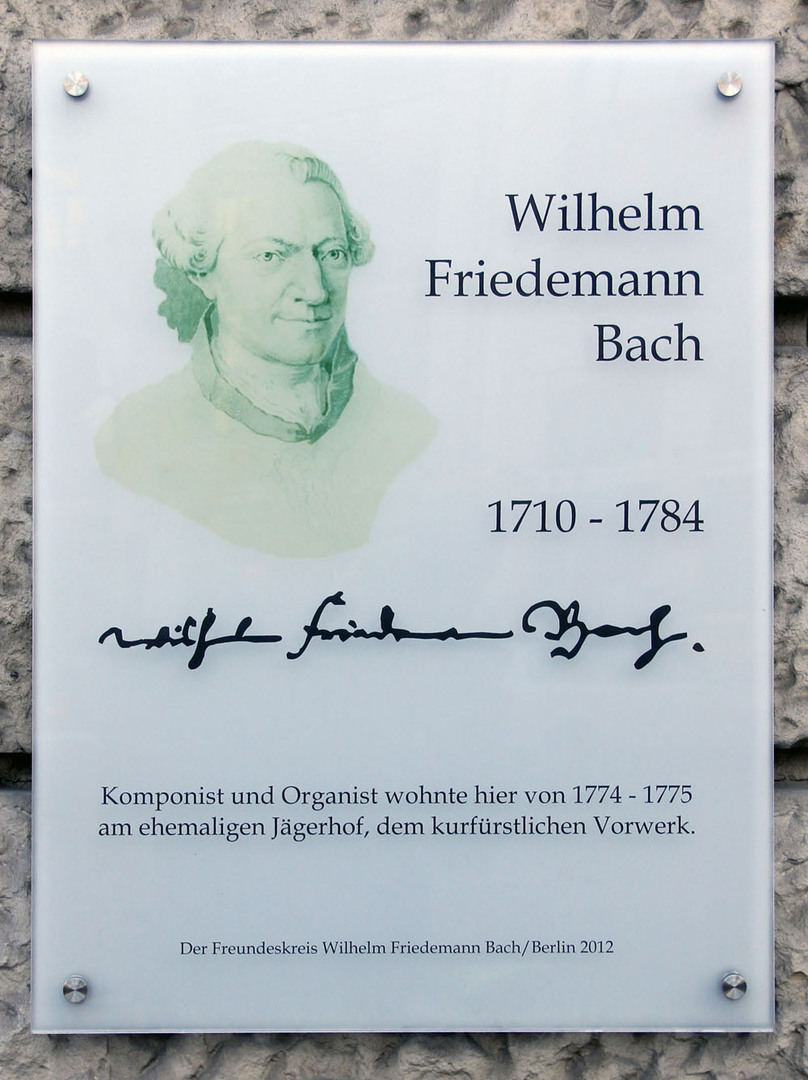
This gentleman on the board in a delicate green – you already saw him above – is Wilhelm Friedemann Bach. That is what he actually looked like! This remembrance in the form of a memorial plaque was initiated by Gisela Thielicke. She was the "driving force" in the "Circle of Friends of Wilhelm Friedemann Bach" and had been working for many, many years to ensure that the image of WFB will finally change again. And namely to the good. Since 2012, the memorial tablet is located precisely where the musician and composer lived in Berlin in 1774 and 1775. You find this memorial plaque in the quarter of Berlin, which is called Berlin-Mitte, namely at the Hausvogteiplatz on the corner of Oberwallstrasse. © Info..
2 Hints Regarding the Wilhelm Friedemann Bach Facts..
The vita of Wilhelm Friedemann Bach – kids in Germany actually use the term of "warrant" for what English-speaking children use the term "facts" – The very short summary above was such a "Steckbrief", such a "warrant" ... almost not possible to explain that better. Funny? Funny! The "warrant" of Johann Sebastian Bach, the "warrant" of Anna Magdalena Bach ... and so on and so on. The vita, the short biography – the one regarding Wilhelm Friedemann Bach – is what you get here and now. The WFB vita to the point. By the way: In the USA, the same result is not what you find if you google "warrant plus name" and it took me months and many interviews with our American friends to figure out what's the same result, when kids in America google, checking on the crucial facts (... now I know) about a person. As I said, ...it is "facts"..
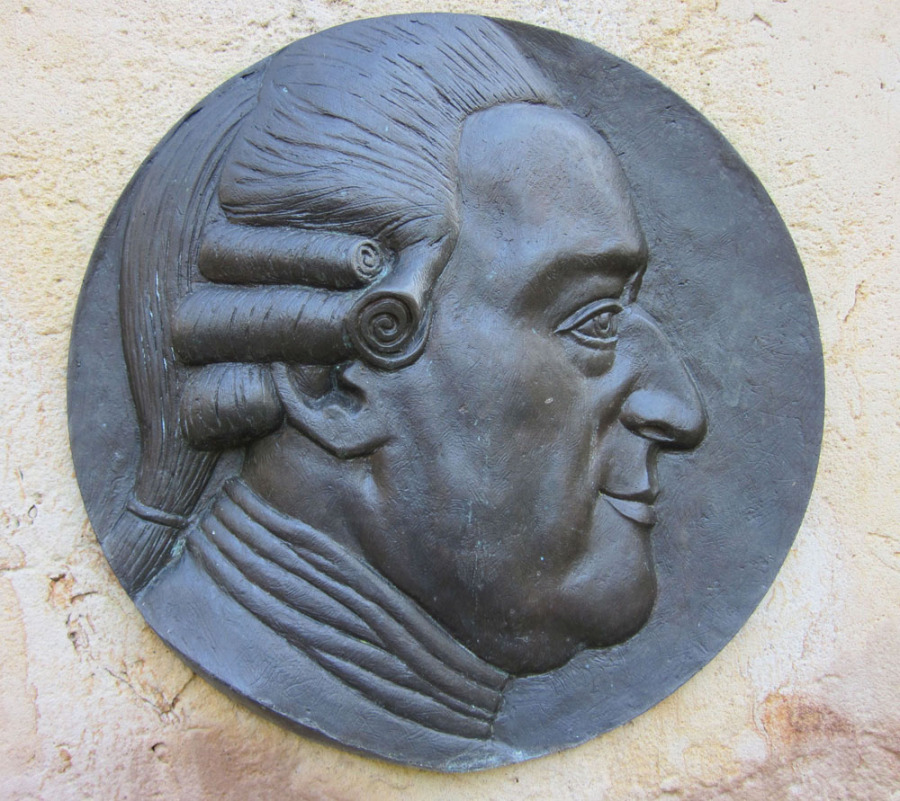
This is Wilhelm Friedemann Bach, too ... on the stele in Berlin to honor him. You find it in one of the green areas in Berlin. It's in Berlin-Mitte, too (... like the plaque; Berlin-Mitte is the name of a district and does not mean the middle of Berlin) at the corner of Alte Jakobstraße and Sebastianstraße. Wilhelm Friedemann Bach is also shown "correctly" – just authentic – in the picture above. And that is since 2002. Two more persons are honored with this stele, and they remind of the Luisenstadt Church in Berlin, which used to have two completely different names in the past. © Info..
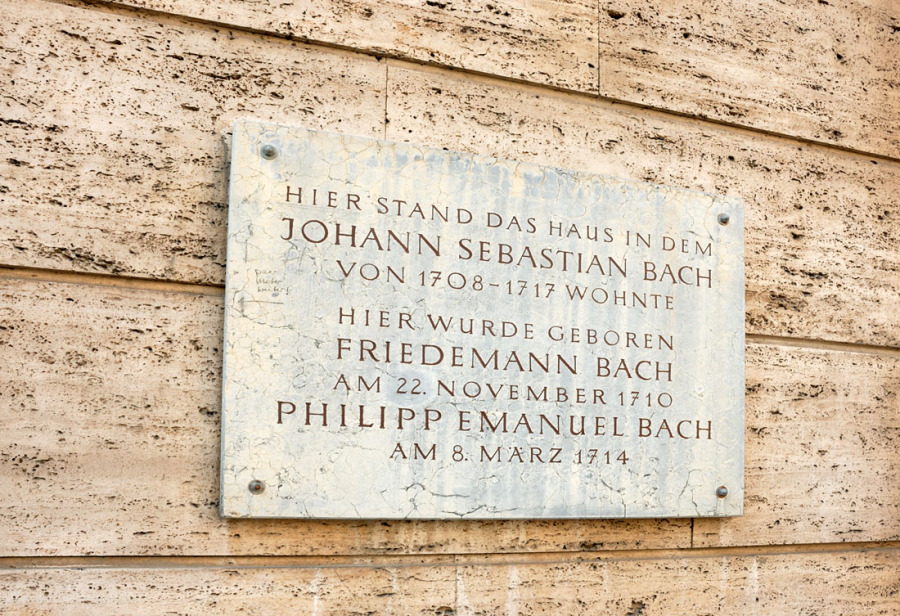
From today's point of view the first honor for Wilhelm Friedemann Bach ... the one in Weimar. Here was the house located, in which WFB was born as the first son and as the second child of the Bachs from Eisenach. Below you may discover in two pictures how that place was looking, what today is a parking lot with a wall around. Plus, you can see the "big picture" with the Johann Sebastian Bach memorial, which you almost miss today, if you do not search for it..
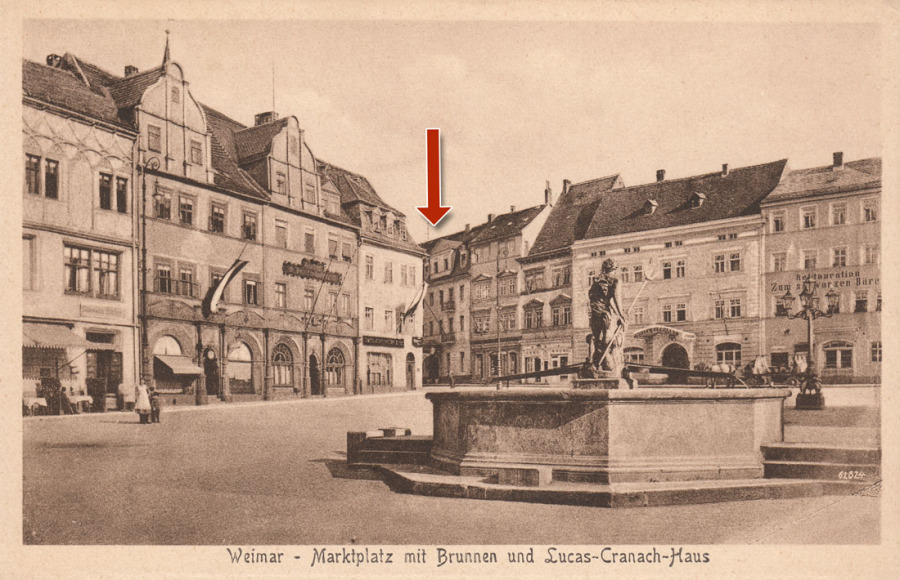
In fact, on this old postcard with the Lucas-Cranach-Haus on the left, you can still see the birthplace of Wilhelm Friedemann Bach and Carl Philipp Emanuel Bach. Exactly behind the fountain is the "Hotel Elephant". Here, in the house under the arrow, is where WFB was born. Anyone familiar with Weimar will certainly find this image particularly fascinating. Those who aren’t familiar with Weimar won’t. But anyone planning a trip to Weimar soon, specifically to follow in the footsteps of the three masters Johann Sebastian Bach, Carl Philipp Emanuel Bach, and finally, and most importantly for us here, Wilhelm Friedemann Bach—should print out this little historical image and simply take it along..
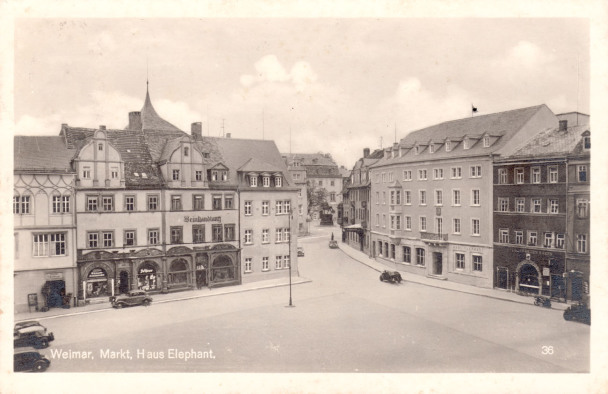
Plus you get a historical "bonus photo", as we found two in our archive when we were looking for just one. Do you see the little canopy at one of the houses on the right side? It is that house. In the middle of the pic, in the background, you see the Red Palace, the Rote Schloss..
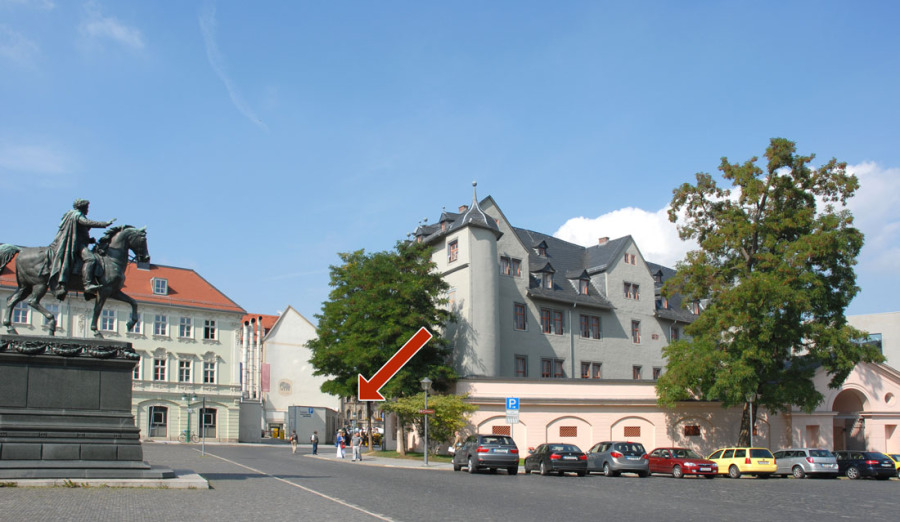
Weimar is "so full" of culture that there is no interest at all in honoring even three musicians of world-class with a museum or a similar place. Three? Sure: First of all, Johann Sebastian Bach, later Wilhelm Friedemann Bach and finally the third famous musician of the family: Carl Philipp Emanuel Bach, second famous son of Johann Sebastian with Maria Barbara. Well, maybe the Bachs simply weren't long enough in Weimar to deserve a memorial site that reflects the world-class of these musicians and this family of musicians. It had been "only" nine years. The arrow points to the wall of the former house in which the Bachs lived back then (... a picture further up you saw the plaque on just this wall). The monument for Johann Sebastian (... in this picture) is so tiny that it has "disappeared" behind one of the trees. But there is a compensation: You get a next photo below..
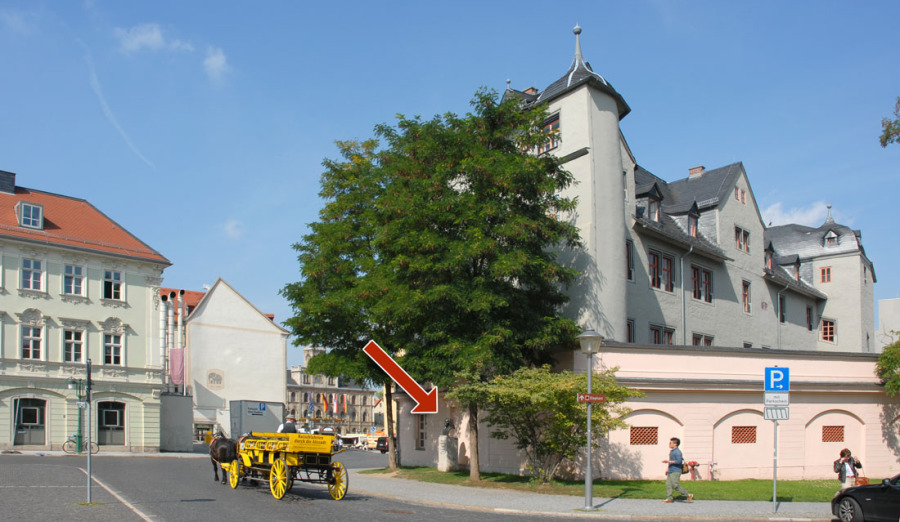
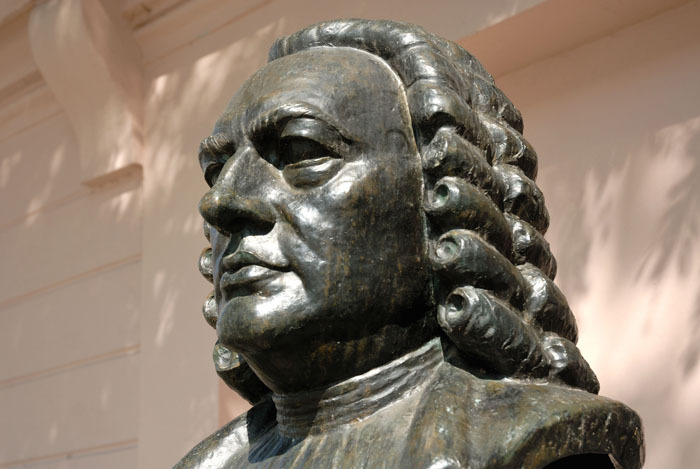
At least the Johann Sebastian Bach monument is not in "garden gnome size" and nobody has to bend down, to admire Bach. And there is one good thing coming with the manageable size: You can easily wipe spiderwebs out of the face of the master ... I mean before you make a photo of him. The Bachs, by the way, lived exactly vis-à-vis of the Red Palace (... Rotes Schloss) and 250 steps away from the town hall..

If you have studied to take pictures, you are able to take pictures of cute teeny tiny miniature monuments and make them impressive "valuations". You just have to approach him a little bit closer, homage him from the bottom to the top, and, as already mentioned, wipe the cobwebs from his face, first. Then it’ll work out just fine with J.S. Bach, too..
Advertisement
Music Calendars and More Music Calendars..
60 music calendars. To the shop..

... and once again, Wilhelm Friedemann Bach’s daddy. But that’s enough of that! Now let’s quickly get back to ... Wilhelm Friedemann Bach. After all, his father only plays “second fiddle” on this page of the website..
3 The Wilhelm Friedemann Bach Short Biography: So ... Who Actually Was Wilhelm Friedemann Bach?..
It was in 1710 when Wilhelm Friedemann Bach was born as the second child of Johann Sebastian Bach and his first wife Maria Barbara Bach in Weimar. It was November, 22nd 1710. He was the first of six musical sons of Johann Sebastian Bach. Two of them even gained more recognition and fame in their time than the superstar of the Bach family – Johann Sebastian Bach – did in his time. In fact, Wilhelm Friedemann Bach was born exactly in the house vis-à-vis of the present Red Palace in Weimar, almost in the neighboring house of the still existing "Hotel Elephant" in the city center of the cultural metropolis. Of course, Wilhelm Friedemann received the first music lessons from his famous father. At the age of seven, he moved with the Bach family to Köthen..
In Köthen Wilhelm Friedemann attended the Latin school. At the age of 13, he finally attended St. Thomas School in Leipzig, when the Bachs had moved again. It is known that at the age of 17 he received violin lessons from Johann Gottlieb Graun and he studied law, philosophy and mathematics two years later, namely 1729. At the age of 22, he first became an organist at the St. Sophias's Church (... Sophienkirche) in Dresden. In April 1746, at the age of 35, he became the music director and organist of the St. Marie's Church (Marienkirche) in Halle on the Saale, where he also directed the school choir and the municipal choir. That is why he is called the "Hallesche Bach"..
In 1764 he ended this office in Halle, now at the age of 53. From this day on, he lived the life of a free-lancing musician, one of the first in this still unfamiliar form of employment at all, but especially in the field of music. This time, until his death in 1784, that is, at the age of 73, had to be completely re-evaluated 230 years after his death. Read much more about it below. Wilhelm Friedemann Bach was famous for his improvisations as an organist and as a pianist. Like many a piece by Johann Sebastian Bach, many works by Wilhelm Friedemann were long forgotten. In Kiev, many of them were found in the inventory of the archives of the Singing Academy Berlin (... Sing-Akademie Berlin). The world owes this find to the Bach connoisseur, Bach author, and Bach scientist Professor Christoph Wolff. In 2010 the Leipzig Bach Archive published a complete documentation in 11 volumes..
Wilhelm Friedemann Bach married 1751. He married Dorothea Elisabeth Georgi. Both had three children, two of whom died very early. Only Friederica Sophia Bach grew up. Wilhelm Friedemann Bach died in 1784, and an obituary was written in the "Magazin der Musik" (... magazine of music): "Germany lost its first (... best) organ player and thus the world lost a man who is irreplaceable as a musician." It is interesting to note that today Johann Sebastian Bach, the father of Wilhelm Friedemann Bach, is considered the best organ player of all time..

Wilhelm Friedemann Bach? Yes exactly. Wilhelm Friedemann Bach. But where is the hat and the fur collar and: the fancy glove, too? We apologize for any inconvenience: not on this page of my website! And as well not on the whole website. This page about Wilhelm Friedemann Bach – on which you are currently reading – has exactly two goals. First of all, we want to inform you about this music expert. And that's right on Google page (... in the future). But ... I also want to clarify two things as well: Wilhelm Friedemann Bach never looked as he is still (... it is the year 2016) so often portrayed on Google. That is, exactly 31 times with black hat, fur collar and a glove in his little paw. And – in addition – Wilhelm Friedemann Bach had never been the personality, that Albert Emil Brachvogel had described a really long time ago. The "Freundeskreis of Wilhelm Friedemann Bach" (... Circle of Friends of Wilhelm Friedemann Bach) had been working on these three areas for around 20 years..
4 The Wilhelm Friedemann Bach Biography ... Up-to-Date, Fair, and Above All: Correct!..
Dr. Ulrich Kahmann. On a whole different path compared with the efforts of Gisela Thielicke and that one of our Bach Mission, this book author rehabilitates the first of the Bach sons, namely Wilhelm Friedemann Bach. He accomplishes it with his biography about the musician. A cordial correspondence with this specialist on the subject of WFB and his help in various forms, lets me, the author of this, my website, present the book author Dr. Kahmann exactly here. Isn't that covered surreptitious advertising? Right, caution. Promotion. It’s also an advertisement for his book, and the “Bach 4 You” Publishing House earns a few cents if you buy this book there. End of advertisement..
Kahmann is just the perfect author on the subject. And almost nowhere else you can get better and more detailed information on the topic "Wilhelm Friedemann – How he really was". This, by the way, is not the subtitle of his book. So it is no surreptitious advertising here ... but proper advertising. For his book. For a joint theme. For your orientation. And now comes the ultimate service: You get to Kahmann's book about Wilhelm Friedemann directly via the following link. And if you order the top work directly at the Aisthesis Publishing House, the team around the publishing house and the author is the most pleased. Oh, you wanted to know the exact title? Here it is: "Wilhelm Friedemann Bach – The Underestimated Son". One fly in the ointment: It's in German only. Sorry, folks..
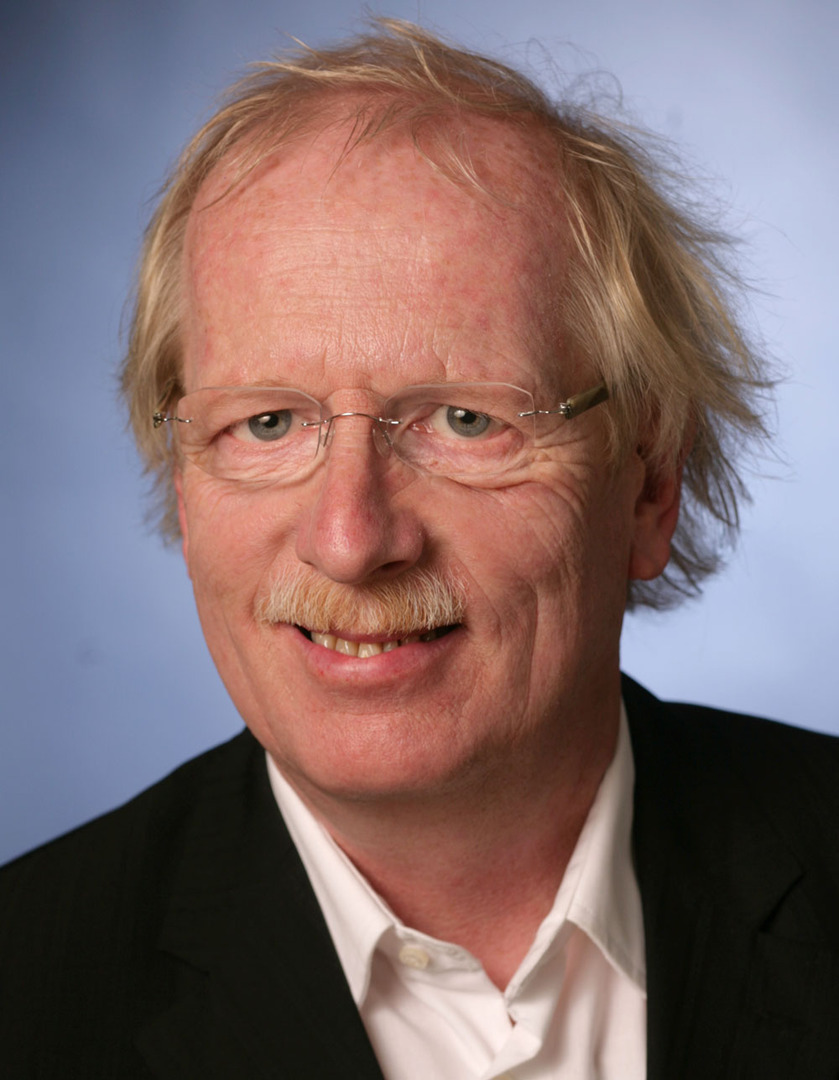
This is how the author looks. Author of "Wilhelm Friedemann Bach – The Underestimated Son": Dr. Ulrich Kahmann. His book was published by the Aisthesis Publishing House in 2010. This is our ultimate recommendation when you want to get to know the first son among the four composing Bach children – who, like two other siblings, was born in Weimar. Of course, then with the correct picture on his book cover, not the "Weitsch picture", from which the world can not free that easily. And, of course, Kahmann writes in a German that is spoken today and not in the 1913 counterpart, when Martin Falck began the common WFB mission some 100 years ago. © Dr. Ulrich Kahmann..
In Our Bunch the Fourth..
Johann Sebastian Bach had six sons who were musicians. One of them is now regarded as the enfant terrible of the six. Among the four well-known and the two famous Bach sons. We have Aisthesis Publishing and Dr. Ulrich Kahmann to thank for the fact that you can now learn about Wilhelm Friedemann Bach through an engaging and, above all, contemporary work ... written in the German spoken today. Dr. Kahmann’s work was published by the aforementioned Aisthesis Verlag very recently ... relative to the extremely long period since Wilhelm Friedemann’s birth. This book is so fresh, in fact, that you can almost still smell the ink..
Why Dr. Kahmann gets such a prominent place on this, our page about the oldest of the Bach sons? Well, this is because in the beginning – in the first version of this page – he had not been mentioned here at all. However, Gisela Thielicke (... I will present her impressive life performance in the subject "Wilhelm Friedemann Bach" further below) wrote to me – when she read about our joint project on this page – that I absolutely ( ! ) should mention the book of Dr. Kahmann and his enormous performance, too. What I had not yet done. I wanted to do that of course. Because Dr. Kahmann supported me so heartily, promptly and firmly in the matter of "Wilhelm Friedemann Bach", I thought that with his publication, he is one more combatant – even earlier than I – to get involved for the truth around the oldest of the Bach sons. So now we are four meanwhile: Gisela Thielicke, Dr. Kahmann, and we two Bachs, with our common "Bach Mission", too. And ... of course, Dr. Kahmann was "on Wilhelm Friedemann's side", long before we – the author of this page and my wife – finally followed in 2016. Just Gisela Thielicke ... she was there even earlier..

With the following text the publisher presents the work of Dr. Ulrich Kahmann (... admitted, the text is a little extreme edited by me; note by Peter Bach, Jr.): Of the six musical sons, the firstborn son of Bach has long been regarded as the "enfant terrible ": Wilhelm Friedemann Bach. Already in the time of Johann Sebastian Bach, he as a composer stood in the shadow of his younger brother Carl Philipp Emanuel Bach. However, he became famous by the unmusical and untrue report about his life. In 1858, Albert Emil Brachvogel made him well-known and he stylized him as a vagabond. In a novel. The author Carl Hermann Bitter finally achieved the disadvantageous reputation of Wilhelm Friedemann Bach – exactly ten years later – when he marked him down a further step: He made him the "faulty" son of the gifted Johann Sebastian Bach. And so until the present day, the reputation of a failed genius is still attached to him. A genius, however, who finally had lost his fight against alcohol in a fogging and died completely destitute as one of the first independent musicians..
Advertisement
Music Calendars and More Music Calendars Are Music Gifts and More Music Gifts..
Please support our Bach Mission … learn more here..
It's the Music Calendar Publishing House "Bach 4 You", where you find so many music calendars in two calendar styles … learn more here..
End of Advertisement
700 Biographies About JSB ... But There Are Just a Handful About Wilhelm Friedemann Bach..
Yes, I could have thought of that myself and included a list of publications on the subject of Wilhelm Friedemann Bach. But I didn’t. And thanks to Dr. Kahmann: He didn’t just mention it. He included a list right away. I sorted it a bit by publication date, and thankfully, there isn’t one biography after another. Unlike with Wilhelm Friedemann’s father..
Unfortunately, unfortunately, the list begins with the “work” of Albert Emil Brachvogel. But he won’t get a link here. Of course not. It was in 1858 when he concocted his “quark” about the eldest of Bach’s sons. Carl Hermann Bitter continued Brachvogel’s campaign against the poor Bach son, and that happened exactly ten years later, namely in 1868. He won’t get a link from us for that either. Not for that. Heinrich Bellermann was the third in the 19th century – seven years later, in 1875 – to speak out about the eldest of the four composers who carried on the family tradition in the Bach household. Whether this turned out to be negative as well, in the tradition of the two authors mentioned above... or whether he was the first of the “redemptors” (... is that even a word?), I intend to clarify soon – if I find the time to read again – and then mention it here..
For more than three-quarters of a century, Brachvogel’s novel had time to steadily spread its message throughout the world of Bach enthusiasts. For even if Bellermann had already begun – though we do not yet know this – to accurately portray WFB’s life ... he certainly did not achieve the same level of popularity as Albert Emil Brachvogel’s novel..
In 1953, Wilibald Gurlitt wrote about Wilhelm Friedemann. In 1964, Hans Franck joined the effort with his book "Friedemann", a work that, though little known, is refreshingly free of prejudice. And Percy M. Young dedicated Chapter 9 of his 1978 work “The Bachs” to him. Friedrich Wilhelm Bautz followed in 1990, and in the third millennium, a creative title on the subject was finally achieved. Michael Heinemann added the subtitle “The Quarrelsome Son” to his biography of Wilhelm Friedemann. That was in 2005..
David Schulenburg was the next to write about the musician from Weimar. Finally, in 2010, Dr. Ulrich Kahmann became the penultimate author to contribute. He added “The Underrated Son” to our hero’s name ... we highly recommend his book – by “we,” I mean Mrs. Thielicke, my wife, and myself – in particular, by the way. In the same year, he also published “A False Image of Wilhelm Friedemann Bach” in "Tonkunst". "Tonkunst" is a magazine dedicated to “Classical Music.”..
The final author on this topic is Daniel Hensel. This makes his work the most recent on WFB. Incidentally, it serves as the perfect complement to Dr. Kahmann’s biography. For while the latter focuses primarily on the life and work of Bach’s eldest son – and delves less into musical detail – Daniel Hensel does exactly that and offers important new insights in his text. Into the compositions of Wilhelm Friedemann Bach..
So, precisely on the 300th birthday of the composer and musician Wilhelm Friedemann Bach in 2010, a biographical study – that is, Dr. Kahmann’s book – contradicts the image of Wilhelm Friedemann that Brachvogel and Bitter have presented: Wilhelm Friedemann Bach was a man driven by inner turmoil. Not only did he face enormous challenges in the immense shadow of one of the most famous musicians of all time, but he also had to grapple with the challenge of finding his proper musical place during the transitional period from the late Baroque to the then-modern Classical era..
The biography about Wilhelm Friedemann Bach of Dr. Kahmann is probably the fourth which came into being after the work of Martin Falck, who – with his biography about the Bach from Halle (... the "Hallenser Bach") layed the foundation for the fair and correct classification of W. F. Bach. 100 years after the first approach 1913, 2013 followed an exciting rectification..
Dr. phil. Ulrich Kahmann is an independent author and has specialized. His area of expertise are portraits of musicians, which he primarily produces for radio stations. Dr. Kahmann is living in Herford, Germany, and he teached at the University of Klagenfurt, Germany and the music scientific seminar at the University of Paderborn, Germany. Okay, that's a short information about the work and the person behind. Here is the link to the book again: "Wilhelm Friedemann Bach – The Underestimated Son" by Dr. Ulrich Kahmann, published in the Aisthesis Publishing House..
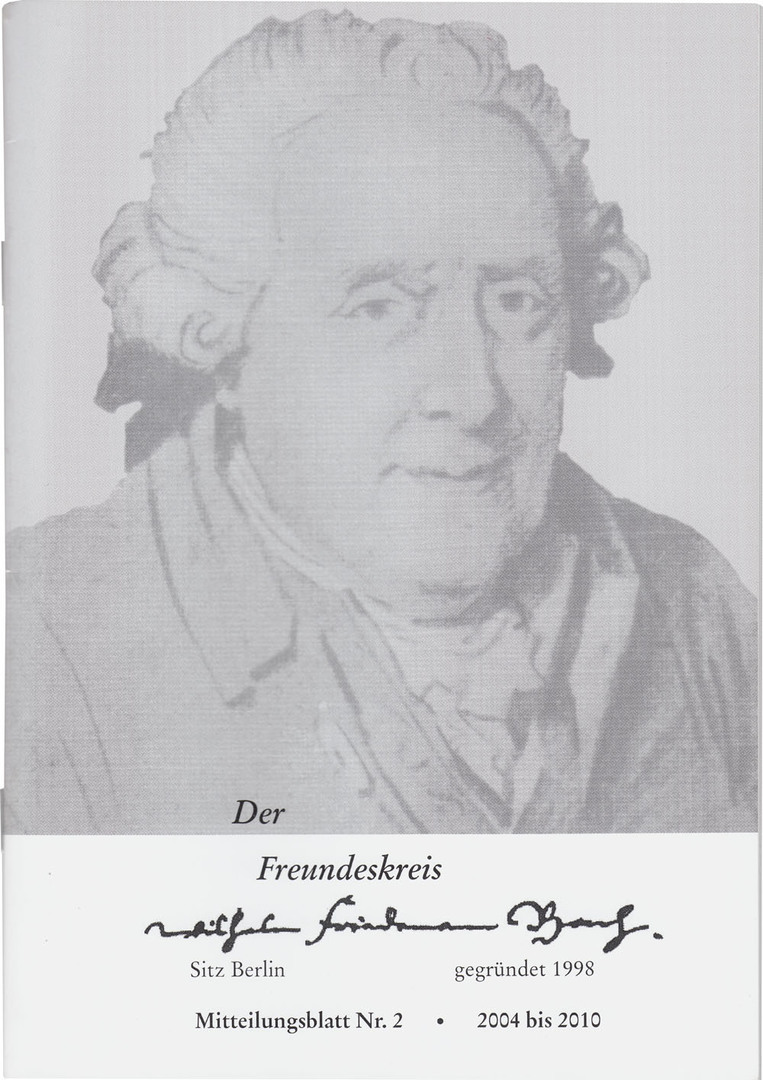
The Wilhelm Friedemann Bach Circle of Friends was, first and foremost – and for nearly two decades – Gisela Thielicke in Berlin. It is also thanks to her energy, her dedication, and her tireless work that the musician Wilhelm Friedemann Bach has finally received the recognition he deserves today. And this is true worldwide. Unfortunately, we only had a relatively short time together “in matters of Bach.” Gisela passed away far too soon..
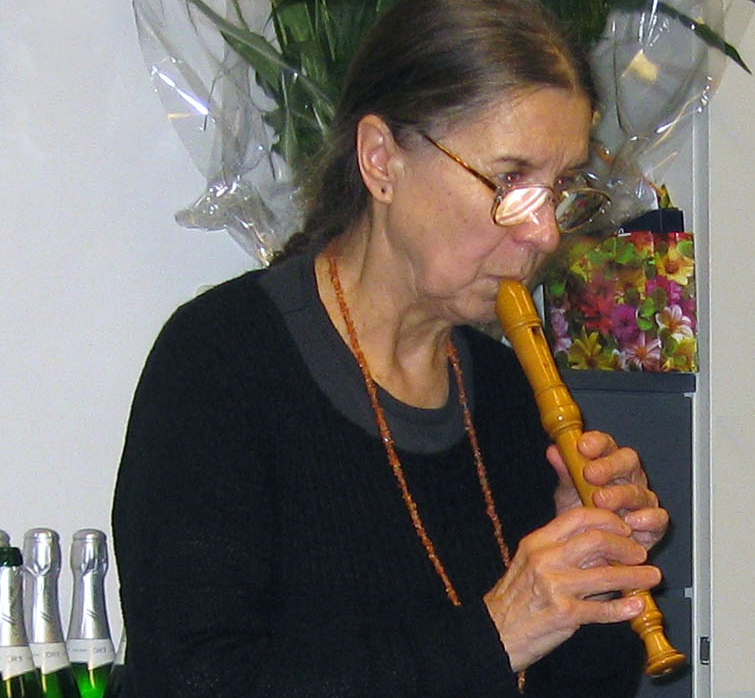
Honor to whom honor is due. Without Gisela Thielicke from Berlin, the so-called Weitsch portrait (... a man with a hat, fur coat, and gloves) and the “rubbish by A. E. Brachvogel” would still be teaching nonsense to our children and our children’s children in the third millennium. The researcher, we at “Bach on Bach” , and the author Ulrich Kahmann want to see if we can change that. Long live Wilhelm Friedemann Bach..
The Biography About Wilhelm Friedemann Bach ... But Please Not by Brachvogel..
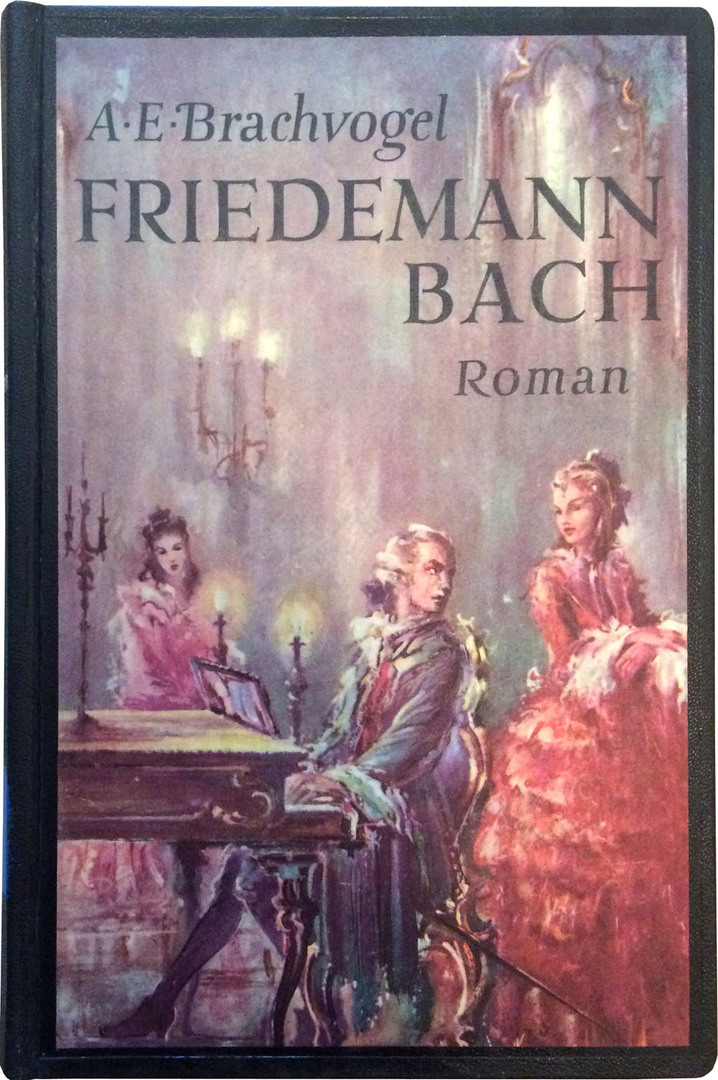
The reviews of Brachvogel’s book by several Bach enthusiasts, as well as by serious researchers and amateur scholars? Rubbish, rubbish, rubbish³. Would you prefer to read a scientific article without any nonsense? Then please read the next chapter..
Wilhelm Friedemann Bach: The Reevaluation of His Personality..
From the music magazine "Der neue Merker", written by music critic Helmut Batliner, Vienna, April 2nd, 1998. Here the copy from the newsletter number 2 of the Circle of Friends of Wilhelm Friedemann Bach, Berlin from November 2010:..
In 1858, Johann Sebastian's oldest son became a "novel hero". The book "Friedemann Bach" was published by Albert Emil Brachvogel which is read in many editions up to the present day. Its content was the basis for an opera by Paul Graener (1872 -1944). In the 1940s, it also served as the basis for a UFA film starring Gustaf Gründgens in the title role..
The book, the opera, and the film have contributed destroying the overall personality picture of this exceptionally talented musician. Brachvogel's dedication in the second edition of 1859 was: "To His Royal Highness, Carl Alexander, Grand Duke of Saxony-Weimar-Eisenach, and Her Royal Highness, Sophie, Grand Duchess of Saxony-Weimar-Eisenach, née Princess of the Netherlands, the sublime friends of art in the most profound reverence devoted from the "author", "and a book so devoted to" high personalities can not be bad at all. But this writer was only interested in portraying Johann Sebastian’s most beloved son as a wayward one, and he succeeded. Friedemann was not the scoundrel who passed off his father’s compositions as his own; he was not the “menace to society” described in the account, the aimless vagrant, or the occasional drinker. Not a single word about the love affairs at the Dresden court is true..
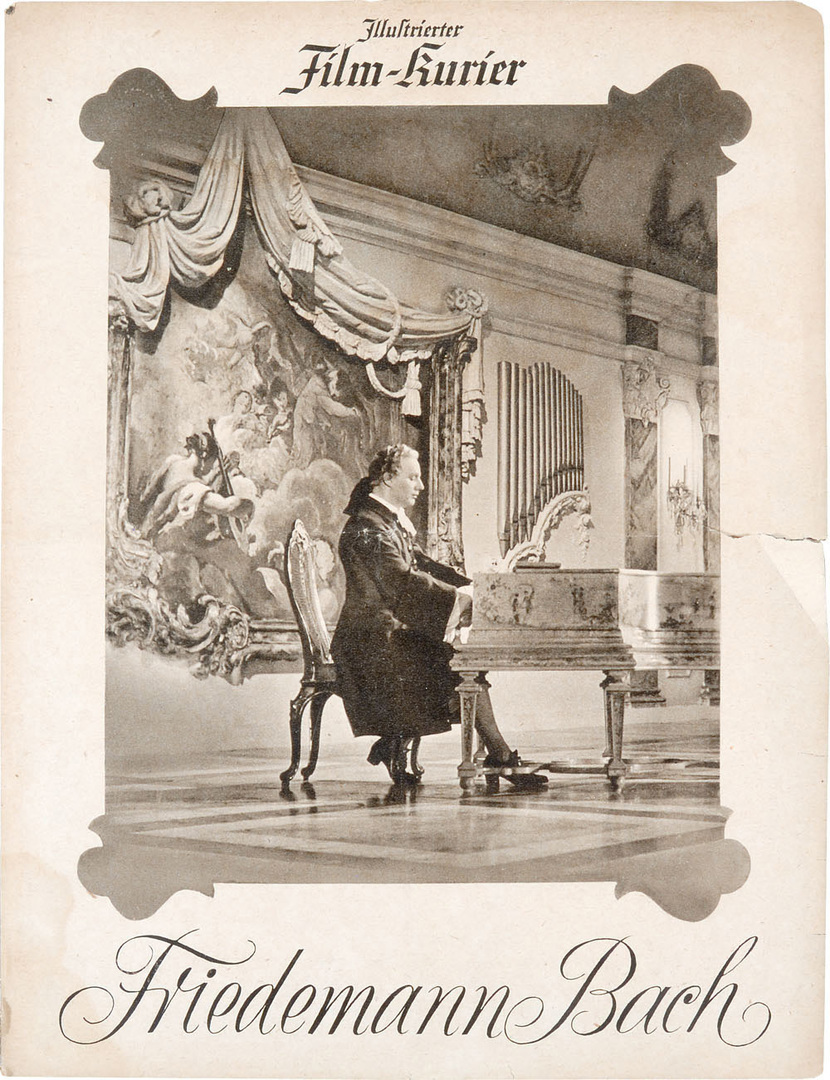
Sure, if the first writer comes up with total garbage, why should the next one even bother?! Just like the book, and the opera too, and of course ... later the movie as well..

We didn’t make this easy for ourselves. Should we feature the “gentleman” ... up there ... or should we not feature “this gentleman” on this page? He certainly doesn’t deserve it. But: Maybe Google will help us get more and more people here ( ! ) to read about Albert Emil Brachvogel, whom you are also “free” to call A. E. Brachvogel. He was practically the Roland Emmerich of his time. Just a negative version. But back then, no one was thinking about aliens yet. So one last time: You have this page to thank him for! Albert Emil Brachvogel. Please don’t buy his book! By the way: Emmerich is cool and nice..
Further on with what we would call a "right of reply" today (... Editor's note):..
The following quote may shed light on this gentleman’s inventive genius: an officer is said to have driven with Father Bach to Königstein Fortress to bring Friedemann – who had been imprisoned for an affair with Countess Kolowrat – back to freedom: “That he is at Königstein is certain; the coachman definitely told me that he brought him there. At that very moment, distant voices and the clanging of weapons could be heard. “My son, my son! ... Friedemann!” A roar, a shrieking sound answered him, and from the circle of soldiers, the son rushed toward his father. “Hi-hi! Having such fun in the moonlight? – Hahahahaha!” Sebastian had his son back, but he was mad!..

The signature of Wilhelm Friedemann Bach..
In the second volume, Friedemann supposedly recovered thanks to the loving care of his relatives. And as you read the book, you find yourself wondering who was actually mad. If Brachvogel had conducted thorough preliminary research on this figure rather than simply scribbling down baseless notions, a more accurate picture would have emerged. The passages in which Father Bach had to give concerts before the king and the nobility show empathy and are convincing. But he also had the father say that Friedemann “... would never make it!”..
What was he supposed to “achieve”? Friedemann was too well educated musically and recognized himself just how immense his father’s artistic shadow was. He also knew that he could not “get past” it and had other, perhaps even new, paths to take. The “noble friends of art” and all readers over the past 140 (... now 160; Editor’s note) years must have been outraged and deeply puzzled to read about such an eccentric artistic existence. In his unrestrained and irresponsible writing frenzy, this man (... Brachvogel) did not concentrate on the so-called biography, but rather compressed everything. This assertion stands even if one knows not only that Friedemann was not a scoundrel, a terror of the bourgeoisie, and a drunkard, but also an exemplary citizen, an orderly church official, and a prohibitionist. But worlds lie between facts and emotions..
Three pictures ... then the text goes on (Editor's note)..
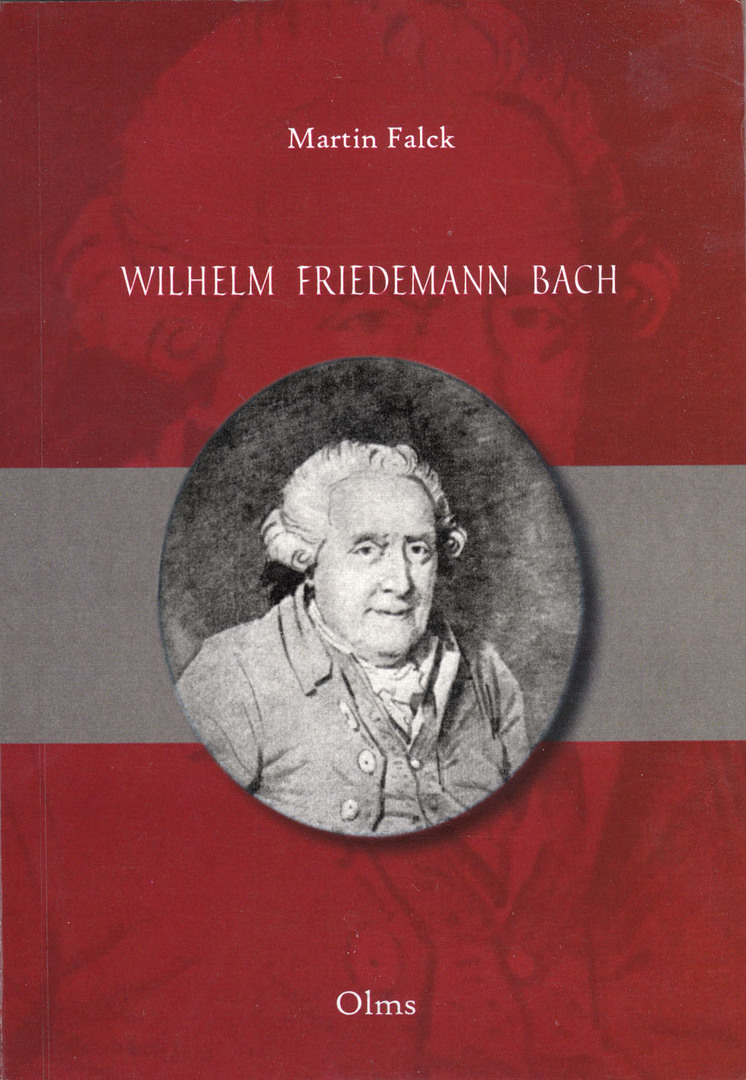
Advertisement begins. It has been about 100 years since someone who really knew his stuff wrote about Wilhelm Friedemann Bach: Dr. ( ! ) Martin Falck. You can still buy a new copy of this little book today. At Bach 4 You. For example. Advertisement ends..
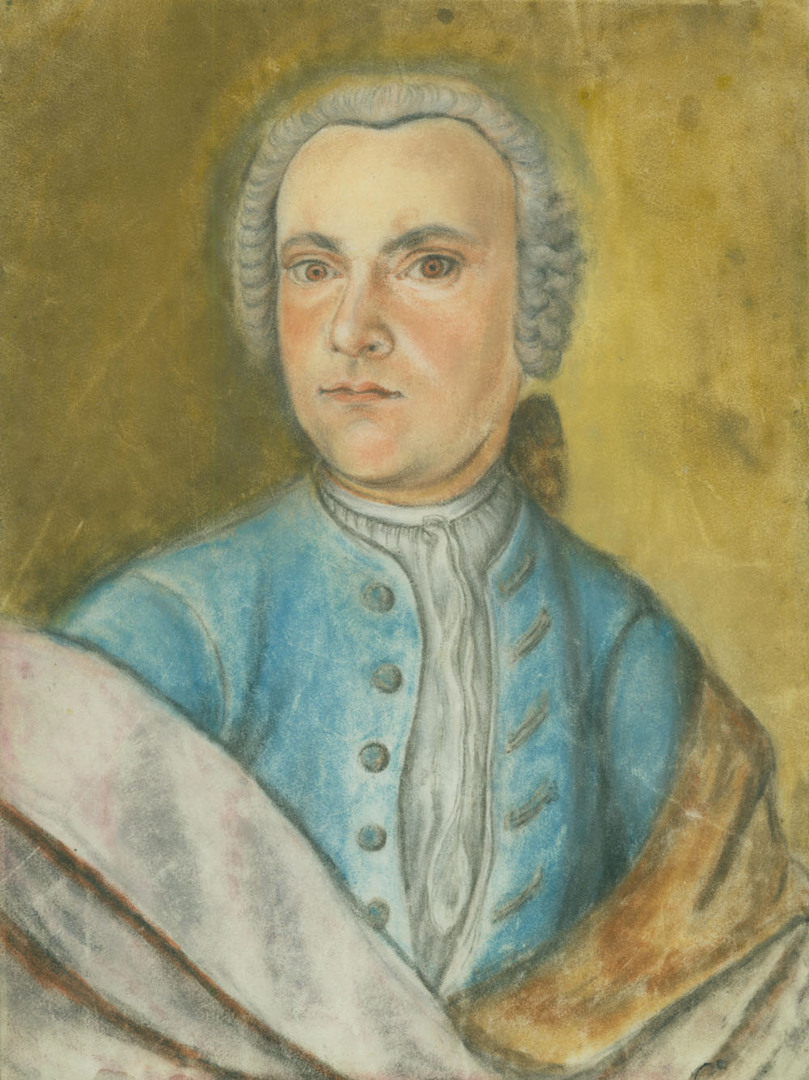
Wilhelm Friedemann Bach, slightly younger ( ... © a very heartfelt thank you to the director of the Bach House in Eisenach for allowing us to display this image here). © Dr. Jörg Hansen..
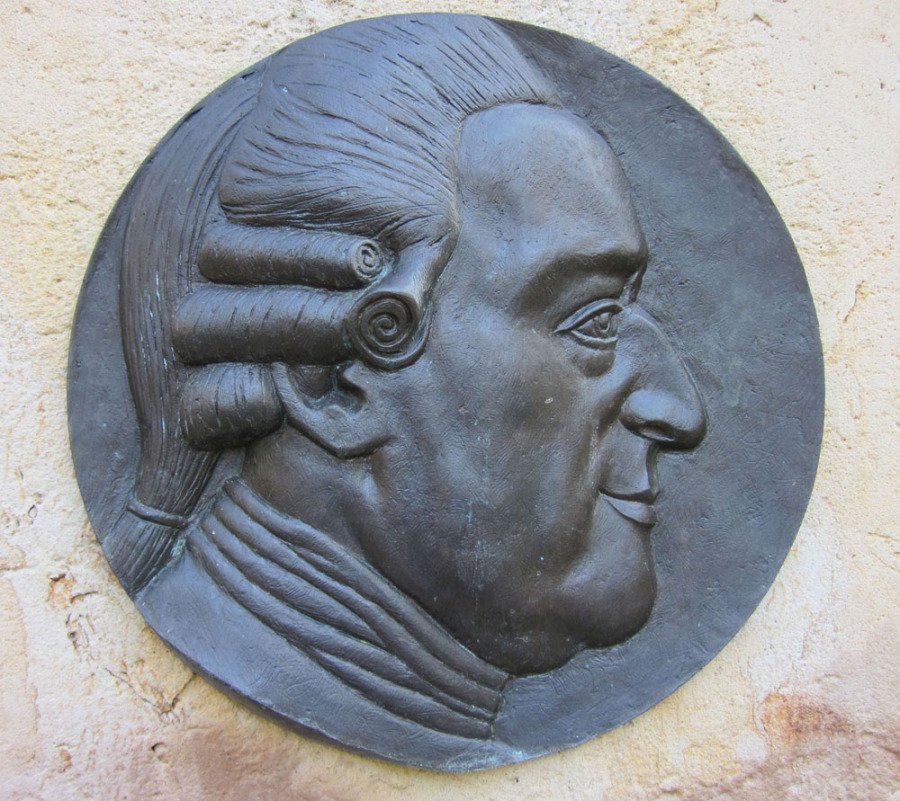
... and once again Wilhelm Friedemann Bach, like already above, a little older. © Here, I would also like to thank the Stiftung Stadtmuseum Berlin. They provided me with this excellent image of the composer and musician to share online..
Advertisement
Bach Busts, Bach Statues, Little Bach Men..
Please support our Bach Mission … learn more here..
Martin Falck scientifically documented the differences listed above in a dissertation in 1913. To this end, he assigned opus numbers to Friedemann’s compositions known at the time (... Sinfonia in F major, Falck 67, “Dissonant Symphony”). The dissertation proves that Brachvogel’s book, in everything concerning Friedemann, is a hoax from beginning to end. Dr. Falck did not live to see the second edition of his monograph – which emerged from his dissertation – in 1919, as he was killed in action during World War I (... a third edition was published in 1956 by Verlag Kahnt, Lindau). His work stands in deliberate and stark contrast to Brachvogel’s book and accepts only indisputably documentary evidence..
Drawing on Falk’s foundational work and his own research, Hans Franck wrote a biography titled “Friedemann” (... published in 1964 by Kreuz-Verlag, Stuttgart; available in used book stores). In it, he brought the life and work of Bach’s son to life through genuine empathy: Franck did not act as an “inventor.” He acted as a discoverer. He did not impose his own interpretations. Rather, he strove to be an “interpreter.”..
Friedemann Bach mastered the Baroque style like few others. Yet he was equally enthusiastic about new sounds; his musical superiority often led him to shift back and forth between the new and the old. This confused his contemporaries at the time. They certainly admired his harpsichord and organ playing, but above all they were enthusiastic about his improvisational artistry. They were mostly at a loss when it came to his creative work with sound..
In the Berlinische Nachrichten (... Berlin News) in 1774, one could read about a concert he gave. Everything that delights the senses ... novel ideas, striking deviations, dissonant phrases ... presented the image of a master of his craft. A transitional phase, in which tastes and demands were changing rapidly, also saw the harpsichord, with its limited expressive possibilities, give way to the piano. His thirst for freedom was so great that he – like Ludwig van Beethoven later on –refused to perform at concerts he had been commissioned to play. And this in the 18th century. His self-confidence – he was ahead of his time – also made him the first freelance artist in an era where everything was “connected.” Such a “job description” did not exist back then. In the eyes of his contemporaries, this made him the headstrong, grumpy son of the great Bach father, who himself gradually faded into obscurity..
It continues further on, below the Clavier-Büchlein vor Wilhelm Friedemann Bach by his father, Johann Sebastian Bach (... Editor's note)..
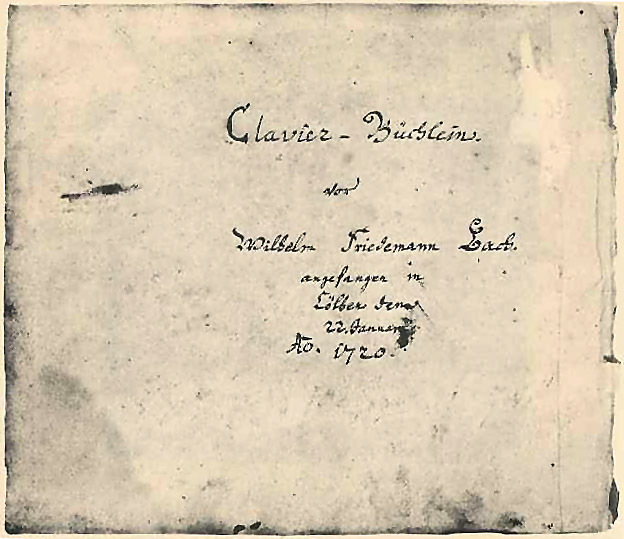
Of course: This cannot be missing on a page like this: the Clavier-Büchlein vor Wilhelm Friedemann Bach (... the “Little Piano Book for Wilhelm Friedemann Bach”. By daddy. For learning. For practicing. And for this website. Some 300 years later. So that’s how far ahead the super Bach was thinking back then. Thank you, J.S.!..
A copy of Friedemann’s Concerto in F Major (... Falck 44) found its way into the hands of his former Berlin student Sara Itzig, née Levy, who turned out to be Felix Mendelssohn Bartholdy’s great-aunt. Perhaps this was the root that made it possible to revive the forgotten St. Matthew Passion in the first place..
After a pneumonia Wilhelm Friedemann Bach died in 1784 and left his wife and his daughter back in poverty..
The obituary published at the time in Cramer’s Magazine of Music read: “Germany has lost its first (…and at that time best) organist, and the musical world has lost a man whose loss is irreplaceable.”..
Only very few of Wilhelm Friedemann Bach’s compositions were ever printed. However, many copies were in circulation. Thus, it came to pass that one of these copies (... Suite in G minor for harpsichord, 2 violins, viola, cello, and bass) bore only the designation “Bach” and remained attributed to Johann Sebastian (...BWV 1070) for a long time. This has since been proven to be an error..
Mozart’s studies of the music of Bach and Handel also resulted in arrangements of fugues from the Well-Tempered Clavier (... for violin, viola, and cello), as well as the 8th Fugue in F minor. These were eight fugues for harpsichord dedicated to Princess Amalie of Prussia. Mozart is said to have prefaced these Bach fugues with his own adagios. However, since no manuscripts of these exist, this is not certain. (... but they sound wonderful!). Friedemann’s surviving works, which have been released on CD, are filled with a wealth of imagination and emotion, captivating expressiveness, and lyrical sentiment in the slow movements. He also astonished listeners with his bold harmonies..
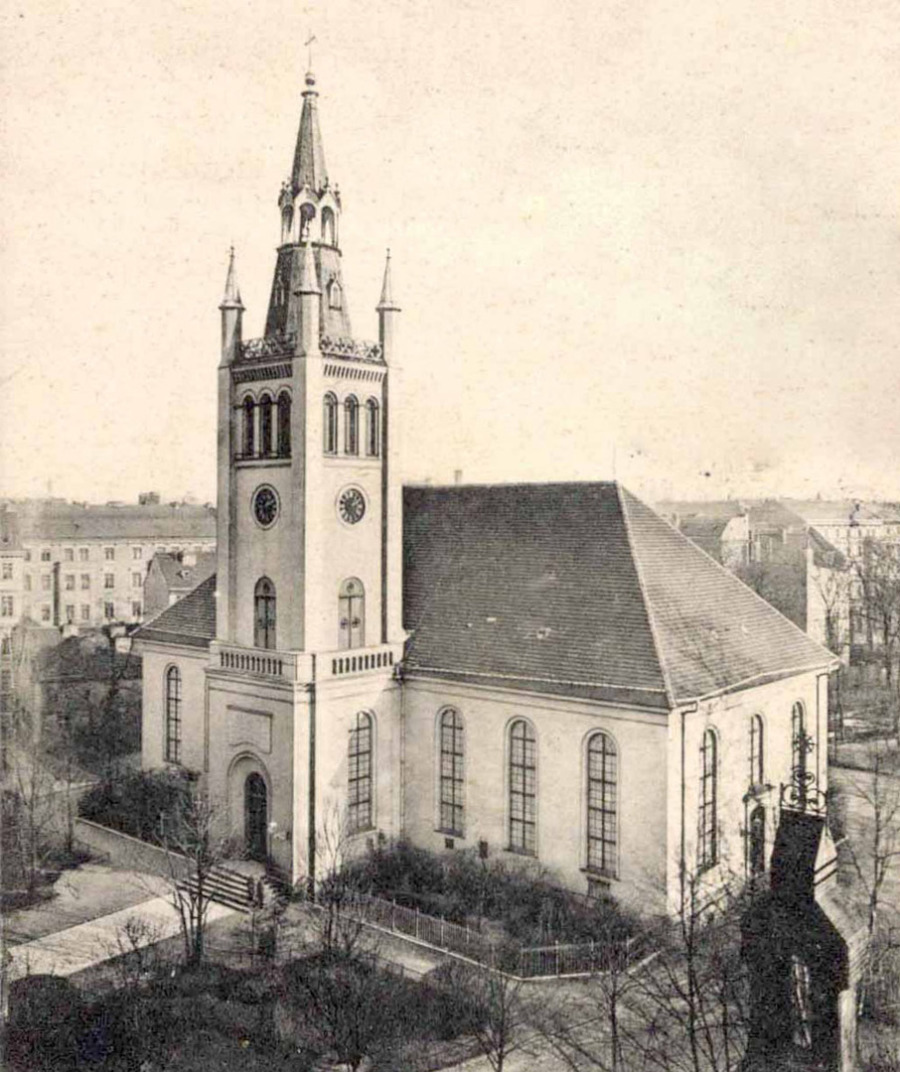
Wilhelm Friedemann Bach was buried in the cemetery next to what was then known as St. Sebastian’s Church. Later, it was called Köllnische Vorstadtkirche, and from 1802 onward, Luisenstadt Church. He died in utter poverty. And just as shown above, this is what the church looked like before it shared the fate of many historic buildings during World War II following one of the bombing raids..
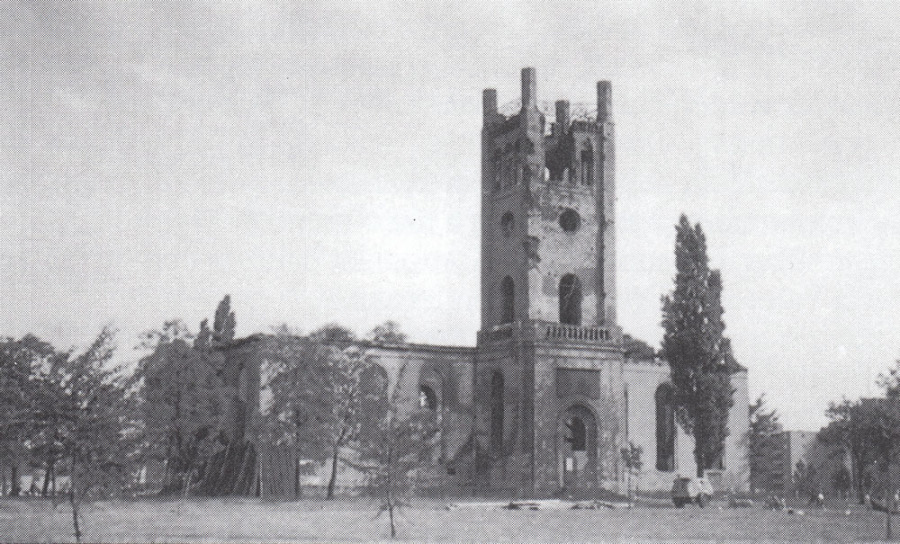
With the demolition of the ruins of the Luisenstadt Church, the memory of Wilhelm Friedemann Bach initially disappeared as well. Prior to this, a plaque had commemorated the musician..
The Circle of Friends of Wilhelm Friedemann Bach in Berlin Since 1998..
It was 1998. That was when plans were first conceived to establish a Circle of Friends in honor of the musician Wilhelm Friedemann Bach. The society’s mission was to permanently rehabilitate the gifted composer and pianist Wilhelm Friedemann Bach. To this end, the aim was to reach as many writers as possible to remove the image depicting a “gentleman in a black hat with a fur collar and gloves,” from their works and to replace it with an authentic portrait of Wilhelm Friedemann..
Also in 1998, the decision was made to establish such a circle of friends. Alongside Gisela Thielicke in Berlin, who remained committed to this goal until her death, the founding members included Klaus-Norbert Kremers from Krefeld and about ten – later 150 – other enthusiastic supporters..
Even before 1998, there was a Bürgerverein Luisenstadt e.V., which in 1998 intended to have a memorial stone erected on the site of the Luisenstadt Church, which had been destroyed during World War II. The pastor of the Luisenstadt Church at that time was Peter Storck. And it was he who informed Gisela Thielicke of this. Three prominent figures were buried in the cemetery that was part of the church at the time: Wilhelm Friedemann Bach, Friedrich Nicolai, and Karl Gottlieb Suarez/Svarez. Nikolaus Bode had been enthusiastically recruited as the sculptor for this memorial. Dr. Frank Eberhardt was the long-time chairman of the Luisenstadt Citizens’ Association at that time. He passed away in 2001. In 1999, the Friends’ Association presented the plans to the Bach Archive..

The historical plaque commemorating Wilhelm Friedemann Bach at the Luisenstadt Church, which no longer exists today..
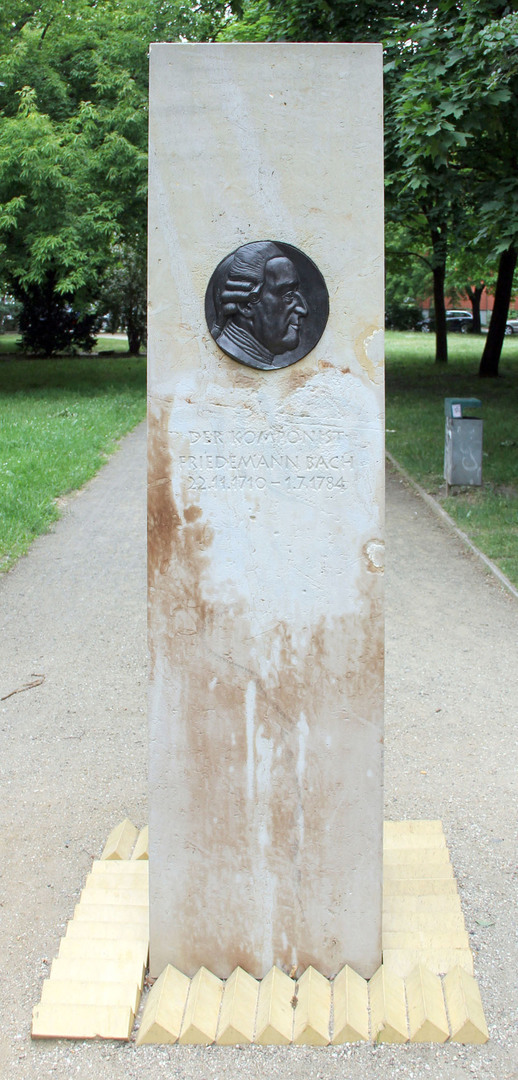
The complete stele by sculptor Nikolaus Bode. Earlier, you had already spotted the round plaque featuring WFB’s head. Today, it stands in the park where the Luisenstadt Church once stood. Without the “Freundeskreis Wilhelm Friedemann Bach” (.... Circle of Friends...) and also without Gisela Thielicke, this tribute would likely never have been featured in today’s publication on this webpage. © Info..
Another great success in commemorating the artist – who, though overshadowed by his father, was an outstanding musician and composer – is the memorial stele dedicated to the Luisenstadt Church ... and to three personalities: Friedrich Nicolai, Karl Gottlieb Svarez, and, last but not least ... Wilhelm Friedemann Bach..
The “Wilhelm” in Bach’s name didn’t make it onto the memorial stele, though. But … let’s not be petty. Let me explicitly mention here that the Bürgerverein Luisenstadt e.V. deserves special thanks for this memorial. After all, they were the ones who launched the entire initiative. The address of the stele again? Certainly. It is located in Berlin-Mitte, in the park at the corner of Alte Jakobstraße and Sebastianstraße..
About a year and a half later, in March 2001, a benefit concert was held at St. Jacobi Church in Berlin-Kreuzberg. The musicians were – fittingly for the event – the Friedemann Bach Orchestra, conducted by Oliver Lüsch..
In the fall of 2001, planning meetings were held regarding the creation of the memorial stele. Despite efforts to publish and convey accurate information –particularly regarding Wilhelm Friedemann Bach – the Friends’ Circle failed to include Bach’s second given name. The Friends’ Circle was more successful in deciding to use P. Gülle’s portrait for the medallion and in ensuring that the medallion could be oriented toward the view of the church..
The new monument was finally unveiled with two separate ceremonies. It happened exactly on September 7, 2002. First, the stele was unveiled in the park grounds at 4 p.m. Of course, the Wilhelm Friedemann Bach Orchestra performed once again. Also under the direction of Cantor Oliver Lüsch. Another benefit concert in the church at 6 p.m. concluded the day’s festivities. On November 7, the Friends Circle of Wilhelm Friedemann Bach was also able to draw public attention to itself for the first time: on the occasion of a lecture at the URANIA in Potsdam. A second opportunity arose shortly thereafter. Namely, when Gisela Thielicke was a studio guest on ORB in Potsdam: “Märkische Zwischentöne” was the program, and the “Wilhelm Friedemann Bach Society” was the topic. Incidentally, ORB Potsdam was at that time the predecessor of today’s broadcaster “rbb,” that is, Radio Berlin-Brandenburg..
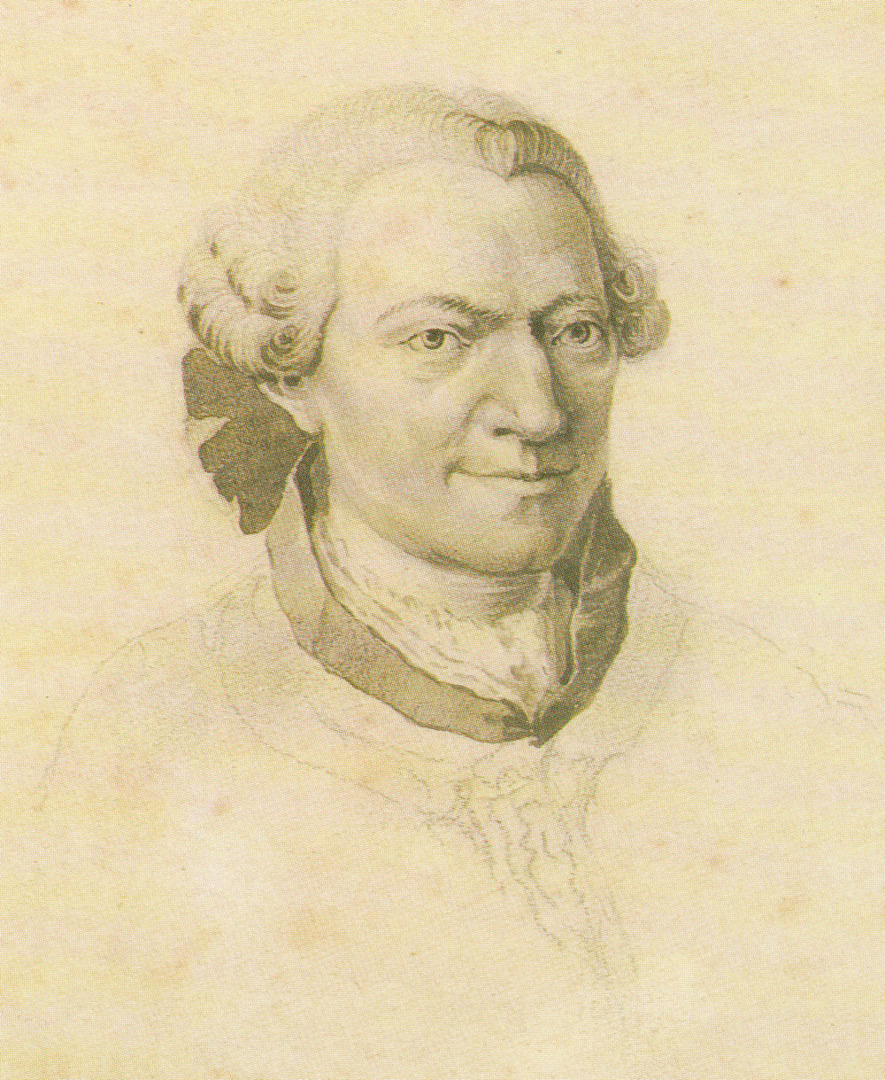
Wilhelm Friedemann Bach. That ... is how we wish his distribution on the internet. That is what Wilhelm Friedemann Bach really looked like..
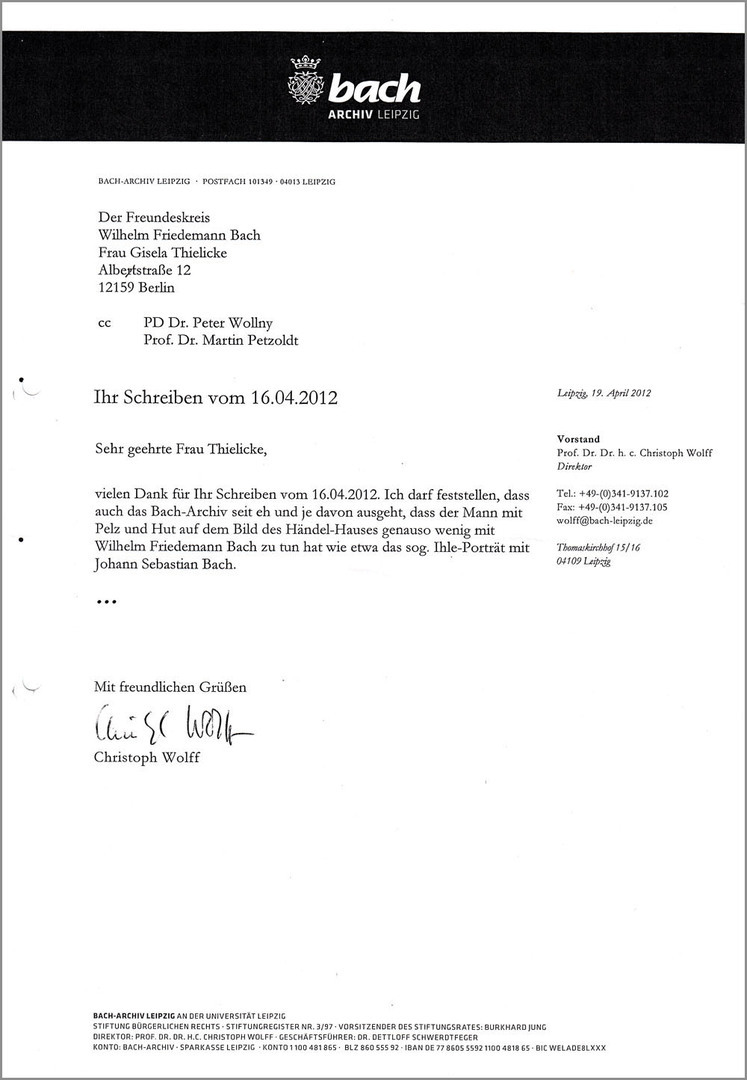
If there is such a thing as an authority on Johann Sebastian Bach – and by extension, on the Bach family of musicians – then it is Harvard professor, Bach expert, Bach connoisseur and Bach author Professor Christoph Wolff. In a letter he wrote to Gisela Thielicke of the Wilhelm Friedemann Bach Circle of Friends in 2012, he confirms this from the most authoritative source: “Man + Hat + Fur + Glove” = “Weitsch Image” = not Wilhelm Friedemann Bach. It couldn’t be any clearer. Now all that remains is to “eradicate” this “Weitsch Image” a little. It will certainly never be completely successful, because this image does, after all, depict a Bach. Just not ... Wilhelm Friedemann Bach!..
We Urgently Need Your Help, Please!..
Please help us: In the coming 50 years, we want to adjust two things with a lot of drive and commitment!..
Please help out if you have a particular interest in Wilhelm Friedemann Bach. First, a heartfelt second request: Please do not –under any circumstances – use the portrait by Friedrich Georg Weitsch: the gentleman with the black hat, fur collar, and a glove in his right hand. Because it is not Wilhelm Friedemann Bach. This was confirmed many years ago by the esteemed Bach Archive to the Circle of Friends of Wilhelm Friedemann Bach. Specifically, in a letter from the board to Mrs. Thielicke. There are three images of WFB: Please use these portraits and help ensure that one day this story – even in the age of the internet, where authors copy from one another and the one from his predecessor – will eventually disappear..
Attributing the “false image” to the right Bach son, however, had at least nothing to do with evil intent or truly great stupidity or malice. The situation is quite different when it comes to the best-known book about Wilhelm Friedemann Bach. That’s right, Albert Emil Brachvogel’s “work”: This novel – the trashy piece is actually declared to be a novel – portrays Wilhelm Friedemann Bach in a thoroughly despicable manner. And it makes him look bad in every way. Albert Emil Brachvogel was born in Berlin in 1824. Exactly four decades after Wilhelm Friedemann Bach had died in Berlin..
Wikipedia states that Brachvogel was a writer. But his main profession was that of a dramaturge. And he actually wrote only two significant works. One of them, of all things, became a bestseller based on fantasy. Just as little as he was able to learn personally from the Greek mythological figure Narcissus. He also had little knowledge of that period. So he simply fabricated a story about the eldest of the famous Bach sons in the style of today’s truly worst tabloids of the so-called yellow press..
Invented? Yes, invented. Not only did Brachvogel’s “novel” become a bestseller – and it continues to sell hot off the press to this day – but in 1931 it also misled interested readers in the form of an opera titled "Friedemann Bach". The climax of this whole affair, however, was ultimately the 1941 film “Wilhelm Friedemann Bach.” Made entirely in the Hollywood style. It was filmed with Gustaf Gründgens. It’s impossible to imagine how one could inflict more harm on a person – posthumously – than with such a schmaltzy melodrama. Perhaps Brachvogel thought that straying from the truth might lead to greater success. After all, he had failed as an actor himself, and his first book was also a flop. Between “Narcissus” and his work on Wilhelm Friedemann Bach, Brachvogel produced several more flops. He later became a Freemason. He even served as secretary of the so-called Grand Land Lodge of Freemasons of Germany in Berlin..
Thus, Albert Emil Brachvogel is practically solely responsible today for the fact that Wilhelm Friedemann Bach is portrayed so dramatically negatively in history. By the way: The fact that his novel and his portrayal of Bach’s son are completely devoid of accuracy and are simply pure fiction is, of course, neither my opinion nor that of the Wilhelm Friedemann Bach Circle of Friends in Berlin:..
All of this was researched by Dr. Martin Falck, who barely lived to see the publication of his work in 1913. Because he was killed shortly thereafter ... in World War I. This reputable author had called Albert Emil Brachvogel’s scribblings “the spawn of a calculating mind.” He had, moreover, denied Brachvogel any qualifications whatsoever. This was because there were sources Brachvogel could have researched. The author of these lines – that is, me (... the “creator” of Bach on Bach, to be precise) – actually had genuine qualms about featuring Albert Emil Brachvogel in the photo on this page. Convinced that this was what he actually looked like. Albert Emil Brachvogel certainly doesn’t deserve it..
Well ... on the other hand, Brachvogel did not circulate the image of Wilhelm Friedemann Bach wearing a black hat and fur collar. Others are responsible for that. Now I’m categorizing you – dear surfer, visitor, or reader who has just come here to research Wilhelm Friedemann Bach – into one of three groups of interested parties. Either you’re already satisfied with the profile or a short biography. In that case, you’re probably not even reading this anymore. But perhaps you are at least someone interested of the “second category” and would like to learn more about Wilhelm Friedemann Bach. Maybe you find it exciting to have been set on the right path by a “small circle of amateur experts.” Because you’d like to buy a truly detailed account of Wilhelm Friedemann Bach’s life ... new or even used. Then you’re still here..
If that’s actually is the case – that is, if you’re thinking of looking for more information about Bach’s first son – then please, please don’t buy "Wilhelm Friedemann Bach" by Albert Emil Brachvogel. Albert Emil Brachvogel will simply give you the wrong impression..
So, do you fall into the third category? Would you even be willing to spend some money on this project? For those in the “third category of interested parties,” here’s an exciting suggestion: If you’re currently a college student. Or a particularly enthusiastic high school student or young person. Music lover or Classical Music fan ... then why not join our Circle of Friends? Here it is, the book “Wilhelm Friedemann Bach” by Martin Falck, with a charming foreword by him about our “scribbler” Albert Emil Brachvogel (... Brachvogel fans may forgive me. But to cast WFB in such a truly bad light, without any need and solely to gain the advantage of good sales for the book he wrote himself ... that calls for some stronger words than the usual ones)..
So ... if you don’t happen to belong to the group of Wilhelm Friedemann Bach enthusiasts mentioned above, but you do have some disposable income and would like to support our common goal, then please do buy the book, which is still available from Olms Verlag. It’s available on Amazon for € 14 and directly from Olms-Verlag for € 19.80. The publisher, who is releasing it at its own risk, also wanted to ensure a little justice regarding Wilhelm Friedemann Bach. In the hope that my publication will help “sell” a few more copies than the few that have been sold so far, I would be very grateful if you could decide to help us, at least financially, by purchasing a copy to minimize his contribution to the topic. Thank you very much for that..
What You Can Find on the Internet About Wilhelm Friedemann Bach: However, Please Do Not Read the Trash of A. E. Brachvogel..
Of course, this Bach portal wouldn't claim to be the most exciting source of information about the Bach family of musicians if there weren't any additional information available..
First, you can really dig into the subject at the German National Library for further reading on Wilhelm Friedemann Bach. In the German Digital Library, there’s more to explore about the works by and about Wilhelm Friedemann Bach. And at Wikipedia Commons / Wilhelm Friedemann Bach … there’s a collection of videos, audio files, and images. Of course, you’ll come across that incorrect image of the musician there, too. We hope we can change that: Why not see if we succeeded? Just click on the last link. I’ll probably do a little more googling and maybe find some other interesting websites. Those will follow in the last section..
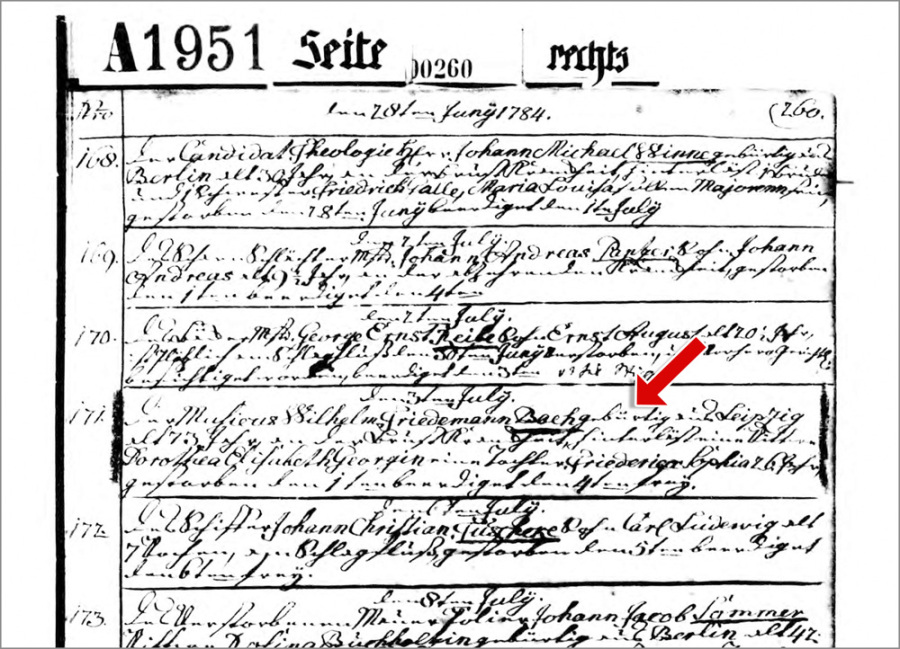
The death record for WFB. We’d like to point out a very small – actually, a tiny – error here, but then quickly and generously overlook it: Wilhelm Friedemann Bach was not born in the Bach city of Leipzig, but in Weimar ... that much is also certain!..
From Rentsch and Ihle to Haußmann, from Albert Emil Brachvogel to Esther Meynell
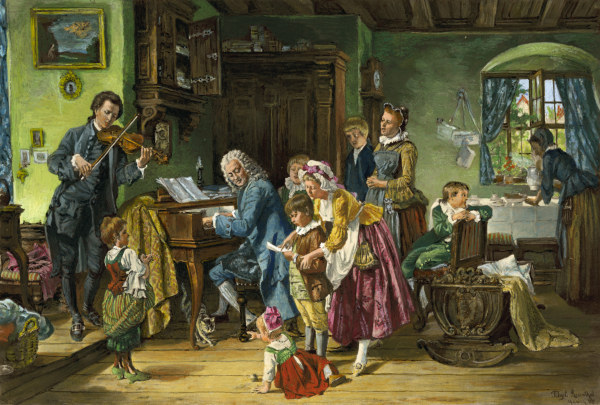
So? Who is Wilhelm Friedemann Bach? Of course, it’s a trick question. Because Toby Edward Rosenthal obviously didn’t know what all the Bachs actually looked like. But probably ... Wilhelm Friedemann Bach is the young man on the far left..
Sure, yes, it is permissible to write novels about people and it is just as okay to invent images of people as they would never have ever looked like in their lives. This is legitimate, is done and is consumed, in the case of pictures just looked at, just read in the case of novels. But there are limits. The producers of "War of the Worlds" in 1938 had to experience this as a great defeat when they aired a report about the landing of extraterrestrials in the US as a radio play. Although the product was defined as a fiction before – but who is listening to so many things right now – panic broke out and only later they became aware of how easily people believe in a superficially used "story"..
The lunar landings, King Ludwig's death in the lake, and Area 51 leave their greetings. But there are limits for similar situations, too. It is about early forms of insults and about what responsibility you take to bend history. And this with intent, with low motives and everything in an ugly form. Many artists have let their imaginations run wild when it comes to Bach. There are dozens of paintings of J.S. Bach that depict him as he never actually looked. One “portrays” him as kind-hearted. Another as serious and energetic ... probably because that is how history portrays him..
It is different from written works and published novels. Two famous books, among many less famous ones, are on the theme of the skilled musicians in the Bach family of musicians. One is the novel by Esther Meynell, which depicts life with the super composer from the perspective of his second wife, Anna Magdalena Bach, as it might have been. Although so much is actually fiction and poetry – and experts do not recommend this book for reading for this reason – we are quite different in our Bach on Bach Mission..
This book is especially readable – even as a used book – and conveys a pleasantly readable impression regarding the essentials in Bach's life. "Easy going" is the motto ... well so! Even if many things are historically not quite correct, the description of father Bach's character is kept in the handed down "green area". So it doesn't really change the image we already have of Johann Sebastian Bach..
Quite different is the rubbish of Albert Emil Brachvogel about Wilhelm Friedemann Bach. He draws a very gloomy and bad picture of the oldest son of the composer from Eisenach. And that is out of the blue. Just like that. He bullied him – is what you would call it today – he draws created a completely different person than it's handed down in history. He made him a bad character..
Today we know that what we read in those cheap, colorful tabloids – especially also in the U.S. – is simply a snapshot of moments in the lives of celebrities. Moments when they occasionally venture out into the neighborhood without makeup. Pictures are published that portray individuals in an extremely negative light. And stories are told that are simply made up out of thin air. It’s part of the range of options for how one can “piece together” one’s world. If that’s what you’re in the mood for. Fine, enjoy these pictures and these “reports.” But beyond that, there are other media. Starting with these less reputable tabloids, through the very reputable ones, and including the internet with its wide range of content. Television and radio expand the range of options, and books round out the picture. But that’s not how it was back then. Sure, there was Die Gartenlaube, a predecessor to today’s magazines. And there were "Illustrierte Weltgeschichte" and "Über Land und Meer". But that simply wasn’t a counterweight to a bestseller, which was almost the only form of publication in book form..
With Bach on Bach you are always right and therefore there are also hints where you can find something additional exciting about Wilhelm Friedemann Bach. Firstly there is the Wilhelm-Friedemann-Bach-Haus in Halle – Halle is not only Handel City but Wilhelm Friedemann Bach City, too. At Halle im Bild you can find more about cultural witnesses in the city on the Saale. A concise and good overview can be found – it goes without saying – at the Bach Archive, of course. And – in the sense of the purpose of this page – we are very pleased that the "man with hat and fur portrait" does not "adorn" this website anymore. That's already something! Because: There are authentic pictures with our star in this FAQ 116. A thank you to Leipzig and via this link, you get there ... right to the perfect page..
Carus-Verlag (... Carus Publishing House) offers Wilhelm Friedemann's Collected Works for sale. If you're interested. They have a convenient online store. Klassika.info is also an exciting site, as you can browse the catalog of works sorted by category. In November 2016, however, the ambitious goal remains to remove the man in the hat and fur coat from there as well. The site also features purchase recommendations and this categorization of his works: by date of composition, by title, by musical genre, and more. All of this is fascinating..
An article in the (... sorry, German) newspaper Die Zeit is worth reading, it’s a full five pages long. Even though we have to overlook the photo of WFB a bit. This article was originally published back in 2010 to mark his 300th birthday. But it’s still a cool read..
The website Luisenstadtkultur.de is charming. It’s the website of the Evangelical Church Congregation of Kreuzberg in Berlin. By the way, the other pages are also fascinating: Click here ... and you can explore much more. And ... there’s even a YouTube video on the subject of Wilhelm Friedemann Bach. In just twelve minutes, you’re in for a truly cool experience with the video titled Wilhelm Friedemann Bach Cantatas: a delight featuring the Bach Choir Mainz. A feast for the eyes and a treat for the ears, even if the first word in that sentence sounds a bit old-fashioned and “cool things to watch” would sound more contemporary. Be sure to take these twelve minutes..
Also worth mentioning is Tobi's Sheet Music Archive. It's just a click away. Finally, there's a reference to the Wilhelm Friedemann Bach House in Halle on the official website of the Handel City. By the way, Klaviernoten.com also offers free sheet music..
One interesting site is Museumstechnik.de in Berlin, which focuses on the Wilhelm-Friedemann-Bach-Haus. Last but not least, there are some great photos of this Wilhelm-Friedemann-Bach-Haus in Halle. Taken by the architect himself, Master Johann-Christian Fromme. Why not check out his website? It’s worth it, because there are photos of the interior and exterior that you couldn’t take better yourself. Even if you think you can photograph things much better (... I’m talking about myself here ... and, as always, with a smile): Be sure to stop by and take a quick look..
We should also not forget a website that no longer exists, mentioned in a notice from the Friends’ Circle on the Internet: wfbach.de. First, the Wilhelm Friedemann Bach Friends’ Circle “lost” its website support. And second, this page on Bach on Bach has now taken its place. In the meantime, the initiator, Gisela Thielicke, has also passed away, sadly far too soon. In the nmz – die neue musikzeitung (... nmz - The New Music Newspaper), there are several articles about the inauguration of this great venue in Halle. And with that, we’d like to conclude our online recommendations regarding and about Mr. Wilhelm Friedemann. By the way – according to Google – there are another 338,000 hits. Approximately. In just 0.44 seconds..
Advertisement
The Most Successful Bach Biography Ever: A Novel by Esther Meynell..

This is how a novel comes into being: Characters in this work are not forced into a completely false context. This book, too, is a work of fiction, not a biography. But it can certainly “pass” as a charming portrayal of a person, a musician, and a life. In the history of Bach biographies – in this case, the Johann Sebastian Bach biography – plagiarism is an integral part of every subsequent work of this kind. At the very least, most of the 700 biographies of the composer have simply been duplicated – or rewritten – by many, though not all, of his predecessors. With very few exceptions. In the case of Wilhelm Friedemann, the UFA, in its film featuring Gustaf Gründgens, made the situation even worse. The film is based entirely on Albert Emil Brachvogel’s trashy work and thus multiplies the false portrayal to an entirely different, even worse level..
End of Advertisement
Dr. Martin Falck Is Just Putting History Straight. A Hurray for Doctor Martin Falck!..
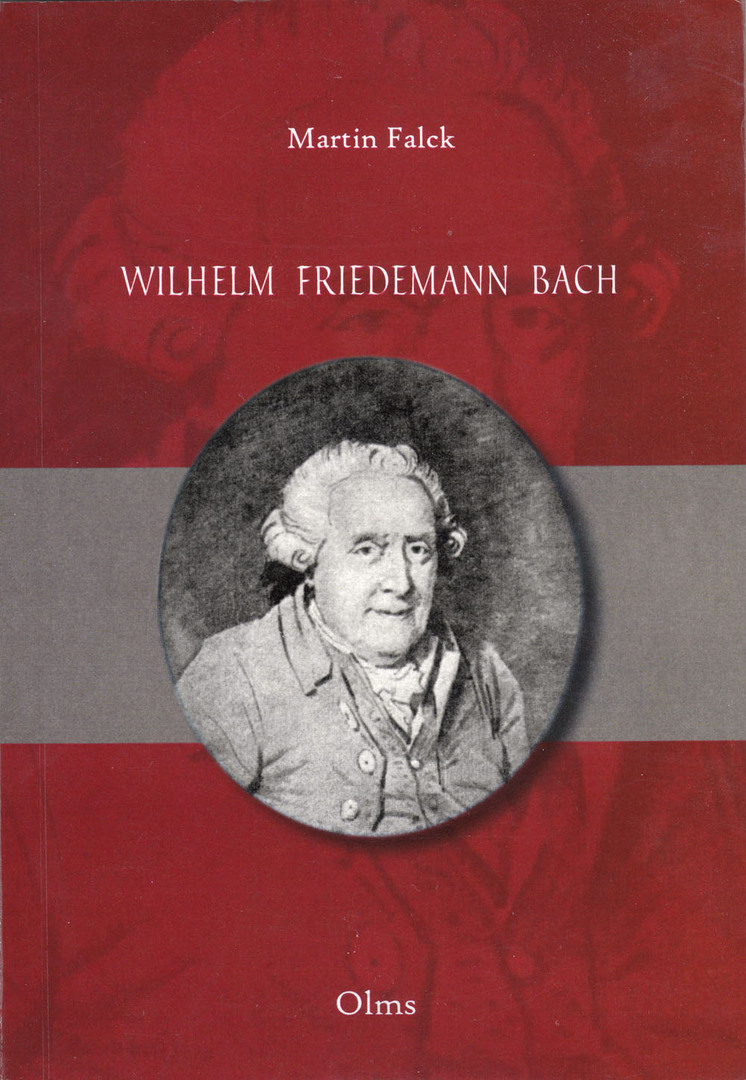
You can purchase Dr. Martin Falck’s *Wilhelm Friedemann Bach*, hot off the press, even today. A reprint was published by Olms-Verlag in 2011. This way, you’ll also receive all the source references and the essential musical excerpts. Olms-Verlag is, of course, very grateful for your interest and your financial support. And we … we’d also be delighted if you purchased this book. Available on Amazon or at bookstores. Not from my wife’s Publishing House..
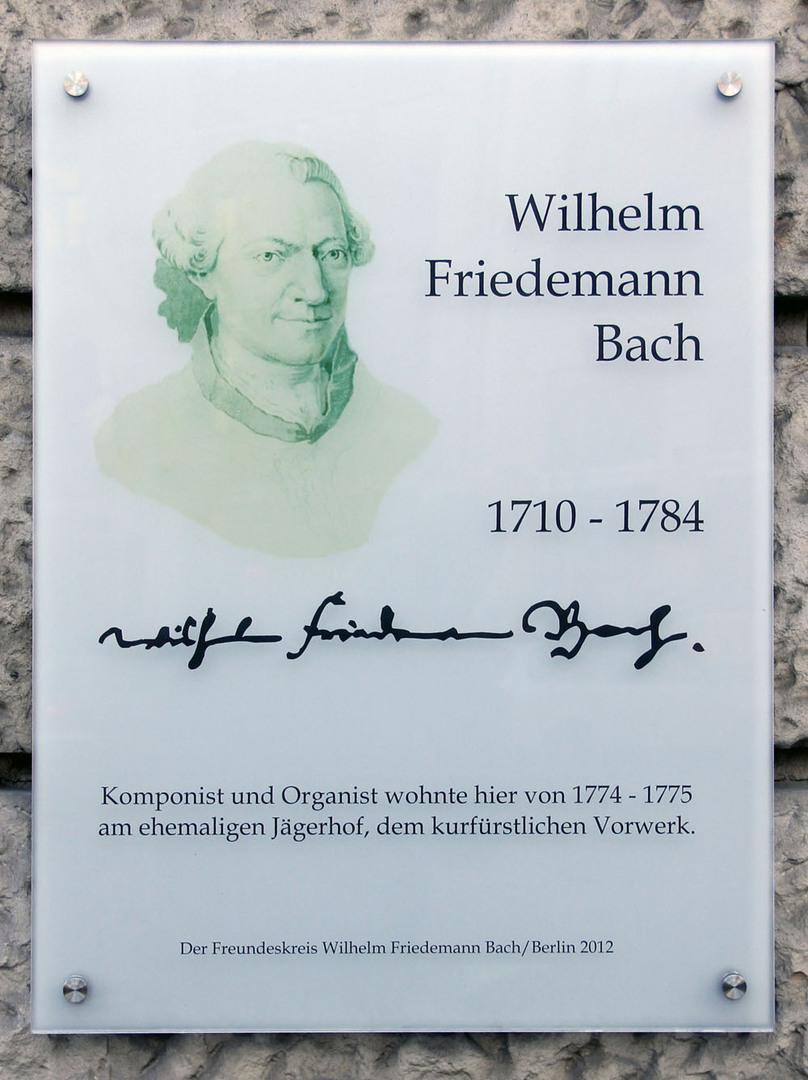
The Circle of Friends of Wilhelm Friedemann Bach and Gisela Thielicke achieved this a few years ago: This commemorative plaque honoring the great composer now adorns one of the buildings in Berlin. Thank you, Mrs. Thielicke! That’s right … the image has appeared above already. But since this is probably the longest page on a website dedicated to this son of Bach, “it’s okay to include it again.”..
The "Weitsch Painting" Showing Bach: The Black Hat, the Fur Collar, and the Glove Is an Absurdity..
Who exactly was Weitsch, and when did he live? To be precise, his name was Friedrich Georg Weitsch, and he was a German engraver and painter. Mr. Weitsch was born in August 1758. That was “more or less exactly. precisely” 26 years before Wilhelm Friedemann Bach died. The portrait showing him in “fur and hat” depicts a man who was “roughly” 50 years old. Wilhelm Friedemann would have been exactly 50 in 1760 ... precisely because he was born in 1710. So, WFB, as musical Bach insiders call him, would have sat for this portrait at age 50. That would have made Weitsch a painting genius at the age of two. It’s also strange that the portrait of Wilhelm Friedemann Bach bears so little resemblance to the authentic portraits of the musician. Well, okay. Wikipedia lists Weitsch’s places of residence as Brunswick and Kassel, Amsterdam, and Italy. Okay, in 1795 he moved to Berlin. That was about 35 years after Wilhelm Friedemann turned 50..
Is She the "Don Quixote in the Subject of Wilhelm Friedemann Bach"? No, Gisela Thielicke Is Now Finally Heard..
This is Gisela Thielicke's speech at the Center for Church Music on May, 21st 2013 in Erfurt, Thuringia, Germany, the epicenter of the family of musicians of composer Johann Sebastian Bach:..
Why Wilhelm Friedemann Bach did neither wear a hat, nor fur, nor gloves. That is to say dainty researched and here in detail. The following speech by Gisela Thielicke is - by the author of this website - just slightly changed because it should be read here and can not be listened to. In addition to this, the author has made small additions to the topic, if there are significant changes between the date of the speech back then and the date on which you read here today and on this website, if essential details have changed. The complete text has been entered by the author of this website..
First of all, I would like to thank Dr. Claus Oefner, who has kindly given me the opportunity to speak to you about these findings. These are not new findings. However, their dissemination is not supported by key institutions. This represents a breakthrough in “Weitsch research” – that is, in the research into the paintings of Friedrich Georg Weitsch – which Wilhelm Friedemann Bach does not represent..
Quite briefly to my person: I am Gisela Thielicke, I founded the Circle of Friends of Wilhelm Friedemann Bach in 1998, and I have, among other things, campaigned for the fact that the actual and, above all, scientific biography, written about Wilhelm Friedemann Bach by Doctor Martin Falck in 1913 and 90 years later, in the year 2003 by publisher Georg Olms in the Olms Publishing House in Hildesheim, Germany, as reprint, is respected. By the way, 2011 was followed by repeated reprints. Furthermore, the Circle of Friends 2012 succeeded in getting the permission in installing a memorial board for Wilhelm Friedemann Bach in Berlin-Mitte, in which the composer and musician lived in the years 1774 and 1775. If you want, you can take a Circle of Friends brochure with you home. And it is my concern to make you interested in the correct biography about Wilhelm Friedemann Bach as a book..
Now I would like to come to the real topic: It is about the so-called "Weitsch-Painting". It is the picture that the painter Weitsch is said to have painted from Wilhelm Friedemann Bach. But this portrait does not show Wilhelm Friedemann Bach. So the general well-known painting "Man with hat and fur collar" just isn't Wilhelm Friedemann Bach..
In addition to the wrong assignment of this picture, there are foolish stories around the composer, which fundamentally distort the personality of Wilhelm Friedemann Bach to this day. And almost nobody cared, that at any time finally the correct portrait was exchanged for the "suitable Bach". Not at all before the era of the Internet. A beginning of an actual scientific workup was done by the later-promoted Dr. Martin Falck already in 1913 – namely, the biography just mentioned. But World War I, unfortunately, did not allow a lasting re-evaluation of the famous composer. Dr. Martin Falk was killed in action in 1913..
2010 was the memorial year regarding the 300th birthday of Wilhelm Friedemann Bach. On June, 7th 2010 and on June, 8th 2010, a scientific conference took place in Halle – the Handel House. On this occasion Professor Dr. Wolfgang Hirschmann – he lectures at the Martin Luther University Halle-Wittenberg, Germany – officially illustrated that and why the well-known painting by F.G. Weitsch clearly does not represent Wilhelm Friedemann Bach. It is handed down In the literature on the subject and confirmed that Weitsch painted this painting in 1760. It shows Wilhelm Friedemann as a man at the age of about 50 years. The painter F.G. Weitsch, however, was born as late as 1758. This is the first disagreement, for how would Weitsch have known what Bach looked exactly like exactly at his age of 50 years. Only pictures of Wilhelm Friedemann Bach in his middle age and one of more advanced age are securitized. In addition, the fashion of the person on the painting points to the 90s of the 18th century. From the portrait's clothes, "the new liberated feeling for life" after the French Revolution, and also the habit of a completely revived artist's stand..
By the way: the father of Georg Friedrich Weitsch – Johann Friedrich Weitsch, who was also called Pascha (1723-1803) – was a miniature painter, worked for the Porzellanmanufaktur in Fürstenberg, Germany and painted landscapes since 1758..
1 The author Reimar F. Lacher wrote his doctoral thesis about the painter Friederich Georg Weitsch in 2005: FU Berlin 2003, as a book 2005, Gebr. Mann Publishing Berlin, Germany; ISBN 3-7861-2321-7. On the basis of stylistic comparisons, he has proved that the "man with hat and fur is precisely not Wilhelm Friedemann Bach..
2 Professor Dr. Wolfgang Hirschmann of the University of Halle-Wittenberg confirmed it on June, 7th 2010..
3 There is a letter from the Bach Archive to the Circle of Friends, dated 19.4.2012 (... picture above, editor's note). Professor Doctor Christoph Wolff, the most versed Bach connoisseur of our time explains the following: "I can state that the Bach Archive has always assumed that the man with fur and hat in the picture of the Handel House has as little to do with Wilhelm Friedemann Bach, as the so-called Ihle portrait with Johann Sebastian Bach. " Copies of this letter to Dr. Wollny and Professor Martin Petzoldt also remain unchallenged..
What Now Is the Problem?..
1 Unfortunately, the Bach Archive in Leipzig – right next to St. Thomas Church – displays the well-known Weitsch painting (... with a hat and fur collar) with the caption “Wilhelm Friedemann Bach.” For thousands of visitors, as well as for many schoolchildren, students, and guests from abroad, however, this very institution is actually a good starting point when it comes to Bach. This contradiction is still reflected on this page as of November 2016 (... editor’s note)..
2 Unfortunately, I also received a cancellation from the owner of the picture – the picture belongs to the Stiftung Moritzburg in Halle – to change. Mr. Wolfgang Buechse, custos of the paintings collection wrote to the Circle of Friends on October 11th, 2012: "The relevant painting was purchased in 1907 as a gift from the Bach family by Miss Lisette Bach (... in the book by Reimar F. Lacher is Liselotte, page 223; note of Gisela Thilelicke). There it was considered as a portrait of Wilhelm Friedemann Bach. And that is how they speak about even today. Inquiries are answered with the hint, that the identity of the portrayed is still not clarified. We can't and we won't do more. In addition to that, I point out, that the painting is signed but not dated. The painting has been created at the end of the 18th century. However, I want to add, that it was not unusual, to order a portrait of people who died after their death. By the way, I have to disagree regarding the clothes of the portrayed, it is too indifferent in the picture, to make a clear testimony..
I want to comment Mr. Bueche's remarks (Gisela Thielicke, Editor's Note), I have the following objections:..
1 The credibility of an untested tradition must be seriously scientifically questioned, especially as in this case all the other proofs are against it..
2 If the picture as a "portrait of a gentleman" (man with hat and fur) is just probably Wilhelm Friedemann Bach, why does it hang in the Handel House with the name Wilhelm Friedemann Bach ... and that without the corresponding indication that It is just probably Wilhelm Friedemann Bach? Not publicly they are convinced that is not sure. But where students, teachers, musicians, and scientists – in the Handel House – pass by, they omit this reference on the caption. (... and now every teacher, every pupil, and every Bach enthusiast has to conclude his own thoughts, comment of the editor)..
3 If it was generally also customary to create portraits posthumously, it cannot be assumed that, in the case of Wilhelm Friedemann Bach, "his portrait" came into being some forty years after his 50s, that is, around 1800. Who should have been interested in it? Wilhelm Friedemann Bach was long forgotten at the end of the eighteenth century (about 40 years after the composer was about 50 years old, editor's note), his music was certainly not performed anymore, and the remaining daughter was according to the approved documentation destitute: she could never have paid the honorarium to the painter Friedrich Georg Weitsch..
4 I quote from a contemporary report: In the "Musical Almanac" of July 26th, 1783 (... the year before the death of Wilhelm Friedemann Bach) – by Carl Hermann Bitter 1868 – and finally Dr. Ulrich Kahmann Carl Hermann Bitter - on the topic "A false picture of Wilhelm Friedemann Bach": "I can say little about the situation of our admirable Wilhelm Friedemann Bach, so incomparable in his art. He almost isn't appearing anymore in the public and it seems, with the exception of few, who still have contact to him and have true respect for art, still accept it, be completely forgotten by most of the rest."..
5 Doctor Uwe Wolf, a studied musicologist and colleague at the Carus Publishing House, before that a scientific colleague at the Johann Sebastian Bach Institute in Goettingen, Germany, as well as a colleague in the Bach Archive said the following: "We are not a scientific institution, The painting (Weitsch) is a trademark: we shall continue to issue it with the title Wilhelm Friedemann Bach. " (... we have to be fair and mention, that on the website is meanwhile a correct picture of Wilhelm Friedemann Bach is exciting ... A thank-you to the Carus Publishing House, editor's note)..
6 There are several paintings showing Wilhelm Friedemann Bach, and all of them are in harmony from his youth up to age pictures. The picture, which is discussed here and of private ownership (Weitsch with hat, fur, and glove; editor's note), discussed here, differs considerably from the other pictures of Wilhelm Friedemann Bach. Ther is a headline above this painting and the biographer Dr. Martin Falck – in his biography about Bach – states on page 56:..
"An oil painting has reached the Hallesche Museum (... Halle Museum) in a mysterious way. It is presenting the artist (Wilhelm Friedemann Bach, editor's note) in natural white flowing hair with a passionate gaze, in a stormy attitude. It differs greatly from the other representations."..
7 Wilhelm Friedemann Bach probably would not have permitted to portrait him without his peruke ... what was common in the time back then, his time..
8 In the book by Reimar F. Lacher, the following is mentioned on page 223 regarding the Weitsch picture: "Up to now always as an unsecured portrait of Wilhelm Friedemann Bach! As soon as a picture is even questioned, this must – scientifically correct – be made recognizable. The Bach Archive cooperates with the Carus Publishing House, so both have the obligation to interact on a correction of this misinformation." But obviously – specifically – this "false" Weitsch picture dominates in the public, while the others – (... paintings by Matthieu, engraved by Christian Heinrich Schwenterley; in Lacher's book on page 223) – are almost completely absent in the public. Because it is enforced by the Carus Publishing House..
The picture is – in my opinion– used to confirm a modest lifestyle and an attitude of mind which have nothing to do with Wilhelm Friedemann Bach. Johann Friedrich Reichardt, Friedrich Rochlitz, and Friedrich Wilhelm Marpurg had laid the foundation back then with their anecdotes. Although Dr. Martin Falck had already been able to refute all these anecdotes with documents in 1913, they are unfortunately still spread even today. That means, the research results of Dr. Martin Falck are not just ignored, but even actively "hidden"..
(Editor's note: It is funny too that even as late as today the novel by Brachvogel, which contradicts the life of Bach, leads with the unsuitable picture of Johann Christian Bach, the cousin of the portrayed person – namely the "Clavier-Bach". The wrong information matching the wrong painting. At least both are wrong. I hope this page of my website can contribute to the fact that the most recent print edition of 2013 is now perhaps the last of its kind. Hopefully ... then finally. You can buy it as a paperback for a whopping € 49.50. Just to make money ... in the tradition of Brachvogel & Co.! End of editorial note)..
Institutions that exercise Bach science, contribute themselves and sustainably to J.S. Bach's son to disparage. The picture of a man with hat and fur and glove shows Johann Christian Bach with the highest probability – all conclusions point to that fact – he was born in Halle in 1743. And was a pupil of Wilhelm Friedemann Bach. Johann Christian Bach became a music teacher at the Pädagogium in Halle later and lived there until 1814. The donator of the picture, by the way, was a descendant of Johann Christian Bach, as Reimar F. Lacher executes on page 223 of his book..
A small genealogical listing by Karl Geiringer indicates that it is the Meiningen / Ruhla branch. I quote from the book of Geiringer on page 116: "At the age of 61 he married (Jacob) for the fourth time and had still two children before he died in 1718. The musical talent that he inherited must have been significant because both first marriages resulted in an especially gifted artist. Footnote 1: Georg Michael Bach, a son of Jacob's third marriage, was a musician as well and worked as a cantor at the Ulrich's Church in Halle. His son Johann Christian, known as the "Piano = Clavier-Bach" "was a student of Wilhelm Friedemann Bach."..
By the way, Johann Ludwig Bach is the well-known Meininger Bach, who had close contact with JSB. So Johann Christian Bach is his cousin. The families were closely linked. The student Johann Christian Bach received from his teacher manuscripts by Wilhelm Friedemann Bach as a gift, including Johann Sebastian Bach's "Clavierbüchlein = Piano Booklet", written for the little Wilhelm Friedemann Bach. You can read that in Karl Geiringer's book on page 175..
So it's obvious: This is a long-standing, “deliberate” confusion in the description of his person and the portrait of him. At the expense of a musical master: Wilhelm Friedemann Bach..
(Editor's note, here again: Please note that Gisela Thielicke published above differs slightly from the original text in insignificant words and passages.)..
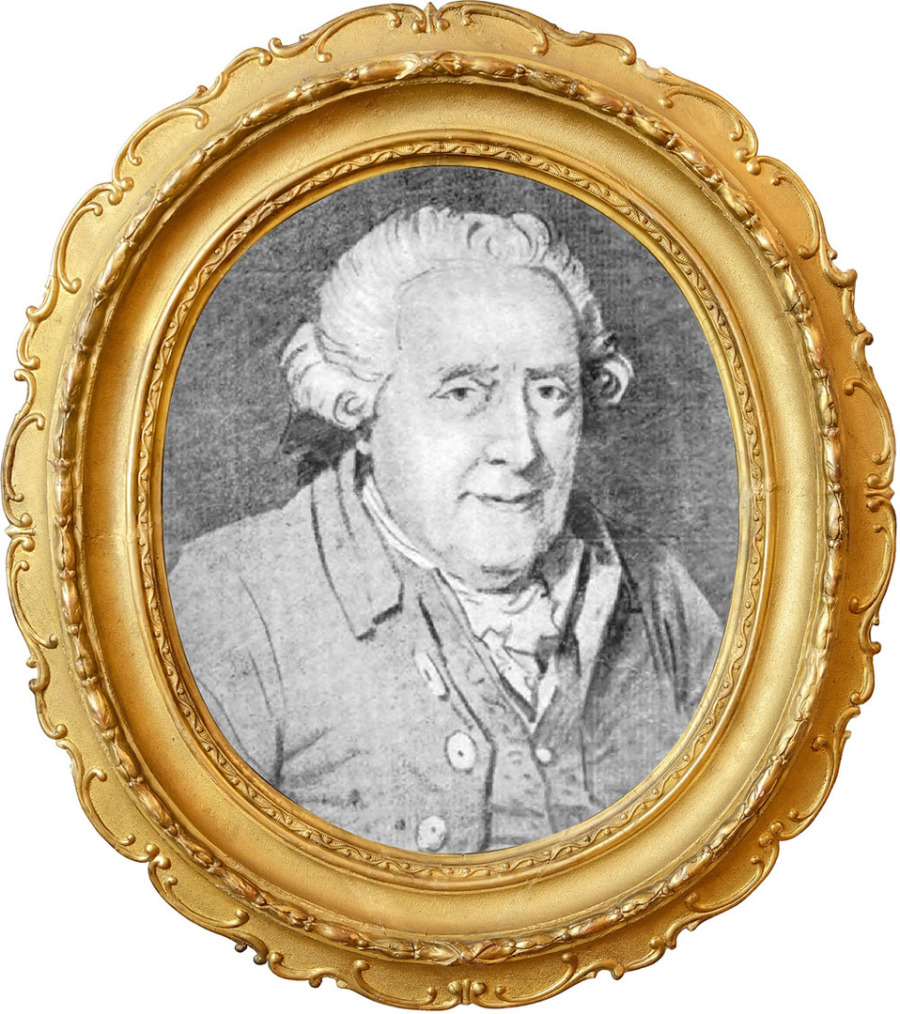
One last photo of Wilhelm Friedemann Bach on this page. A photo of Wilhelm Friedemann Bach showing what he really looked like. Thank you for your interest, for visiting, and perhaps also for your support and assistance regarding Wilhelm Friedemann Bach..

Advertisement
"Truck Loads" of Cool Music Gifts, "Truck Loads" of Exciting Bach Gifts..
What if you visit one of the shops right away? Click here..
Music Calendars, Composers Calendars, Bach Calendars, and Pipe Organ Calendars..
On the left, one of the latest Bach calendars. Three sizes. For this year and next year. In European style and US style. And on the right? One of two Bach statues. To the Shop..

Did you know that “Bach 4 You” specializes in Bach T-shirts and in Bach seal T-shirts? Visit the shop..
End of Advertisement
 Druckversion