

Bach FAQ 132
Was Antonín Leopold Dvořák the Great-Great-Grandson of Johann Sebastian Bach?..
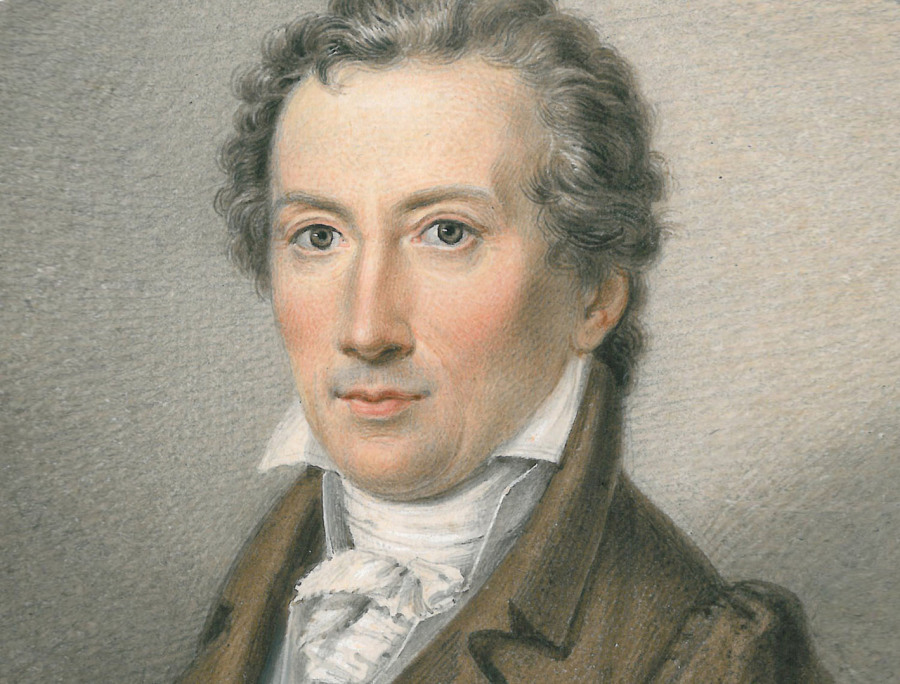
Is Antonín Dvořák the great-great-grandson of his Thuringian colleague Johann Sebastian Bach? But first … which Antonín Dvořák are we talking about? The first, the second, the third, or the fourth? So, actually … Antonín Dvořák I, II, III, or IV? We’re talking about Antonín Leopold Dvořák, the most famous of the four Antoníns. Although: Logically, all four of them are also grandsons of Johann Sebastian Bach … albeit with varying numbers of “great-grand” prefixes. By the way, you can get to know Antonín Dvořák III. Here … and maybe even in the Czech Republic..
Straight to the point ( ! ), about the connection between Johann Sebastian Bach and Antonín Leopold Dvořák? Not with me. But if you click here, you’ll go there ... right now. But … let me entertain you instead. With plenty of reading material on the subject..
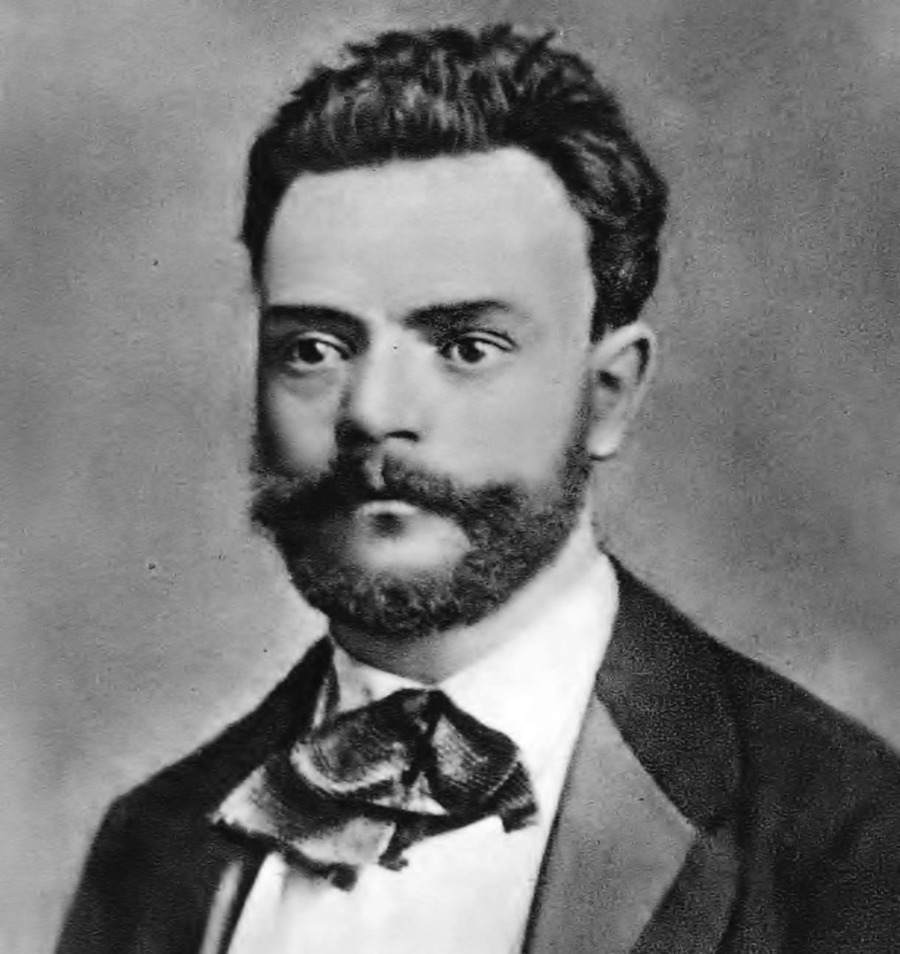
Antonín Leopold Dvořák. About 20 years before this website page on the relationship between Antonín Leopold Dvořák and Johann Sebastian Bach was created, the topic had already been published in a renowned magazine..
It was shortly after the Fourth Sunday of Advent in 2022 when I received an exciting email. It contained a “Christmas gift related to Bach” of – for me – almost unbelievable significance. This surprise has since long found its place on Bach on Bach. It has, in fact, been rediscovered. Like so many other curiosities, especially in the Bach genealogy..
Of course, I’m not claiming to be the one who discovered it. Incidentally, this surprise had already been found a full ten years earlier. And it had been published for almost as long. But … even back then, very few Bach fans seem to have come across that publication. Plus: With each passing year, this sensation was increasingly forgotten. After more than ten years, this discovery was actually “doomed to be forgotten”: It was something special that had endured for many years. And then it was discovered. And presented to the public. From that point on – slowly, very slowly, yet surely – it threatened to vanish back into the depths of history. Even today, you can read about it in a magazine from that time. But nobody looks there anymore..
J.S. Bach ... The Bach Genealogy ... And Our Joy of Researching..
Bach über Bach, my German portal, and its international English-language version – featuring 20 brief articles in 20 languages – Bach on Bach – are a unique and innovative offering. It is definitely different from a book and also from a magazine. If you’re looking for exciting things about Bach – including the specific, the rare, the unique, the funny, and everything else that can’t be “conveyed” through any other medium – then you’ve come to the right place with my wife and me. My wife Renate handles the genealogy of the Bachs. I’ve successfully researched the earliest genealogy – prior to Veit – and unique aspects of the “Bach topic.” I am a rediscoverer, not a discoverer. Except when it comes to the topic “Bach 1504.”..
That is also our shared credo: rediscovering what had once already been explored. And what was lost again due to a lack of widespread interest. Not really, but practically speaking. For a wide variety of reasons. One major exception should be mentioned: It is the evidence that Veit Bach did not come from Hungary ... and thus that none of the Bachs originated from Hungary. Rather, they returned from Austria. Back ( ! ) to Thuringia. Back to the area around Gräfenroda and Wechmar. Just a four-hour walk apart. And strictly speaking, this final realization also found me. In the form of an email in which another Bach fan was able to bring three elements together: Veit and Bach and Ungern..

Johann Sebastian Bach did not speak of Hungary, nor did he mean Hungary. Up until Carl Philipp Emanuel, his ancestors adhered to the wording that Hans the Minstrel had sent “into the future” regarding the subject of “Great-great-grandfather Veit.” As late as 1747, Johann Sebastian Bach told his friend and publisher Johann Gottfried Walther about this “Ungern” for Walther’s “Musicalisches Lexikon.” Just as he had already written it down in 1735 and, with near certainty, passed it on. It was only Carl Philipp Emanuel who claimed to have known that the ancestor had meant “Hungary” (... Ungarn) back then when he said “Ungern.”..
I Am Also Searching ... But I Let Myself Be Found Just as Well..
My contribution: I’ve optimized a process, how not I find information via Google, but for interested parties to find me. A first decisive result was the rediscovery of this Bach family’s emigration to Bohemia. And … I considered the Bachs’ early move to Bohemia and then their return from Bohemia to be the solution to a mystery. Not discovered by me, but rediscovered by me. “Buried” in the endless copying of the next biographer by the previous one. Incidentally, this was largely done by the greatest figures in the Bach community as well. The decisive sentence, however, was my last one in my book-length essay, together with Part 1 totaling around 20,000 words. That’s roughly 170 letter pages. Very roughly: I had calculated it once. Hopefully I remember correctly. But it’s not essential either..
Regarding this crucial sentence: “If any reader who is also a Bach fan has read this far, please contact me if you have anything substantial to contribute on the subject of Veit Bach.” The rest … is history. My Bach history. And now official Bach genealogy. Since the former “bibles of Bach genealogy” have been outdated for 20 years. All three are the genealogy books by Ragnhild Siegel and Hermann Kock, as well as the purple genealogy book by the “lone warrior in matters of Bach genealogy,” Kurt Hermann Frickel. And, of course, the one by Helga Brück. Even today, and ever since the beginning of Bach über Bach (... Bach on Bach), we have been highlighting the foundational research of these key researchers and others. We do so whenever we republish their research findings. Not least, for example, the incredible discovery of an early American branch of the Bach family in Rochester, Minnesota, USA..
All three authors– or rather, the Siegl/Kock team – failed, however, due to a modern-day phenomenon… data protection. But even here, my method of asking people to contact me “works.” The foundation: my and our unconditional discretion regarding the publication of sensitive data. This is how the currently unquestionably most accurate and comprehensive family tree of the “musical-Bachish family” came into being ... and continues to develop. It has since expanded in width, extending back to the time before the return migration to Thuringia, and has been supplemented in our present day by many current family members..
My Promise: Honor to Whom Honor Is Due ... And Sensitive Handling of Data..
A promise also led to the fact to contact us two Bachs regarding our then joint hobby: True to the motto “Honor to whom honor is due,” we present experts who have earned merit. Like Gisela Brück in Erfurt. And Kurt Hermann Frickel in Niederwerrn, who passed away shortly before we had the chance to meet him. Then there are Mrs. Evelyn Odrich and Mrs. Gisela Thielicke, both of whom have since passed away, much to our personal grief. Their research, however, lives on through our portal..
With a digital will, hopefully lasting for eternity and always remaining up to date, we want to preserve these insights. Not like so many biographies, which are constantly supplanted by newer ones. Even if they aren’t any better. Or more enjoyable to read. This “sharing of glory” makes the next generation of Bach enthusiasts consider whether they want to share the laurels. Only then is a discovery or a contribution for eternity “preserved anew ( ! )”. This sense of community will be of great importance on this page ... the one you are reading right now..
What a Surprise for Me..
Back to the Christmas email from 2022. The surprise turned out well, and the sensation could be found on this Bach-on-Bach portal from that point on. Where … will not be revealed here. With a smile, of course. But completely unnoticed, I also read, in the last two lines, a reference to a connection between Johann Sebastian Bach and Antonín Leopold Dvořák. That’s right, this Dvořák. A Czech. A master. However, the actual reason for contacting me electrified me so much more that I practically overlooked the reference to Dvořák at first..
Later, I vaguely recalled that I had come across this tip before as well. At some point. On the internet. And back then, other things were probably much more important. And so I forgot about that early hint. By the way, I eventually found it again. I’ll go into more detail about it later, just before the end of this Dvořák discovery..
Speaking of “a Christmas sensation”: The Bach fan who had sent me the email and I exchanged several messages. Once this actual surprise – which I hadn’t explained in detail above – was finalized as text on two website pages, “garnished” with images, I received a special piece of information regarding the first “Dvořák reference.” That is, where, when, and in which publication I might be able to learn the background on this. By then, my mind was clear for it, by the way. And I hoped that I would receive this article as a copy, scan, or photo. Because, of course, such a genealogical connection between “Bach and Dvořák” would have been a priceless addition for us. The requested photo of it arrived at lightning speed. A day later, I had three pages in front of me, photographed with perfect clarity..
It Is Proven: Dvořák Is Great-Great-Grandson of Johann Sebastian Bach..
Once upon a time, long, long ago – some two decades now – a Bach enthusiast who is today highly regarded both locally and regionally, and who also holds an exciting public position, caused a sensation. With a complete background story to boot. A genealogical sensation that fits perfectly into our research philosophy. This person, in fact, proved the direct lineage between Johann Sebastian Bach and his great-great-grandson Antonín Leopold Dvořák..
The author opened on it, on three pages, with the keywords "Sensation" and "Finally Proved:". And titled: "Antonín Dvořák Descendant of Johann Sebastian Bach in Direct Line". Below the author's name are two large pictures: Bach on the left, Dvořák on the right. The first four paragraphs are of no importance to our Bach hobby. Then follows, at the bottom of the first page in bold type and dressed up by thick hyphens at the top and bottom, the sentence "It may be considered proven that Antonín Dvořák is a descendant of Johann Sebastian Bach in a direct line!"..
The fifth section, too, was – for us – of no significance. But now came the part that is probably of the utmost importance to exactly two people out of over eight billion. For then, with our Bach genealogy and our Bach Mission, we would have (re)discovered yet another Bach branch that had not yet been integrated. And that would not have affected “the quality” of the final determination regarding the return of the first Bachs from abroad back to Thuringia. But it would certainly have been on par with the inclusion of what is now a second American branch of the Bachs. Naturally, a careful review should confirm the facts. But that shouldn’t pose a challenge. That’s how precisely many names, institutions, and events were listed in this report. Moreover, it was scientifically rigorous, well-researched, and written in an engaging, captivating style:..
On the subject of genealogy: The ties between Bohemia and Thuringia/Saxony – the two regions that gave rise to our two protagonists – are multifaceted. Johann Sebastian Bach’s ancestors hailed from Bohemian lands, as evidenced by the baptismal name of his great-grandfather, Veit Bach, whose patron saint also lends his name to the central cathedral in Prague. The Bach family’s ties to Bohemia by no means ceased in the first half of the 18th century. And so it is no wonder that Bach’s youngest daughter, Regine Susanne (1742–1809), married Petr Venceslas Przky in 1764—14 years after the death of the Thomaskantor ... a Bohemian merchant who, shortly after the wedding, took her back to the banks of the Vltava. There she bore him eleven sons and one daughter. It is here that the Bohemian branch of the Bach family tree has, until now, been lost in the proverbial “Bohemian villages.”..
Call it coincidence or fate: In April 2003, a reorganization of the Dvořák Archive began in his hometown of Nelahozeves (German: Mühlhausen), during which an awkward movement caused the seat cushion to fall out of one of the eleven surviving chairs on which František Dvořák’s family used to sit for their Sunday lunch. It is likely due to the innkeeper and butcher’s financial straits that not only horsehair but also “waste paper” was used for the upholstery. For protruding from the upturned seat cushion is a corner of a barely legible piece of paper, which is immediately handed over to the Faculty of Philology at the University of St. Peter and St. Paul in Plzeň for decipherment and transcription..
On July 18, 2003, it was determined that the paper quality and watermark date the document to around 1850. The heavily damaged sheet contains a sort of brief biography of Dvořák’s father written in awkward German (…the colloquial language of that region at the time), the key passage of which reads as follows:..
“In 1780, God blessed my late grandmother Regine Susanne Przky, after eleven sons, with a healthy daughter, who was married to my father Bedrich Dvořák in 1799. In 1810, I myself was born as my parents’ third child; I have been a butcher and innkeeper in Nelahozeves since 1835 and married my wife Ludmilla in 1836. Our marriage has so far produced two sons. Anton, the eldest, has nothing but music on his mind; Pavel will one day become a capable butcher.”..
I was thrilled, and of course I wanted to know more about this super find. That’s right, it wasn’t ( ! ) me who discovered the connection back then. Nor was it me who rediscovered it today, 20 years later. No, this incredible news – so to speak – “found me”. Through the email from the Bach fan mentioned above..
My Request for More “Dvořák with Bach”..
Of course, I wanted more after that: more story, more pictures, more background … and I planned to put it all together … just like I always do..
Of course … that’s how you start these days … you do a Google search. And I found so little using the keywords “Johann Sebastian Bach” and “Antonín Dvořák” that I was disappointed. I translated my keywords into Czech: I didn’t need to be able to read the results. It was enough if they were there. And translation software eventually led me to my goal in every language with my findings. Again, nothing but disappointment. By the way, I also came across that exact entry again, the one I had such a “vague” memory of. Back then, I realized: I’m even quoted there myself. And the author also refers to a Wikipedia entry where this connection is documented. I couldn’t explain this “meager result.”..
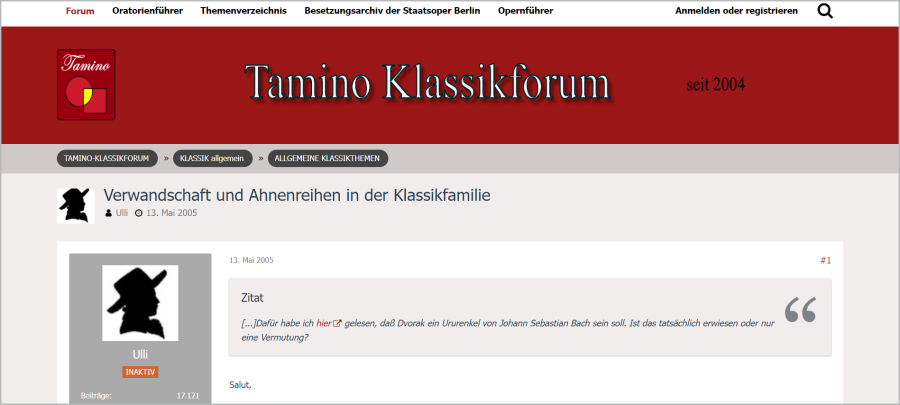
The Tamino Classical Music Forum: A long time ago, I found a faint echo of a discussion there on the topic of “Johann Sebastian Bach’s great-great-grandson Antonín Dvořák.” Here – above and below – is a screenshot of it. Just in case this forum ever stops existing. This way, the content on this fascinating topic is “preserved.” Click here to access it as of the time these lines are being written. © Tamino Classical Music Forum..
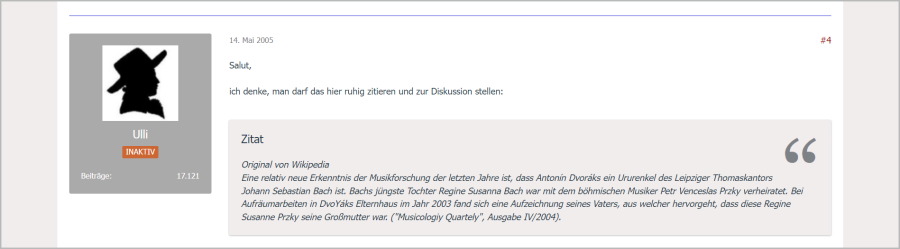
This note clearly refers to a passage in the Wikipedia article on “Antonín Leopold Dvořák.” And what’s written on Wikipedia can’t really be that wrong, can it?! Please also note the timestamp: 2005. © Tamino Classical Music Forum..
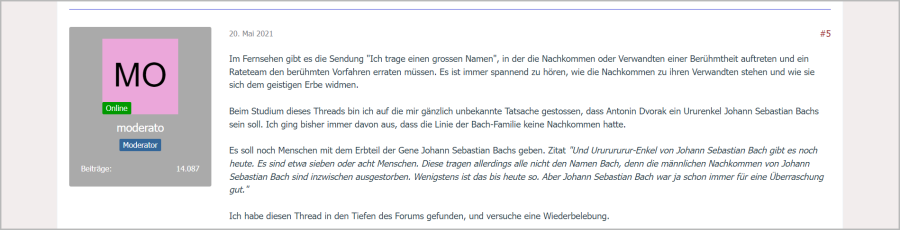
This forum post on the topic was posted about 16 years after the first one ... and my post is also quoted here. It’s FAQ No. 70 on “Bach on Bach” (… Are there still any grandchildren of Johann Sebastian Bach alive today?): The statement that “Bach has always been good for a surprise” is my own text, and I was pleased to find it here again. The moderator attempted to “revive” the topic. Incidentally, of course, the line of Bach’s grandchildren has not died out: There are simply no grandchildren (… with more or fewer "greats") left with the name Bach. © Tamino Classical Music Forum..
Freedom of Quotation, Johann Sebastian Bach and Antonín Leopold Dvořák..
Perhaps this surprise did not get around because, as it happens, no one posted anything about it online. The most important publication was, after all, printed on paper. And it isn’t available in the same form on the internet. Now … well, in the meantime … of course it is.* And by the way, what about the copyright on the written text I’m sharing here?..
* Because my version of the original text above constitutes a fair use under the fair use exception (§ 51 UrhG) and I am engaging with the work intellectually, I am permitted to reprint a published work even without the author’s consent. I must simply make it clear which text is my own and which text is the quotation. I can do that. The quotation is in blue and italics, and in some places also in bold and in quotation marks. The only thing I am not providing is the reference to the journal and the author. Because I do not want to “drag anyone into the spotlight” with this short essay on the genealogy of Bach and Dvořák..
I Am Wondering: Am I the Only One Researching in the Subject "Bach Plus Dvořák?"..
Yes, I was getting more and more curious. So I wrote to the author. I assured him that I didn’t want to take the spotlight. That he deserved the credit. That’s how I always do things ... with those who accompany me on my journey. I asked him for some background on the topic. And, of course, for photos. And for his permission to share those photos. I really wanted to get in touch with him. I was looking forward to his reply. Preferably that same day. You do get more and more impatient these days, since Amazon delivers so fast that you wonder how they even do it. But not really in this case..
The days went by, and I received, not immediately, and not by return mail … no word. But there was, of course, much more to discover at the same time. Because I was naturally now also interested in the eleven chairs you just read about. I wanted to know what the University of Pilsen had written about them. What the Dvořák institutions thought of them. I wanted to know if the document, at least as a high-quality scan, had been given a place of honor in some Dvořák institution in the Czech Republic. I wanted to find out everything about this more than fascinating constellation..
Waiting in the Internet 3.0 Era..
Even a week after I’d sent my email to the author of the article, I still hadn’t received a reply … and I probably wouldn’t get one ever. That’s what I assumed at the time. So perhaps these other exciting clues were waiting for me. I decided to cast my net “wide” in my research … not just to one municipality. Not just to one university. But ... I was overcome by an uneasy feeling: Renate hadn’t found anything about it on her genealogy portals. I hadn’t found any clues on the internet either. And now, on top of that, there was the lack of a response from the author, who obviously lives among us, middle-aged and in perfect health: Could it be that something wasn’t right? A mistake in my thinking? Something else?..
Win-Win With Dvořák and Bach..
I was only briefly disappointed that perhaps no sensational “new territory” awaited me. That I hadn’t rediscovered anything exciting. That I hadn’t found a new “caterpillar for my collection.” But then my spirit of discovery brightened again. I found myself in a win-win situation: Either it was all true. Then I would be the only one who really ( ! ) spread the word. Or ... it was nonsense. Then ... I could just turn it into a cool “story.”..
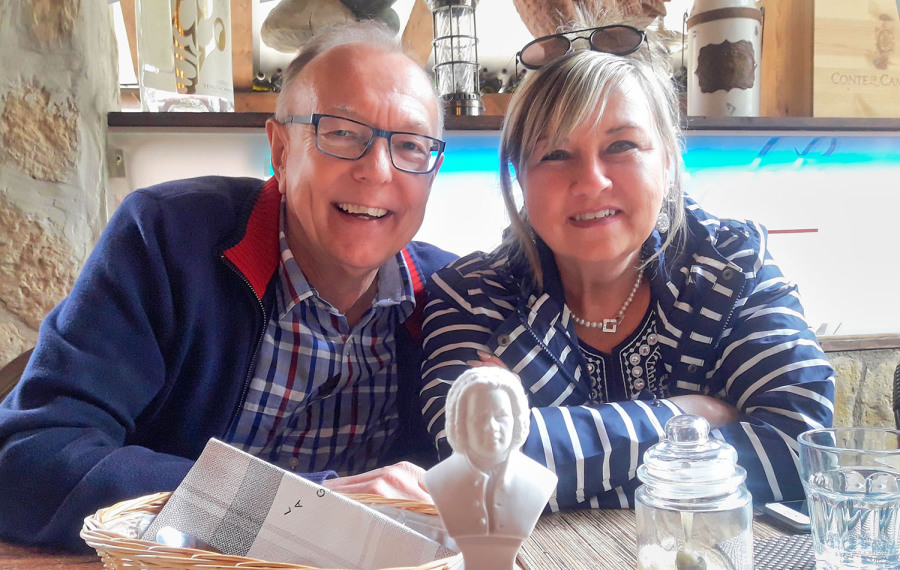
My wife Renate and I: the Dvořáks as a new branch in the Bach genealogy ... what a sensation. © Roman Schreuer..
I almost missed the first hint mentioned by my wife, Renate, in my excitement about being able to publish such a valuable discovery once again. What did she mean? Several names didn’t fit the genealogy she was able to piece together from her records regarding Antonín Dvořák. But that didn’t “stick” with me. It’s one of those times when you pay so little attention that you later ask yourself why you didn’t give this or that remark or insight more weight right away. Alternatively: You just aren’t listening! But I should have..
Let’s continue working our way through the fascinating sections of the article together. So, the note was found in the chair cushion in poor condition. And it’s hard to read. Plus, it’s written in German handwriting. It was sent to the Faculty of Philology at the Petr and Pavel University in Plzeó, a district of Pilsen. Probably mainly because German wasn’t spoken at the museum. What’s uninteresting, however, is that the institution in Nelahozeves confirmed that the paper dates from 1850. It’s unimportant because, if the content itself is comprehensible, then the date of the writing is irrelevant..
But if it isn’t the correct ( ! ) genealogy, then all you have in your hands is old waste paper. Perhaps even 170-year-old waste paper. The watermark mentioned and its authenticity also tend to undermine the research. For if the paper bears a watermark, it can hardly have been waste paper over the course of many decades. Not at any point in 150 years..
Finally, however, “the author of the article shot himself in the foot”: While officials at the Dvořák Institute could not be certain of the content at all – precisely because they might not speak German – the University of Pilsen was quite certain it had stumbled upon a potential gem. A proud Czech professor and a “pack of students” would certainly have “set to work” on the Dvořák family tree, which hadn’t changed in decades. And also on the well-known Bach family tree, which likewise hadn’t changed in the last 30 years ... in this era..
Furthermore, this professor in Pilsen would certainly have contacted Bach specialists in Leipzig and Eisenach. There, the research would have been conducted at a level appropriate for these two musical figures. I wanted to know more about this, so I searched online for this university. And I found … no university in Pilsen with that name. What’s more … or in this case rather less … I found absolutely no Czech university with that name. And only a single philology faculty at a university in the entire country. Google was all too eager to present many philosophy faculties with the suggestion “Did you mean …,” but of course I wasn’t interested in those at all..
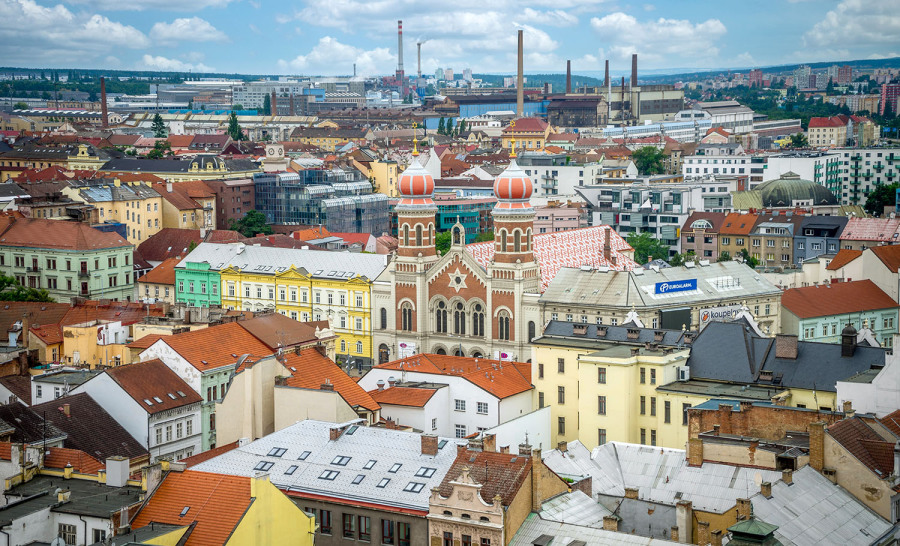
Pilsen: There the Petr and Pavel University Plzeó is significant for me. There, the 170-year-old document concerning "Johann Sebastian Bach and great-great-grandson Antonín Dvořák" was examined about two decades ago. © Pixabay..
17 Universities and a Dozen Cities and Places on the Edge of the Vltava River..
So I do – in the meantime, until maybe an answer from the author arrives – what I always do when I am very interested in something, but there is no budget available for it: I send off ten mails with my request for free help. And I get no answer at all to five mails, two people write me nonsense, one of the addressees complains, and one or two people I write to lead me to an extraordinarily valuable result. So I write to a selection of universities in the Czech Republic: Not only 10, but 17. These are 1. Charles University Prague, 2. Palacký University Olomouc, 3. Mendel University Brno, 4. Masaryk University Brno, 5. Academy of Fine Arts Prague, 6. Academy of Performing Arts in Prague 7. Janáček Academy of Music and Performing Arts Brno, 8. University of Economics Prague, 9. The University of Pardubice, 10. The Silesian University in Opava, 11. The South Bohemian University in ?eské Bud?jovice, 12. The West Bohemian University in Pilsen, 13. The Jan Evangelista Purkyně University in Ústí nad Labem, 14. The University of Ostrava, 15. The Tomáš Baťa University in Zlín, 16. The Metropolitan University in Prague and 17. The Archives of Charles University..
... and I get a quick reply, just a few hours later: There is no Petr and Pavel University... not in the whole Czech Republic and certainly not in Pilsen..
Why are here two so exaggerated listings, further above the one and also concerning the Vltava towns and Vltava communities further below? Because we – regarding Bach and the Bach Genealogy – not only want to work meticulously, but also want to supply immediately provable sources. No source references with small numbers and a lot of tiny writing at the end of the page or at the end, as usual in books on the last page. Yes ... that's how we are ... yes ... that's how I am..
From the Warm Vltava to the Elbe: 430 Kilometers (... 267 Miles) of Banks..
So, where else can you research? In the genealogy: first in that of the Bachs, then in that of the Dvořáks and – you could also start it completely new and thus again – in the church records first in Leipzig, Germany then in the places and cities at the mentioned Vltava banks. A wedding in a place between the bank of the Vltava and the Pleiße does not seem to make sense. Let's start with the Vltava bank. What is the definition of Vltava bank, Mississippi bank, Danube bank? This is the first consideration when listing the localities, municipalities, cities and large towns that are located on a river. Is a place with the local mark only one kilometer away from the Elbe still a "municipality on the Elbe"? Rather no. Why is this relevant to the study? Because it is a matter of searching for people in church records. And it matters whether there are ten towns and villages or 250..
I Tend to Overdo Things Quite a Bit..
The Vltava is the longest river in the Czech Republic and flows into the Elbe. The Vltava has two source streams. One is the Warm Vltava near Kvilda (... Außergefild), a village of 143 inhabitants in the Bohemian Forest (... Šumava) at an elevation of 1,172 meters above sea level … and the other is the Cold Vltava. The “well-known” Vltava is 430 kilometers long. However, the Little Vltava and the Grass Vltava are not among the source streams. In Chlum (... Humwald), a district of Volary (... Wallern), the Warm Vltava and the Cold Vltava converge..
The first somewhat larger town is Vyšší Brod (Hohenfurth). A respectable 2,621 people live here. It is the first place behind the first reservoir. The local Vyals Monastery is worth mentioning as a notable tourist attraction. The towns along the Vltava River grow larger: The town of Český Krumlov (Krumau) already has 12,788 residents, and a highlight is Dívčí Kámen Castle (... Maidstein). Before reaching the city of Budweis (... České Budějovice), the Vltava bids farewell to the Bohemian Forest. The next stop, Budweis, has 94,229 residents. Shortly thereafter, you reach the outskirts of Prague (... Praha). Of course, Prague is the dream city on the Vltava. And well over a million people live there. To be precise – as of today, as these lines are being written – there are 1,335,084 residents. Next: The following place is Týn nad Vltavou (... Moldaustein). 7,887 people live there. Neznašov (... Nesnaschow) is a district of the municipality of Všemyslice in the Czech Republic. However, only 535 people live there..
The next town is Kralupy nad Vltavou (... Kralup on the Vltava) … 20 kilometers northwest of Prague. Population? 18,485. Near Mělník (... Melnik), the Vltava finally flows into the Elbe. The population there? 19,579. Later, I heard from a top genealogist with decades of experience that all the church records in the Czech Republic are available online. I therefore saved my research in these few cities and towns for later … and looked forward to it..
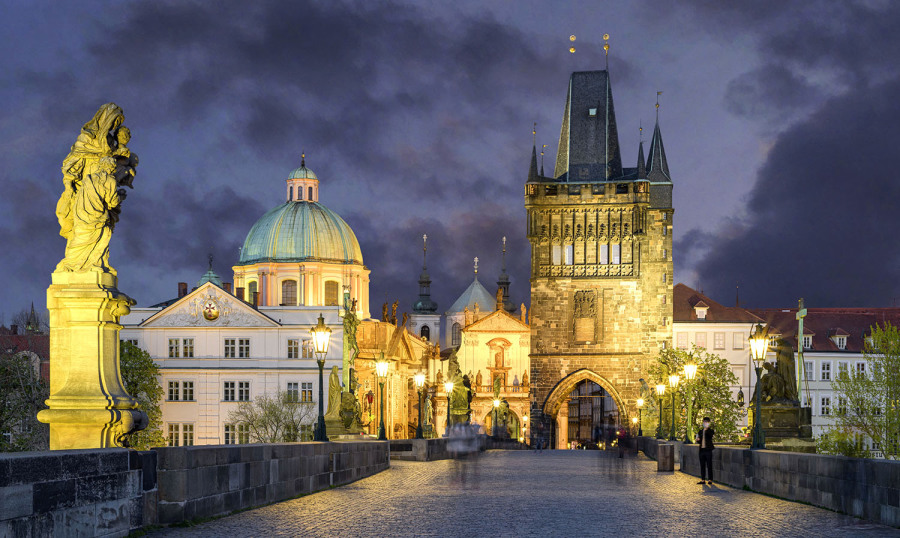
Prague may not be the most likely city to find people named Bach in its historical church records, but it is the largest in the Czech Republic. © Pixabay.
Then I had the idea to ask the absolute ( ! ) expert and authority on Anna Magdalena Bach – the twentieth and youngest child of Johann Sebastian’s second wife, Regina Susanna – for help: He replied within a few hours, getting right to the point. He’s a scientist, I’m just an entertainer:
Dear Mr. Bach, just a quick note today, as I’m in a bit of a hurry. But since your questions are quite easy to answer, this is certainly possible. There is a death record from 1809 for Regina Susanna Bach: “A maiden [...] Regine Susanne, the late daughter of Mr. Johann Sebastian Bach, Music Director and Cantor at St. Thomas School, on Quergasse [died] Dec. 14 at 11 a.m.“. She was buried on December 17, 1809, at the Johannisfriedhof in Leipzig. This entry proves that she was never married. Otherwise, she would have been referred to as a widow and her husband’s name would have appeared. She also had no children. Otherwise, she would not have been allowed to be called “maiden” . Nothing is known about a gravestone. That was also uncommon at the time. Unfortunately, I cannot provide more details today, as my book [...] is scheduled to be published on Feb. 27. I still have a little work to do on it, and the text is due to go to the translator today. Best regards..
Of course, I told this expert that this, his expertise was more than enough for me. Because I was impressed by his knowledge, which aligned perfectly with many other clues and the “storm brewing” in the Bach family genealogy. Of course, my research was nowhere near comparable to the investigation into the fake news surrounding Johann Matthias Korabinsky in Pressburg. Regarding “the Bachs’ time in his hometown.” A time investment of just one-tenth of one percent of the research: compared to the investigation into the relationship between Johann Sebastian Bach and people in Pressburg. But still: It took several days of careful “digging.” And further reading about the incredible connection between two great musicians. But all of that was exciting for me, too ... and entertaining..
The top genealogist mentioned above, who has a special interest in every aspect of the genealogy of Johann Sebastian Bach’s musical family, helped me a second time. My question: How long do you think would it take to search through all of Leipzig’s church records? Trying to find out if the wedding mentioned much earlier “in blue” might have taken place there. He replied, again just a few hours later:.
Hello Peter, … generally speaking, Regina Susanna Bach’s life story has been thoroughly documented. She was unmarried and died in Leipzig in 1809; all of this can be found in her biography, so I don’t think there’s anything unknown about it. If she had indeed been married to the (... mentioned) merchant , why did she die as a Bach in Leipzig? The problem with Leipzig is that the records are not available online. Furthermore, there are a great many parishes. So one would have to check all of these parishes for the alleged marriage in 1764. I estimate the time required for this to be about 3 hours. Best regards..
Now my research gains momentum and I exaggerated – as I always do – with the lesser pros and cons and here they are compiled:..
I began my search for probable, highly probable, and very specific coincidences. And for those particular clusters that only came to light when added together. Taken individually, rare constellations are conceivable. But when added together to form a chain, coincidence is almost impossible. With that in mind, the analysis of these minor inconsistencies – strung together – should now continue:..
Small, Insignificant Inconsistencies in Nelahozeves..
If Antonín Dvořák had been Johann Sebastian Bach’s great-great-grandson, the discovery in 2003 until 2004 would have been a sensation. However, no one – except the magazine to which everything on this, my website, refers – had published anything about this in Germany or in Leipzig. And no one had investigated this particular connection either: Kurt Hermann Frickel alone would have been highly interested: already at a time when we were just “very cautiously” beginning our Bach genealogy.
No one had reported on the author’s discovery of the piece of paper in the chair’s upholstery at the time: not a single academic journal, not dpa (German Press Agency), not a classic journal, not the Bach-Jahrbuch (Bach Yearbook), and no music magazine either. Except for that edition of the aforementioned reputable publication, but only in print. Not online..
Then: It also wasn’t explained how the author of the article came across the content. In other words, how he had obtained this information ... namely, through the moving helpers all the way up to the board of the Dvořák Archive in Nelahozeves. There must have been some connection between the author and the museum – at the very least – at that time..
Regina Susanna Who?..
One distinctive feature is the narrow path to knowledge regarding the deeper genealogy of the Bach family: at the very least, gaining familiarity with the names of Johann Sebastian Bach’s children. After all, one must be a Bach expert who not only knows that Bach had 20 children, but also knows what Bach’s 20 children were named. In a certain sense, this is the following relationship: For a few names, the average, generally educated person knows the corresponding first name: for example, Johann Sebastian …, Wolfgang Amadeus …, John F. …, Karl Theodor …, George W. …, and a few other personalities..
But Regina Susanna… that name doesn’t ring a bell. On the other hand, this “Bach expert” wasn’t so deeply “involved in the subject” that he had bothered to find out whether – and what – is known about Regina Susanna. A quick look at any family trees – whether in biographies, the Bach Archive, or further reading on Bach – would certainly have led to the realization that one would need to delve much deeper into the subject. Which obviously did not happen..
Even the wording of Regina Susanna’s name – assuming she had been married – is perfectly easy to research. Antonín Leopold Dvořák’s family tree has long been the subject of research. It remains easy to trace even today. And it is currently very well preserved in church records. In short … it’s simply correct.
What does not appear in any of these Czech church records, however, is the name Regina Susanna. And certainly not “Regine Susanne” – with two times “e” at the end – as noted in the 1850 document. She would surely have been present, at least in one of the villages or towns along the Vltava River, as the great-grandmother of the great composer Dvořák. And besides that, one should also be able to find a grandfather of Antonín Dvořák there: Bedrich. But he cannot be found anywhere in the Czech Republic. Bedrich simply wasn’t “our” Dvořák’s grandfather. Those were the first two key clues that I almost overlooked when my wife had supported me very early on in our joint search: It’s just that she’s even more meticulous than I am. I’m only really well-versed when it comes to “Veit Bach’s ancestors.”..
What a Chair, What a Find: A Document Instead of Horsehair..
Next, we turn to the discovery of the document. At first glance, this paper seemed to have existed for a full 150 years, from 1850 until its discovery in 2003. Starting as a simple handwritten note in 1850 – when this mini-family chronicle could easily have been written a second time – the document grew increasingly exciting over time. When it found its way into the chair cushion is unknown and also unimportant. What did seem important, however, was this: If the document had been of significant family value, how did it end up one day in the chair as a substitute for horsehair? Directly from where it had previously been kept among the family’s unique, important documents?! That is therefore very unlikely. Alternatively, from a pile of waste paper collected sometime between 1850 and 2003? It is also unlikely that pure waste paper would have been kept for that long at all. A third option is that the replacement of the upholstery took place immediately after the document was written. That, too, seems rather strange, because then one could have used this paper blank and immediately for the upholstery. Again, this option seems strange. A fourth possibility is, of course, that it was deposited as a kind of “time capsule” or “message in a bottle”… long live the conspiracy theory..
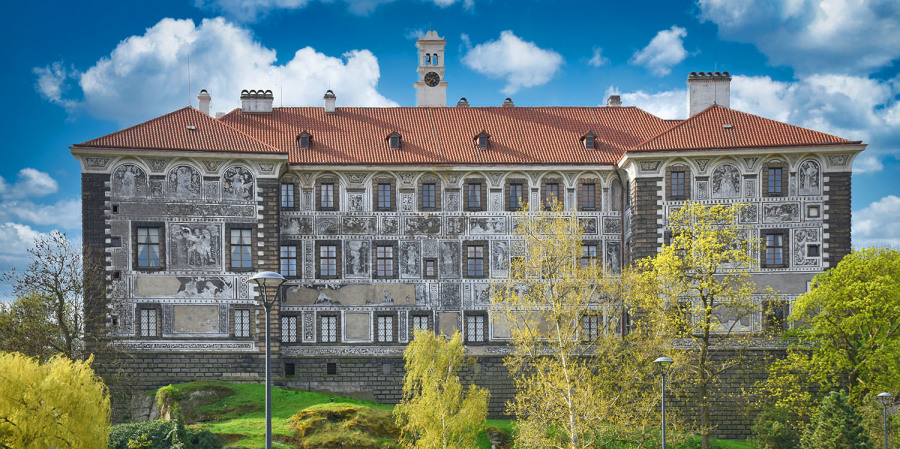
In Nelahozeves "happened" the more than cool discovery. Not in the building above. Aboove, that's just a nice motif in this city, with the Dvořák Archive. © Info..
Moving on to the discovery: So there were eleven chairs. They were moved from one place to another. Perhaps to yet another location afterward. Or even back again after the rearrangement. “Purely by chance,” this very seat cushion then fell down after presumably many decades and a “twist.” Because it was likely not secured properly. As the only one. Next, this gem – though damaged and barely readable – stood out explicitly. The fact that its value was recognized is also not an everyday occurrence. Because they didn’t simply mount the seat cushion back onto the wooden frame, but examined the filling..
However, no one had conducted any genealogical ( ! ) – let alone meticulous –research. Even though one would have only needed to examine church records for about 15 consecutive years. And that in just around eleven locations and cities in the Czech Republic … plus a single year in Leipzig: For the year of the wedding “was clear”: in 1799, JSB’s daughter married her Bedrich Dvořák. In 1810 (... actually 1814), Frantisek Dvořák was finally born. And none of the church records listed in this paragraph had been burned. Or lost, or destroyed by war..
And now to my wife Renate’s core competence: She’s gotten right to the heart of the matter. Specifically, in the Czech Wikipedia article: Antonín Dvořák’s grandfather was definitely not named Bedrich, but rather Jan Nepomuk Dvořák..
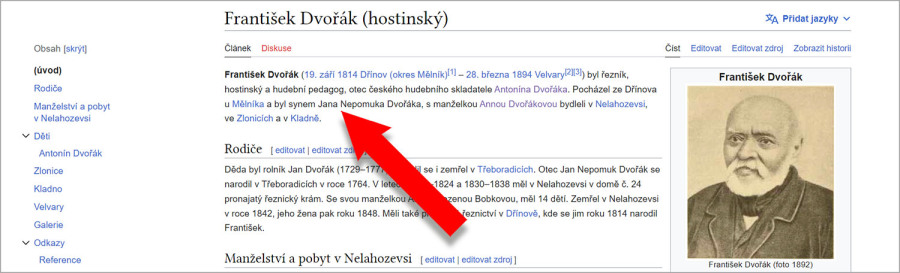
Crystal clear, Antonín Dvořák's grandfather was named Jan Nepomuk. © Wikipedia..

Here again, Antonín Dvořák's grandfather was named Jan and not Bedrich, as you can see on this birth certificate. © Wikipedia..
And Antonín Dvořák's mother was simply not called Ludmilla, but – according to the entry in the church register (death certificate) – Anna..
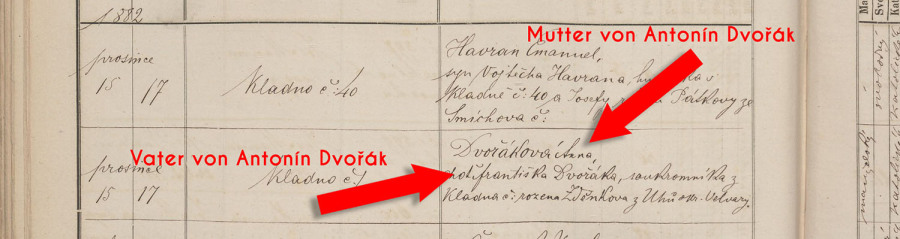
Also crystal clear: Antonín's mother was called Anna. And not Ludmilla..
Plus, what’s really and truly “hilarious” is this: The author of the family history from around 1850 apparently didn’t even realize that he wasn’t his parents’ third-born child. He was actually the ninth. On top of that, he misdated his own birthday by a full four ( ! ) years. Well, in the heat of the moment … that kinda stuff happens..
This brings us to an even more detailed description of the life of Regina Susanna Bach (... daughter of Anna Magdalena Bach and J.S. Bach), which we owe to Maria Hübner (... Leipzig) in the Bach Yearbook 2002. She examines in detail whether Regina Susanna Bach could have been married at all. If not, there is no need to go into detail about the 13 children. Here is the link..
Or download it here:..

PDF-Dokument [2.4 MB]
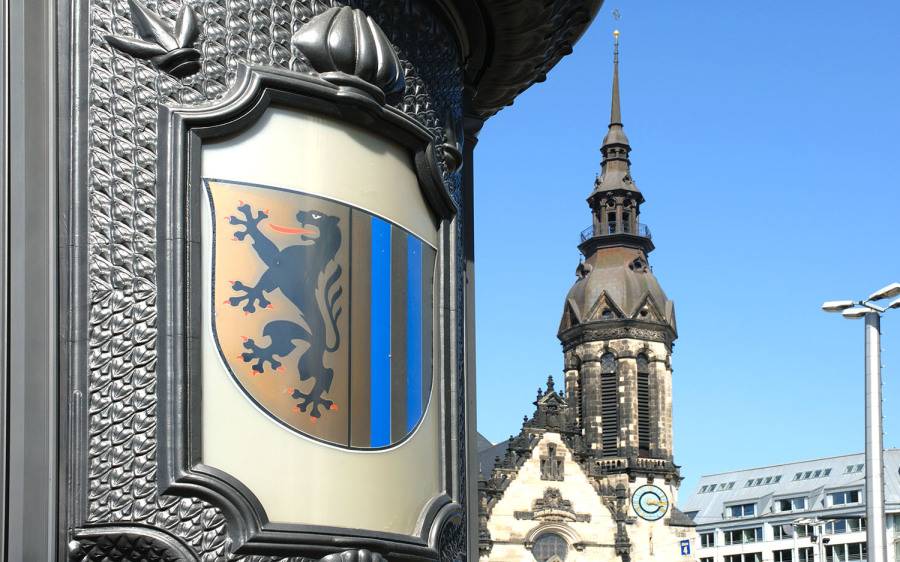
None of certainly twelve super genealogists over the centuries on Bach family matters has found any evidence that Regina Susanna, twentieth child of Johann Sebastian and thirteenth child of Anna Magdalena Bach was married..
This – Well Researched – Is What It Says on the Internet..
After Bach’s death, the Bachs in Leipzig were not only left without a breadwinner; worse still, because they had naturally been living in company housing –specifically at the St. Thomas School – as part of their salary during Bach’s lifetime, they were forced to move out as well, adding to their misery. Regina Susanna was eight years old at the time. At least the new apartment on Hain Street was not far away. The "remaining members" of the Bach family thus did not have to adjust to a completely different living environment. Regina Susanna, along with her older sister, remained with their mother, Anna Magdalena Bach..
In the mid-1760s, her half-sister Catharina Dorothea may also have been living in Leipzig again. Her presence in Leipzig is documented in records from 1771. For several years, the sisters were able to live off the income that had originally been allocated to Anna Magdalena. Perhaps they also received a small additional allowance. And some extra money from Carl Philipp Emanuel Bach in Hamburg..
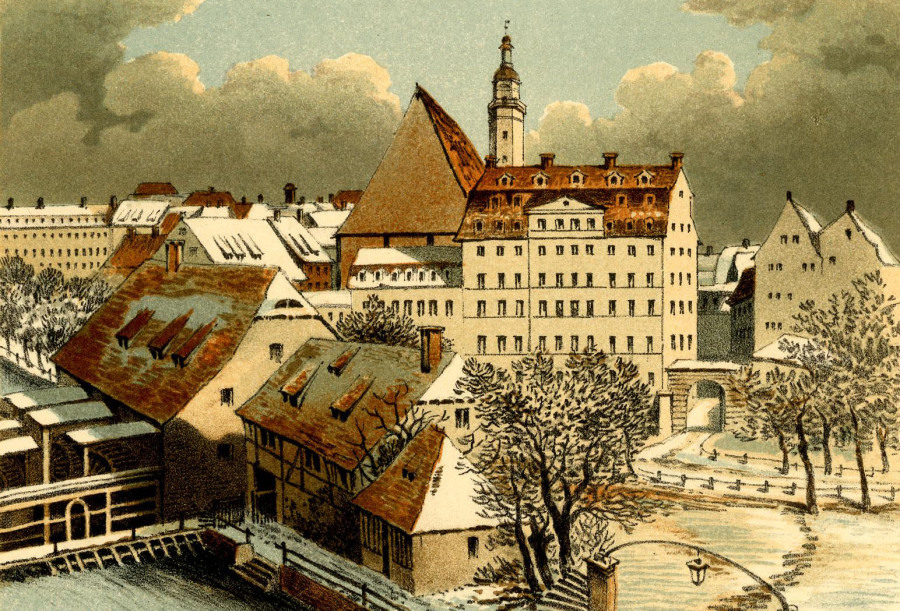
After the death of Johann Sebastian Bach, the remaining family of the Thomas Cantor could of course no longer stay in the apartment at St. Thomas School..
In May 1800, Friedrich Rochlitz, a composer and music writer, launched a fundraising campaign for the last surviving daughter of Bach. He did so by publishing an appeal in the Intelligenzblatt zur Musikalischen Zeitung, a journal he edited. This appeal resulted in a marked improvement in her living conditions. In it, Rochlitz described her living situation with the words: “This daughter is in dire straits.” Certainly, even back then, this phrase indicated poverty. After the fundraising campaign, Rochlitz published a list of donors. And a preserved letter of thanks from Regina Susanna (… you will find this receipt below)..
Another initiative by the piano maker Streicher even extended the collection until 1801 and raised an additional 200 talers. Rochlitz also reported on this. Regina Susanna’s letter of thanks, which, however, did not correspond to the published version, is still preserved today. Regina Susanna had lived in a residential neighborhood that was considered prestigious at the time. The fact that Regina Susanna in 1760 was still receiving 16 groschen a month – half of the university alms paid to Anna Magdalena before her death – is irrelevant to our discussion. Because that would have been in addition to the income she received before her marriage. However, the fact that on October 12, 1767, she was still receiving 12 groschen weekly as “Miss Bachin” is of the utmost importance to us. For that would have been three years after her "wedding"..
He started the collection for Regina Susanna when she was "starving" in Leipzig: 100 Thalers were collected. The following year, another collection was made for Bach's youngest daughter and even 200 Thalers were the proud result..
And why is the last record important for us? Firstly, because she is explicitly designated as a "Damsel." At this time, she is – according to this document in 1767, which is three years after her "marriage" – officially – no longer a "Damsel". Secondly, at this time and according to the document found in the seat cushion, she no longer lived in Leipzig, but on the banks of the Vltava. Finally, thirdly, she gave birth to a total of thirteen children, was thus net ten years "busy", rather eleven, even more likely twelve..
A document dated 1768 records a grant of four groschen in “wood money” for “Maiden Bachin,” which indicates twice that Regina Susanna could not have been married to the aforementioned Petr Vencelas Przky at that time. For then she would no longer have been called “Maiden Bachin”. Theoretically, however, she could not yet have been divorced from Przky either. For then she would have given birth to their thirteen children in just four years: biologically highly unlikely. And she would no longer have been called “Bachin” either..
After all, her husband could not have died at an early age. For even then, she would presumably have been named Przkin. She would no longer have been listed as “maiden.” And how could she have had thirteen children? A document from 1781 records that her weekly alms were cut in half to just six groschen. It is noted that this amount was maintained until her death in 1809. Which would likely not have been the case had she been living on the banks of the Vltava in the Czech Republic. In addition to the financial sources mentioned, there was also the Erdmuthe Sophie Frege Foundation, from which Regina Susanna received eight groschen four times a year. The first payment was in June 1795. The last was in 1809..
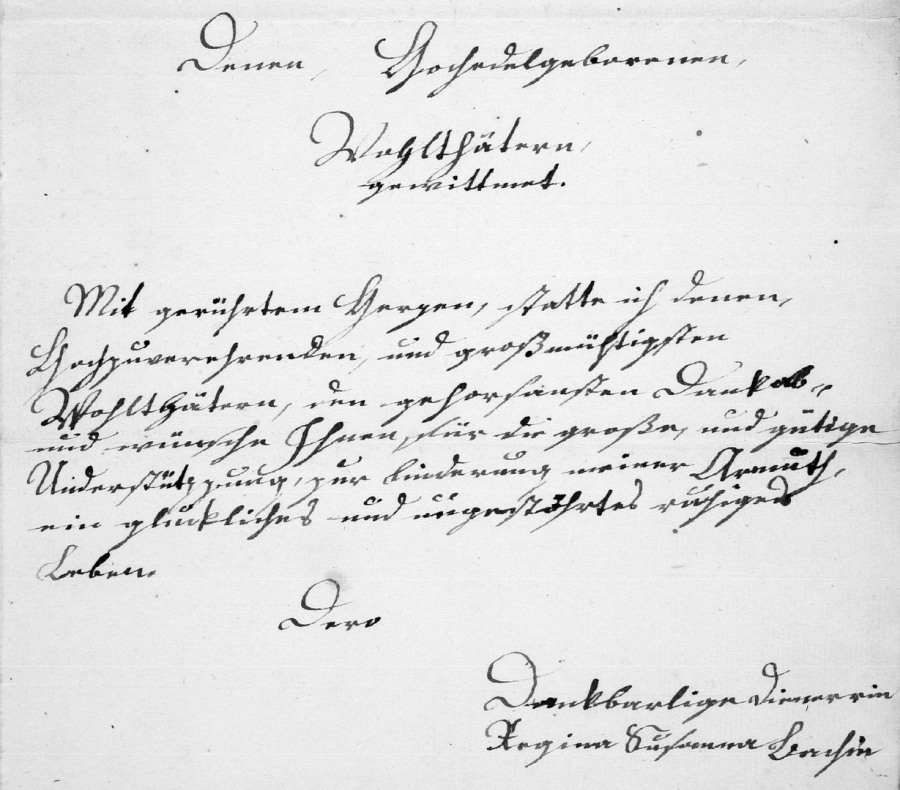
In handwriting – finally then also printed in the newspaper – Regina Susanna Bachin thanks for the donations so that she no longer had to "starve" ... which she then no longer had to do..
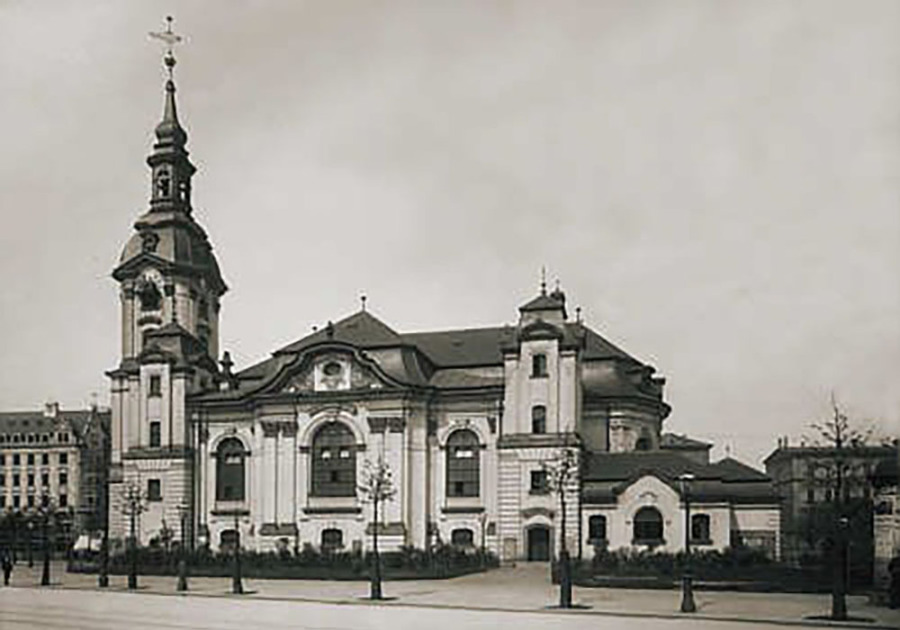
Regina Susanna was buried in the St. Johannis cemetery next to St. Johannis Church in Leipzig, in fact in the cemetery where her father was once buried. Also not on the banks of the Vltava River..
So much for the genealogy of Regina Susanna..
Interesting regarding this collection is also the dissertation of Christoph Öhm-Kühnle from the year 2008. From page 107 (... Excursus: The appeal for donations for Regina Susanna Bach 1800 / 1801 and its aftermath) you can read a detailed description of this collection..
PDF-Dokument [11.1 MB]
By the way: I, too, could “pull your leg” with a made-up story. How do you know that this magazine article ever existed? It can actually be verified. In this Tamino forum, there’s a link to Wikipedia ... specifically to the German Wikipedia article about Dvořák. If you click on this link, you’ll be taken to a page that quotes an excerpt from the printed publication. Or rather … was quoted ( ! ). Because the topic and the sensational story were actually published on Wikipedia once. But then they were removed again. And that is still recorded today (… you can see this yourself by clicking on the “version history” link). Probably for eternity..
Also exciting: The writer refers to the source, which today also cannot be found on the internet, in fact the "Musicologiy Quarterly" and finally to the volume IV/2004. I could not find an offer of this name either. Meant here could of course be "The Musical Quarterly" of the Oxford Academy, and it is spelled just a little differently. And it is likely that the Wikipedia editor did not find the text there, but referred to the paper article at the time. Because, of course, I searched the journals at "The Musical Quarterly" for the entire past century and found nothing for all conceivable keywords, not even in the corresponding year..
Also interesting: The writer refers to a source that can’t be found online today either – namely, the “Musicology Quarterly” – and specifically to the IV/2004 volume. I couldn’t find a publication with that name either. Of course, this could refer to the “The Musical Quarterly” published by the Oxford Academy, and the spelling is only slightly different. And it’s likely that the Wikipedia editor didn’t find the text there. Rather, he was referring to the article in print from that time. Because, of course, I’ve searched through the entire past century in the journals of “The Musical Quarterly.” And found nothing for every conceivable keyword. Not even in the corresponding year..

This is … you guessed it … a photo montage. Created by my wife. To make it look nice. In reality, the huge Wikipedia globe isn’t actually sitting on the right. You can tell from the date: In 2005, two Wikipedia authors “exchanged views” on the spelling. Shortly thereafter, once everything was grammatically and stylistically perfect … all the new content on Dvořák was discarded. And it was removed, as you can still see today: There’s simply no trace of it left in the article. © Info..
The next-to-last highlight is, of course, the whereabouts of the original ... though that’s irrelevant to our discussion. There isn’t a single photo – and as early as 2004, we were already capable of scanning, photographing or copying – a single photo would have been enough to prove the authenticity of the entire story. Much more interesting, of course, is the successful sale of the original to the Antonín Dvořák Trust in Virginia Beach. And for the incredibly steep sum of $ 450,000. It’s just a shame that this trust doesn’t exist either. Unless, of course, it’s invisible online. At least there is … Virginia Beach in the USA. That much is certain..
Let’s allow the author himself – a few paragraphs later in that very article – to have his say once again, as he reiterates in the penultimate paragraph:..
“… Many examples could be cited that attest to Dvořák’s rich compositional heritage from Johann Sebastian Bach, just as is the case in this … with composers such as Schönberg, Webern, Brahms, Bruckner, and Mendelssohn. But in the case of our Czech composer, it is not only a matter of intellectual relationship, but also of blood: Antonín Dvořák was the true great-great-grandson of Johann Sebastian Bach. …” ..
Why am I doing this … this analysis, now that it’s clear this news from 2004 is “alternative truth”?..
Well, first and foremost, I’d like to entertain you. With facts, with exciting stories, with curiosities … and for some Bach fans, this possibility of a family connection – which has been haunting the media for nearly 25 years now – certainly fits the bill. The serious Bach elite had already done their homework back when the publication came out. So this nonsense certainly won’t be “republished” anymore … but nobody … could find any pros or cons on the internet today. That … has now changed. Because I naturally want to pamper my “baby” so that it appears in the number 1 spot on page 1 of Google for the keywords “Johann Sebastian Bach” and “Antonín Leopold Dvořák.” Let’s see if that works..

Yes, finally ... that's how we know him best. Antonín Leopold Dvořák, who is just not ( ! ) the great-great-grandson of Johann Sebastian Bach..
But I also hope that the confusion that the two “experts” – Carl Philipp Emanuel Bach (… only as a genealogist) and Korabinsky (… as a fool) – “caused” regarding the Bach family’s origins doesn’t happen again or in a similar way. So … I’d at least like to do my part to prevent that..
The same thing happened to Wilhelm Friedemann Bach, by the way, whose reputation ended up being historically defamed simply because of a novel by an unsuccessful writer. Through genealogy platforms like Ancestry and less “moderated” Wikipedia articles, such nonsense can quickly be “spread” across the internet. And it then goes viral. With a final post of my own on the Tamino Classical Music Forum, I would like to conclude my research following the publication of this, my work..
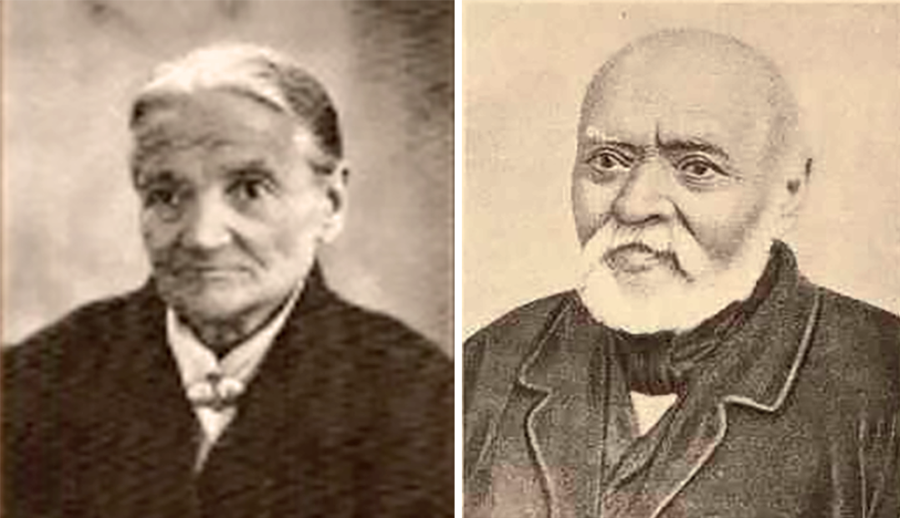
The parents of Antonín Dvořák, but not related to Johann Sebastian Bach. Whether it was already noted in the then Wikipedia contribution regarding Antonín Dvořák, that the parents of the Czech super composer, on his mother's side, were already known? We could find out. But at some point, enough is enough..
Epilogue..
Finally, a closing remark, directly to the author of those lines printed back then: Surely it was the same reasons that had prompted the writer from Pressburg, Korabinsky, to create such fascinating genealogical confusion at the time. But certainly not with the same “success.” I benefit from this today, because this nonsense adds another nice page to my website. For the handful of interested people who might search for an answer to this alternative truth via Google in the future, it might be pleasant entertainment ... and also something to smile about. What I don’t want is to put you “in the spotlight” with this, my estimation. After all, I specialize in the discipline of “finding,” and – for new members of this family – the “preservation of personal secrets.”..
And now I am convinced: Virtually all living adult Bach experts were already aware of your “discovery” back then and – at best – quickly classified it as fake news. Not a single one of them will want to consume any further content on the topic of “Dvořák vs. Bach”. So these 99.99 percent of all Bach specialists won’t be stopping by here anymore. For them, the topic has long been “settled.”..
And what about the few remaining interested people? They won’t find out who you are. Because only the printed article leads back to you. And since not everything was posted online at the same time back then, the links on Google only lead to two pages. One of those is Tamino, the Classical Music Forum … and that’s where the trail ends. Or rather, it leads back to me again. And also to Bach on Bach, specifically to FAQs 132 and 133. With that in mind, I’d like to thank you – with a wink – for this brilliantly crafted, well-rounded fairy tale by Antonín Dvořák and his great-great-grandfather Johann Sebastian..

The signature of the master. © Info..
Epilogue Number 2..
After exactly twelve days and 57 minutes, I at last received a reply to my email. It was from the truly respected (… and I mean that!) author of the article in that ultra-conservative publication from a good 20 years ago. Very politely, but in a truly ultra-brief manner, he wrote: “The text is satire.” By then, however, the entire latest page on my website – the one you’re currently reading – FAQ 132 and FAQ 133, had already been thoroughly researched, written, and laid out. And the images had been edited. It is now … also satire … but I’m happy to let you all know this here..
So let’s put it this way: Perhaps Korabinsky’s claim back then – that the Bachs came from Hungary – was also satire. This would finally explain why this Korabinsky fooled the Bach world so thoroughly so many decades ago. And continues to fool it to this day. And here we are, Googling once again … one last time … now on the topic of what satire actually is:..
Let’s use the ten best definitions for this, specifically those found on Google’s first page of results: One website defines it as an “artistically crafted prose text used to denounce people, events, or occurrences.” Second, satires have the following characteristics: “It is a mocking and/or humorous presentation of criticism. Things that are obviously bad are portrayed as positive.” Third: “It is an exaggeration or an understatement used as a stylistic device.” Fourth result: “Satire is a form of representation in which, in particular, people, events, and grievances are ridiculed in an exaggerated form through exaggeration or understatement.” Fifth: “Today, satire is understood to be an artistically crafted joke.” Sixth result (… an excerpt, just like the five above, were of course only excerpts) and particularly intriguing: “What is satire not allowed to do: distort facts. And spread untrue facts.” No. 7: What is satire allowed to do today? Today it is allowed to do anything, provided the message is conveyed in order to “improve the world.” Result number 8: “Satire is protected by freedom of speech and also by artistic freedom.” The ninth result (… ta-da … Wikipedia …): “Satire is an art form that denounces, mocks, or criticizes events. To the point of the ridiculous and the absurd. No single definition applies to all satire.” And the “crowning result”? It’s number 10: “First and foremost, satire must be recognizable as such. Satire is not always understood as such.” This is the statement from the law firm Gulden Röttger Rechtsanwälte. In the article “What Is Satire” under paragraph heading 4, one reads: “How do you assess satire legally?”: “First, satire must be recognizable as such … and satire must, in essence, be subject to the question of whether the satirical piece is capable of improving the world. If the work fails at this point, then we are dealing at most with comedy” (… the last sentence comes from the section “Satire and Law Today”)..
Well, these ten results are totally awesome. Okay, so apparently all the Bach scholars, Bach experts, Bach genealogists, and a few hardcore Bach fans recognized the project as satire. Only I, the sole person out of today’s eight billion people on Earth – oh, what am I saying … in the entire universe – was fooled by it. And didn’t realize it was “satire.” How embarrassing, how embarrassing..
And one more thing on top of that … because whether the entire report back then only became satire after its publication is something the interested reader can now figure out for themselves..
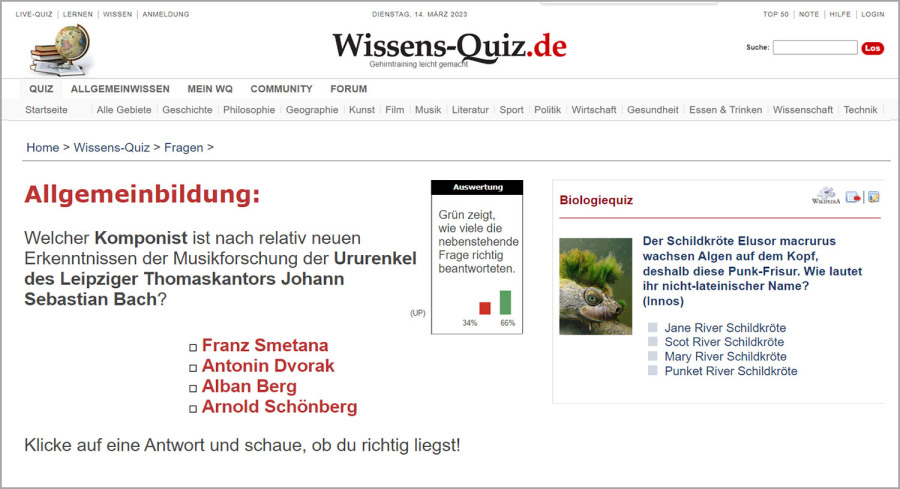
Ah, I see ... it's spreading. Here's the original link. And that's exactly what I hope to achieve with my “Bach on Bach” project. © Wissens-Quiz.de..
Excuse Me ... It's Not Yet Over?..
Once upon a time, long ago, shortly after the turn of the millennium, a fairy tale – brief yet intense – “enchanted” some curious minds. But the fun, the amazement, the doubt, and quite a bit of head-shaking have surely reached everyone interested some twenty years later. And there remains only a tiny – truly homeopathically ridiculous – circle of people who, starting today, will find an answer here to a story that sounds unbelievable. And that isn’t true. Finally, this fantasy is thus preserved for eternity for the next individuals searching for a hair-raising connection between Johann Sebastian Bach and Antonín Leopold Dvořák. My heartfelt, sincere thanks go to everyone – truly everyone ( ! ) – involved..
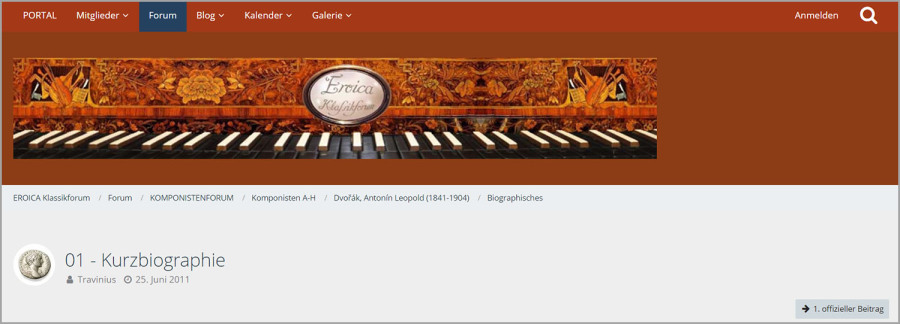
In this forum, too, things are now clear. And once again, I am one step closer to my goal of providing clarity on the subject of Johann Sebastian Bach. © Eroica Klassikforum..

Advertisement
Thousands of Bach Gift Ideas..

Five “Bach 4 You” online shops offer a wide variety of Bach gift ideas. Specialties include T-shirts and Bach calendars. Click here to visit these shops..
One of the three most recent Bach calendars. Click here for the calendar overview..

“Bach 4 You” is the specialist when it comes to Bach T-shirts and Bach seal T-shirts. Click here..
Ende der Anzeige
 Druckversion