

Bach FAQ 106
Is There One Bach Seal or Two Bach Seals? One Bach Monogram or Two Bach Monograms? Or Maybe Even Some More?..
To the point: There is not only one up-to-date Bach seal. Or, if you want ... Bach Crest, Bach Monogram, Bach Sign, Bach Motif ... or rather less frequently Bach Insignia..
For those in a hurry: The current and "correct" graphic Bach Seal since 2009 has exactly five prongs or cones in the crown. For over 250 years until 2009, there were seven prongs. This is how it was interpreted, what was seen on the ancient documents as Bach's seal depicted in the sealing wax. In addition, since 2009 there is the thousand times unknown original Bach Monogram in the best quality. and with it the second "right" logo. It was "found" in this year 2009. Who is interested, whether there are now even three Bach seals, or four or meanwhile eight ... or just "only" two ... can find out with very little of my exciting entertainment in the following chapters. Have fun with it..
By the way, it is also interesting to note that if you google "Bach seal" on the internet and additionally click on "images", you will find the "wrong" Bach seal twelve times among the first fifteen images. The "correct" one, more precisely one of the two correct Bach seals, however, is included only three times. But at least the today correct one is on place 1, thus ... the one of the two current ones. But that ... of course changes on Google day by day. This page on my website about the Bach seals is very, very detailed. A shorter overview of all eight Bach seals can be found in the answer to FAQ 93. An even shorter and therefore clearer description of the Bach logo is provided in the answer to FAQ 94..
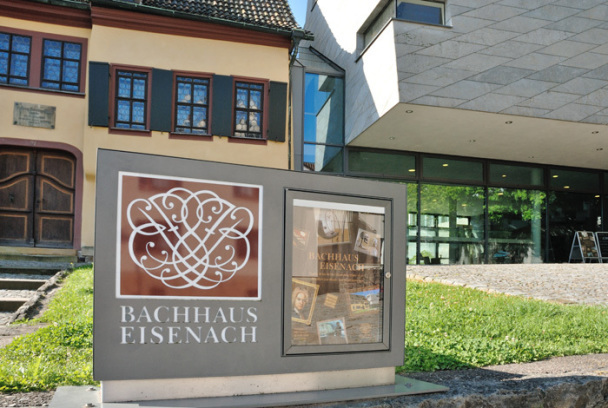
Exciting, thrilling. And right: The Bach seal / Bach monogram in front of the Bachhaus Eisenach, Thuringia, Germany. Without crown. And without the "stuff around it". But with 14 spots. 14 ... a "Bach number". Is this then really "correct" after all? Yes, it is. But please read more about this below..
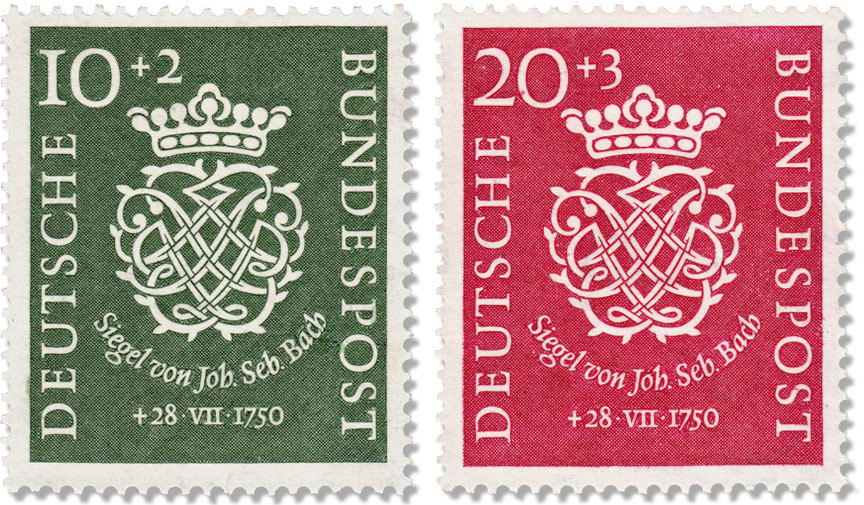
In 1950, the official Bach seal / Bach monogram was still the one with the crown and its seven prongs or cones. At that time, it had already been that for around 200 years ... almost from the death of the famous composer..
One More Section, Then It Starts ... Regarding the Bach Seal / Bach Monogram 1, to Bach Seal 2 and to Bach Seal 3, 4, 5, 6 and Finally to Bach Seal 7 as Well as 8..
Particularly in Bach science, individual areas have their own history. And because this exceptional musician – once again – is, was and will be a little complicated in every respect, the same is true for the story around the Bach seal. But before I introduce you to this history of the Bach seal, it should be mentioned the following: The most famous Bach scientist and author Prof. Christoph Wolff assumes that the research around this expert of msuic will probably never be 100 % completed.
Of course, over the past 270 years, more and more pieces by the Royal Court Composer have come to light. What is unusual, however, is that people have also argued about them. And in some cases, they’ve even reached a consensus. Including the fact that some pieces weren’t by the Thomas Cantor after all. Even though that had been considered a certainty for an infinitely long time. Whether Bach himself copied, that is, transcribed works – albeit mainly his own – is a great topic. And one worth arguing about. I ... am staying out of it.
For roughly 115 years, for example, it was also assumed that the Bach House in Eisenach was the birthplace of Johann Sebastian. This was from 1850 until the 1960s and 1970s. But it wasn't..
Next: The "Origin of the Musical-Bachish Family", a compilation of 53 members of the clan, collected by Bach himself ... it is invaluable, but it is not a family tree. No Bach genealogy..
The origin of the famous musical family: For over two centuries, it was written that Veit was said to have come from Hungary. But the family did not come from Hungary. And they returned: two ( ! ) significant differences. In any case, the history of the Bachs. It did not begin in 1609. But that of the Bach family of musicians did. And ... finally – in 2021 – it is actually clear. After a full 270 years of research. Documented evidence confirms this: These Bachs really did not come from Hungary. But from Ungern. Bach himself wrote and spoke of it that way..
Another Bach-related topic: The Bach in a fur coat and hat with such a warm smile: For decades, people thought this was Wilhelm Friedemann Bach. WFB, the eldest of four famous and five musically gifted Bach sons. But it isn’t him. Someone must have slipped a scholarly “cuckoo’s egg” in the form of a painting into this musical family’s “historical nest.” WFB looked different. Very different..
The famous composer from Eisenach (... JSB), painted by the artists Ihle and Rentsch: These paintings are also famous depictions of Bach. But ... that’s simply not what the Thomas Cantor looked like at all. Only one portrait is authentic: it’s the one by Elias Gottlob Haußmann.
The Beer Cantata, which Bach is said to have composed. This cantata does exist. But it isn't by Johann Sebastian. And it isn't called the Beer Cantata either.
The re-premiere of the St. Matthew Passion: It was the pivotal event that marked the beginning of Bach’s current popularity. It was re-premiered exactly 100 years after its “first premiere.” Exactly 100 years later to the day, as it was Good Friday again, and very likely even to the hour. Then Bach scholars discovered that the St. Matthew Passion had actually been “premiered” two years earlier than previously thought. This means that the re-premiere took place 102 years later: Unfortunately, this is no longer such a nice, round, exciting date. Unfortunately. Today, by the way, this date is referred to as the beginning of the “Bach Renaissance”.
You’ll notice ... there isn’t just the one true story surrounding the musician from Thuringia. No, there are often stories about the story itself. And the one about the Bach seal is particularly fascinating. Here it is again. Perhaps for good. Added to FAQs 93 and 94, rewritten! As FAQ 106, it will never be “lost” again..
I first heard about the history of the Bach insignia at the Bachhaus in Eisenach. Since I was researching the topic after reading about it, I also asked the Bach Archive in Leipzig for help. I’ve received a great deal of support from them over the years, ever since I started my Bach project. And that was certainly the case with the Bach seal as well … back then, once again.
I initially drew the content from this institution’s 2009 Annual Report. But I also used material from the 2009 Yearbook in particular. I would like to extend my sincere thanks to the author of the detailed text in the Yearbook, Mr. Ulf Wellner, for his research and the report. I would also like to thank the Bach Archive for sending it to me. Below is a link to much more reading on the subject.
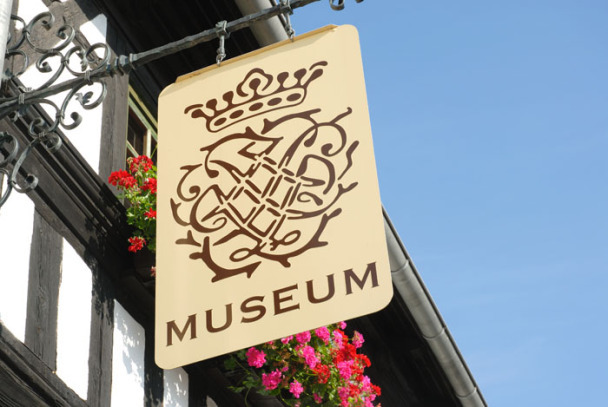
The sign at the Bach Ancestral Home in Wechmar: It is the Bach seal that has been the only correct one since Bach’s death in Leipzig in 1750. Well into the third millennium. Only a few years ago did another version become the correct one. With just five points or spikes in the crown, instead of seven..
Advertisement
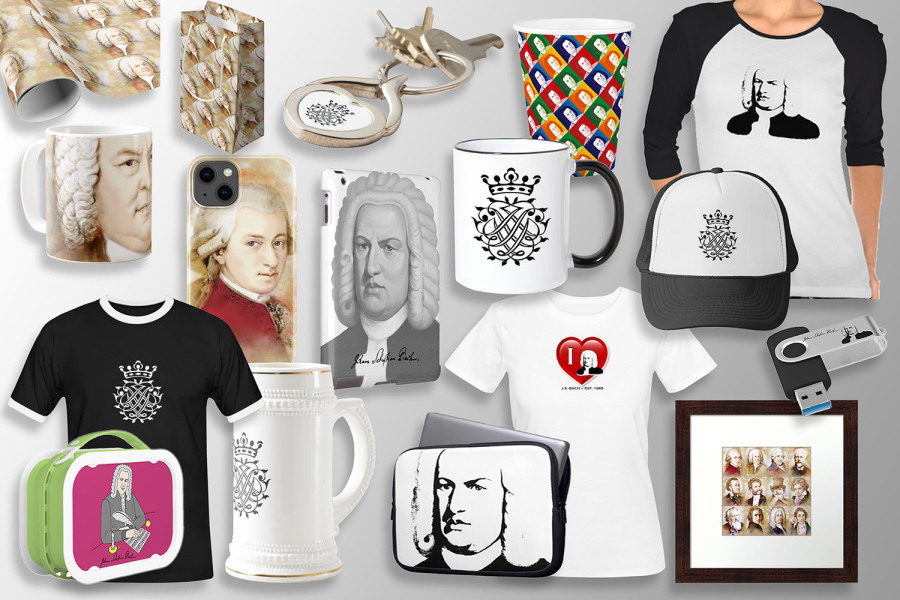
So Many Items With Two Different Bach Seals: Two Cool, Official Bach Seals..

Both Bach seals are now considered “official.” But the one on the right will never catch on. For one thing, because starting in 2023, it will be featured almost exclusively in our Bach Mission. And also because the one on the left has become so dominant across all media. Whatever: In the five online shops of the “Bach 4 You” Publishing House, you’ll find gift ideas featuring both. And not just on the items pictured above, but on many more as well. And ... we can even fulfill your very own special requests. Are you interested in browsing there now? Here follows your first step to visit all five shops. Click on this link, please.
Two Different Bach Seals on T-Shirts, Hoodies, Baseball Caps, Bags, Mugs, Bed Linen, Key Rings and More..
A Bach Seal of the Past Develops Into the Bach Seal of Today..

We’ve known this for a long time: Johann Sebastian designed his own seal. And he did so very early in life. It was the precursor to the Bach seal we know today: an exciting interlacing of the three letters J, and S, and B ... plus the same letters repeated in mirror image above them. A little crown on top ... and it’s done. In practice, the then band leader and Thomas Cantor used it as a relieff on his signet ring or seal stamp and pressed this seal into the hot, still viscous, soft, red sealing wax. It is documented in early documents to this day. However: This very signet ring and this very seal stamp are no longer preserved. But the prints do exist on some of Bach’s original documents..
Later they discovered: Sometimes, however, this Bach seal has no crown at all as its second element. Or no leaves, no dots, and/or no laurel branches. Alongside the ornate, upright and mirrored letters “J S B”. Time and again ... it’s a little different. One might also assume that the crown refers to the honor bestowed upon Johann Sebastian as Royal Polish and Electoral Saxon Court Composer. But: Even when he took up his position in Leipzig, the crown was already above the letters. With the points. Seven in number. At least seven were interpreted later from the historical documents. For a full 260 years. Later, in 2009, it turned out: More than two decades before his “ennoblement,” the genius from Eisenach had already been playing with the crown above the letters, as will be revealed regarding seal No. 7..

The Bach seal: the crown with two fewer points (... is that why people speak of the “points that don’t fall out of the crown”? Because ... points ... there aren’t any in Bach’s crown!). So the Bach Seal with exactly five points has been, since 2009, the “official” Bach Seal..
Bach's Treasure Box: Welcome to the "World of Indiana Jones"..
Meissen is located a good half-hour northeast of Dresden, and that’s where the Meissen Cathedral Chapter is located. And what was found there in 2009? A treasure chest, or something even more exciting ... a “Putzkiste” (... “putz” like “dressing up for a party” is in German "to putz out" ... sort of ...). Or, to put it more simply... a “treasure box”..
According to Bach scholars, this box undoubtedly belonged to the Thomas Cantor of Leipzig. And what did the experts find on the inside of the lid? The Bach Seal. How many points or spikes does the crown have there? Five. And not seven. The Meissen Cathedral Chapter entrusted this rarity to the Bach Archive and Bach Museum in Leipzig. As a loan. There, you can actually admire it “in person” today..
The Bach coat of arms – or the Bach seal – had long been a mystery to Bach scholars. For the most part, it was unclear whether it had five or seven points. Heraldically speaking, five points would have suggested a commoner. Whether seven points, by contrast, would indicate a nobleman is not specified in the source: But I knew where I could find out. Following this discovery in the cathedral in Meissen, the seal in the Bach Archive’s logo was “officially” corrected. And all over the world, the new version with only five points was immediately considered the cool and “correct” one. Of course, it is a modern black-and-white graphic design..
Thus, the Bach Seal now has its own unique history. Consequently, one could describe the Bach seal with its seven points or prongs as “incorrect” today. Or, alternatively, as the correct one, specifically, “as before 2009”. Or at least as a plausible version and, for many, the correct one, but specifically from the period between 1750/60 and 2009..
The Bach Seal ... A Hefty Thank You..
Thank you to Ulf Wellner from Lübeck, the author. And also to Dr. Peter Wollny, the editor of the Bach Yearbooks: The facts are taken from an article in the 2009 Bach Yearbook. Here on this, my website, it is my intention to “rescue” this amazing little story about the history of the musical genius from being “drowned” in the more than 60,000 books, reports, dissertations, essays, and online publications on Johann Sebastian and the Bach family of musicians that exist today. With this, my page, the Bach FAQ 106. Plus the hope that people will actually find it. On the internet. When they search for it on Google..

More than 270 years after the death of this genius, research surrounding the Thomas Cantor takes us to Meissen: a town of 27,000 inhabitants in Saxony, 25 kilometers from Dresden. Located on the Elbe River. The photo above shows a view of the castle hill, the cathedral, and the Albrechtsburg. © Pixabay..
There It Has Been for a Really Long Time: Johann Sebastian Bach's Putz-Schranck, JSB's Money Chest With the Bach Seal..
First of all, it should be made clear that, in this context, it was not ( ! ) discovered that the Thomas Cantor had been wealthy. The so-called “money chest” was a chest in which the composer’s money was not found. Rather, it was an iron container featuring Baroque paintings on the inside of the lid. This money chest had already been placed in the ticket office area of the Meissen Cathedral Museum in the mid-1990s. No one had any idea what it was. It was put there, and the Bach seal with the crown was clearly visible to everyone ... it was used to collect donations..
It wasn’t until 2009 that a visitor to the cathedral – an apparent Bach expert –noticed: It is indeed Bach’s seal. Only it has five points, not seven. Later, it was also determined that the painting dates back to before 1750. And the seal, combined with the age of the box, led to the realization that this stately “box” had belonged to the composer. As mentioned: the box. No money inside. By the way: The German word Putz-Schranck – with “ck” – is the scientific and historically correct name for this box..

Meissen Cathedral (... behind the castle): There it stood, the money chest, with its lid open and the Bach Seal clearly visible. It took many, many years before anyone realized that a gem in the history of the musical family had been sitting there completely unnoticed. © Pixabay.
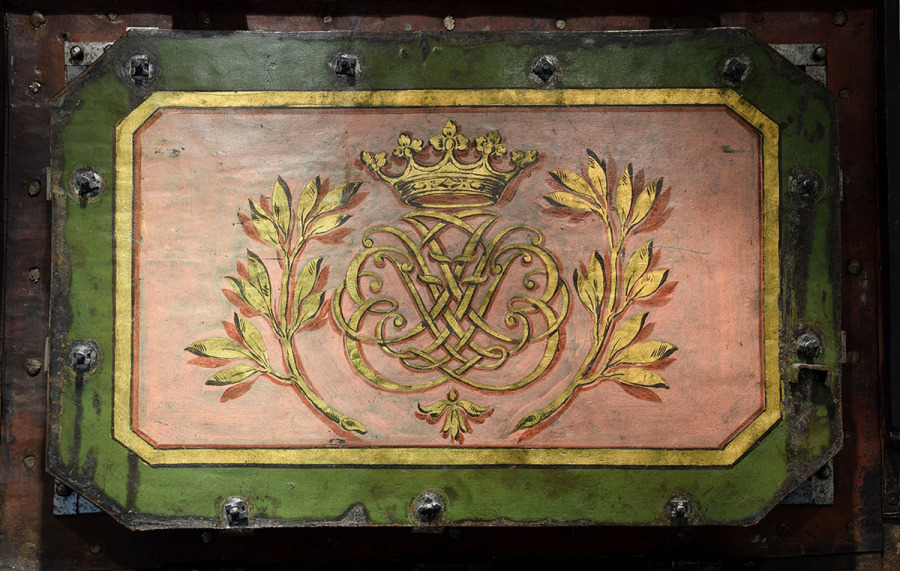
Here it is: the inside of the lid of Johann Sebastian Bach’s money chest. © Dr. Markus Zepf (Bach Archive, March 2019). Many thanks..
Advertisement
The Bach Figure, the Bach Bust, the Bach Statue..
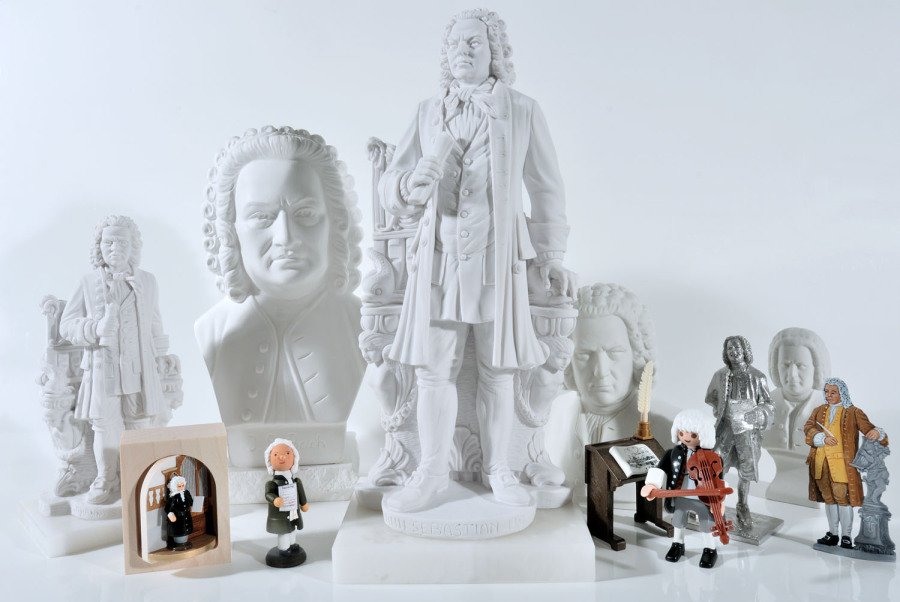
Where can you find more Bach busts, Bach figures, and Bach statues than in one of the shops in the Renate Bach Publishing House? To these shops..
Two Padlocks Plus 11 Bolts ... That's How Bach Secured the Putz-Schranck (Money Chest): What's Coming Next Is No Kidding!..
The dimensions of the money box? Height 54 cm (... 21.3 inches), width 69 cm (... 27.2 inches, depth 45 cm (... 17.7 inches). Not so small after all! The keyhole on the front: a dummy. But there is also a key. And it fits in a completely different spot. Two padlocks were intended, but neither of them exists anymore. And inside: a total of eleven bolts. Plus screws and nuts. These are the original nuts from back then. Experts can tell this from the paint on them, which is also found on the seal..
Anyone still reading this right now should know that, for once, I’m not spouting any nonsense on this page. Otherwise, with me, you often can’t really tell: whether I’m weaving a bit of entertainment into what might otherwise be “overly dry material.” Or, as in the chapter on Johann Sebastian’s music, regarding the Golden Records on the Voyager 1 and Voyager 2 space probes, whether I’m just – or at least mostly – messing around a little. But: That is not the case in this chapter. It’s important that I mention it. Because in Johann Sebastian’s estate inventory, a “Putz-Schranck” (... the Money Box) is listed among three pieces of furniture. And if you’ve already been exploring my website extensively, then it’s important to note: “... without any kidding.”
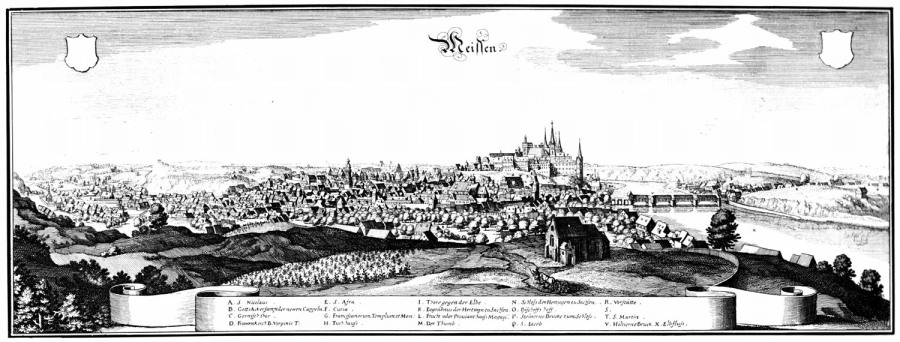
It took many, many decades for the chest containing Bach's seal to find its place in Meissen Cathedral. Here is a view of what the city looked like during the composer's lifetime.
What exactly is a “Putz-Schranck”? Literally translated into English, it means “Cleaning Cabinet.” For us today, it’s obvious: it contains cleaning supplies. From Mr. Clean to washing machine salt. However, the word “Putz” can also be linked to the phrase “sich herausputzen”, meaning “to spruce oneself up,” and to “dressing up” with jewelry. And jewelry is valuable and fits perfectly with the “Money Box” from Meissen. So presumably this very box is exactly the “Putz-Schranck” mentioned. A researcher named Zedler was the expert behind this discovery and uncovered it for those of us interested in the subject. For us, therefore, it is the Bach Seal Number 3.

Is that also one of Bach's coats of arms? No, not even from someone who usually doesn't take everything related to Bach entirely seriously (... me): The one above is a charming bit of fun and looks cool, too. But it was never that, nor was it a seal of Johann Sebastian Bach.
What Does the Crown Mean in the Bach-Siegel ... the Bach Seal? We May Never Ever Figure that Out for Sure..
Incidentally, a surviving document from 1716 is the first time the composer from Eisenach “signed” with a seal. That means he may have done so earlier, but there is simply no evidence of that today. It is, so to speak, “our” original seal ... though that is not an official term. It bears no crown and is thus our Bach Seal number 4 (... even though it was the first one. But only for a relatively short time)..
And what about the seven-pointed seal? The one as it was known for over two centuries, right up until 2009? It first appears – in sealing wax – on a document from the Köthen period, when the composer was performing at Prince Leopold’s court. It is dated March 15, 1722. What is interesting for anyone “on the hunt” for an explanation for the crown is that the Köthen Kapellmeister (... band leader) and music director was, at that time, still far from being the “Royal Polish and so on ... Court Composer.” So why the crown ... cannot be easily determined..
To sum it up, one could also say that the seal on the inside lid of the money box looks slightly different in many small details from the seal we know today, that is, different from the graphic Bach seals 1 and 2. So to speak. However, it wasn’t these minor details that made this Bach seal in the box our Bach Seal Number 3, but rather the number of points or prongs ... in the crown. And why the crown? Please read on a bit further.
Surprise, Surprise: When Will We Finally Get the Fifth Bach Seal?..
There is actually yet another Bach seal. So – as of 2022 – there are ultimately five. However, Seal No. 5 is mentioned nowhere else except on my website, which you are currently reading. The fifth, significantly different Bach seal is engraved on a glass goblet made for Mr. Bach. The goblet is now on display at the Bach House in Eisenach. This was the subject of very controversial debate, first in the 1930s and again later in the 1950s. That is, among genuine Bach scholars. Fascinating: The letters are reversed: Instead of JSB, it says SJB. And that makes for yet another truly distinct Bach seal. It appears on the glass goblet without a crown. But the laurel branches to the right and left below it are included here. Our Bach Seal Number 5..

The glass goblet from the Thomas Cantor’s collection bearing the fifth Bach seal. Do you remember the other four? One in sealing wax (1), one with a crown and seven points (2). And then a Bach seal with a crown and five points (3). That’s right ... or prongs. Next, the coat of arms in the Treasure Chest (4). And finally, the one on the glass goblet, above (5). © Another big thank you to the Bachhaus, which provides me with such cool photos like the ones above..
Advertisement
It's Not Whether There Is a Bach Bust, a Bach Figure, or a Bach Statue ... It's About Its Beauty, Quality and Uniqueness..

The Bach statue or the Bach monument above. You can order it in two sizes. To the shop..

Please support our Bach Mission.To the shops..
Bach 4 You Is the Specialist, When it Comes to Bach Busts, Bach Tin Figures and Little Bach Men..
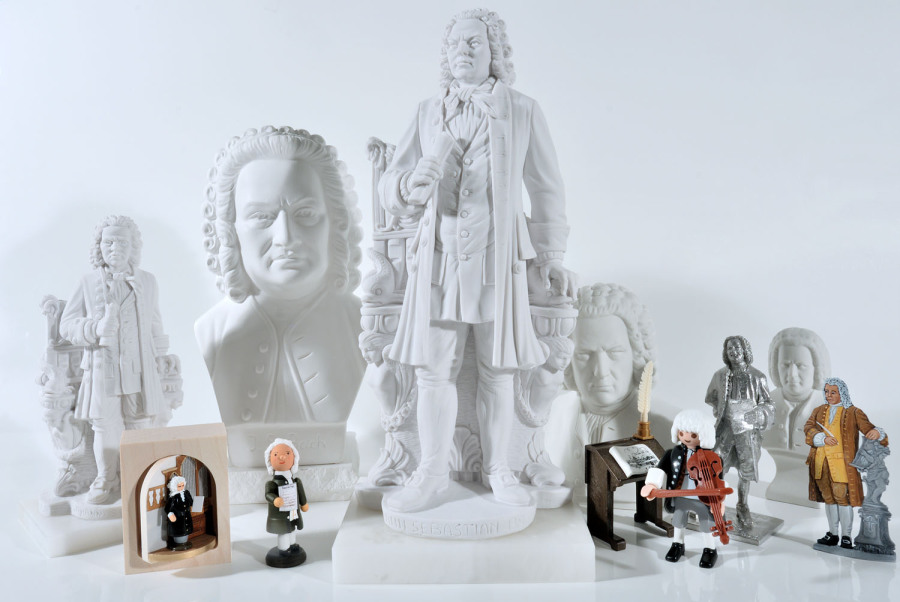
Please check out what, which ad-ons you get with the purchase of some of the Bach figures, Bach busts, Bach statues and Bach, Bach tin figures and little Bach men above ... learn more here..
End of Advertisement
My Postscript on the Putz-Schranck (Treasure Box): Did Anna Magdalena Sell Johann Sebastian’s Chest?..
My very own opinion on this:..
One suspects that this “Putz-Schranck” (Treasure Cabinet) found its way into Meissen Cathedral sometime between 1936 and 1980. However, there is no way to trace the journey it undertook in Leipzig following the death of the Thomas Cantor in 1750. In any case, it is still listed in the estate inventory from 1750. There is no evidence that Anna Magdalena sold it at that time or later..
My personal opinion? Yes, she did; she sold that piece of furniture / that chest. Because Anna Magdalena did not survive her husband “in prosperity.” But that simply meant she had to get creative to continue living the way she had with the Thomas Cantor. In other words, in keeping with her station in life. And what is “relative” about that? Anna Magdalena was not poor after her husband’s death. This went on for a full ten years. So, first of all, it made no sense to keep a container for valuables if you had sold your jewelry to make a decent living … because she had certainly sold her jewelry first. That is, when her financial situation was no longer quite so “easy-going.” Second, this money chest, with its many times greater value compared to the other two pieces of furniture, was an item that would sell well. Which, in terms of the proceeds relative to its useful value, made perfect sense as a sale. But, as mentioned, that is just my personal opinion. That is, the opinion of the author of this website. By the way, there is plenty to read about the fact that Anna Magdalena did not live in poverty or die after Johann Sebastian’s death. A great deal of nonsense has been spread about this over the past 250 years. Bach scholar Dr. Eberhard Spree sets the record straight..

If there is indeed one “authentic” Bach seal today, it is this graphic representation: three letters, JSB. Plus three letters, JSB, in mirror writing. Then there’s the crown. The one with the five points, or prongs, or spikes. A few tendrils and leaves in the center … and that’s it..
Thank You so Much, Thank You so Much!..
None of these findings regarding the Bach seal would have been preserved for posterity had Dr. Peter Wollny, Dr. Michael Maul, Mr. von Stülpnagel, and finally the author of the report in the yearbook, Mr. Ulf Wellner, not worked together so brilliantly. For anyone interested in learning more about this, I recommend the NBG Yearbook, Volume 95, 2009. It is published by Prof. Dr. Peter Wollny on behalf of the Neue Bachgesellschaft..
Let’s now explicitly highlight three additional points of information regarding the Bach Seal. First is a very simple yet pedagogically perfect video explaining the Bach Seal: perfectly suited for children and beautifully set to Bach’s music. Then – this time for a completely different audience –the Bach seal on the Bach Cup, which can be viewed in person at the Bach House in Eisenach, is presented in a scholarly manner. Particularly fascinating in one video is the explanation of the play with the “Bach number 14”: an absolute must-see for Bach fans. And it only takes a full five minutes to watch..
Finally, regarding Dr. Ulf Wellner’s article in the 2009 Bach Yearbook. It is to him that we owe the “discovery” of the Treasure Cabinet of Johann Sebastian Bach. So why is “discovery” in quotation marks? Because the Bach expert travels the world “only” with his eyes open and perhaps with “Bach in the back of his mind” at all times. And that’s how he made the sensational discovery during a visit to the Meissen Cathedral. He didn’t have to search, because it suddenly stood before him. As he entered the cathedral. He was the only one who recognized it. Ever since the chest had stood there. With this clearly recognizable depiction of the Bach seal on the inside of the lid, it was finally clear: The crown in Bach’s seal – the Bach seal of today and of that time – had “only” five points. Or spikes. or prongs. And not seven. With that – with Wellner’s discovery – the entire Bach world redefined this very clear graphic artwork. And the Bach seal has its own history ever since. Just as the Bach House has one. And the Bachs’ origins were not in Hungary. Added to this are a few musical pieces that have only relatively recently been attributed to Bach’s complete works … or remain in question..
Was There Something Else? Oh Yes. Sure: The 5th Bach Seal..
I had – already several years ago – that there would be five seals. But the fifth one is still missing on this page. Until now. It is the Bach seal in red sealing wax. Until recently, there was only one image of it, which was relatively rare to find on the internet and via Google. Here on this page, however, it absolutely and definitely must not be missing. That is why it now brings the topic to a close*: “Are there two Bach seals or three Bach seals? Or just one Bach seal? Or four or five?”..
* This FAQ has been around for quite some time. But in 2023, I had to revise it again. That’s because I received information – via email – about an additional Bach seal related to my project and our mission. So this page now continues here. And things are about to get especially exciting again..
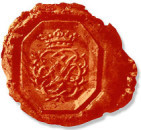
Promise kept. Until just a few years ago, this was a very rare find on the internet: a photo of the fifth Bach seal in wax on a photo. I’ll introduce you to another and very special find regarding Bach seals right after the next ad..
Advertisement
The World of Bach Gifts and Music Gifts

There are actually almost countless gift ideas, all of which can be personalized with musical elements and Bach motifs ... learn more here..
60 Music Calendars, Composers Calendars, Pipe Organ Calendars, and Bach Calendars..
Bach calendars are music calendars ... and musical gifts. Three sizes. This year, next year. European style and U.S. style. To the shop..
End of Advertisement
The Sixth Bach “coat of Arms” (... Not the “sensation Regarding the Bach Seal” Just Yet ... That Comes Later)..
Of course, it’s the official Bach Coat of Arms … right … or Bach Seal. The one that guides thousands of visitors to the Bach Museum in front of the Bach House in Eisenach. They stay away from all interpretations there ... and thus from this one as well. The graphic design completely disregards the crown. And the laurel motif to the right and left beneath the “ornamental flourish.” For us here and on this page, where we – perhaps together –want to “picking nits”: It is the sixth, entirely official Bach seal. However ... who actually decides that?..
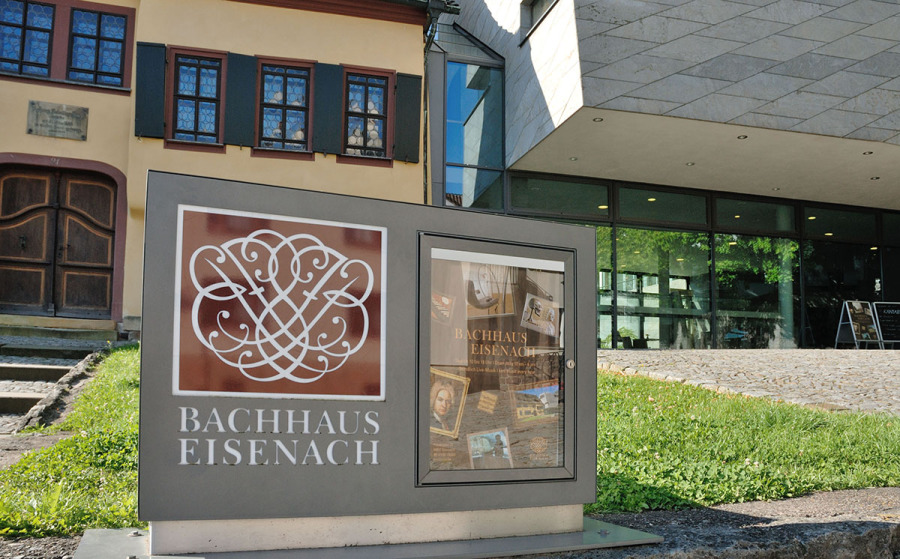
No crown, but 14 points of significance. That way, you don't need a new sign “ every few years”..
Finally, Now, Bach Seal No. 7... What a Sensation!..
At the beginning of 2023, I received some exciting news from Church Music Director Martina Pohl in Sangerhausen. That’s where the beautiful St. Jacobi Church stands, home to the world-famous Hildebrandt Organ. Martina Pohl plays it regularly. Oh, by the way ... Martina Pohl and her “colleague,” music teacher Ulrike Großhennig, have wonderfully demonstrated how an organ works in a video. Click here ... to watch this video. Back to the topic of the Bach Seal. Under the next picture. It's a pity, it's only in German..
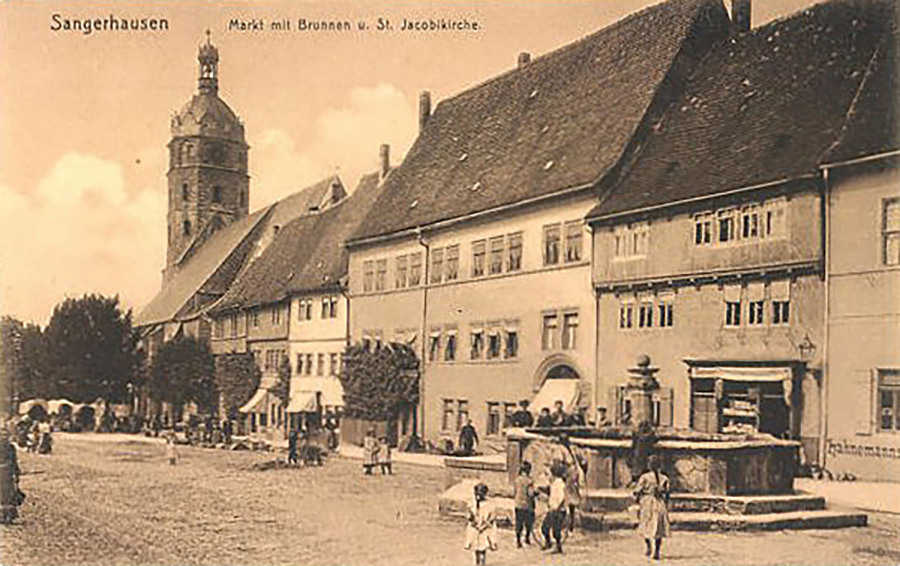
Sangerhausen between 1702 and today. Sometime in between. The St. Jacobi Church is in the background..
The Bach Seal. Of course, the general public – and Bach fans in particular – are initially familiar only with the “official” black-and-white graphic Bach seal. Whether it has seven or five points or spikes. On ancient original documents, signed and sealed by the famous composer himself, there is a red wax seal. On a document from 1735 that still exists today. Perhaps there were earlier documents, but they no longer exist today ... at least nothing is known about such documents. Bach certainly conceived the design long before he first considered his order to have a signet ring made. Presumably not before his first job. Or perhaps as early as that in life? But when exactly?..
For 270 years after his death, there was no specific information about this. But there is today. Thanks to the attention of Martina Pohl in Sangerhausen. And her interest in Bach. Because otherwise ... she wouldn't have found me. And she surely assumed that her (!) discovery would interest me..
Interested? That word doesn’t quite do justice to my enthusiasm. Her tip left me absolutely thrilled. And she even backed it up with some fascinating photos: On a wall near the organ in St. Jacobi Church – on the first floor, so to speak – she found a petroglyph. A petroglyph? Yup ... an engraved image in stone, or rather in plaster. And just as with Bach’s Treasure Cabinet, it took a Bach fan who sensed what she had found there. And that was Martina Pohl. She recognized: That looks very much like Bach’s seal..
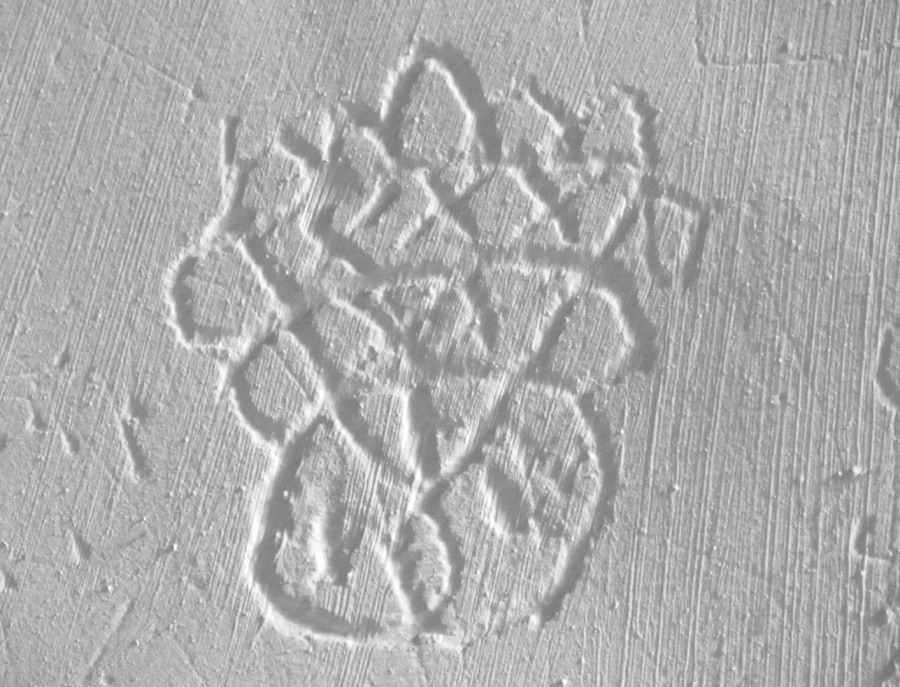
Yes, if you – as Martina Pohl did – take a photo at the right time of the day. And that's only possible during an extremely short period of the year. Then the shadow cast makes it clear: This could read “JSB” – once right-side up and once mirror-inverted. And you can also make out the crown. © I would like to express my sincere thanks to Martina Pohl for all the images related to the Bach seal in Sangerhausen..
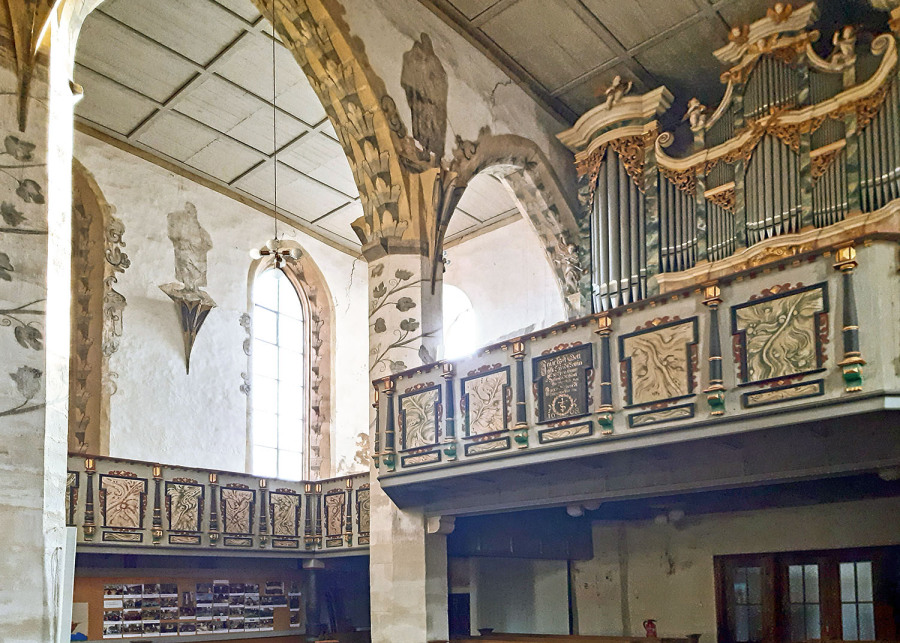
Especially for me – at my heartfelt request – Martina Pohl took another photo of the entire location. Do you see the left of the two windows? To the left of the organ? And to the left of that window ... there it is: the oldest Bach seal. Undoubtedly the very first Bach seal. © KMD Martina Pohl..
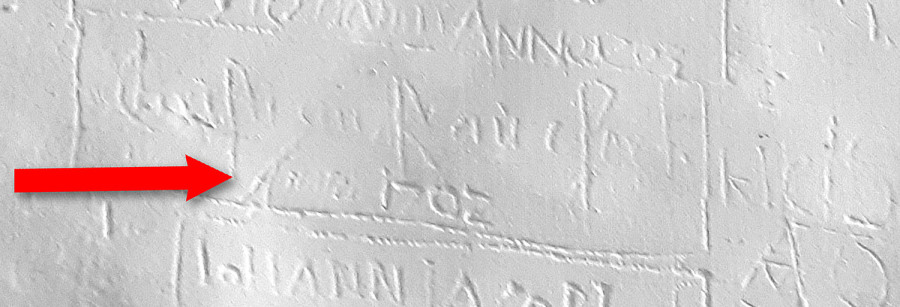
And a little away from the Bach seal, you can also see the number 1702. It is certainly a reference to a year. © KMD Martina Pohl..
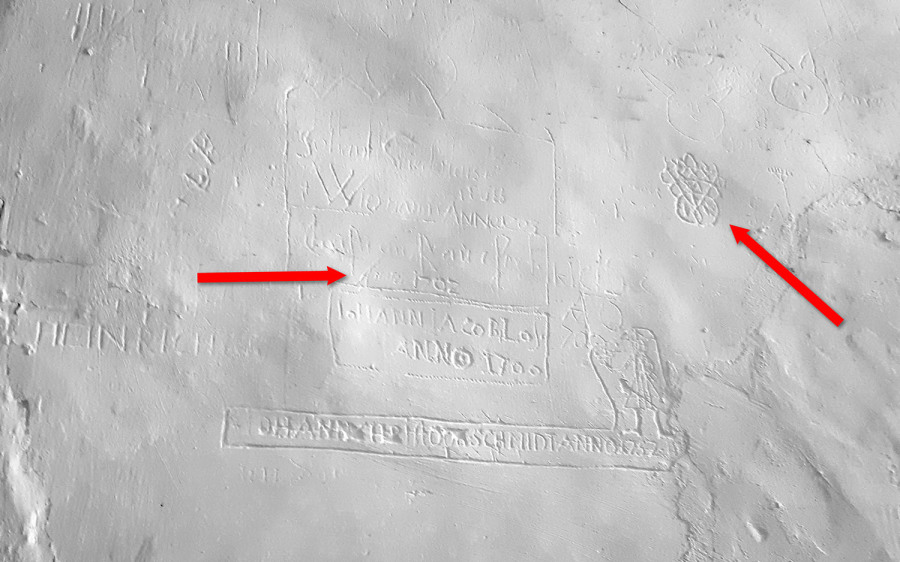
The interesting spot next to the Hildebrand Organ. On the right is the Bach seal; on the left is the inscription with the year. © KMD Martina Pohl..
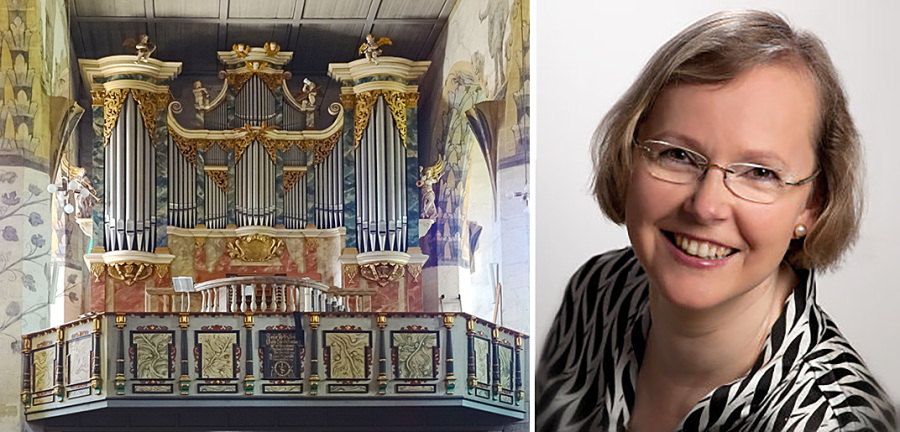
Martina Pohl: We owe her a debt of gratitude for bringing this to our attention. She contacted the Bach Archive many years ago. But of course, the Archive has little way of “conveying” this sensational discovery across the decades. But I can do just that with my Bach portal. Namely, exactly when someone is “really interested in Bach seals, Bach coats of arms, Bach monogram, or Bach insignia” . On the left, it is the Hildebrandt Organ. © KMD Martina Pohl..
Who Claims It’s Actually by Johann Sebastian Bach? What Is My ( ! ) Adventurous Theory on the Subject?..
Sangerhausen is “only” a fourth-category Bach city. But it is ( ! ) a Bach city. For me, it was already one even before Martina Pohl’s wonderful news. Because Bach performed there. And he got his first job there. Only, the prince in Sangerhausen wanted to hear someone else play there at the time. Even back then, it was no different from how it often is today. Bad luck. Too bad. But that was enough for me to include Sangerhausen in the “club of Bach cities and Bach locations.” In 1702, he auditioned there and … we remember the number that played a role in the images above. Bach traveled to Sangerhausen to audition there in 1702 for his first real job after his schooling in Lüneburg. With success ... or perhaps not..
Now here is my own personal theory, not Martina Pohl’s, though she does agree with it to a certain extent. If Bach walked back from Lüneburg to Erfurt at the time –perhaps also to Ohrdruf or Eisenach – then he certainly would not have traveled by carriage to Sangerhausen a few months later. And even if he had: According to Bach author Klaus Eidam, carriages were no faster than traveling on foot. The roads were bad, axles broke, or the carriage wheels broke..
So Bach faced the challenge of “showing up” in Sangerhausen on time for the agreed-upon appointment. Just as today, there are three ways to approach such an appointment. You arrive on time ... or you arrive “just in the nick of time,” barely ahead of schedule ... or you arrive ... late. According to Google Maps, it takes about 15 hours to walk from Erfurt (... where Bach may have stayed with his sister after returning from Lüneburg) to Sangerhausen. Net. From Ohrdruf (... where his oldest brother lived and worked), it’s already 22 hours. And from Eisenach (... but why would Bach have walked to Eisenach?), it’s even 23 hours. Today. Back then, that was certainly not doable in that amount of time. Because while there are perfect roads and paths today, conditions were far worse back then..
Of course, no one walks for 15 hours straight. So we can imagine that Bach’s journey took several days. We know that Johann Sebastian Bach was a perfectionist. And as a result, he would certainly have much rather arrived far too early than even a little bit late..
And what does that mean? Bach was certainly in Sangerhausen at least an hour before his playing appointment. More likely, though, he arrived half a day or even a full day early. After all, he still had to change out of his travel clothes into an outfit appropriate for the occasion. He surely wanted to “play a few bars” beforehand as well … and do so alone. And he certainly freshened up, too. So, back then, Bach – just like me today – had plenty of “time left over” if there were no traffic jams on the way; well … not in Bach’s time. Back then, there were other uncertainties..
So he was most likely bored ... with all that extra time on his hands, provided no unforeseen circumstances got in the way. And so, at the age of 17, he carved his initials into a church wall next to the organ: That way, at least he left his mark for eternity. On such a beautiful white wall, right next to the Eisenach native’s favorite instrument. Surely, quite a few other young musicians had already immortalized themselves there before him. Namely, when the wait for their musical contribution dragged on. So Bach was certainly not the first. Or so I imagine. 320 years later, we can all agree: Bach had plenty of time, and his mind was creatively at work..
So he carved his very own graffiti –his vision of a Bach seal – into the limestone of the church wall. Hardly anyone in the audience would see it anyway. Because even today, churchgoers don’t see this carving. Not unless you’re there at the right time of the day and standing right in front of it..
If you know anything about photography – like Martina Pohl does – only then can you capture something truly compelling there. Bach arranged – perhaps for the very first time – his idea using the three letters of his name, once “the right way around” and once mirror-inverted. Above it: a crown. So he already had the crown “in mind” back then. Not just when he was ennobled as Royal Polish and Electoral Saxon Court Composer. No ... he saw his music as a “royal work.” And that was already at the age of just 17. Even before he had taken on his first real job..
1702 ... that was more than 320 years ago. And this Bach seal still exists today. Church music director Martina Pohl discovered it. Together with her, we want to keep this memory of Bach’s work in Sangerhausen alive..
If you simply can’t get enough reading material on the Bach seal, then we highly recommend the Bach Yearbooks published by the Neue Bachgesellschaft. You can find them right here and now, via this link, including interesting facts about the Bach Cup featuring the seal. Finally, and just “for you to discover on your own,” we’d also like to mention the essays by the authors Freyse, Schnapp, Smend, and Wollner. They can be found in BJ 33 (1936), pages 101–108; in BJ 35 (1938), pages 87–94; in BJ 40 (1953) on pages 109–118, in BJ 42 (1955) on pages 108–112, in BJ 43 (1956) on pages 162–164, and finally, in BJ 95 (2009) on pages 215–225. And what does that mean? You certainly won’t find more information on the topics of Bach’s seal, Bach’s symbol, Bach’s logo, Bach’s insignia, and Bach’s coat of arms anywhere else on the planet..

Once again, the Bach Seal No. 6, taken from the lid of the Treasure Chest, recently graphically edited by my wife. And one thing is and remains clear: This Bach logo will never, ever replace the black-and-white one..
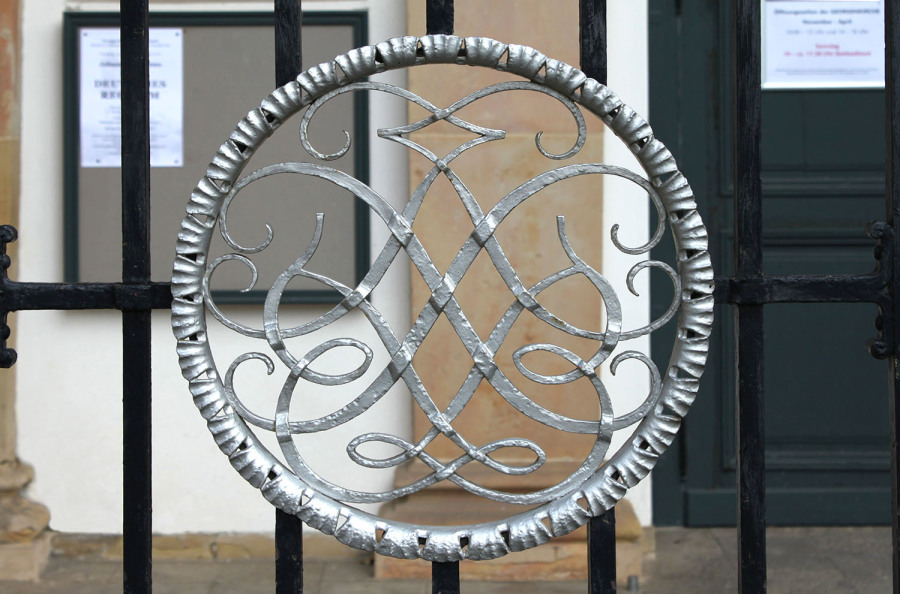
And here’s another Bach seal bonus: this pretty flourish adorns the gate to St. George’s Church in downtown Eisenach. Not quite meant to be taken seriously, this is yet another variation, the eighth Bach seal. © Christian Hoske..

Advertisement
The Bach and Music Gift Ideas World..
There are actually countless gift ideas, all of which can be personalized with musical elements and Bach-themed details. Above is one of the three latest Bach calendars, available in three sizes. For this year and next year. And in two calendar styles ... learn more here.
60 Music Calendars, Composers Calendars, Pipe Organ Calendars, and Bach Calendars
Bach calendars are music calendars ... and musical gifts. Three sizes. This year, next year. European style and US style. Visit the shop.
End of Advertisement
 Druckversion