

Bach FAQ 119
43 Bach Quotes, Bach Tributes, Bach Anecdotes and Bach Aphorisms: Are There Also Quotes by Johann Sebastian Bach Himself?
Click here to go directly to the aphorisms, sayings, anecdotes, quotes, and stories about Johann Sebastian Bach: Just click here, down to the bottom of the first image. Enjoy!..
But ... here’s a very important tip: If you want to know what famous people – politicians, other composers, a pope, and kings – said about Bach, you won’t find it here or now. Not in this FAQ 119. But you’ll find it on this , my website. But in a completely different section. You can click here to go there. And we’ll get started right away with Bach’s quotes, anecdotes, aphorisms, and stories..
Quotes, Sayings, Stories, Anecdotes – About Bach or from Bach: They Really Are Two Completely Different Things
So what exactly are quotes? It depends. On the perspective. When the 44th President of the United States, Barack Obama, calls Bach a “gifted composer” (... he didn’t, but Obama has always loved Bach’s music), then it is, in Bach’s direction – found by us to be a fact – a saying about Bach, or rather an honor. A tribute. But when I tell you about it, it is not a Bach quote. It is an “Obama quote”.
But if you’re looking for praises, then you just google – well, maybe not you – Bach quotes. You probably mean sayings, praises, anecdotes, or aphorisms about Bach. Now we have a problem. Not a big one, but a mini-problem. And because Bach on Bach now wants to inform and entertain you about this and that about Bach, my project centered around Bach quotes has become a challenge..
1,000 Music Gift Ideas or 10,000,000 Music Gift Ideas?...

It’s rather 1,000,000+ music gift ideas. That’s where “Bach 4 You” also offers you a wide range of options when it comes to Bach and music. Please support our Bach mission. Find out how here.
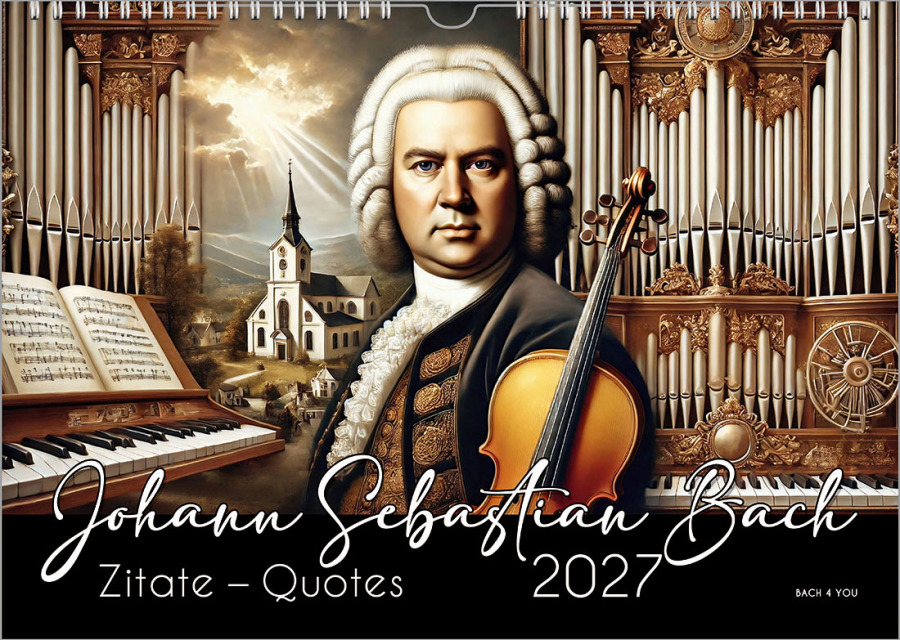
There are five Bach online shops run by the Music Calendar Publishing House. Above is a Bach quotes calendar. And these aren’t quotes that Bach left behind, but quotes from famous people about Bach. 1,000,000+ music gifts, 60 music calendars ... learn more here..
End of Advertisement
Or Maybe, You Are Actually Looking Exactly for Those Statements and Quotes, that Johann Sebastian Bach Once Said?
Is that exactly what you do? But you would never Google “Bach” and “statement.” Right? Right!..
Exactly. And that’s how I’m meeting you halfway. I try to figure out what you might be googling. And what you mean. Either quotes, words of wisdom, anecdotes, and statements that Bach once said... or – alternatively – what others have said about Bach..
Thank you for your patience. To start with, here’s the direct link again to what is probably the largest collection of Bach quotes (... that is, what other notable figures once said about Bach). From now on, we’ll simply call them Bach quotes. Just like all the others. So this is what a great many prominent figures have said about Bach over the course of roughly 300 years.
And what Bach once said? Here it is: These are also quotes and more Bach’s quotes. But in this case, they’re from Bach himself. Bach’s sayings, Bach’s poems, Bach’s remarks, Bach’s anecdotes, Bach’s aphorisms.
Here We Go ... Sayings, Anecdotes, Aphorisms, and Stories About Mr. Bach ... and Quotes from Him..
No, not a picture of Johann Sebastian Bach. But one of me, the funny maker (no typo, but rather anvient German, not a comedian) in the Bach family of musicians..
1
Robert Schumann, himself a musician and composer – and certainly no unknown personality – once searched for the grave of the famous Johann Sebastian Bach in a Berlin cemetery. In his 1854 publication "Collected Writings on Music and Musicians", he writes that one evening he went for a walk in the Leipzig cemetery. He wanted to visit Johann Sebastian Bach’s final resting place. For many hours, he searched back and forth. But ... he found no “J.S. Bach.” And when he asked a gravedigger (... yes, that’s how Schumann describes him) about it, the gravedigger shook his head at the man’s (... Schumann’s) “obscurity” and said, “There are many Bachs.” You can explore the original yourself here..
2
“Through your imprisonment,Son of God,
freedom has come to us.
Your prison is the throne of grace,
the freedom of all the faithful.
For if you had not entered into bondage,
our bondage would have been eternal.”
(... Quote from JSB)
3
“... so that this may produce a pleasant harmony
for the glory of God and the lawful delight
of the soul, and, like all music, ... its purpose
and ultimate end should be none other
than the glory of God
and the recreation of the soul.”
“Where this is not observed, there is
no real music, but rather a
diabolical clamour and din.”
(... Quote from JSB)
4
“All you have to do
is press the right key
at the right moment.”
(... Quote from JSB)
5
“If I must ever part,
do not part from me…”
(... Quote from JSB)
6
“We sit down in tears and
call out to you in your grave: Rest in peace,
peaceful rest!”
(... Quote from JSB)
From the St. Matthew Passion.
7
“For those for whom art is life,
their life is a great work of art.”
(... Quote by JSB)
8
“Penance and repentance
crush the sinful heart
into pieces.
(... Quote from JSB)
From the St. Matthew Passion, 6th aria.
9
“I am satisfied with my status,
to which the Most High has appointed me,
And I do not consider it a disgrace at all,
that I am not held in equal esteem by everyone.
I have as little right to accuse my Creator
as clay has to accuse the potter.”
(... Quote from JSB)
10
“Through your imprisonment, Son of God,
freedom has come to us.
Your prison is the throne of grace,
the freedom of all the faithful.
For if you had not entered into bondage,
our bondage would have been eternal.”
(... Quote from JSB)
11
“With devotional music,
God is always present with
His grace.”
(... Quote from JSB)
Note in Bach's Calov Bible.
12
“We sit down in tears
and call out to you in your grave:
Rest in peace, sweet peace!”
(... Quote from JSB)
13
“... so that this may produce a pleasant harmony to the glory of God and for the lawful delight of the mind, and, like all music, ... its purpose and ultimate end should be nothing other than the glory of God and the recreation of the mind. Where this is not observed, it is not true music, but a devilish clamour and din.”
(... Quote from JSB)
14
“No one can defeat death.”
(... Quote from JSB)
15
“I had to be diligent;
whoever is just as diligent
will be able to achieve
just as much.”
(... Quote from JSB)
16
“For those for whom art is life,
their life is a great work of art.”
(... Quote by JSB)
17
“His naturally somewhat stupid face, which had been further weakened by his extraordinary enthusiasm for studying, during which he would sit up all night, especially in his youth, led to an eye disease in his later years.”
(... Quote from JSB)
CPE Bach in his necrology for JSB regarding the latter's eye ailment.
18
“Johann Ludwig Krebs (... born around October 10, 1713), a native of Buttelstedt, was the favorite pupil of the great composer Johann Sebastian Bach. The relationship between the two went far beyond that of teacher and student. Krebs not only became Bach’s music copyist; no, a close friendship also developed between them, one that likely stemmed from their shared passion for organ playing. The following anecdote can be read as a depiction of their close friendship, although it could not have happened exactly as described. There is a decisive reason for this: Krebs did not move to Altenburg until 1756, after the death of his mentor and friend (1750), to work as court organist for Frederick III. Bach therefore could not have heard him play there. Nevertheless, this anecdote can be read as a reflection of the close friendship between the two organ virtuosos.”
Quote Anette Huber-Kemmesies
“Johann Sebastian Bach arrives in Altenburg on a trip. Since it happens to be Sunday, he goes to church to hear his student Krebs (... Crab) play. There, Bach believes he can stand among the townspeople unnoticed and unknown. Krebs arrives, looks around, and immediately spots his teacher. He then sits down at the organ and begins a fugue with the theme b. a. c. h., performing it masterfully. Bach was said to have remarked afterward: ‘I caught only a single crab (...Krebs) in my brook (... Bach).’”
(... Quote)
19
“Once, Bach was pestered for weeks by a foreigner, a mediocre musician who played him trivial compositions for hours on end. He even had the audacity to criticize Bach’s school and claimed that, just like Bach’s favorite student at the time, Krause, every child played like that at his home. It so happened that Bach’s former student Krebs was just visiting what is now the musical metropolis of Leipzig. Bach decided to teach the foreign musician a lesson. Krebs had to disguise himself as a coachman, and when the stranger had begun playing again, he entered under a pretext. Bach then asked the coachman to perform something on the piano, and the latter played several piano sonatas with great mastery. The stranger was astounded. “You see, my dear sir,” said Bach, “this is how our coachmen play.”
(... Quote)
20
“Heinrich von Kleist recounts the following anecdote: When Sebastian Bach’s wife died, he was supposed to make arrangements for the funeral. But the poor man was so accustomed to having his wife take care of everything that, when an old servant came and asked him for money to buy mourning ribbons, he replied, with silent tears and his head resting on a table: ‘Tell my wife.’”
(... Quote)
What is interesting, however, is that it is common knowledge that Bach’s first wife had already been buried by the time Bach returned from a trip to Karlovy Vary with his prince.
21
“A famous anecdote, which Bach himself likely told his sons, is actually true – namely, that even as a boy in Ohrdruf, Thuringia, he copied pieces, including some that his older brother, an organist, considered too difficult for the little one. He is said to have pulled the forbidden fruit – “a book full of piano pieces by the most famous masters of the time” – through the barred door of the locked cabinet at night and copied them by moonlight. Whether the part about the moonlight is true remains to be seen. However, Peter Wollny, a renowned Bach expert, considers it possible that Christoph Bach, who was 14 years older, withheld such challenging pieces as Buxtehude’s tablature for pedagogical reasons. The fact that he possessed them at all greatly enhances this church musician’s reputation. Until now, it was assumed that it was J. S. Bach himself who later brought North German organ literature to Thuringia.”
(... Quote)
22
“I, a poor soul, who will hear me?”
(... Quote from JSB)
23
“When Leipzig’s first coffeehouse opened in 1685, no one could have imagined the triumphant rise of the black beverage in the centuries to come. While coffeehouses were initially regarded as dens of iniquity, they shed their disreputable image a few decades later. Soon, concerts were even being held in Leipzig’s coffeehouses, including some conducted by the Thomas Cantor Johann Sebastian Bach. For one such concert by the Bach Collegium Musicum, he composed his “Drama per Musica” titled “Schlendrian, mit seiner Tochter Liesgen” (... Mr. Schlendrian with his daughter Ließgen) ... the so-called Coffee Cantata, which is documented as early as 1754.”
“Unlike most of Bach’s other secular cantatas, this work is not a tribute to the authorities, but rather humorously and ironically sketches a scene from the everyday life of Leipzig’s middle class: Mr. Schlendrian (bass) tries to wean his daughter Liesgen (soprano) off her daily coffee habit with angry threats. Only when he holds out the prospect of permission to marry does the headstrong daughter initially yield in the aria “Heute noch, lieber Vater tut es doch” (... "Still today, dear father, please do it), but in the narrator’s subsequent recitative, she secretly makes it known that she will only accept a husband who allows her to drink coffee at any time, even after marriage. The cantata concludes with an ironic and conciliatory trio by the three vocal soloists, “Die Katze lässt das Mausen nicht." (... The cat can't resist catching mice)."
(... Quote)
24
“The "Capriccio" Cultural Forum, dedicated to promoting Classical Music and culture, has an exciting section on its website titled "Bach Legends – False, but Indestructible." If you really feel at home here on my site, with all the little Bach stories, anecdotes, aphorisms, and sayings, you’ll find plenty to enjoy there. Have fun, but please come back afterward.” Howeer, it's in German. Sorry.
25
“Although I didn’t really want to downgrade from court composer to music teacher – which is why I postponed the decision for three months – this position was made so appealing to me that eventually, for heaven’s sake, I went to Leipzig, auditioned, got the job, and still have it to this day.”
(... Quote from JSB)
Johann Sebastian Bach to his friend Georg Erdmann.
“What makes this particularly interesting is the contrast: specifically, how the city of Leipzig searched for a new Thomas Cantor over the course of three rounds. The first two "rounds" ended with world-class musicians of the time – like Bach himself – already having declined the position, in part because, after applying in Leipzig, they had been receiving a higher salary from their employer until that point.”
The final shortlist of candidates now included Johann Friedrich Fasch (... kapellmeister in Bohemia), Georg Balthasar Schott (... organist at the New Church), and Johann Sebastian Bach. Apparently, however, the council was not particularly enthusiastic about the remaining candidates, which prompted Leipzig councilman Abraham Christoph Plaz (... who was also one of the city’s three mayors) to make the now-famous remark: “Since we cannot get the best, we must settle for the average.”
From today’s perspective ( ! ), this is of course a gross misjudgment regarding Bach, one that could hardly have been more blatant. It should be considered, however, that Bach was little known as a composer at the time, since hardly anything of his had been published. Although he was a famous organ virtuoso, playing the organ was not the primary duty of the Thomaskantor.”
(... Quote)
26
“When people die, there’s more money to be made from funerals; when people are healthy, there’s less to be made.”
“Overall, however, they – the children – are natural musicians, and I can assure you that they could already put together a concert featuring both vocal and instrumental performances with my family, especially since my current wife sings a beautiful soprano and my eldest daughter isn’t half bad either.”
(... Quote from JSB)
Bach to Georg Erdmann. Many thanks, Martin Schlu.
27
“Johann Sebastian Bach’s son, Carl Philipp Emanuel Bach, played music and composed while in the service of Frederick the Great in Berlin. When the palace in Potsdam was completed – CPE was living in Berlin at the time – he complained one day that he would no longer make the life-threatening journey from Berlin to Potsdam unless King Frederick II took steps to improve the road.”
28
Do these quotes from Bach’s Russian colleague even belong here? I suppose, in a way, they do. Where else would you find something like this about Johann Sebastian Bach? And then I’ll just throw in “a little extra” of my own!
Pyotr Ilyich Tchaikovsky probably considered himself one of the greatest composers on earth. That seems to be the case to me when I read what he had to say about other prominent “colleagues”; he said …
Pyotr Ilyich Tchaikovsky probably considered himself one of the greatest composers on earth. That seems to be the case to me when I read what he had to say about other prominent “colleagues”; he said …
Tchaikovsky on Johann Sebastian Bach:
“I can safely say that I enjoyed playing Bach because playing a fugue is entertaining, but I don’t see him as a great genius.”
Tchaikovsky on Ludwig van Beethoven:
“… and while I do not in the least deny Beethoven’s great historical significance, I nevertheless consider the unconditional and unquestioning admiration for each of his works to be inappropriate …”
(... Quote PIT)
Tchaikovsky on Charles Gounod:
“Gounod’s work is a complete mystery to me … everything he wrote after *Faust* is weak and lacking in talent.”
(... Quote PIT)
Tchaikovsky on the musician Franz Liszt:
“Liszt’s compositions leave me cold; they reveal more poetic intent than genuine creative power, more color than form, more outward brilliance than inner substance …”
(... Quote PIT)
Tchaikovsky on the composer Giuseppe Verdi:
“This son of the South has done his art a great disservice by flooding the whole world with his tacky barrel-organ tunes, …”
(... Zitat PIT)
29
“Through your imprisonment, Son of God,
freedom has come to us.
Your prison is the throne of grace,
the freedom of all the faithful.
For if you had not entered into bondage,
our bondage would have been eternal.”
(... Quote from JSB)
30
“Ruler of Heaven, hear my stammering – bear with my feeble songs – until Your Zion exalts You with psalms– exalts You with psalms!”
(... Quote from JSB)
31
“Oh! How sweet the coffee tastes, sweeter than a thousand kisses, milder than muscat wine.”
(... Quote from JSB)
32
“I can’t write songs
about unhappy love or
longing for love,
since I own Magdalena.”
(... Quote from JSB)
33
“What better gift could God give us than to grant our authorities the spirit of wisdom – a spirit that punishes evil at all times, loves what is good, and watches over our welfare day and night?”
(... Quote from JSB)
34
“I am satisfied with my position, into which the Most High has placed me. And I do not consider it a disgrace at all that I am not held in the same esteem as everyone else. I have as little right to accuse my Creator as clay has to accuse the potter.”
(... Quote from JSB)
35
“Stay with me, angels, stay with me! Guide me on both sides, so that my foot may not slip. But teach me here, too, to sing of your great holiness and to give thanks to the Most High.”
(... Quote from JSB)
From the cantata “A Conflict Arose”
36
“For those for whom art
is life,
their life
is a great work of art.”
(... Quote from JSB)
37
Whoever sees her in her wreath
and beautiful wedding gown,
their heart rejoices with pure delight
at her well-being;
no wonder, then, that my mouth and heart
overflow with joy.”
(... Quote from JSB)
38
“Your servant, dear Virgin Bride,
“We sit down
in tears
and call out to you
from the grave:
Rest in peace, gentle rest!”
(... Quote Georg Philipp Telemann)
39
"Come, O Death, brother of sleep, come and carry me away; release the oars of my little boat, and bring me to a safe harbor.”
(... Quote from JSB)
40
“As is well known, Bach had set out for Lüneburg at the urging of the Ohrdruf cantor Elias Herda, accompanied by Georg Erdmann, and attended the old Michaelis School there as a guest student from Easter 1700 to Easter 1702. He was 15 years old at the time, and apart from a few scattered anecdotes and legends, this period is as well – or poorly – documented as the rest of the composer’s biography. But here the master still has a downy beard and pimples, and that is why heightened interest may arise. This is all the more so because Bach’s son, Carl Philipp Emanuel, whose necrology is the main source of all accounts of this period, further heightens this interest. In response to probing questions from the first Bach biographer, Johann Nikolaus Forkel (1749–1818), regarding the accuracy and validity of circulating anecdotes, the following strikingly brusque reply was given: “There are many adventurous traditions about him. Few of them may be true and belong to his youthful fencing pranks. The late Bach never wanted to know anything about them, so please leave these comical things out.”
(... Quote)
Matthias Strässner.
41
"What better gift could God give us than to grant our authorities the spirit of wisdom – a spirit that punishes evil at all times, loves what is good, and watches over our welfare day and night?”
(... Quote from JSB)
42
“But how anyone could hope to discern something "specifically Protestant" from the vast array of these finely animated genre and character pieces that Bach has recorded in these volumes, or from the wild storm of his organ fantasias, let whoever can understand that! One of our most erudite cultural historians even denies that Bach possessed a sense of humor. A sense of humor, one of the strongest aspects of Bach’s nature! A sense of humor was a family trait of the Bachs, and when they celebrated their annual family reunion, it always found dramatic musical expression. In his humor, Bach, much like Luther, often reveals himself as a man of the people. There he turns to the simple dance tunes and folk songs that are familiar and endearing to everyone. The aforementioned biographer of Bach has identified a number of genuinely whimsical folk melodies that Bach smuggled into larger works. Bach gives free rein to good cheer in his suites and concertos for orchestra. The vigorous expressions of joy predominate, yet the delicate ones are not entirely absent. The Polonaise from the B-minor Suite is such a perfect picture of merriment among Rococo society.”
(... Quote)
Article in the magazine "Gartenlaube" from 1885.

Advertisement
Countless Great Music Gift Ideas: Bach Seal T-Shirts for Example..

“Bach 4 You” is the only publishing house that offers such a wide selection of Bach T-shirts and Bach seal T-shirts..

Thousands of Bach gift ideas ... learn more here..
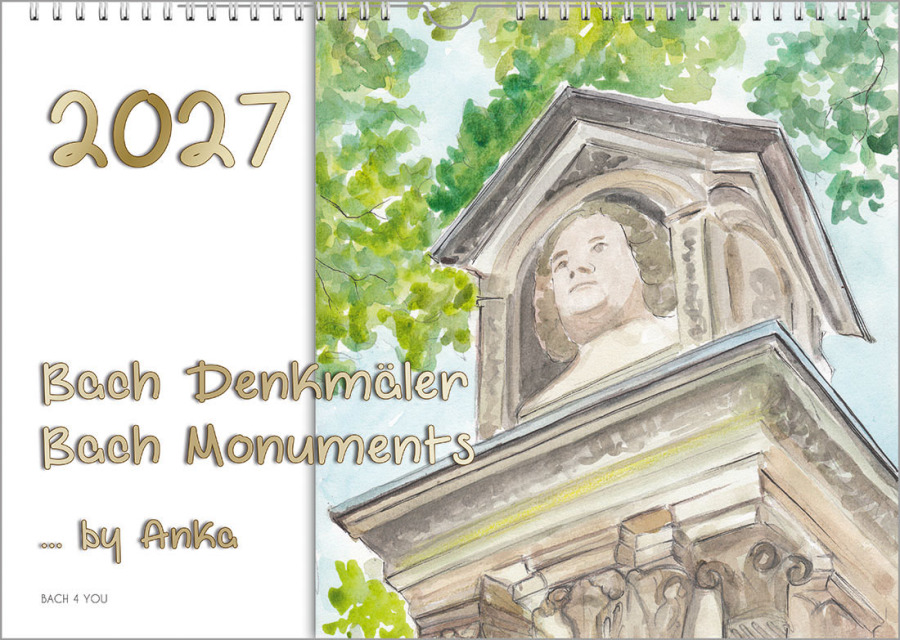
A Bach calendar and a Bach monuments calendar. Three sizes. This year and next year. European style and US style. To the shop..
End of Advertisement
 Druckversion