

Biography? Short Biography? Johann Sebastian Bach ... The Life of the Master in 60 Minutes..
Want to go straight to the short biography of Bach on this page? Just click here.
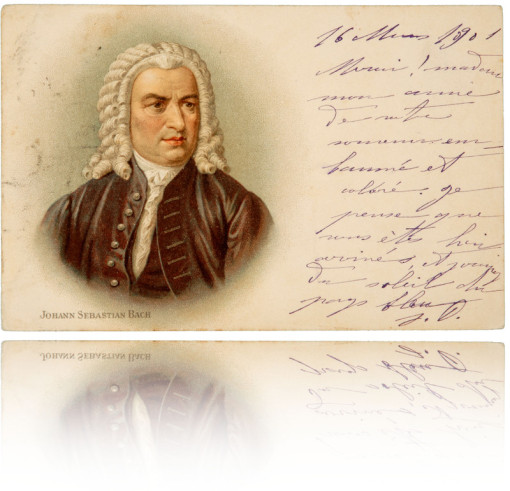
Johann Sebastian Bach – read about him, learn more about him, discover the universe around him – that is possible here on my Johann Sebastian Bach Website. Enjoy the fun of reading in two versions: with Bach Videos, in which you discover the Bach Cities and Bach Places in Germany. Or with Bach Videos without narrated text. Instead of that you get to to hear one of his most famous works of music – plus pictures of the Bach Cities and Bach Places.
Advertisement
Bach Busts, Bach Statues, Bach Tin Figures, and Little Bach Men from the Ore Mountains..
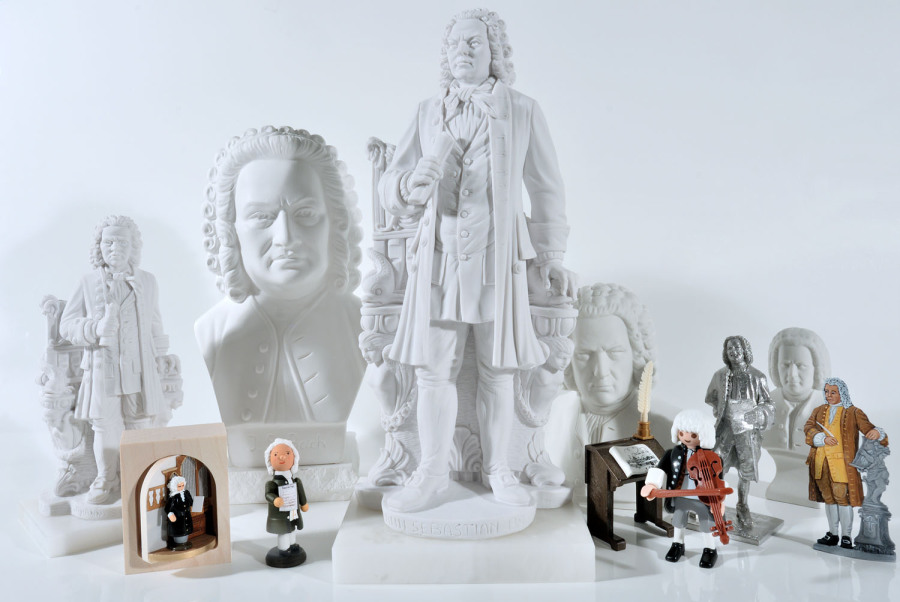
It was a long research until we found five Bach busts of different sizes with an exceptionell facial expression. To the shop..
Of the 60 music calendars, ten are pipe organ calendars. Most of them are also available as brochure calendars (... US style). This year and next year. Click here to access the calendar overview..

Bed linen, duvet covers, kitchen aprons, T-shirts, USB sticks, key rings ... and so much more: It's all available with designs from the "Bach 4 You" Publishing House. One click ... and you really are spoilt for choice..
End of Advertisement
From Here... The Bach Biography Gets Multimedial..
My longest of the eight short biographies about Johann Sebastian Bach, which takes 60 minutes to read, offers you something very special. You can watch and listen to various short video portraits of cities and places section by section..
These are cute, super-short videos about the composer's places of residence and work. There is also a short show about Wechmar, one about Erfurt, and one about Gotha. In addition, there is one about Gräfenroda, one about Janegg in Czechia, and one about Hanfthal and Ungerndorf in Austria: Some cities and places are Bach locations, even if they are not locations where Johann Sebastian Bach worked more than once or twice or only for a very short time. Wechmar is significant as a Bach location because this is where everything began for the musical family. All of these short videos are accurate, but nevertheless brief portraits of the towns and places today. The texts are narrated by professionals and set to music by Bach as well as contemporary music..
It is therefore worthwhile exploring the three longer versions of my short biographies about Bach to discover what multimedia bells and whistles they have to offer. The videos about the Bach cities and Bach locations are entertaining and to the point. They are also contemporary, with very short photo and film sequences. Nevertheless, you will learn everything you need to know about each Bach city or Bach location in a clear and concise manner..
In summary, these are, for example, the three options again:..
1. The Bach biography in 15 minutes: It is illustrated with historical postcards of Bach locations. You can find it here..
2. The Bach biography in 25 minutes: It is enriched with videos without information about Bach's locations and cities. But of course with Bach's music. Is that the right length?..
3. The Bach biography in 60 minutes on this page of my website: It includes three to five minutes of narrated information, pictures, film clips, and music. Please continue reading..
Johann Sebastian Bach..
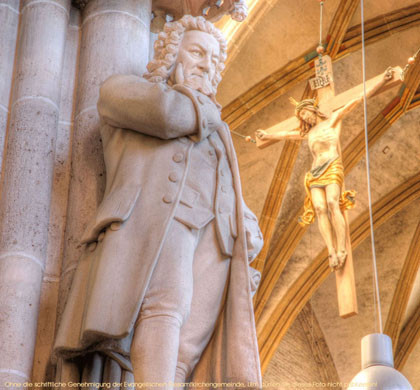
Johann Sebastian Bach in the Ulm Muenster, Germany..
1
Everything Begins in Wechmar..
The number one video with the short biography about Johann Sebastian Bach: a little show with info. Check out what Wechmar looks like today. Wechmar near Gotha isn't one of the Johann Sebastian Bach cities. But this is where the story of the Bach family of musicians started. And Wechmar is more than worth a visit in the subject of Bach..
Video number 2 with the short biography about Johann Sebastian Bach: a little show with information. Take a look at what Gotha looks like today. Gotha is not one of the Johann Sebastian Bach cities, but Bach played here at least once and other Bachs also performed in Gotha ... which is why Gotha is a Bach city..
The history of the world's most famous family of musicians began in a small town in Thuringia: in Wechmar. Wechmar is located just outside the gates of the beautiful city of Gotha. The first musician in the dynasty was Veit Bach. Although the history of the Bach family began 110 years earlier, the first church record of the family is from Veit Bach, the first musician. It dates back to 1619..
Johann Sebastian Bach was a shining light in this widely scattered family of musicians. He was gifted, particularly blessed. But his era did not begin until three quarters of a century after 1619. The Bachs were a clan that had been based in the heart of Germany – in Thuringia – for many centuries. A clan unlike any other that came after it. In this family of Bache, as they were called at the time, the talent for music was clearly passed down through many generations. Even in the various side branches. The name Bach alone allowed one musician or another in some cities in Thuringia to play on a wide variety of occasions with a special privilege. It also allowed them to hold offices and positions. They played as town musicians and court musicians at calendar festivals and family celebrations, parades, and dances. But they also earned their living as organists and cantors. Accompanying church services on the “king of instruments,” the pipe organ, was a little easier to achieve with the name Bach than with any other name..
Back then, “making music” was a real craft. It was a trade: There were apprentices and journeymen. From solemn church services to cheerful occasions, the Bache accompanied people with their music over the centuries. An early leaflet from 1600 points this out: “Here you see Hansen Bachen playing the violin – when you hear it, you have to laugh.” Even before Johann Sebastian Bach, Bache lived and earned their living with music: Already during his lifetime alone, there were 44 musicians in Thuringia and Saxony with this name who did the same. Many of them were professional musicians with the name Bach... and all from one family!
2
Erfurt and Eisenach..
Video number 3 with the short biography of Johann Sebastian Bach: a brief show with information. Take a look at what Erfurt looks like today. Erfurt is the Bach city par excellence. With more than 60 entries relating to members of this musical family in the church records. But... Erfurt is actually not a “Johann Sebastian Bach city".
Video number 4 in the short biography of Johann Sebastian Bach: a small show with information. It is the “Bach city of all Bach cities”: Eisenach, Thuringia. Take a look at what the city below the world-famous Wartburg Castle looks like today. Johann Sebastian Bach was born in Eisenach and lived here for the first ten years of his life. © Info.
Of course, Johann Sebastian Bach's father, Johann Ambrosius Bach, was a musician. And his father was also a musician. Namely, a court piper. Erfurt was initially the home of Johann Ambrosius. He was employed by the municipal music ensemble. Ambrosius married Elisabeth Lämmerhirt, the daughter of a respected citizen of Erfurt. After his marriage, he was appointed to Eisenach as a city and court musician. On March 21, 1685, not far from the Bach House, the life of one of the greatest musicians of all time began: the life of Johann Sebastian Bach. A charming legend has long told that he was born in a niche of St. George's Church while the organ was being played. Considering that the birth took place well over 300 years ago, today's scientific knowledge that the Bach House is not the birthplace is relatively recent..
Virtually nothing is known about Johann Sebastian Bach's childhood. It can be assumed that it was not an easy one. It is believed that he helped his father earn a living for the family, even in his spare time. He probably already sang and played the violin and viola. And he did so at wedding celebrations. And also at funerals. This was an important source of extra income for the Bach family at that time. Ambrosius also played with little Johann Sebastian in taverns. With “funny tunes,” as they were called at the time, “to entice the young people to dance.”
Ambrosius was ambitious and gave all his sons a thorough musical education. In addition to Johann Sebastian, four of his brothers also played music. In 1694, when Johann Sebastian Bach was just nine years old, he lost his mother. Shortly afterwards, in 1695, first his uncle and then his father died.
In the fourth grade of the city school, little Johann Sebastian studied Latin and religion in particular. He probably received music lessons not only from his father, but also from his uncle, Johann Christoph Bach. He was the organist at St. George's Church in Eisenach. It was probably he who introduced the young Johann Sebastian to pipe organ playing and composing. It is believed that Johann Sebastian's love for the pipe organ began during this time, when he sat next to his uncle on Sundays and listened to the majestic sound of the pipe organ. He is said to have been ambitious from an early age.
Advertisement
Our “Bach Mission” and Our “Classical Music for Children” Mission
With every purchase in one of the "Bach 4 You" shops you support our Bach Mission and our mission "Classics for Children". Thank you. Here you can visit the five shops.
One of the latest, cool Bach calendars.
End of Advertisement
3
Learning and Living in Ohrdruf, Thuringia
Video number 5 in the short biography about Johann Sebastian Bach: a mini show with information. Find out what Ohrdruf looks like today. Johann Sebastian Bach lived and studied in Ohrdruf for three years.
Now that Johann Sebastian Bach was an orphan, he left the loneliness of his parents' house in Eisenach's Fleischgasse. Together with his older brother, he made his way to his eldest brother in Ohrdruf. Ohrdruf is located on the northern edge of the Thuringian Forest. Johann Sebastian's brother Johann Christoph, who was named after his uncle, was an organist in Ohrdruf. Johann Christoph had been apprenticed to the famous organ composer Johann Pachelbel. Pachelbel had worked in Eisenach for a time.
Johann Sebastian's eldest brother already had three sons of his own when the youngest member of the Bach family arrived in Ohrdruf with his brother from Eisenach. By the way, all four of Johann Christoph's sons became skilled musicians. He lovingly took Johann Sebastian and his second brother in. In Ohrdruf, Johann Sebastian attended a school with an excellent reputation. He studied there until the sixth grade. Greek, Latin, and German language usage were on the timetable. Mathematics, of course, as well.
Johann Christoph also recognized his brother's unusual talents at a very early age. And he encouraged his musical enthusiasm. He taught him to play the piano and pipe organ and instructed him in thorough bass and composition in such a way that Johann Sebastian did not lose his enthusiasm, even though he had to practice a lot. Johann Christoph is credited with dampening Johann Sebastian's zeal, or rather overzealousness, a little.
4
Going "Abroad" on Foot from Thuringia ... To Lüneburg
Video number 6 on the short biography about Johann Sebastian Bach: a tiny presentation with information. See what Lüneburg looks like today. Where Johann Sebastian Bach lived, played music, and studied for two years. © Info..
At the end of his time in Ohrdruf, Bach's scholarship there also expired. And his eldest brother now needed more space for his own family. So it turned out that Johann Sebastian Bach and his school friend Georg Erdmann simply moved to Lüneburg without any firm commitment. After all, it was a distance of around 350 kilometers, which is 217 miles . Both were accepted there without any problems. In Lüneburg, the quality of education and teaching improved once again ... and it also became more comprehensive. In addition to free accommodation and meals, the students at that time also received a small share of the money that the choir received from foundations. And they also received a small share of the income generated from street singing, weddings, or similar occasions..
Even during his time in Lüneburg, Bach felt compelled to write his first compositions. Especially compositions for the pipe organ. It was probably Bach's favorite instrument. Although, like his father Ambrosius, he was also a gifted violinist. He also played the viola. With these skills, he performed in quartets and larger instrumental ensembles. In Lüneburg, he also wrote his first preludes and fugues. And he began to see a lofty task “in perfecting the fugue form, which, in its strictly ordered sequence of confirming or contradicting voices, in its lively structure of parallelism and varied imitation, of unification and separation, of contrast, correspondence, interlude, and condensation, seemed to him like a symbol of world harmony.” This is how Bach's biographer Felix Adam Kerbel described it as early as 1896..
Bach also reached a point in his life that almost all young people still experience today: that is, when it came time to decide between different career paths. At the age of seventeen, Johann Sebastian stood at such a “crossroads” in Lüneburg. And so Johann Sebastian decided to walk the relatively few kilometers from Lüneburg to Hamburg to listen to one of the most respected organists at St. Catherine's Church. He was a master of his genre: the 81-year-old Johann Adam Reinecken. A second journey took him – also on foot – to Celle. After all, that was almost 100 kilometers, that is 62 miles, away when Bach became acquainted with the secular and festively lively suites of French composers and their ballets and operas at the court of the Duke of Brunswick-Lüneburg. Of course, Bach did not close himself off to this type of music and studied what he heard: sarabandes, gavottes, and minuets. And once again, he wrote down and copied furiously... the piano pieces of François Couperin and the compositions of many other French masters. He wanted to learn... and study these works..
5
Back to Thuringia
For a short time, it almost seemed as if Johann Sebastian Bach had decided to devote himself entirely to secular music, rather than church music. At the age of 17, he finally finished school in Lüneburg. He was the first member of his musical family to have the opportunity to study at a university. He walked back south to Thuringia.
That was in 1702, and it is believed that he spent the first few weeks after his time in Lüneburg living with his older sister in Erfurt... or once again with his brother in Ohrdruf. Weimar was a brief professional interlude in Johann Sebastian's musical career. He followed Duke Johann Ernst's call to his court in Weimar. That was in January 1703. Duke Ernst was looking for a violinist and a musician who could play the viola for his chamber orchestra. Just four months later, Bach applied for a position in Arnstadt. Even at this early stage, the exceptional musician realized that he could only fully develop his art and his understanding of perfect music on the pipe organ and with sacred music.
6
Arnstadt, Thuringia Becomes a Bach City
Video number 7 on the short biography of Johann Sebastian Bach: a brief video with information. Take a look at what Arnstadt looks like today. Arnstadt is the first Bach town in a series of five well-known Bach towns where Bach was employed. More precisely, these are five towns where Johann Sebastian Bach lived and worked during his lifetime. These are Arnstadt, Mühlhausen, and Weimar in Thuringia. Two other towns are Köthen and Leipzig, Köthen in Saxony-Anhalt and Leipzig in Saxony.
And so Johann Sebastian Bach applied for the position of organist at the New Church in Arnstadt. At that time, of course, it was not yet called Bach Church. In Bach's days, Arnstadt was the capital of Schwarzburg-Sondershausen. Even today, all biographies point out that the willingness to appoint an eighteen-year-old to this position was already an indication of early recognition. Just as much as Bach's extraordinary talent. Arnstadt was Johann Sebastian's first place of employment with a “full adequate salary,” as it was called at the time. His task, according to tradition, was "... to play the pipe organ properly on all church days. And also to devote himself to teaching and practicing the fear of God, sobriety, and compatibility. In addition, to refrain completely from bad company and distractions from his profession". He was said to be diligent and devoted. He performed his duties there without giving the impression of being overwhelmed.
7
The Journey of Bach to Buxtehude
Johann Sebastian Bach was now an adult. But he was still very young when he worked in Arnstadt. One of the most significant events during this period was his trip to Lübeck. To visit Dieterich Buxtehude, who was then 78 years old and organist at St. Mary's Church in Lübeck. Buxtehude was concertmaster and one of the great pipe organ composers. In the fall of 1705, when Bach was 20 years old, he asked for a four-week vacation. The consortium in Arnstadt approved this vacation, but on the condition that Bach must find a capable substitute.
Once he had done that, Bach began his journey. Once again, it was a long way to go on foot. The distance from Arnstadt to Lübeck was even greater than that from Ohrdruf to Lüneburg. Bach was well aware of how long he would be on the road. Just for the journey alone... first north and then south again. Even today, biographers still disagree on whether Bach was fully aware that these four weeks would by no means be enough time. It was almost 800 kilometers, that is some 470 miles round trip. And this in autumn, at a time when the roads were becoming muddy again, the days shorter and the weather worse. And yet Bach was certainly in high spirits at the prospect of meeting the artist and musician whose works for organ, orchestra, and piano he had already heard.
Bach hoped that this meeting would give him a deeper insight into the secrets of church music, which justified such a long and arduous journey. And he would not be disappointed. He finally arrived in Lübeck in mid-October. He immediately visited Buxtehude to undergo an initial examination of his organ playing skills. Of course, the experienced master immediately recognized the extraordinary potential of the younger man and his very special talent. Buxtehude then invited Bach to his home. He played music with him and was thrilled by the idea that Bach could take over his position in Lübeck. At 78 years of age, it was only natural to finally think about the end of his working life... especially back then.
Every autumn, Spiritual Evening Concerts were held in Lübeck. Buxtehude had introduced them there in 1673, long before Bach was born. These were church concerts, held on the last Sunday after Trinity and on the four Sundays of Advent. They featured a 40-piece orchestra and a large choir. These evening concerts were famous throughout Northern Germany. The Marienkirche was illuminated by candlelight and filled with music lovers at every event. In 1705, two “extraordinary,” that is, two special compositions by Buxtehude were premiered. Two events were the occasion: The first reason was the death of Emperor Leopold, the second was the accession of Joseph I to the throne.
So there were two works in the fall of 1705, when Bach was among the audience: first, the aforementioned funeral music for the emperor who had just died. He had been a special friend and patron of sophisticated music. The second composition was a welcome music for the new emperor. These events, indeed his entire time in Lübeck, left a deep impression on Bach. This encounter is still regarded today as the foundation for Bach's own mastery. Overwhelmed by these powerful impressions, Bach simply forgot to set off on his journey home. Or – we simply don't know – he just wanted to learn more and for longer from the unique artistry of his role model.
During this time, his vacation at home in Arnstadt came to an end. And Johann Sebastian Bach might never have returned to Arnstadt. After all, this position in Lübeck was quite special, both professionally and artistically. Succeeding Buxtehude was certainly special. But there was a “hurdle” that had nothing to do with music: a first challenge, similar to another – of a different nature – that had twice had a significant impact on Bach’s life.
At that time, it was customary for the new organist to “woo” the incumbent's daughter... meaning that he should have married her. However, since Buxtehude's daughter was a full ten years older than Bach, and certainly for other reasons as well, Bach, despite his respect for the master composer Buxtehude, could not imagine doing so. Interestingly, other masters, most notably George Friedrich Handel, who was born in the same year as Bach, were also deterred by this requirement from applying for the position of organist at St. Mary's Church in Lübeck.
8
The Foreign Damsel
At the end of February 1706, Bach finally returned to Arnstadt. His four weeks' vacation had turned into many more weeks. But Bach was lucky: The Arnstadt consortium merely reprimanded him for exceeding his vacation time and dropped the matter. Perhaps the committee recognized what a talented musician they had hired for lovely Arnstadt.
During his absence, his cousin Johann Ernst Bach had been “torturing” the pipe organ. This reprimand was not to be the last between the young Bach and the council. New complaints arose, which today are also seen in connection with his experience in Lübeck. “The composer elicited new sounds from the organ: sounds like those he had heard in Lübeck ...” people said in Thuringia. These new sounds ... displeased the churchgoers. And they were also too long for the church audience. When the superintendent complained about a chorale prelude that he considered far too long, Bach felt provoked and went to the opposite extreme. Of course, to the displeasure of everyone involved, he now preluded ... too short.
And what happened then gives us an idea of how outrageous it must have been at the time: He caused real offense and annoyance when he allowed a woman to sing in the pipe organ loft. She went down in Bach's history as the “foreign damsel.” Bach refused to comment on this accusation in writing, as requested. Nor did he want to give in, even if it meant losing his job. What the authorities certainly did not know at the time was that Bach had already applied for the position of organist at St. Blasius Church in nearby Mühlhausen.
Whether this “strange damsel” was Maria Barbara Bach, who accompanied the master on the pipe organ with her singing, is ultimately not known for certain. Nor is it known exactly when Johann Sebastian met his future wife, or where and on what occasion. However, it is possible that it was at one of the Bach numerous family celebrations, which took place in a different city each year.
Maria Barbara Bach was the daughter of her avuncle Johann Michael Bach, who was organist in Gehren: Gehren ... 25 kilometers from Arnstadt. She was his youngest daughter, and Johann Michael Bach was a respected musician and composer in Gehren. Maria Barbara was twenty years old when Johann Sebastian Bach, then 22, married her. This ... during his time in Mühlhausen. On October 17, 1707. However, the wedding did not take place in Mühlhausen or Arnstadt, but in the small community of Dornheim, very close to Arnstadt. The couple was married by a pastor who was a friend of Bach.
9
Johann Sebastian Bach in Mühlhausen
Video number 8 with the short biography of Johann Sebastian Bach: a brief presentation with information. Take a look at what Mühlhausen looks like today. Although Johann Sebastian Bach only spent a relatively short time in the Bach city of Mühlhausen, he wrote his first of what are now very well-known works there. It is the council change cantata “Gott ist mein König” (... “God is my King”). Bach and Mühlhausen separated without any hard feelings.
The Free Imperial City of Mühlhausen, which is also a Hanseatic City, was the first shared home for the newlywed Bach couple. The city of towers and gates, the city with two enormous, impressive churches, among many others. Almost as a matter of course, his marriage to Maria Barbara inspired Johann Sebastian, as he could assume that she shared all his work, his ideas, and his ideals, including in musical terms. Biographers described Maria Barbara's relationship to music as highly gifted. Bach had meanwhile further deepened and refined his skills and was also devising plans to improve the organ. He had a new type of pedal glockenspiel installed. And with a great deal of detailed work, he optimized the performance of the choir and orchestra in Mühlhausen.
During this period, Bach also composed one of his few works to be published in print. It is his cantata “Gott ist mein König” (... God is my King). The occasion for the composition was the first ceremonial inauguration of the newly elected council of the city of Mühlhausen, with him as organist at Divi-Blasii. This cantata is also known as the Ratswechselkantate (... Council Change Cantata). Bach even wrote two more cantatas for the council of Mühlhausen after he was no longer employed there.
Two opposing movements within the church were fiercely competing with each other during this period. Bach's music-making and composing were greatly affected by this. These struggles and disputes were not limited to Mühlhausen, but took place in many cities. The newly emerging Pietism sought to internalize the life of faith; through recognition of sin and reflection on the ever-present “heavenly bridegroom,” the mind of the individual was to be purified ..." Christian Jenssen commented on this dispute. “Strict Lutheranism, however, held to the view that the salvation of the soul depended solely on God’s grace.” Today, it is hard to imagine the intensity of the warring religious factions among the population.
Advertisement
Nowhere Else Are There So Many “J.S. Bach Gift Ideas” as in the “Bach 4 You” Publishing House
... and nowhere are there as many different Bach figures as there. All the Bach busts have impressive facial expressions. Click here to visit the publisher's website and from there you get to the publisher's shop. All music calendars are available in three sizes, plus this year and next year. You can buy them in both, the US style and the EU style.

"Bach 4 You" is the Bach seal T-shirt specialist.
End of Advertisement
10
Johann Sebastian Bach Marries
Video number 9 regarding the short biography about Johann Sebastian Bach: a small show with information. Take a look at what Dornheim looks like today. Dornheim is the Bach place that you can "visit for free" when you visit Arnstadt. It is only a two-minute drive away... so a visit there is not only a must for every Bach fan, but also a wonderful place to “encounter” the master.
Although Bach had lived in Arnstadt for several years and also had excellent connections to the respective churches and pastors in Mühlhausen, he preferred to be married by his friend, the pastor of the small village church in Dornheim.
11
Johann Sebastian Bach in Weimar, Thuringia
Video number 10 with the short biography about Johann Sebastian Bach: a little video with info. Check out what Weimar looks like today. Johann Sebastian Bach was in Weimar twice during his career as an outstanding musician. Even so, Weimar is now the only major Bach city without a Bach house or a similar important institution.
Bach did not argue ... in Mühlhausen. He stayed out of it. His art, music, was of far greater, higher importance to him than these disputes in Mühlhausen. But of course, he could not completely escape the quarrels. And, of course, they hindered his work and his music-making. And so it happened that in 1708 he accepted a call to Weimar. The call of Duke Wilhelm Ernst. Duke Wilhelm Ernst was an art lover ... and he ran his court in an almost bourgeois simplicity.
During his time in Weimar, Bach was not only known as an outstanding organist and pianist, but was also already highly regarded by a few as a composer. Many cantatas were written during Bach's time in Weimar. The best known are Gottes Zeit ist die allerbeste Zeit (... God's time is the very best time), Wachet, betet, seid bereit (... Watch, pray, be ready), Ich hatte viel Bekümmernis (... I had much sorrow), Himmelskönig sei willkommen (... Welcome, King of Heaven), Der Himmel lacht, die Erde jubiliert (... Heaven Laughs, Earth Rejoices) and finally Ein' feste Burg ist unser Gott (... A Mighty Fortress Is Our God), which Bach composed for the 200th anniversary of the Reformation. Secular cantatas were also premiered for the first time during this period, for the many different celebrations at the Weimar court. Organ works were also composed between 1708 and 1717: preludes, toccatas, fugues, chorale choruses. In addition, there was a collection of pipe organ chorale pieces, which were practically a textbook for future organists. Bach's own handwriting handed down: “To the glory of the Most High God, to teach one's neighbor.”
Anzeige
If You Love Bach, You Will Most Likely Also Love the Five Bach Shops
Everything possible on the subject of Johann Sebastian Bach ... can be found in the publisher's shop. Music calendars are available in three sizes, this year and next year. There are meanwhile three types of Bach beer steins: two historical ones and dozens of new, individual ones.

The publisher also offers countless gift ideas that you can turn into a musical gift, with lots of designs on the themes of Bach and music. Click here to get there quickly.
End of Advertisement
12
Johann Sebastian Bach Becomes a Father
Weimar was also where Bach's first children were born: Catharina Dorothea in 1708 and Wilhelm Friedemann Bach two years later. Johann Christoph Bach, who was born in 1713, did not survive the turn of the year. His twin sister Maria Sophia also died. The following year, in 1714, Carl Philipp Emanuel Bach was born. And finally, in 1715, Johann Gottfried Bernhard Bach.
From Weimar, Bach undertook successful and, for him, very stimulating concert tours. Among the most important destinations were Halle, Leipzig, Meiningen, Kassel, and Dresden. In Kassel, Crown Prince Friedrich of Hesse was impressed by his works and, in his enthusiasm for Bach's organ playing, gave him a very precious ring, which he even took from his own finger. “His feet flew over the pedals ...” he said at the time about Bach's playing, “... as if they had wings; the powerful sounds thundered through the church.” And Bach's playing on the harpsichord, an early form of the piano, must have been just as impressive, although not as loud..
1717 was a special year in Bach's history. It was the year in which the celebrated organ and piano virtuoso Jean Louis Marchand from France and the composer from Thuringia wanted to compete against each other. Jean Louis Marchand was a man full of temperament. This worked to his disadvantage, because after a sensational incident at the court of Louis XIV in Versailles, Marchand had to flee to Augustus the Strong of Saxony. The drama and the reason: Marchand had separated from his wife. As a result, the Royal Chamber had ordered that half of Marchand's salary be paid to his former wife. For this very reason, Marchand interrupted a grand, pompous concert at Versailles in the middle of the performance... and declared to the king and the audience: “If my wife gets half of my salary, then she should also perform half of my organ playing!” No one at Versailles found this particularly funny, and so Marchand's stay in Dresden ultimately gave rise to the idea of a musical competition: a contest between the two great musicians of their time, both masters of the organ... a truly musical contest..
Today, it is no longer known for certain who issued the challenge, but it would have suited the self-confident Frenchman Marchand. Perhaps it was one of the officials at the king's court. Bach immediately agreed to play any piece from the sheet music. Or to solve any conceivable musical task. However, this was on the condition that Marchand was also willing to take on the same challenge. Marchand agreed, and they settled on a referee. The Saxon Prime Minister, Count Flemming, provided the venue for the contest: his own house..
An artistic and social event of extraordinary significance was expected. However... the one who did not come... was Marchand. He left unnoticed at the time. Later, it was said that he had secretly listened to Bach practicing and realized that he would not have been able to win a competition against this musician from Thuringia. Bach played for the royal society that evening. And he was celebrated. He was celebrated like never before in his life. And how rarely after this memorable event in Dresden..
13
Johann Sebastian Bach Is Sent to Jail
In Weimar, Johann Sebastian Bach's triumph in Dresden received no attention. On the contrary, it was precisely at this time that the previous music director Drese died in Weimar. Bach had already been relieving Drese of a large part of his duties for some time. Now, when the time had actually come for Johann Sebastian Bach to succeed him, Drese's insignificant son was given preference..
Of course, Bach not only missed out on the recognition and the title, but also on the higher salary. Because, naturally, the position was better paid than his current one. Bach was annoyed. And with this annoyance, Johann Sebastian Bach accepted an offer to become a Kapellmeister. However, it was in Köthen. Prince Leopold of Anhalt-Köthen made him this respectful proposal. And the time had also come for another career change for Bach. However, in order to live and work in Köthen, Bach needed formal permission to leave. He was a servant, he was not an employee. He had to ask to be released from the Duke's service..
Bach only applied for this permission after his appointment in Köthen. In other words, retrospectively. But Duke Wilhelm Ernst did not reply. This was an enormous strain for Bach, and the two men, who had got on very well for nine years, fell out bitterly... but not face to face. The result: after expressing his anger to colleagues, Bach was imprisoned for four weeks “for stubbornly insisting on his resignation.” He was also dismissed without honor. For Duke Wilhelm Ernst, this was a way to go down in history. Three hundred years later, and certainly for all time to come, he was, is, and remains the duke who sent the greatest composer and musician on earth to prison..
14
Köthen ... Paradise and the Deepest Abyss
Video number 11 with the short biography of Johann Sebastian Bach: a miniature show with information. Take a look at what Köthen looks like today. Johann Sebastian Bach could well imagine living in the Bach city of Köthen until the end of his days. But everything turned out differently. Bach experienced his happiest days and also his most difficult days in Köthen.
Johann Sebastian Bach spent many happy years with Maria Barbara and his children in the royal seat of Köthen. Bach enjoyed his job and he also consciously enjoyed this beautiful city. He repeatedly expressed his desire to live and work here until the end of his life. Bach even formulated this as a wish..
However, Bach's enthusiasm for this city is thought to have been somewhat limited by the fact that he mainly composed secular works during his time in Köthen. What he certainly missed most was playing the pipe organ. An organ was very rarely available to him in Köthen. For a long time, the violin, viola, and piano took center stage. Certainly, secular music could be composed and performed in a more cheerful and free manner. However, it can certainly be assumed that this part of his ambition was unsatisfactory. Nevertheless, posterity owes this situation a debt of gratitude for the outstanding, precious works of piano, chamber, and orchestral music. Particularly noteworthy is The Well-Tempered Clavier, a collection of preludes and fugues in all major and minor keys..
15
The Death of Maria Barbara Bach
Johann Sebastian Bach was now earning 400 talers a year. His position as Kapellmeister in the service of the Prince in Köthen was highly regarded. Prince Leopold was warm-hearted, and a friendship developed between the two men that was mutual. There was no class snobbery between them, as the prince's grandmother was also a commoner and Leopold's mother came from the landed gentry. When Bach came to Köthen at the age of thirty-two, Prince Leopold was only twenty-three. However, he had already traveled extensively and was highly educated in many areas. The prince enjoyed music. Both listening to it and playing it himself. He rejected wigs, contrary to the customs of the time. It was also unusual that he not only maintained a band of eighteen outstanding musicians at his relatively small court, but had also set up a theater. And he hardly ever traveled without his Kapellmeister Johann Sebastian Bach accompanying him..
After such a journey with the prince, something terrible happened. It was the summer of 1720. Upon his return, Bach received the terrible news that, just a few days earlier, his beloved Maria Barbara had died. Even worse, she had already been buried without him being present. It is not known what illness Maria Barbara had so suddenly succumbed to in the summer of that fateful year, 1720. Deeply affected by this catastrophe, Bach expressed his feelings in one of his musical pieces. Thus, even today, the world can still sense his despondency at that time: "Whoever exalts himself shall be humbled". Johann Sebastian mourned his wife for well over a year... but then married a second time. His choice was the 20-year-old court singer Anna Magdalena Wilcke. It is not known whether he married Anna Magdalena for love. Or “only” to get the necessary support for his children and household. However, various indications point to the former assumption.
Anna Magdalena Wilcke also came from a musical family. Her father, Caspar Wülken, had been court trumpeter at the Saxon-Weißenfels court. Anna Magdalena herself was a successful soprano at the court in Köthen. And so the prince generously continued to pay her the high singer's salary of 318 talers. That was around eighty percent of Bach's salary as Kapellmeister. With two high salaries and a relatively small family, there was no financial hardship in Köthen. Whether joy and courage returned to the life of Johann Sebastian's family from 1721 onwards, or whether so many things in Köthen still reminded him of his first wife, must be left open here. Anna Magdalena was impressed by Bach's artistic work. And she enjoyed being taught by Johann Sebastian. In addition, she had a profound desire to deepen her understanding of Bach's music. In 1722, Johann Sebastian Bach wrote the well-known Klavierbüchlein vor Anna Maria Bachin (... Note Book for Anna Maria Bachin) for his second wife.
It was also during this time in Köthen that he witnessed his sons' first successes in music. This naturally filled him with particular pride. The fact that he knew how to nurture his sons' talents in an educationally valuable way is still evident today in the Piano Book for Wilhelm Friedemann Bach. He was the eldest of the six musical sons. The Well-Tempered Clavier, which was also written during his time in Köthen, was “... a textbook and a masterpiece for all masters” who followed him. It was a kind of ... daily bread for young musicians, as Robert Schumann later called it. During this time, Bach also composed for the Margrave Christian Ludwig of Brandenburg. These were the six Brandenburg Concertos. Bach met the Margrave during a trip with his prince Leopold to Karlsbad. The Brandenburg Concertos are one of Bach's greatest symphonic instrumental works.
16
Johann Sebastian Bach Travels to Hamburg
1720 was the year in which Johann Sebastian Bach first returned to church music. The occasion was a trip to Hamburg. The organist Bach already knew from Lüneburg lived there: Johann Adam Reincken. He had since reached the age of 97. Bach visited him to play his art on the pipe organ in St. Catherine's Church to the man he considered to be the most skilled organist and knowledgeable listener. And to this end, Bach improvised. He improvised on the old chorale An Wasserflüssen Babylon. This left a deep impression on the elderly master and organist Reincken. It was Reincken himself who had thrilled the music world with an interpretation of this chorale in his younger years.
Reincken was moved and said to Bach, “I thought this art had died out: Now that I see that it still lives in you, I can go home with joy.” In fact, Reincken died a few days after this meeting between two of the greats of music history. However, this seemingly vacant position had already been filled by a successor. At the same time, Bach applied for another vacant organist position at St. Jacobi's Church in Hamburg. But there, for the second time, as had happened in Weimar, an insignificant musician was given preference over him. This was because the latter promised, as was customary at the time, to pay 4,000 marks (... not the much later Deutschmark, but a local currency at the time) into the church treasury if he was appointed. This greatly angered the then pastor at St. Jakobi, Erdmann Neumeister. In his Christmas sermon, he expressed himself very clearly and unambiguously: “I firmly believe that if one of the angels of Bethlehem came down from heaven, played divinely, wanted to become organist at St. Jakobi, but had no money, he should just fly away again.”..
But Johann Sebastian Bach's desire for church music was reawakened. And it took up more and more space in his feelings. A second development that was extremely disadvantageous for Bach took place at the court in Köthen. Prince Leopold, his friend, also married during this time. He married a princess. A princess who had no interest in music whatsoever, indeed no appreciation for the fine arts at all. And with this lack of interest, and while both were in love with each other, the prince's enthusiasm for music also faded. More and more, his friendship with Bach no longer meant the same thing to him that it did to both men before his marriage. Bach complained in a letter, “... she seems to be an amusa, and it appears as if the prince’s musical inclination is becoming somewhat lukewarm”..
In Köthen, every square, every corner, and every person reminded Johann Sebastian Bach of his happiest time with Maria Barbara. These constant reminders made his everyday life there difficult. In addition, there were two other important reasons that made him think. All of this together led Bach to become increasingly open to changing his job and his living environment..
In the summer of 1722, the well-known piano composer and cantor Kuhnau died in Leipzig. Bach heard about this. Kuhnau was cantor at the already famous St. Thomas School in Leipzig. So Bach decided, certainly also because of his somewhat cooled, though still good, friendship with Prince Leopold, to consider leaving Köthen for Leipzig. Succeeding Kuhnau was one option. However, he did have certain concerns. The deciding factor may have been that Bach considered the education for his children, especially his sons, to be much better in Leipzig: after all, he would become the Thomaskantor at St. Thomas School there. In Leipzig, Bach's sons would also have the opportunity to study at the university immediately after completing their school education..
Advertisement
The Next Birthday of Friends or in Your Family Is Coming for Sure!..
... here you will definitely find an exciting music or Bach gift. To the shops now?..
End of Advertisement
17
27 Years in Leipzig, Saxony..
Video number 12 for the short biography of Johann Sebastian Bach: a little video with some info. Check out what Bach's city of Leipzig looks like today. There's hardly any other city that's so closely linked to the name Johann Sebastian Bach. Leipzig has changed a lot over the last thirty years. Leipzig is gorgeous..
It seemed to have been complicated in Leipzig, even before Bach's time. Renowned musicians had declined the vacant position of Thomaskantor in 1722. Bach applied for the position, performing one of his own cantatas. This happened in February 1723. The Leipzig City Council took three full months to finally appoint Bach as cantor of the municipal school at St. Thomas in Leipzig..
Even several famous musicians had previously declined to take up a position in Leipzig. Like a bad omen at the very beginning of the Leipzig era, the sentiment that if you couldn't hire one of the best, you would just have to be satisfied with a moderate musician has persisted to this day. In Leipzig, the cantor was the most important teacher at St. Thomas School, alongside the headmaster. However, as Thomas Cantor, Johann Sebastian Bach was also responsible for the four main churches in the city of Leipzig and many other smaller churches..
Almost as a matter of course, Bach had other obligations beyond teaching music. He had to teach five hours of Latin per week. His position had therefore deteriorated compared to his position in Köthen. His status was also lower than that of the Kapellmeister in Köthen. However, he retained his title of Fürstlich-Köthenschen Kapellmeister (... Princely Kapellmeister of Köthen). Bach had long hesitated to commit himself to Leipzig. What ultimately made the difference? It was certainly the educational advantages: the fact that his sons would enjoy what was undoubtedly the best education currently available within the spectrum of Bach's possibilities. Bach's enthusiasm for playing music in church and on the pipe organ may also have played a significant role in what was certainly a difficult decision for Bach at the time. If it is true that Bach saw his calling in the composition of church music and playing at church events, then this may have been another point in a whole series of considerations. All of these ultimately led him to Leipzig..
Although the position of the cantor at the Thomas School in Leipzig was less prestigious than that of the Kapellmeister in Köthen, Leipzig was significantly more important than Köthen. And the position of Thomas Cantor was the most prestigious within the city limits..
Bach's predecessors had all been well-known and respected musicians. All of them had had a decisive influence on the city's entire music scene. Not least, the good and lively connection to the university, especially to the student music association, the “Collegium musicum”, contributed decisively to Bach's deliberations and decision. Only his inner connection to the church was even closer..
Mainly students from St. Thomas School were required to provide musical accompaniment for church services. There were four choirs at that time. They sang at various events on Sundays and holidays in the four important churches in Leipzig. In addition, they provided musical accompaniment for weddings and funerals, which is another reason why the cantor was a well-known figure throughout the city. A special feature of this period was the great influence of the church on the school. Thus, although Johann Sebastian Bach had been appointed by the city council, the consortium had to confirm the musician from Eisenach. And this confirmation was not granted immediately or as a matter of course. Only after an examination of his religious principles, which even Johann Sebastian Bach had to undergo, were the consortium's concerns dispelled..
18
The Thomas Cantor..
However, Johann Sebastian Bach's appointment as Thomas Cantor also had advantages that he particularly appreciated. His duties at the school and church did not burden him so much that he still had enough time to compose. With the position, he also received free accommodation in a wing of the school building. Although it was initially too small for his entire family, this disadvantage was only short-lived thanks to a corresponding renovation. His income at that time was 700 talers, which was 300 talers more than in Köthen..
However, Anna Magdalena's additional income was naturally lost. If you add the free rent to Bach's earnings, it was a very decent salary. Of course, there was also additional income when Bach played at various events. He also gave private music lessons. However, measured against the significantly higher standard of living, life in Leipzig was very expensive for the Bach family. This is how Bach described it after a few years in Leipzig in a letter to his school friend Georg Erdmann, with whom he had walked from Ohrdruf to Lüneburg many years earlier and spent his school days.
But then there were also the downsides that would accompany him for almost three decades in Leipzig. Whether Bach thought about them when he hesitantly applied for the position in Leipzig is no longer known today. We can only guess, but that's all. In any case, St. Thomas School did not have an excellent reputation, as it does today. It was only through Bach's work that St. Thomas School and, of course, the St. Thomas Choir became what they are today: world-famous. At that time, St. Thomas School was supported “more by luck than by design” exclusively through donations. Mainly children of poor parents attended the school. For this reason, the school was also dependent on income from the boys' choirs. And it was precisely for this reason that the boys were expected to participate in as many different events as possible.
However, the social component was only one part of the problem. In addition, there were simply too few classrooms available. Several classes were taught by different teachers at the same time in the same room. This resulted in disorder, uncleanliness, and, of course, the spread of diseases. There was also strife and envy within the teaching staff and a lack of desire to fulfill their duties. All of this resulted in a certain lack of discipline, as it was called at the time. In fact, one could even speak of neglect. This was the situation at the St. Thomas School in Leipzig when Johann Sebastian Bach began his service there. The year was 1723..
All these circumstances naturally also affected the discipline that such a choir needed to perform well. In fact, its performance was severely impacted. What the St. Thomas Choir represents today throughout the world – even its name, apart from its superb performances – could not be compared to today. Today, the St. Thomas Choir stands for the highest musical achievement. Today, the Thomas Cantors are counted with the addition “... the tenth, the twelfth, the sixteenth Thomas Cantor after Bach ...”. Back then, things were different. However, this changed with Bach's work..
The young singers' voices suffered. This was the result of the choirs' frequent performances. Hours of public singing to raise money for the school led to widespread colds. This, in turn, naturally led to a neglect of musical education. Carol singing had a particularly negative effect. In accordance with a centuries-old custom, the Leipzig choirs sang at all festive occasions. And especially, of course, during Advent. To do this, the students marched from house to house. And they sang in all weathers. Of course, even in sub-freezing temperatures, rain, snow, and ice... in houses, on the street, in doorways, and on stairways. All to collect money... to distribute it – in part – among themselves. Of course, their voices wore out under this strain. The money was usually wasted immediately. At that time, opera was emerging in Germany. And it exerted a strong attraction on these students. It was tempting to attend these performances. Or even to participate in them. And, of course, the fact that cheerful, secular music was presented there was particularly appealing. It was an opportunity for the young people to “immerse” themselves in a fairy-tale world in a magnificent setting, far removed from the confines of boarding school life..
19
"Music Director and Cantor"..
There were thus a number of difficulties and challenges awaiting Johann Sebastian Bach in his position as Thomas Cantor in Leipzig. Whether he was fully aware of this is no longer known with certainty. Only a few documents relating to this situation have survived from Johann Sebastian Bach. It remained a risky decision for him, with an uncertain outcome..
It was also a step down the career ladder. From Kapellmeister in Köthen to Thomas Cantor in Leipzig. He felt guided by God himself. And he told himself that art was worship and that his church music would achieve the highest perfection. He had the self-confidence and patience to shape the St. Thomas Choir according to what he could imagine in his mind, similar to his music. Even if it took a long time and a great deal of patience. He simply wanted to shape the St. Thomas Choir into his “musical instrument.” With the performance of his cantatas and church music, he would ultimately change and reshape the entire musical life of Leipzig..
Johann Sebastian Bach had a reputation that preceded him. And he was aware of this. Deep down, he did not see his position in Leipzig as that of a teacher. Instead, he saw it as a kind of municipal music director... and not as a position as a teacher with certain general additional duties. Initially, he saw teaching as a secondary aspect that had to be carried out “for better or worse.” This, his view of his position, was also evident in documents signed by Bach. Unlike his predecessors, who used the job title “cantor” after their names, Johann Sebastian Bach signed with “Music Director and Cantor”. Or simply with “Music Director.” Only then, when it was actually and exclusively a matter of school affairs, did he sign with the official title “Cantor.” Of course, this was noticed negatively by the city authorities. And it was noted accordingly in the files. But, as with the decision on which songs should be sung in Sunday services, Bach asserted his will with his form of signature... and stuck to his wording..
In general, Bach did not allow others to interfere with his work. He often asserted his artistic freedom by cleverly playing the city council and the consistory off against each other. This was not difficult for him, especially when there was already tension between them. If Bach had problems with the council, he complained to the consistory... and if he had problems with the consistory, he did the same in the other direction..
20
Two Universes: On the One Hand, Bach’s Music... On the Other, Bach’s Everyday Life..
Of course, it comes as no surprise that Johann Sebastian Bach had to contend with enormous difficulties and hostility in the early years of his career in Leipzig. Nevertheless, it was a very productive and, above all, creative phase for him artistically. In addition to countless cantatas, he composed two great passions: the St. John Passion in 1724 and the St. Matthew Passion, which premiered during Holy Week in 1727..
By the way: Not a single word was mentioned about the premiere of the St. Matthew Passion, the most important work in Christian music, in the Leipzig daily newspaper at the time. Both Passions are immortal works by the master about the suffering and death of Jesus Christ. They are created in a magnificent musical sequence of instrumental movements, recitative, elevation of the recitative to melody, solo singing, choral singing, and chorale. This type of presentation of the Passion story dates back to the Middle Ages. From early on, people wanted to celebrate the Passion story of Christ in pictorial, musical, and theatrical performances. The chants that were common in Passion plays in the twelfth century slowly developed into the musical Passion among composers before Bach. The most important of these musicians were Johannes Walter, an advisor to Luther, and Heinrich Schütz..
Johann Sebastian Bach's Passions are incomparable masterpieces. Originating in Protestant worship, they can still be attributed not only to one denomination, but to Christianity as a whole. Although they date from the Baroque era, they are timeless in their essence. They form a bridge between the Middle Ages and the music of our time. Some believe that Bach's music is closer to the architecture of Gothic cathedrals than to that of Baroque churches. And his music continues to have an undiminished impact on us in today's world. Bach's two Passions, the St. John Passion and the St. Matthew Passion, are overwhelming revelations of both art and faith in God. Their expressiveness can only be compared to the grandeur of the greatest cathedrals of the Middle Ages..
21
Bach's Famous Letter to George Erdmann..
After the Passion play had fallen into disuse since the Reformation, and the motif of the Passion had increasingly faded into the background in the visual arts, Johann Sebastian Bach saw it as his highest calling to keep the sacrifice of Golgotha alive in the consciousness of contemporary society through his “sacred music,” or “musica sacra"..
The premiere of the St. Matthew Passion in 1727 was thus a very special and significant event in Western cultural history. The same was true in 1730, when three great cantatas by Johann Sebastian Bach delighted audiences for the first time on the occasion of the centenary of the Augsburg Confession. The only problem was that they failed to impress the Leipzig City Council. The magistrates were solely concerned with how the cantor conducted his school lessons. And that he did not take too many liberties, of any kind..
Many events provoked the council and led to both accusations and formal warnings. For example, Bach had sought a substitute to teach the Latin lessons he was supposed to give, but the council was dissatisfied with the substitute's performance. This substitute certainly had just as much difficulty dealing with the undisciplined young people as Bach did. All in all, it was a situation that had to lead to problems... sooner or later..
The next difficulties arose when the council cut the university students' grants and in some cases even canceled them altogether. This had consequences for Bach's work, because he needed precisely these university students to participate in the St. Thomas Choir. Despite all these adversities, Bach defended himself against the council. Sometimes he was simply stubborn, but at other times he was also brusque. This, in turn, led not to more, but of course to less goodwill on the part of the council. Ultimately, the councilors stated that “... the cantor does absolutely nothing and is incorrigibly incorrigible ...” and so they even reduced the income of Johann Sebastian Bach..
Bach was upset. He was very upset. And judging by his achievements, which were recognized later and are still recognized today, he had every right to be. He actually considered leaving Leipzig! On October 28, 1730, he wrote in a letter—more precisely, in his famous letter to his school friend Georg Erdmann—about the grief that weighed on him. Erdmann was now living in Danzig, where he held a high office. Johann Sebastian Bach described to him the high hopes he had had when he left Köthen to take up the position in Leipzig. And he explained, in his own words: "... But now I find that, first, this position is not nearly as lucrative as it was described to me; second, I have lost out on many additional sources of income associated with this position; third, it is a very expensive place; and fourth, the authorities are strange and not very devoted to music, so I am almost constantly in a state of vexation, envy and persecution, I will be compelled to seek my fortune elsewhere with the highest assistance"..
Bach also described his family situation in this letter. He wrote: "... I am married for the second time, and my first wife died peacefully in Köthen. From my first marriage, I have three sons and one daughter who are still alive. From my second marriage, I have one son and two daughters who are still alive. My eldest son is a law student. The other two are still attending school. And my eldest daughter is also still unmarried. The children from my second marriage are still young, the first-born boy is six years old. All of them are born musicians, and I can assure you that I am already able to organize a vocal and instrumental concert with my family. Especially since my current wife sings a clear soprano and my eldest daughter is not bad either".
22
Johann Matthias Gesner, a Ray of Hope..
But at precisely this time in Leipzig, the tide seemed to be turning. The era of Principal Ernesti, with whom Bach had such difficulty getting along, had come to an end. St. Thomas School got a new principal: Johann Matthias Gesner. He was not only a famous classical philologist, but also an outstanding educator and school administrator. Under his leadership, teaching became more rigorous again. He ensured that the teachers worked together. And he tightened discipline in general. He was considered a man of vision, but above all he recognized Bach's genius. Because he had a very refined understanding of art. And he was aware of the prestige and recognition that St. Thomas School would gain if it succeeded in helping the master, Johann Sebastian Bach, achieve full mastery. This was a gain not only for the St. Thomas School, but for the entire important music city of Leipzig..
A few years later, when Gesner was already a university professor in Göttingen, he wrote about Johann Sebastian Bach: “I am otherwise a great admirer of antiquity. But I believe that my friend Bach embodies many men like Orpheus and twenty singers like Arion.” Gesner was known for his affable nature, impeccable manners, and decisive manner. This earned him the boundless trust of the council, as he had succeeded in resolving most of the problems between the council and Bach. Bach, in turn, was able to obtain many concessions. And so it came to pass that the Thomaskantor gradually reconciled with his employer, the Leipzig City Council..
Advertisement
Nowhere Else in the World Are There as Many Bach Calendars as at “Bach 4 You”
Furthermore, nowhere else will you find more different Bach figures, Bach busts, and Bach statues in one Publishing House...
... than in the "Bach 4 You" shops. Click here and then on the next page to the exciting "Bach 4 You" shop.
End of Advertisement
23
Ernesti ... The Scond..
However, this peaceful period did not last long. In 1734, exactly four years after Bach had written to his school friend Georg Erdmann, Johann Matthias Gesner was appointed to the University of Göttingen. He left Leipzig. Ironically, another man named Ernesti became rector. However, he was not related to the first Ernesti: Johann August Ernesti... the name alone was not a good omen. As rector, he was now Bach's direct superior. Ernesti was twenty-seven years old. Bach was forty-nine. Ernesti was a young adult with youthful ambition. He was also a zealot of classical antiquity. He was ambitious and wanted to turn St. Thomas School into a model institution. He didn't want any “beer fiddlers,” as he called the musically gifted St. Thomas students. Instead, he wanted to train young academics. As with his namesake, Bach and “Ernesti 2” got along at first. There was a good rapport between them..
24
The Fight of the Prefects..
But very soon, the fundamentally different views of the two very headstrong men became apparent: with regard to the value of music education. Mutual dislike quickly developed. Naturally, the issue extended to their respective areas of responsibility: that of the rector on the one hand, and that of the Thomaskantor on the other. At that time, it was customary for each of the four choirs to be led by a “prefect” during church services. Prefects were mature, reliable, mostly older students who were selected by the cantor..
When one of the four prefect positions needed to be filled, the rector, Ernesti 2, demanded that a student close to him be appointed. Bach initially gave in, even though sources show that he considered this student to be a “dissolute dog.” He also had doubts about his abilities. Because the student did not prove himself, Bach replaced him without further ado with another student. However, Ernesti now insisted on reinstating the student of his choice. At the behest of the rector, the student took his place at the conductor's podium, despite Bach's refusal. Bach did not give an inch and chased the student down the stairs from the church gallery. Now, however, no other student wanted to take on this task for fear of reprisals from the rector. So it happened that Johann Sebastian Bach himself finally took over the conducting of the service. The inevitable happened: Ernesti appealed to the council and at the same time to the superintendent. Ernesti was proved right. However, Bach did not comply with this ruling and remained stubborn. “... Whatever it costs! ...” he is said to have commented on the matter. But Bach knew how to wage this political battle. He turned to the Saxon Elector and Polish King August III, who ended the dispute. He ruled in Bach’s favor..
In 1737, Bach had already been appointed Royal Court Composer one year earlier. He owed this promotion and recognition of his life's work primarily to the Royal Chancellery in Dresden. He had applied twice in writing for this patronage from the king. For this very reason, he also composed several festive cantatas for the king. As early as 1733, three years before his appointment as Royal Court Composer, he had the compositions delivered to him. These included the first parts of his B minor Mass with a specially composed, submissive dedication. Bach hoped that the success of this particular work would make a special impression on the Catholic ruler..
25
There You Go!..
When August III, Elector of Saxony and King of Poland, finally settled the dispute between the cantor and his superior, the rector, the two adversaries, Bach and Ernesti, lived, taught, and worked “side by side” for quite some time without further incident. Or rather, they avoided each other. They tried to find a compromise and provoke each other as little as possible. There were no significant incidents. At least for a while. Bach fulfilled his duties with composure. And he worked on improving the performance level of the St. Thomas Choir..
Bach saw his work as a teacher at the school as less and less his primary task. He devoted more and more of his time to composition and equally to public performances in the municipal music association. Concert tours were also part of his working year. He traveled to Dresden, Köthen, and other places in Thuringia to give concerts there. Bach was also able to indulge another talent during this time: He was able to use his skills in organ building. He was often commissioned to test and evaluate new organ constructions..
26
Bach and the People of Leipzig..
The people of Leipzig loved Bach. For many, many years, they regarded Bach as the undisputed leader of Leipzig's musical life. Moreover, no musician of any standing or renown came to the city of Leipzig without paying his respects to Johann Sebastian Bach. Johann Christoph Gottsched, the successful and controversial literary reformer of the Enlightenment, as well as many professors at Leipzig's universities, also paid him respect. This contradicted all those who believed that Bach only became famous long after his death. Of course, today's global dimension of recognition is different. And we must distinguish between the recognition accorded to Bach the composer and the enthusiasm for Johann Sebastian Bach the musician. However, the appreciation of Bach's compositions only very slowly overshadowed his incomparable artistry as a master organist and pianist. Because, of course, Bach was experienced more as a gifted musician during his lifetime..
Of course, the general public at that time did not have an overview of the entire quality and scope of Bach's work. Bach achieved what was important to him. First and foremost, that was earning a living for his family. To this end, his work in music was also important to him, namely the creation of new works and the unhindered performance of his public playing. And Bach wanted the recognition he deserved: appreciation for his public musical work. Beyond that... he placed his worries in God's hands..
Many conclude from this, both then and now, and in the 250 years in between, that Bach was completely unaware of the significance of his work. There was also Bach's answer to the question of how he explained such skill: "... I had to be diligent. Anyone who is just as diligent will be able to achieve the same." This seems to support this assumption. However, this is contradicted by the fact that Bach regularly exchanged ideas with other greats of his time, such as Handel, Telemann, Hasse, and other masters. On the other hand, it is true that he did not strive for external fame. But his modesty was certainly also based on the fact that he understood his skill and the perfection of his art as a gift from God. His scores bear the initials “S.D.G,” or Soli Deo Gloria. Translated into English, this means to God alone be the glory. Or he added the letters “J.I.” or Jesu iuva, meaning “Jesus help.” The textbooks that all his students read also stated: “The ultimate purpose of all music is nothing other than the glory of God and the recreation of the mind. Where this is not taken into account, there is no real music, but rather devilish noise and drivel”..
Advertisement
60 Music Calendars: Pipe Organ Calendars, Composers Calendar, Bach Calendars..
Bach calendars are gifts for musicians. Three sizes. This year, next year. To the shop..
1,000,000+ Music Gifts?..
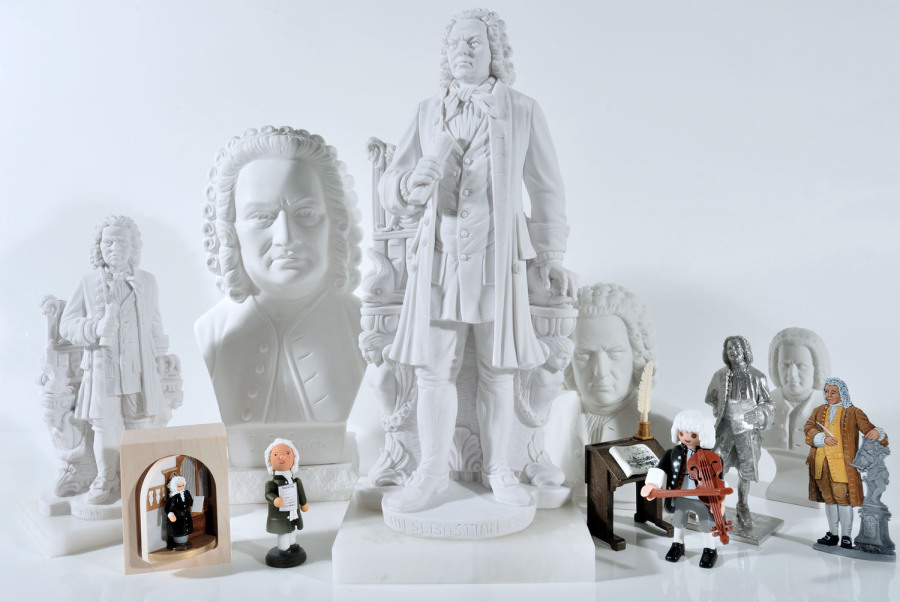
Bach bust, Bach statue, Bach figure.
End of Advertisemen
27
The Private Johann Sebastian Bach..
Although little is known about Johann Sebastian Bach's private life – we know as little about him as we do about almost any other figure of similar significance – we do know that Bach was a good citizen. He was also a so-called house father and a conscientious servant of the princes. However, he always retained the inner independence of the artist... of the musician. Trust in God accompanied him through both the bright and dark times of his life. He is said to have been calm. Certainly occasionally quick-tempered, but otherwise patient and calm. Some even attributed a certain amount of humor to him: this is reflected in a few of his works. Particular evidence of this can be found in his secular cantatas, many of which, however, have not survived. Some of the texts, some of which he wrote himself, have been preserved. In them, he wrote about “chosen and joyful Leipzig.” And he cheerfully confessed how, despite all the friction, he still felt at home in Leipzig..
28
About the Coffee Cantata and Other Cantatas..
Bach composed some cantatas for public celebrations in the city. And also on the occasion of honorary days for outstanding personalities in Leipzig. These choruses, duets, and arias were often performed in scenes ... Singers wore colorful costumes. The venues for these spectacles were on the banks of the Pleiße River, which were illuminated by torches in the evening. Decorated boats sailed on the river. Promenades served as backdrops, and there were secluded spots framed by bushes and hedges in the pleasure gardens..
Bach's Hunting Cantata, the Name Day Cantata, the Wedding Cantata, and other festive cantatas are full of cheerful joie de vivre and light grace. Bach's cheerful dances were still popular in the villages around Leipzig in the last century. These small, secular compositions also reveal between the lines that Bach was by no means averse to the small pleasures of life. Tobacco and coffee certainly played a role in this..
The small, amusing musical comedy Kaffeekantate (... Coffee Canata)was also performed as a puppet show until the last century. The main characters were Father Schlendrian and the clever and droll maid Liesgen. It is believed that the characters were based on Johann Sebastian Bach himself and his daughter, who – unsurprisingly – was also called Liesgen. However, it is important to understand that at that time, drinking coffee was still quite frowned upon in bourgeois households. And Liesgen liked to brew this coffee secretly. Until even her benevolent father had had enough. He warned her that she would never find a husband if she did not give up drinking coffee. Liesgen was cunning and promised to give up coffee if her father would “find her a husband” in return. However, when he went looking for suitors, she secretly postulated: “No suitor shall enter my house unless he has promised me himself that I may be allowed to brew coffee as I please.” Liesgen believed that she did not need to be a fresh, desirable young girl to achieve her goal. Incidentally, this amusing verse is the work of a family friend of Bach's, Henrici. Henrici called himself Picander as a poet. A postscript about Liesgen Bach: she later married a talented student of Bach's named Altnikol, who eventually became an organist in Naumburg..
People even believe that the lively, cheerful, humorous setting of the Coffee Cantata provides a glimpse into the Bach family's life. Johann Sebastian Bach had nine children. He had 20 children with his two wives. In his second marriage, Anna Magdalena gifted him with three more sons and another daughter, in addition to the three sons and one daughter from his first marriage. Other children died at an early age. The fact that all six sons were musical and four even became famous, two even more famous than their father in his lifetime, must have filled him with immense pride..
Wilhelm Friedemann, the eldest son, born in 1710, first became an organist in Dresden. Later, he moved to Halle. Carl Philipp Emanuel, born four years after Wilhelm Friedemann, became a harpsichordist at none other than the court of Frederick the Great in Potsdam. He later moved to Hamburg, where he became a highly respected director of church music. Johann Christoph, son of Anna Magdalena and Johann Sebastian Bach, born in 1732, became a chamber musician at the age of 18 and later a Kapellmeister in Bückeburg. And finally, Johann Christian also showed Bach's talent at a very young age. He later even worked in Milan and London. His works are described by some music lovers as a bridge between the work of his father and that of Wolfgang Amadeus Mozart..
In addition to the many deaths – Johann Sebastian Bach experienced the death of his first wife and eleven of his children – one of his sons caused him such grief that it has been passed down to the present day. Gottfried Bernhard, also a musician, and not a bad one at that, became organist in Mühlhausen at the age of twenty-three. But he was not like the other members of the musical family. He was said to lead a dissolute life. And he ran up debts. He “loitered around” and once even had his father pay off his debts. He wanted to “start all over again” as a student in Jena before he suddenly died. The cause of his death is unknown to posterity. Bach was dismayed by this development in one of his children, as all the others had turned out well. In his bitter letter of 1730, Johann Sebastian Bach wrote: "What can I say or do? Since no amount of persuasion, indeed, no amount of loving care will suffice, I must bear my cross with patience and leave my misguided son solely to divine mercy, not doubting that it will hear my wistful pleas and finally work on him according to its will: so that he may learn to recognize that instruction is solely attributable to divine goodness"..
Of course, his son Gottfried Heinrich, who was born in 1724, caused him even greater concern, as his mind and spirit were clouded. At the time, it was said that “only occasionally does a ray of light fall into the twilight of his poor soul.” At such times, however, even Bach's disabled son was able to coax heart-rending sounds from the piano. This never lasted long, however, and his mood would fall back into “mad melancholy”..
29
Johann Sebastian Bach and Frederic the Great, King of Prussia
From 1740 onwards, Bach increasingly withdrew from public life. At first, this was hardly noticeable. Nevertheless, he did not slow down in his creative work. Secular works and church compositions increasingly competed with each other. They became intertwined and divided the population of Leipzig, his admirers and his critics. It was reported that in church circles, the secular influence of Bach's music was viewed negatively. Others, on the other hand, had problems with his religiosity. They criticized Bach's religiosity – he did not preach, nor did he evangelize or moralize – but he proclaimed the certainty of eternal life in God, peace, and serenity. During these years, Bach chose the church as the actual venue for his music, rather than the increasingly modern concert hall. In 1743, highly respected citizens of Leipzig joined together to form the “Concert Society.” Bach was initially not on this list, but sixteen influential personalities were. The concerts organized by this society from then on took place in the Gewandhaus, the cloth merchants' meeting house. To this day, the Leipzig Gewandhaus concerts are a highlight of cultural life in this city of music..
In 1747, three years before his death, Johann Sebastian received another of his greatest honors. Perhaps it was even the greatest of his life. Once again, he received royal recognition. Frederick the Great, the Prussian King in Potsdam and Berlin, himself a musician, more precisely a flutist and devoted to the fine arts, wanted to experience Johann Sebastian Bach in person. He had his son Carl Philipp Emanuel, who was playing music at the king's court at the time, invite him several times. In May 1747, Bach finally boarded the stagecoach and traveled to Potsdam. He arrived there on May 7, 1747. He stayed at an inn, just in time to be added to a list that showed the regent the number and names of the personalities staying in Potsdam on that day..
The officer on duty presented the king the “List of Foreigners in Potsdam” while the regent was in the music room of the Potsdam City Palace. He was surrounded by his chamber musicians, whose names were Graun, Quantz, Benda, and Carl Philipp Emanuel Bach. They were joined by several officers who were interested in music. Concerts were held daily in the hour before dinner. The king even composed music himself. And on this particular evening, his suite was being played. When the music ended, no one spoke, as no one could break the silence in the king's presence..
It was a strange atmosphere, the light from the hanging chandeliers was dim, and the king silently scanned the list that had been handed to him. The king smiled and announced: “Gentlemen, the old Bach has arrived”! Of course, he immediately sent for Johann Sebastian Bach. And after just fifteen minutes, Bach was escorted to the king. Still exhausted from his journey. Without having freshened up. Still in his “travel clothes”. The king just smiled and gestured that Bach need not apologize. The others present greeted Bach reverently and warmly. And Carl Philipp Emanuel also rejoiced at that moment, given that the honored guest was his father.
As expected, Bach played music in a way that only he could. Over the course of the evening, he developed a beautiful fugue on the piano from a theme devised by the King. Later, he complied with the regent's request and played a six-part fugue on a theme inspired by His Majesty at that very moment. And King Frederick admired Bach. He stood behind the Thomas Cantor at the piano and finally exclaimed to those standing around him: “Only Bach! Only Bach! Only Bach!”..
30
Back in Leipzig..
When Bach returned to Leipzig, he immediately composed a work for the king. It was a precious set of variations, the Musical Offering. In it, he set the theme that the King had given him on the day of his arrival in Potsdam. Partly for piano, partly for string instruments, and also for the flute. Bach performed it in thirteen different ways. For example, as a fugue, a canon, a sonata, and more. Bach even dedicated the work to the king. And from this creation grew the high Art of Fugue, in which each movement “should stand blameless before God”..
31
The Years 1749 Through 1750.
In 1749, Bach fell ill, and to this day, scientists are still puzzling over what caused Bach's eye problems. A stroke or diabetes. Or both at the same time. Bach was now sixty-four years old when his inability to see began to particularly hinder him. At that time, a famous English oculist was travelling to Leipzig. It was in the spring of 1750 that John Taylor operated on Johann Sebastian Bach. Not once, but twice. Without success. And yet, even during those weeks, Bach continued to play the organ at St. Thomas Church, blind as no one would have expected otherwise. In powerful and delicate improvisations, he conducted his conversation with God: devoted, trusting, waiting, patient, absorbed, and remembering the great moments of his intense life. He did not even stop composing at this time. He asked his son-in-law Altnikol to come: Altnikol wrote down the notes that the master dictated to him. This included the notes for a final, then unfinished work... an unfinished organ prelude with the telling title Wenn wir in höchsten Nöten sind (... When we are in greatest need). Bach became aware of the approaching end and asked Altnikol to give the prelude a different name. It was and is today the title Vor Deinen Thron tret' ich hiermit (... I hereby step before your throne).
32
Johann Sebastian Bach Can See Again..
Just a few weeks before his death, a miracle happened: Johann Sebastian Bach could see again. It was as if by the hand of God. He saw the faces of his family, his wife, and his children. He experienced summer on that day. He saw the blue sky, the white clouds, the church tower, the sun... and his beloved sheet music again. He played Nun danket alle Gott! (... Now thank we all Our God)...
33
The First Years after Bach's Death..
Anna Magdalena survived him for ten years during what was a difficult time for her. However, Anna Magdalena did not live in poverty during this period. She simply had to earn an income in order to continue living socially on an equal footing. She sold copies of her husband's musical works and also some instruments. A request for alms has been preserved to this day, but this should not lead to the conclusion that she was poor. She was simply entitled to such a grant. It was common practice at the time. It was only recently that it was discovered that Bach also had a financial stake in a silver mine. However, this does not say anything about the Bachs' wealth. At that time, as today, it was quite possible that this investment was a loss-making venture. During this time, Anna Magdalena naturally took care of the Thomaskantor's grave in a Leipzig cemetery. It was located next to a wall in the Old St. Johannis Cemetery. Not even a gravestone reminded people of the master. He was "hastily buried” without any honors..
He was later exhumed because the church was to be expanded and the space was needed for the foundations. The second burial was more fitting, and the people of Leipzig mourned the master. Bach finally rested for many years in the “Bach Gellert Crypt” under St. Johannis Church. After St. Johannis Church was demolished following its destruction in World War II, “Bach moved again.” Today, he lies – finally in keeping with his rank and importance – in a prominent central location in St. Thomas Church, directly near the altar..
After his death, however, memories of Bach faded more and more... both of him as a person and of his work. Certainly, musicians always remembered his achievements. The general public, however, simply forgot Bach. From then on, more modern music was in demand. In the 1920s, Robert Schumann searched for Johann Sebastian Bach's grave in Leipzig. No one knew where it was. Schumann reported: “... I searched the cemetery for many hours ... but I couldn't find Johann Sebastian Bach. And when I asked the gravedigger, he shook his head at the man's unknown status: "Bach ... there are many of them!’”..
Bach's artistic legacy, his work, was divided among his sons, and the oblivion of Bach's uniqueness was also the worst enemy of his life's work. For even his own sons did not recognize Johann Sebastian Bach's incomparable legacy. Nor did they recognize his significance for music and his value to the world. Thus, many of the works entrusted to them were gradually lost. Of course, at that time, in the daily struggle for money and survival, these treasures were the difference between having dinner and not having dinner... but this development also contributed to the fact that practically all knowledge about Bach and his work was lost in a “sleeping beauty slumber” lasting three-quarters of a century..
It was not until 1829, after this infinitely long period, that the equally famous musician Felix Mendelssohn Bartholdy performed the St. Matthew Passion again. In a somewhat simpler version “... so as not to overwhelm the audience”. That was 102 years after Bach had premiered it. On the very same day, namely on Good Friday. Since then, the world has worshipped the composer Johann Sebastian Bach and enjoyed his divine music anew all over the world..
Very, very loosely based on Bach biographer Felix Adam Kerbel, 1822 to 1901..

Advertisement
Bach Busts, Bach Statues, Bach Tin Figures and Littel Bach Men from the Ore Mountains..
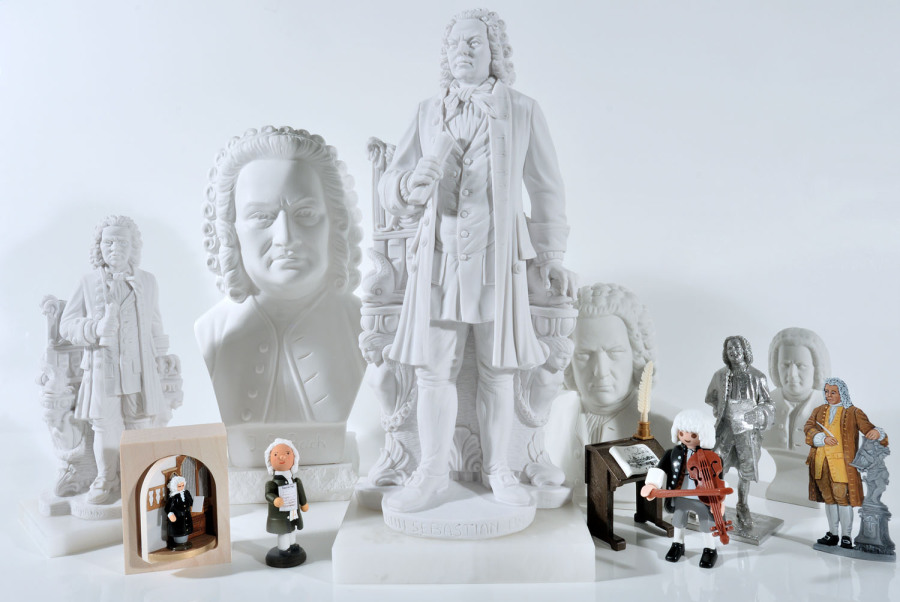
By the way, two hints: The facial expressions of five Bach busts of different sizes are the most important criteria for us. Plus, you get the Bach eraser, which is a Bach bust at the same time only in the shop of the Renate Bach Publisher..
Please Support Our Bach Mission..

Once again, here you get to all five “Bach 4 You” shops. Just one click away..
One of the latest Bach calendars..
End of Advertisement
 Druckversion