

Bach Cities and Bach Places: Gräfenroda, Thuringia, Germany..

1 Why Is Gräfenroda One of the Bach Places?..
Gräfenroda. One of the Bach cities? Is Gräfenroda even a city? Certainly not. Gräfenroda was never a city, even before it merged with other municipalities to form the town of Geratal. Not with 3,300 inhabitants and a garden gnome factory in the center. Is it at least one of the Bach places? That's much, much more likely. Or rather: definitely..
The second important Bach biographer, Philipp Spitta, already referred to this place in his work 200 years ago. Somewhat nebulous. And he mentioned Hans. A Hans before “our” Veit. Well, if you are not particularly interested in Bach genealogy, then it's best to click away later. And do something better with your time. Because after my presentation of Gräfenroda, we will delve a little deeper into the disputes and many misunderstandings surrounding Johann Sebastian Bach's visit to this place: These are the views and inconsistencies surrounding the origins and ancestry of the famous family of musicians. Which, before Veit, was not yet a family..
My cute video about Gräfenroda. With music and narration. In a completely different position on this page than the presentation of the other 20 or so Bach cities and places – out of 33 – on my website. Why? So that you don't overlook this video. Namely, when I “delve” too deeply – and with far too much text – into the genealogy of the very early Bachs for your liking..
For what is surely only a handful of Bach enthusiasts who, beyond Bach's music, are interested not only in his life but also in his family, I have written a chapter on the Bach family, here too. A “handful of enthusiasts”? Yup, because comparatively few people want to know more about the Bach family ... They visit Wechmar for that purpose. But hardly anyone is interested in the era before that. Please read more about this in detail under the next advertisement..
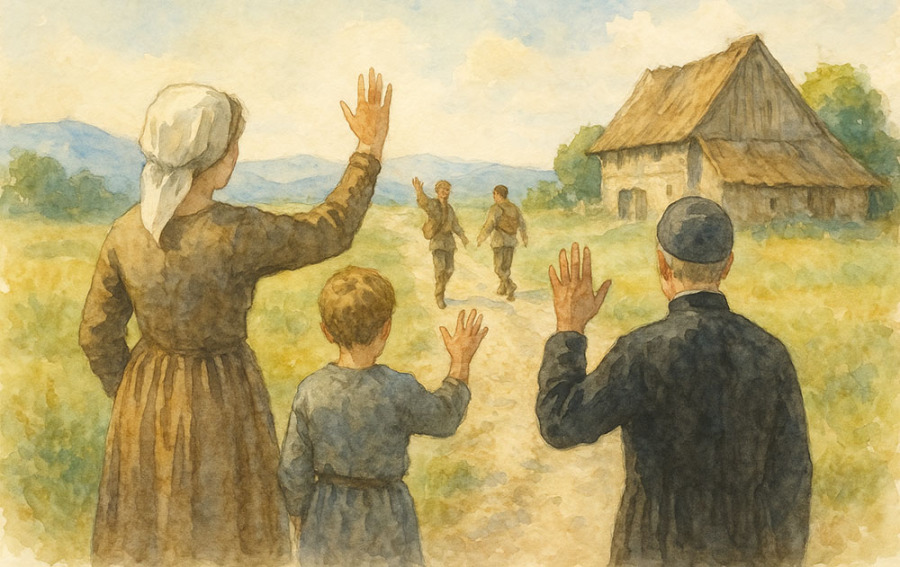
Wait, wait. It's not an authentic watercolor up there. It's a small work that was only created in the 21st century. It shows Hans-Veit Bach and his friend Obentrot on their way to Bohemia. Before that, the pastor had given them the so-called “travel blessing” in the then even smaller parish of Gräfenroda. © Peter Bach, Jr..
Gräfenroda is something of a “red rag” for many Bach experts and researchers. This leads to some curious situations. Some Bach fans are convinced that this is not where it all began. With the Bachs. Others believe that perhaps it was only much later that the Bach family from Gräfenroda became the Bach family of musicians. And: Practically all Bach biographers, except for one, leave Hans, Hans-Veit, Veit 1, and Veit 2 out of the picture altogether. And some people in the recent past would have preferred it if Gräfenroda had never existed on the map..
However, very, very few people on the planet today know the truth. And as is often the case with the history surrounding the famous Thomas Cantor: Something is found. And then it is lost again. Later, it is found again. And lost again. But ultimately... that is precisely why there is now Bach on Bach. Thanks to “digital long-term archiving” with inviting and user-friendly access, it will never be lost again..
At my place and on this page, you can read about the role Gräfenroda plays in the very early Bach genealogy. You can also find out whether Veit came from or originated in Ungern – definitely not Hungary – or whether he came from Bohemia, Ungernland, or Ungerndorf..
In addition: Whether Bach “only” moved from there. Or whether he also “moved away” to there earlier. One thing is certain. And it is documented. There is a time “before Wechmar.” At least from our perspective today. Back then, the Bach family was not yet a family of musicians. But of course, they already existed. Well, strictly speaking... that's logical. They had to have existed somewhere: the Bache, as they were called back then. In the meantime, it has been discovered. Proven. Documented. In the 1950s. It's a fact. Genealogy beats biography. Documents beat arguments. And... I finally discovered it: the actual origin of the Bache. From Ungern. Together with Michael Lehner. All of this... sounds very aggressive..
Staying Overnight in Gräfenroda..
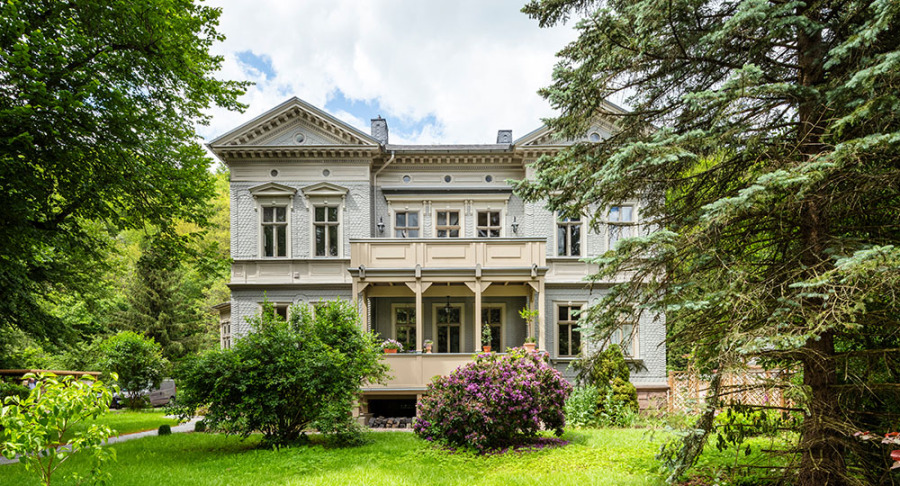
The chocolate view of the “Villa Heimlicher Grund.” Many thanks to © Photographer Thomas Müller, who took the photo above and allowed me to publish it..
If you would like to stay overnight in Gräfenroda and use it as a starting point for exploring the “Land of the Bache,” then I can recommend a really cool destination. It's fitting for such an exciting past..
But first: Why am I recommending a place to stay?..
And it happened – how dramatic – at the very moment when I wanted to finally present Gräfenroda here as a Bach location. Another small video was almost finished. And so was this “Gräfenroda page” that you are currently reading. To accompany the words in the video “... you can stay overnight,” I found this gem “Villa Heimlicher Grund”, on the internet ... as an image to accompany the text. I asked the owners for permission to use pictures and website screenshots for my video. This resulted in a particularly cordial correspondence. With so many lovely compliments that it simply required this exception to advertise such a wonderful offer here. As an aside: We do not stay there cheaper because we recommend this offer. And we also have no other advantage. So... it is my editorial recommendation. And not advertising..
A website page of the "Villa Heimlicher Grund". Click here to visit it again. © We would like to thank Mr. Henry Czauderna and Thüringen.info for allowing us to publish two additional photos on this page..
This heritage-listed “Villa Heimlicher Grund” is truly an insider tip. It stands on park-like grounds. The grounds border directly on the “Wilde Gera” river. There, the Stark family offers a wonderful vacation apartment: 140 square meters, living room and dining room with antique furniture, a well-equipped kitchen, three bedrooms, and two bathrooms... these are just some of the amenities. Everything is described in more detail on the “www.villa-heimlicher-grund.de” website. And there are pictures that you can explore directly and right now by clicking here. There on the page... then at the very bottom..
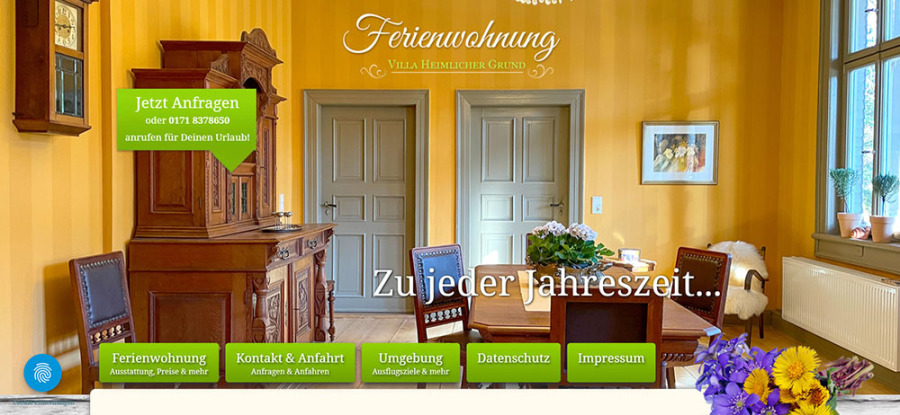
Stay overnight in style at a very reasonable price: This is possible in the “Villa Heimlicher Grund” with the Stark family in Gräfenroda. © see above..
The villa was built in 1886/87 and purchased by the Stark couple in 2020. But a lot of work had to be done before it could be offered as a luxury vacation home. The project was supported by the German Foundation for Monument Preservation. It took five restorers and several years of work to bring the magnificent paintings hidden beneath ugly wallpaper back to light. For their efforts, everyone involved received the Ilm District Monument Award. The adventure lasted five years and was accompanied throughout by experts from the monument preservation office. Today, the entire villa, inside and out, along with the park surrounding it, is a gem of an ensemble where you can rent a dream apartment. How about for your first or next Bach adventure? And the name of the villa, “Heimlicher Grund” (... Secret Ground)? Read more about it on the Stark family's website..
Advertisement
60 Music Calendars, Composers Calendars, Bach Calendars, and Pipe Organ Calendars..

Music calendars, composers calendars, pipe organ calendars, Bach calendars. Three sizes. This year, next year. European calendar style and US calendar style. To the Publisher's shops..
Please Also Support Our Classical Music Mission..
There is so much to discover here: gift ideas related to Bach and music. Would you like it now?..

Nowhere else will you find so many different Bach T-shirts and Bach seal T-shirts in one publishing house. Click here to get directly to the selection..
End of Advertisement
Does It Really Only Interest About Four People on Our Planet?..
Gräfenroda is practically unmentioned in Bach literature, at least when measured by the total number of Bach publications. Only one Bach biographer, although one of the five most famous of around 700, namely Philipp Spitta, devoted half a line to Gräfenroda. He also admits that the connection to the family of musicians is unclear. Even exciting, relevant reports in the local daily newspaper in Thuringia between 1950 and 2000 naturally found no lasting reference to the early history of the Bach family..
No Pig Can Read This..
Gräfenroda is home to the Johann Peter Kellner Society. Johann Peter Kellner was an outstanding personality in Gräfenroda. He was a musician, organist, and composer. He was also a teacher. Kellner was known far beyond Gräfenroda as an organ virtuoso and organ expert..
The Johann Peter Kellner Society has been in existence since September 2010. Peter Harder is the chairman of this society. He kindly provided me with some information, which meant that I did not have to search my own website to complete one of the last pages of my presentation about Bach's cities and places, namely Gräfenroda. Thank you again. Incidentally, a dissertation has even been written about Kellner's work..
I would like to quote the exciting introduction to Peter Harder's article in the "Kellner-Kurier", published by the Kellner Society, issue 9 of 2015, which you can read in full below: “Based on the numerous Bach transcripts, Kellner's remark is credible: "I desired to get to know this excellent man and was also fortunate enough to enjoy doing so.” (End of quote). How does this introduction relate to the accusation of the subsequent falsification of an important document?..
We Employ AI..
The article in the Kellner Journal takes a clear position. Peter Harder suggests that it is a kind, but nevertheless fake. He cites as the most essential and important criterion that Kellner is referred to as a “cantor” in the document discussed below. At a time when Kellner could not yet have been a cantor. He was an organist. Are there other terms for an organist around the year 1700? AI replies: In rural areas, the organist and cantor were often the same person ... there, only one title was usually used (... e.g., “schoolmaster” or “cantor”)..
I formulate a second question for “my” AI: Was there another term for cantor in 1700 (... so now the cross-check ... so to speak ... now I ask about the term “cantor”)? The AI states: Yes, there are several terms that were used around 1700 as synonyms or related terms for a cantor. This depended on the regional, denominational, or institutional context. In many smaller communities, the cantor was also the teacher at the village school. Therefore, he was often called the “schoolmaster.” In many cases, the cantor was also the organist, so that both roles coincided..
I now tend to continue my research with AI. My third question: Is it possible that around 1700, in a small community, the teacher and organist were also referred to as cantors? The answer: Yes, absolutely ... that was even the norm in many small villages around the year 1700. In small communities, the cantor usually held multiple positions: teacher, organist, church singer, and often choir director ... all in one person. The term “cantor” was often used as a generic term ... even when organ playing was the primary activity. In small communities, it was hardly possible or financially feasible to separate the offices (... like in cities). In historical sources, the same person may be referred to as, for example: cantor and schoolmaster, organist and “teacher Cantor loci.” Or simply: cantor, which meant all of these functions..
Am I “obsessed with AI”? For heaven's sake, no... I can handle it. Although ... AI always makes an exciting contribution to practically all topics. But of course, these contributions must then be carefully verified. However, I will “skip that here” because it is enough for me to simply highlight the issue with the term “Kantor” in the "Kellner- Kurier"..
Back to the "Kellner-Kurier"..
While reading the article, I noticed that the "Kellner-Kurier", specifically edition 9 from September 2015, contained previously unknown references. They suggest that Bach had been to Gräfenroda not just once, but several times (... you read about this in the introduction above). Peter Harder wrote his own publication in the aforementioned "Kellner-Kurier" at around the same time that I was searching for Gräfenroda in a completely different way. And in doing so, I “rescued” the connections from the past..
Kellner's relationship with Bach, both musically and personally, has been known to us since 1728 and 1729. Kellner and his students seemed to have collected everything they could find of Bach's compositions. Kellner said: “I had a desire to get to know this excellent man and was fortunate enough to enjoy doing so” (quote). This is the decisive clue that Bach was indeed in Gräfenroda. So all that remains is that Bach was there, but had not done exactly what was written down?..
Kellner was also accepted into Bernhard Bach's “Bach Circle of Friends.” This is evidenced by correspondence between Bach's students..
In today's world, Peter Harder's research and my own have now come together. The “Kellner-Kurier” with Peter Harder's article leaves no doubt as to whether a document from 1728 is a fake or a credible historical record. However, I have extracted my findings directly from the results of the small group of experts at the time, led by Professor Kraft, Dr. Niemeyer, and also by Helmuth Karl Abendroth, who is very well known locally in Arnstadt..
What is exciting is that I was not so much interested in Gräfenroda as the Bach's place of origin, but more in the Bachs' origins in Ungern. Even whether Johann Sebastian Bach was actually in Gräfenroda was of no interest to me at that point. For my goal of determining whether it was these Bachs who emigrated, I have transcribed around 600 of the 800 pages of Prof. Kraft's habilitation thesis, which the University of Halle made available to me and which Kraft's son-in-law, Professor Wahl, allowed me to evaluate. This means that my publication is based largely on the correspondence between the research group and those who would have had to be “charged” with fraud at the time. My research was therefore more concerned with assessing credibility, as I was finally able to get past the “no pig can read that document” with my knowledge of many aspects..
So we are now talking about a document that no longer exists today. And my personal opinion is that it was embezzled, if not destroyed, by the then Ministry of Culture of the GDR in East Berlin. Just like a church register that never “reappeared.” You can read more about this in my Bach genealogy 2012 / 2015 / 2021. In 1728, a pastor named Schneider wrote a kind of protocol in “a notebook,” which was passed on to Dr. Niemeyer and Professor Günther Kraft via the local pastor in the 1950s. The local pastor in Gräfenroda had given this document to Dr. Niemeyer as a gift. With the words: “No pig can read what's written anyway.” But Professor Kraft could..
It is the diary of Jeremias Schneider, pastor of Gräfenroda, who recorded Johann Sebastian Bach's visit to Gräfenroda on September 28, 1728. The complete description of Johann Sebastian Bach's visit, their joint music-making, and topics relating to ancestors and origins can be found on my genealogy pages. It is particularly interesting that this document – like the church penance – also mentions the year 1504. Incidentally, Bach did not write down his addition of the 50 members of his family until seven years later. Many of the gentlemen listed there did not play music at all..
And of course, there are contradictions when one of the participants remembered swinging chandeliers in the church because of the sound of the organ, but it was only a small Romanesque church in Gräfenroda at the time. My opinion? Even in huge churches, chandeliers do not swing because the Toccata sounds so powerful. These were probably more like “perceived, imaginary vibrations”..
So It Remains Open?..
The arguments in the “Kellner-Kurier” are thought-provoking. However, it is of course not enough that it was “a great temptation for the people of Gräfenroda” to dishonestly adorn themselves with Bach's visit. In addition, it is assumed that Schneider certainly could not have known all of Bach's relatives whom he listed “inside out.” If both were justified, then the whole story would even be a conspiracy..
Ever since I started my Bach portal, I have also been interested in history and archaeological discoveries around the world in general. And I was and still am amazed, and in some cases horrified, at how much history, findings, and insights in many disciplines have been and continue to be bent. Nevertheless, and in this case: I have original correspondence that clearly shows that active ( ! ) manipulation took place. This was done to obscure historical discoveries concerning “Gräfenroda and Bach” and to ‘bury’ them in the mists of time. A fragment of a sentence in this original correspondence reads as follows: “Gräfenroda, the origin of the Bachs? So the family of musicians were miners? Dr. Schweitzer's ”image of Bach" seems more accurate to us. Here in the GDR, we have a stable Bach history, and who am I to question that?" (... paraphrased from a well-known figure in East Berlin in the GDR at the time)..
In addition: I spent weeks, or rather months, researching the topic of “The Bachs from/in Gräfenroda.” I also studied the work of Abendroth, Dr. Niemeyer, and Professor Kraft in depth. As mentioned above, I have transcribed 600 of the 800 pages of Professor Kraft's habilitation thesis, which was never published. In some cases, entire pages were barely readable. For me, the existence of this document, which initially “no one could read,” is therefore conclusive..
Of Course, It Is Also Possible Without AI Altogether..
Alternatively: Let's do without AI. This gives rise to further approaches that speak for the authenticity of the document found. First of all, a simple mix-up is conceivable. The author of the document, “which no one could read,” simply confused the words “
cantor’ and “organist” in his enthusiasm. Unbelievable? Carl Philipp Emanuel Bach even confused Ungern with Hungary. Or he changed it deliberately. It could also have been a form of flattery or ingratiation that the author at the time sent to the organist Kellner. Of course, he had no idea what he was doing..
Next consideration: What reasons could have prompted the author of the document to initiate such a fraud? Now, we must assume that it was not the researchers in the 1950s who could have committed this forgery. And also: What special knowledge must the writer have had?! Furthermore, the question of “why” arises. Did the “chronicler” want to prepare as early as 1728 for what would happen if this document would be discovered 250 years later and Gräfenroda would then become a “Bach pilgrimage destination”?! However, it must be taken into account that the document must have been forged at the time it was dated. Or alternatively, at the time it was given to Dr. Niemeyer? It seems rather pointless to forge a document around 1950 and then not use it..
Finally, my counterargument: We can consider the two scientists, Niemeyer and Kraft, in the “Team 1950” to be extremely reputable. You don’t do research for an 800-page book and then falsify a historical document on the side. Or rather, design one. Several experts on the subject were also involved in the evaluation. However, none of this group noticed 70 years ago that Kellner must have been an organist rather than a cantor. In addition, this circle effectively “controlled” itself. Professor Günther Kraft studied German music over the centuries. Meticulously. I am one of the few people who have seen the finished manuscript. He was the recognized specialist in his discipline. And he can't tell the difference between an organist and a cantor? One of the five in this group (... I only mentioned three by name, but there were a few more) must have noticed that Kellner could not yet have been a cantor. And that this term would have been of extraordinary importance if it had exposed a fraud..
Qui bono? Better … Cui profuisset?..
Who would have benefited from it? The people of Gräfenroda, as Harder cautiously suggests? Hardly. It would not have been useful at the time the document was created. Even in the neighboring village, no one was interested in it at that time. Then in the 1950s? But why would scientists who are not from Gräfenroda want to put Gräfenroda so much in the spotlight of the Bach history? Well... it naturally corroborates, in the case of the authenticity of Professor Kraft's findings, that it were these Bachs who once migrated from Gräfenroda to Bohemia. And then came back again..
However, it would also be a bit of “bacon on the sausage”, as we say in Swabia in Germany. That is to say, the Bach visit described above may have had something to do with the Bach family’s emigration 200 years earlier. In addition, none of the “1950s researchers” were from Gräfenroda. And so they could not have been motivated by tourist considerations. Quite apart from the fact that before the fall of the Berlin Wall, not a single additional tourist would have strayed to Gräfenroda in the case of the “ennoblement” of Gräfenroda..
What did they think in Berlin? Even the analysis of the document's authenticity by highly qualified musicologists in East Berlin, to whom the document was sent for examination, did not lead to the conclusion that is the focus of attention today. That is, the discovery that Kellner had not been a cantor at the time of Bach's visit. For these “gentlemen” in Berlin, however, it would have been “an inner mission celebration” if they had been able to uncover this fraud 70 years ago. However, this is not apparent from the correspondence I have at my disposal. With such a discovery, these lines could have been returned (... which was not done). This would have made it possible to more emphatically question the origin of Bach from Gräfenroda ... and even to do so in a qualified manner. And not with the above-mentioned “nonsense about Dr. Schweitzer's stable image of Bach in the GDR”..
It is also conclusive that no fraud took place, because there are just as few original documents to prove the contrary. According to my correspondence, which has been recognized by all sides, one would have to assume that at least the four people involved – the then local pastor in Gräfenroda, local historian Abendroth, Dr. Niemeyer, and also Professor Kraft – jointly and knowingly committed fraud. This seems to me to be much less likely than the opposite. I am convinced that so many components are consistent. I believe that Johann Sebastian Bach was indeed in Gräfenroda. And regardless of that ( ! ), this has nothing to do with the fact that Gräfenroda is a Bach location..
No matter how you look at it, the objections to the authenticity of the report given away in the 1950s are not sustainable. The probability that everything is “in order” seems to me to be many times higher than the conspiracy theory of “conspiratorial deception.” But... that's just my own opinion. And my wife's..
So now, in my role as one of the family speakers for the Bache family in Gräfenroda, I am “ennobling” it to a “real" Bach location. And at the same time, I am taking the opportunity to use my Bach portal to transport this knowledge far, far into the future. For anyone who is interested. Perhaps, after an initial “local aha moment,” four more people every year?!..
2 Music of Bach and Pictures of Gräfenroda..
The video without any “distracting text.” Gräfenroda in pictures. Accompanied by a piece of music by Bach..
3 The Bach Place of Gräfenroda in a Few Pictures..

You can only take this photo if you're not afraid of approaching trains. Gräfenroder... or is it Gräfenrodaer ... know what I mean. And I know: That's... not just actually ... unacceptable. There are a few more pretty photos from me for you on Flickr..
4 Info About the Bach Place of Gräfenroda..
Gräfenroda is a small community but it nevertheless has a population of 3,200 people. There is a garden gnome factory in the center of the village. One such gnome even adorned the official website of the municipality in the past. It certainly had its place there. In fact, the entire garden gnome craft, or the “garden gnome industry” as it were, had its origins in Gräfenroda. Gräfenroda was first mentioned in 1290. It is almost self-evident that there is also a gnome museum in Gräfenroda, namely the Zwergen-Museum Griebel. Gräfenroda is also home to a glass studio, which of course has a website..
5 A Short Video About Gräfenroda... Here Again... in Case You Haven't ... ..
... overlooked or skipped the invitation at the top of the page. The same video about Gräfenroda again? Yes and no, it's a different clip from the one just above. But it is the same video as the one at the very beginning of the page. While the short piece above consists only of images and music, you can also find information in the clip here..
6 Where Exactly Is This Bach Place Located?..
On the map above, you can clearly see how close the village of Gräfenroda is to the cities of Arnstadt and Ohrdruf... if you scroll a little ... and also to the Bach origin place, which is Wechmar. Philipp Spitta already mentioned the village of Gräfenrode in his biography. A long, long time ago. However, it was only many, many decades later that the accuracy of his reference and the associated “Hans” was recognized. © Google Maps..

Advertisement
Bach Calendars and More Bach Calendars: A Total of 20 Cool Works..

On the left is the Bach Drehkastl (... Bach Turning Box) from the Ore Mountains in Germany. And on the right? Bach calendars are great gifts for musicians. Three sizes. This year, next year. Two calendar styles. To the shop..
Bach T-Shirts, Mozart T-Shirts, Beethoven T-Shirts ... and Music T-Shirts ... Plus ... There are Also 20 Bach Calendars..

Countless Bach gift ideas? Probably. Now perhaps to one of the five Bach online shops? With one click here..

There are hip and cool Bach calendars. But there are also very conservative Bach calendars. So, the right one for every Bach fan..
End of Advertisement
 Druckversion