

Bach FAQ 134
The Bach Seal in Sangerhausen, Germany, the Bach Seal from 1702..

One of a total of eight different “official” Bach seals. © KMD Martina Pohl..
The Bach Seal. Also known as the Bach Monogram, Bach Coat of Arms, Bach Logo, the Bach Insignia ... and finally, the Bach Museum in Leipzig also calls it “Bach's Sign.” This page on my website is dedicated to just one of a total of eight Bach seals. It is the Bach Seal in Sangerhausen, found on a church wall and immortalized there by Johann Sebastian Bach himself. Long before Bach had put his thoughts into a “proper,” that is, clean template. So that a signet ring or a seal stamp, a small desk utensil, could be made. By the way: The complete history of the Bach seal from 1702 to the present day can be found by clicking here..
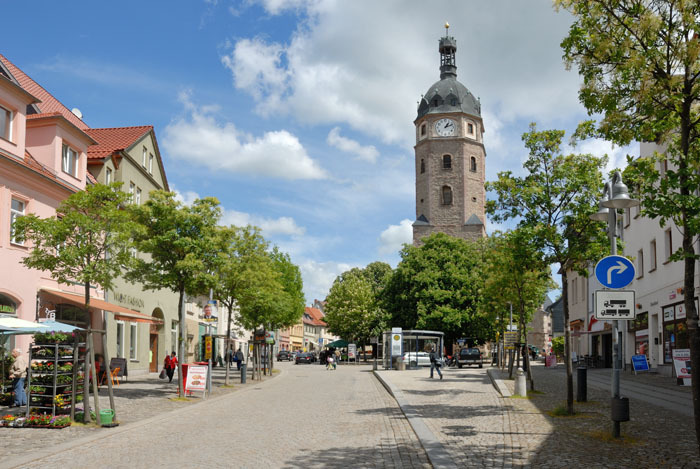
In fact, Sangerhausen in Saxony-Anhalt is one of the Bach cities. Not because Johann Sebastian Bach lived here for a while. Or even worked here. No ... that's not why Sangerhausen is a Bach city today. But Sangerhausen is nevertheless a “real” Bach location. A location for those who are particularly interested in exciting things related to the master composer. For us, Sangerhausen is therefore a Bach city in category C. So we ask for your indulgence in allowing us to call this town, which hardcore Bach fans do not consider a “real” Bach location, a Bach city. For us, category C means “... not quite a Bach city ... but sort of” . And there are even lower-ranked “Bach places” ( ! ). Namely those in category D. These only have a connection to the Bach family, not to the Thomas Cantor himself. For example, Gräfenroda..
Is Sangerhausen then a special Bach city in category C among the “unimportant” Bach cities? That doesn't sound good ... and on this occasion ... no, even this website page, which you are currently reading, cannot be explored “quickly and easily”: My pages are always meant to be enjoyed as reading material. So, they are a pastime. Let's continue: In category C of my Bach cities and Bach places, Sangerhausen is ... at least for me ... something very special. Because the topic of “Bach seals” is one of the most exciting topics in my and our Bach world, with its treasure of special, original, and rare items. And Bach on Bach wants to preserve these findings as knowledge. As far as possible ... for eternity. But ... now back to the topic..
Two of them are worth mentioning here: One is the bookseller and “night watchman” for tourists, as well as the musician in the Oropax Band in Laa on the Thaya, in the far north of the Weinviertel region (... “Wine Quarter”) in Austria, Michael Lehner. He crowned our eleven-year search into the origins of the Bach family. In particular, the origins of Veit Bach. The person who died in Wechmar in 1619 as the forefather of the musical Bachs. For 99.9 percent of lovers of Bach's music, this is absolutely unexciting. But not for us! Because anyone who is interested in Bach's life as well as his music might find the early Bach genealogy far from exciting. And the one before Veit in Wechmar even less so..
But ... there are actually a few individuals among the more than eight billion people on this planet who do just that. A special thank you, also at this point, and once again to Michael Lehner from Laa on the Thaya. He first had to work his way through my Veit Bach explanations. Then he knocked on my door electronically with a sensation and pictures..

Laa on the Thaya. In Austria. This is where Michael Lehner lives. And he ( ! ) found what researchers and genealogists had been unable to find for over 270 years..
The second discovery was made by church musician Martina Pohl. She works at St. Jacobi Church in Sangerhausen, where she enjoys - among many other things - playing the world-famous Hildebrandt Organ. It almost goes without saying that Martina Pohl is also a Bach fan. And my offer to read about the Bach seal prompted her to send me an email. She also attached some incredible pictures. Another big thank you here and again to her. In St. Jacobikirche, she noticed various scratch drawings on a white wall very close to the organ. Apparently, several “early graffiti artists” had left their “works” there. And one of them reminded the musician of the current Bach seal. The Bach seal - designed by an artist, painter, or graphic designer - which has been the “official” Bach seal for around 270 years. Or the Bach Monogram, the Bach Coat of Arms, the Bach Insignia, or even Bach's Symbol. Whatever you prefer..
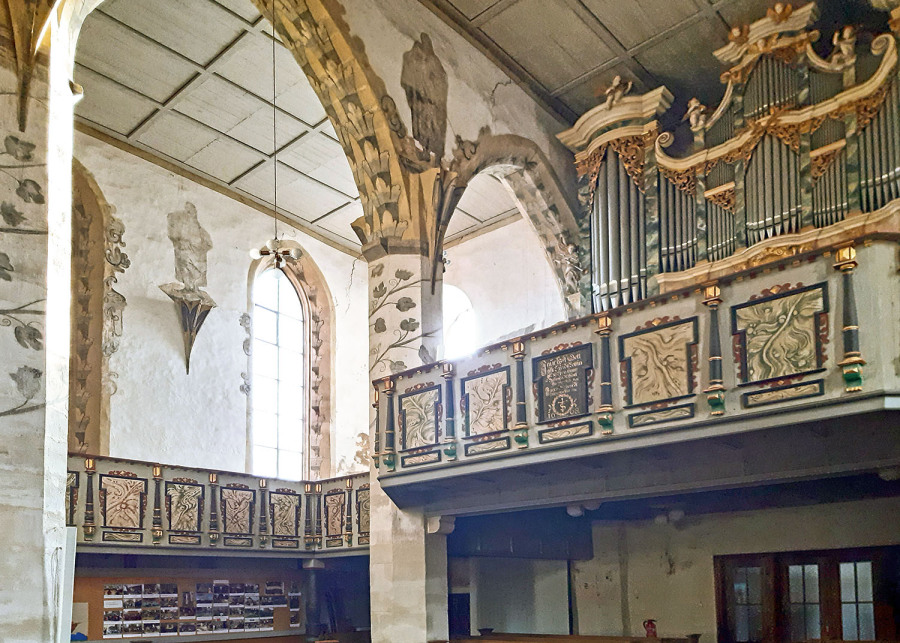
As a photographer and Bach fan, it is almost always very unlikely that attached photos, whatever the subject, can satisfy my curiosity (... in this case, however, I was thrilled by all of them). So I asked Mrs. Pohl to send me one more picture. One that shows the location of her find in a spacious setting. She did so, and here is the result. A window is clearly visible on the left-hand side. To the right of it, a second window is only recognizable due to the glare. To the left of both windows is a large white wall. It is actually open to the public, but why would a believer climb stairs when there are still enough seats available downstairs? © KMD Martina Pohl.
Why was this special website page created exclusively for the Bach Seal in Sangerhausen? Well ... twice I “sent” interested parties to other pages of mine. Pages that offer text and images on all Bach seals. And both times, for the Bach Seal in Sangerhausen they were “too fast underway” to find it. That's why.
Back to Sangerhausen and St. Jacobikirche. The organ playing of church music director Martina Pohl is certainly impressive. But for me – as a photographer and, above all, a Bach fan – it was even more exciting that Mrs. Pohl pointed out to me that the “object of my desire” can only be photographed sufficiently plastically at a certain time of day. But also only at a certain time of year. That is, when the sun conjures up vivid “works of art” from the carved works, names, and sentences. This also explains why no one else has made this sensational discovery in 300 years.
So if a “work” on the wall next to the organ is only “visible” briefly at around 6:00 p.m., churchgoers on Sunday morning at 10:00 a.m. or 11:00 a.m. simply do not notice it. Added to this is the fact that there is usually no one up there anyway. Except for the organist in the 300 years mentioned above. In addition ... as already mentioned above ... an organist in Sangerhausen also had to be a fan of Bach's music. And also be interested in Bach's life. And finally, they also had to be familiar with the Bach seal, at least to some extent. This happened exactly once, 300 years after the very probable creation of this “early work of art” by Johann Sebastian Bach.
Why such detailed information on such an unimportant topic? Well, every visitor can click away. But those who are interested probably can't get enough on the subject. And it should be preserved. The knowledge of this find in Sangerhausen ... and the information about it. When searching Google with the keywords Bach, Sangerhausen, and Bach Seal.
And how do we two Bach fans, or three or four more people, if you count the people in the closest circle of the two publicists who were significantly involved, come up with the idea that it was Bach who left his “scribble” there?
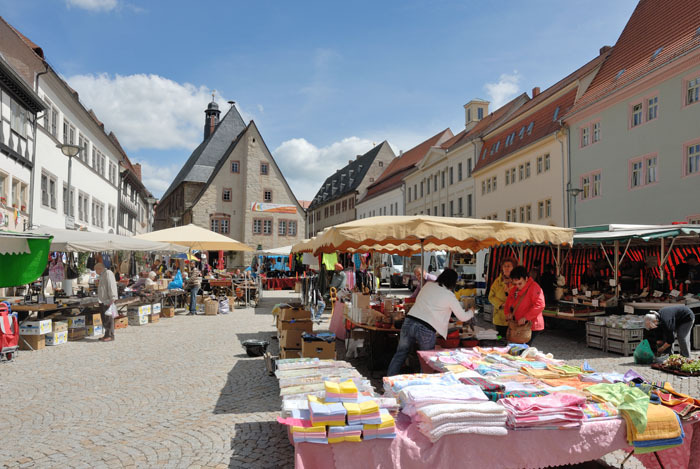
Once again, St. Jacobi Church. This time from the other side. Finds such as the early Bach Seal are highlights in our hobby and our lives with this exciting pastime..
So how did anyone come up with the idea of classifying the “scribbles next to the world-famous organ” as being as significant as the work of organ builder Hildebrandt? To see it as an early Bach seal from the master himself. Or is it wishful thinking? Is it a thirst for discovery, in this case mine? No. It is neither. One is “piecing together facts.” First of all, there is of course the obvious similarity to the Bach seal known today. Namely, the one with the seven cones. Or prongs..
If you hold both creative results side by side at a certain distance from the viewer, the similarity becomes very apparent. But that's not enough for us. Not even close. Please continue reading below the advertisement..
Advertisement
No ... the Bach Seal from Sangerhausen Is Not Available on Any T-Shirt, Hoodie, Baseball Cap ... and Not on a Coffee Mug..

The current Bach Seal no. 1 and the current Bach Seal no. 2. Both are available on many gift ideas that you can turn into Bach gifts ... or treat yourself. Click here to visit the Bach Shop..
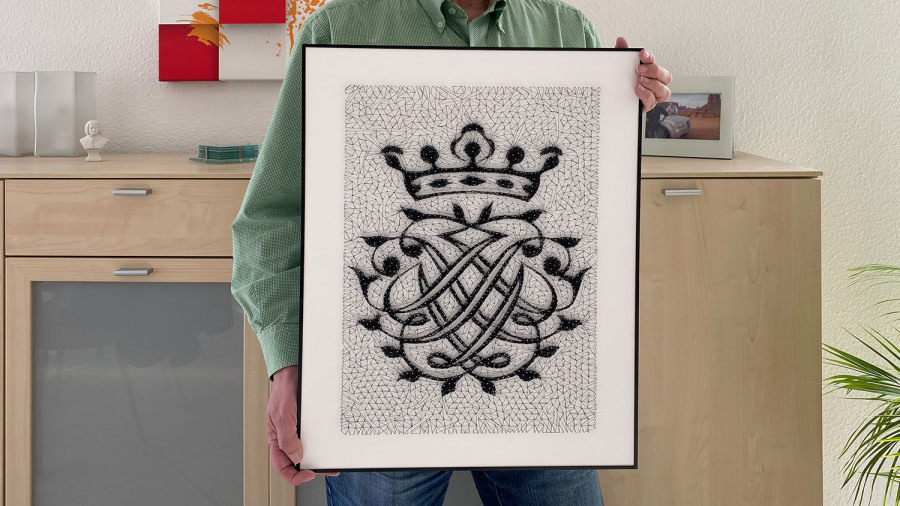
Without question, it is the most elegant form that you can get excited about. That is, if you find the Bach Seal exciting. It is the Bach Seal as a thread picture or a nail picture..
This Engraved “Bach Seal” ... Is It the First Monogram / Coat of Arms / Symbol / Logo ... and Really from Bach?..
So there is a petroglyph. And it looks at least “a little” like the Bach Seal that has accompanied us Bach fans for a good 300 years. First as a seal in sealing wax. Later, from 1750 to 1760, as a graphic representation with seven prongs. And finally, well into our millennium, as a logo with only five prongs..
And one person believes that this scratch drawing could be by Bach himself. That person is musician Pohl, a Bach fan and organist. She turned to Leipzig, which has been synonymous with Bach research for many, many decades..
One of the most renowned Bach experts and scientists, Professor Schulz, confirmed the similarity to her in a quality that led him to mention this discovery as a tiny article in the 2010 Bach Yearbook. It has therefore already been published that there is a similarity between this scratch drawing and the Bach Seal as we have known it for three centuries. This is an exciting assessment, expressed and published by a Bach expert, which suggests that the assumption that Bach was responsible for this “scribble” at such a dignified location is not “far-fetched.” But for us – my wife and me – that was still not enough. We ( ! ) were missing the matching “story.” And more facts to support the assumption that Bach himself had “painted” or scratched it..
I attach little importance to another piece of evidence. But it is there. So I put it, together with the photos taken by Mrs. Pohl, in the right light. In the best sense of the words. Not too far away, the year 1702 can also be seen. It would be unusual, however, for Bach to have placed this date – if he had carved it – quite apart from his more exciting legacy. Namely, in a completely different place, certainly 50 centimeters (... some 20 inches) away. Four digits. 1702. But ... they are there. Below, you can see both. First, the distance between Bach's Seal and the date. Second, the number itself..
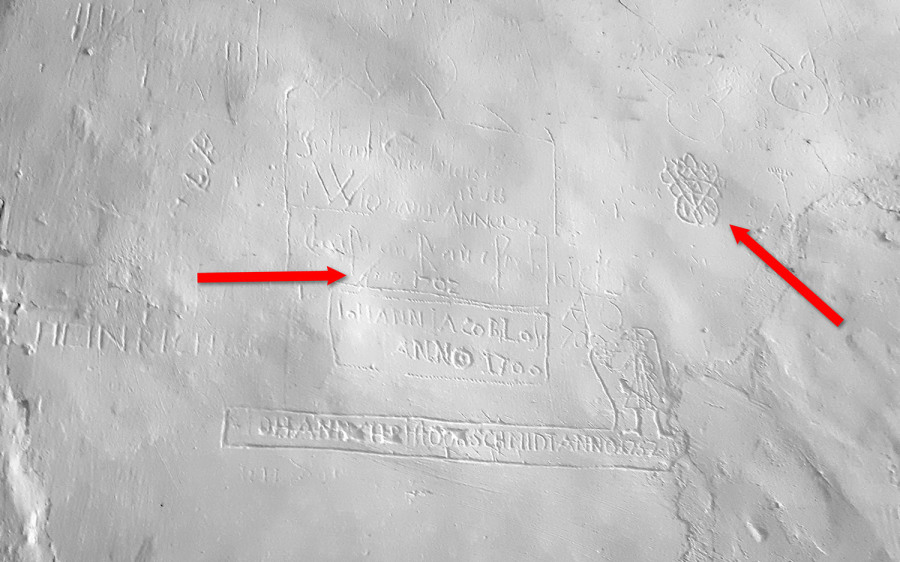
That's quite a big distance between Bach's seal and the figure 1702. © KMD Martina Pohl..
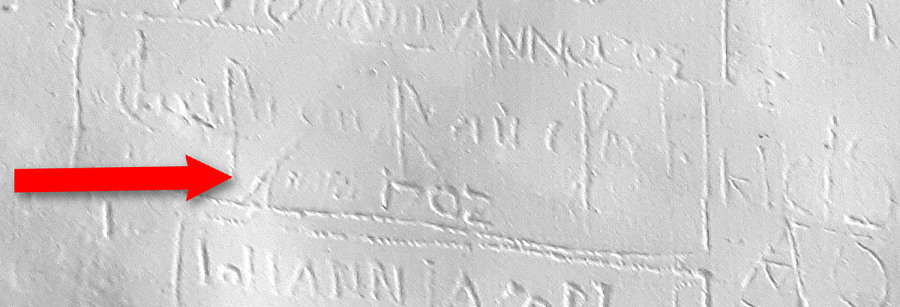
There it can be deciphered, crystal clear. The year number is 1702. It is located slightly to the right of the red arrowhead. With a lot of effort, you can see the word “Anno” in an enlarged image: That is why I have marked ( ! ) the distance in the image above: between the arrowhead and 1702. © KMD Martina Pohl..
Was It Bach ... or Was It Not Bach? Is It Bach's Sign / Bach's Seal?..
First of all: If this petroglyph is not by Bach, what story would suit it? That a Bach fan, be it a cantor or a sacristan, a churchgoer or a confirmand, was such a big Bach fan that sometime after 1750 he or she carved his or her enthusiasm into the church wall next to the Hildebrandt Organ in Sangerhausen of all places? That would be completely amateurish. After all, what the Bach Seal looked like after 1750 was well known by then. Hardly. Actually ... so exaggerated “as constructed by me here” that this imagined variant can practically be ruled out. In any case, according to Ockham's Razor Thesis, the least unlikely of all possibilities is not the one that is most likely to be true. I dare to rule out this thesis 100 percent..
So what speaks in favor of Bach as the artist who immortalized himself there? Let's start with the year carved into the wall, which is far away from the seal: 1702. Should we consider it a coincidence that Bach arrived in Sangerhausen in 1702 of all years? To play for his first professional position there. Successfully, by the way. This was crystal clear even before he took up what would later become his first – not really serious – job in Weimar. Which he only held for six months. He actually didn't get the job in Sangerhausen ... “Nepotism among princes back then ... and so on.”..
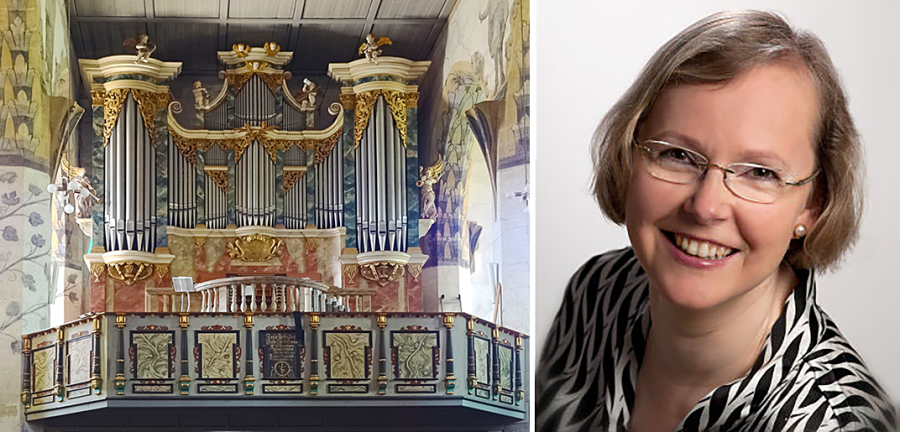
Honor to whom honor is due. For many people, the Hildebrandt Organ, on the left in the picture, is the most impressive aspect of St. Jacobi Church. For me, it is and remains church director Martina Pohl. She not only read on my “Bach on Bach”portal, but also contacted me because she thought her discovery might interest me. And it certainly did. © KMD Martina Pohl..
We have known for a very long time, indeed for more than 300 years, that Bach was the “incarnation of perfectionism.” What other organist or pianist plays or played the organ with a stick in his mouth? When, because both hands and both feet had “other tasks to perform,” he could only reach the key that was missing from his work to complete the presentation with such a tool? Exactly ... our Johann Sebastian Bach..
This perfection is the basis for my theory that the engraving in St. Jacobikirche in Sangerhausen was made by his quill. Although it was certainly not a quill that he used to engrave it. Why is this perfection significant? Well ... Bach was definitely very ambitious. And he certainly wanted this first job in Sangerhausen after finishing school. What do you do in such a situation? You arrive at the aptitude test well prepared and, above all, on time. So what?..
It is not clear where exactly Johann Sebastian Bach moved to in Thuringia after finishing school in Lüneburg. He spent six months in Thuringia at a place that no one knows the location of anymore..
And the time periods? It was the year 1702. Bach had completed his schooling in Lüneburg at Easter. And in the summer of 1702, the audition was in Sangerhausen. That ... also fits!..
Back to Bach the perfectionist. Why is it important to note that he was a perfectionist? Today, when you set off for a very important appointment that is three, four, five, or even six hours away by car, the most important thing is to leave on time. Because so many things can happen. A car breakdown. Above all, one of those annoying traffic jams. And a hundred other minor events: no parking space at your destination, a police check, a detour, a sprained ankle (... rarer today, but back then, on unpaved roads and paths, a perfectly conceivable cause for delay)..
So what do you do? Leave well in advance. And that's certainly what Bach did back then, in 1702. So ... he started walking. Almost certainly. He didn't take the stagecoach. He left plenty of time before his appointment. Especially since he didn't have to take anyone or anything into consideration. Between school and his first job ... it was, as is often still the case today, the ultimate free time in a person's life..
So Bach set off at the right time. And the right time meant that he couldn't walk 24/7. That he certainly took breaks. That he didn't want to perform without having had enough sleep. That he certainly wanted to freshen up after the march. And that he definitely wanted to change his clothes. Playing a few notes before the presentation was certainly a must for him. So Bach definitely thought about when he had to leave so that nothing would go wrong..
From Ohrdruf, it took 22 hours to walk to Sangerhausen back then ... today, it would certainly be faster due to better roads. From Erfurt, it would have taken only 15 hours. Walking around ten hours a day, he was on the road for one or two days..
Then ... Bach was a “rascal” back then. We know this from his time in Arnstadt. He was young and, like many 17-year-olds today, had “silly ideas in his head.” Several years earlier, he spent his nights copying music instead of sleeping. He had a “foreign damsel” sing in the Arnstadt church ... an unthinkable thing at the time. He called his choir students unacceptable names when they “didn’t toe the line,” and he ended up taking a four-week vacation, which he extended by eight weeks without notice or permission. Before returning to Arnstadt. And took care of his job again. Finally, he even drew his epee on several of his choir students at night. But he didn't use it. That wasn't customary, either. And he complained intensely and often at his first real job. So he was “still a scamp, so to speak.” Even at the age of 17, when he arrived in Sangerhausen ... on time..
So it was the summer of 1702, and Bach most likely arrived many hours before his important appointment. And what did he do? Freshen up, change clothes, grab a bite to eat, play a little music on the organ ... and... get terribly bored. It is very likely that Bach, even as a seventeen-year-old, had already thought about how he wanted to mark the documents and receipts he would have to sign in the future in a special and unique way. Namely with a seal. Namely with his seal. And so, long before his visit to Sangerhausen, he had probably been toying with the idea of combining the three initials of his name, J, S, and B, into an exciting little work of art. But of course, we don't know for sure..
Bach's final musical rehearsal certainly took place two or three hours before the official performance. And since Bach didn't know anyone in Sangerhausen, he was most likely already in the church. Where? In the upper section, on the first floor, so to speak. Next to the organ. Music students or church servants had most likely already immortalized themselves on a wall there before him. And so he carved. He carved his thoughts ... “his” Bach seal ... into this church wall..
Finally, it is exciting to take a closer look at the seal in Sangerhausen. In fact, the three letters J, S, and B are clearly visible, if you look closely. The mirrored letters are also visible. It is also interesting to note that this crown was already part of the seal or symbol in 1702. This makes it unnecessary to consider whether Bach added this crown only at the time when he was allowed to call himself Royal Polish and Electoral Saxon Court Composer. This is also particularly exciting for those who are interested in this topic..
In Bach's first written draft, that is, this seal on the church wall in Sangerhausen, there are clearly three ( ! ) prongs. And here they are prongs. And not “pom-poms,” as was later implemented in Bach's seal between 1750 and 1760, as well as in the black-and-white graphic that is still valid today. It is also interesting to note that the original seal in “Bach's Putz Schranck” (... Bach's treasure chest) does not have seven prongs either. Instead, it has only five: This image is available as a “treat” for Bach seal fans after the next image of Sangerhausen..
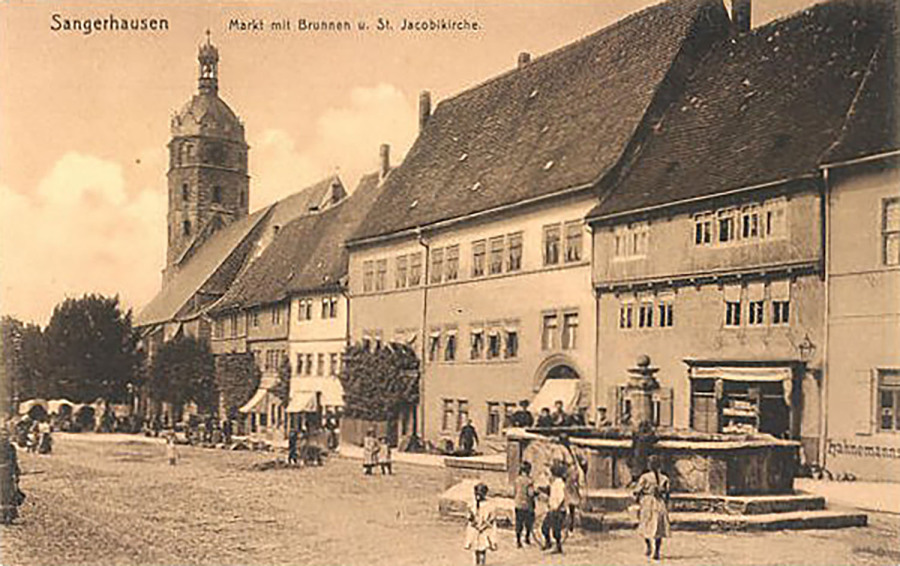
From 1702 to 2009, roughly and almost exactly 300 years, a sensation concerning Bach remained undiscovered. This was also the case at the time when the postcard above was photographed..

Basically, this is the actual “official” Bach Seal / Bach Coat of Arms / Bach Logo / Bach Insignia / Bach Monogram and, finally, Bach's Sign. However, because this seal will never, ever — never ever — become established on the internet, on CD boxes, in books, newspaper articles, or anywhere else, the now “official” black-and-white Bach seal, that is, since 2009 minus two cones, should of course not be missing here either: It concludes this page further down..

Advertisement
Where You Might Put the Bach Seal: On Mugs, Shower Curtains, Bedding, Beer Mugs, Cell Phone Cases, and Much More..

Why not take a look at Zazzle, Spreadshirt, Cafe Press, or Redbubble? Many of the items there can be customized to make them the perfect gift. Click here to visit the Bach shops..
Twelve famous personalities shared their enthusiasm for Bach's music: the Bach Quote Calendar, one of the latest publications from the "Bach 4 You" Publishing House..
End of Advertisement
 Druckversion